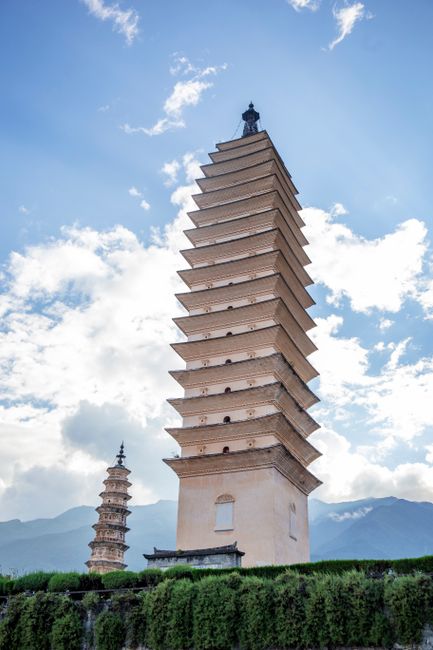
Dali, in western Yunnan province in southwest China, lies on a high green plain between the long wall of the Cangshan mountains and the blue waters of Erhai Lake, at about 2,000 m (6,500 ft) above sea level. For centuries it was the capital of the independent Nanzhao and Dali kingdoms, and it is still the heartland of the Bai people, known for their whitewashed houses painted with blue designs, their tie-dye cloth and their three-course tea ceremony. Within the Ming-dynasty walls of Dali Old Town are stone-paved streets of guesthouses, cafés and shops with mountain streams running beside them; just to the north rise the Three Pagodas of Chongsheng Temple, the symbol of Dali, the tallest about 69 m (227 ft) high and more than 1,100 years old. Ride a cable car to a glacial lake near the summit of Cangshan, walk the Jade Belt Road along its flanks, cycle the ecological corridor around Erhai, and visit the Bai villages of Xizhou, Zhoucheng and Shuanglang on the shore. With its gentle climate, sunshine and slow pace, Dali is a favorite place to relax on a trip through Yunnan, between Kunming and Lijiang. Dali is in the 240-hour visa-free transit area. The best months are March to May and October to November.

Right now in Dali
- Wed 14–22°C 57–71°F 2 mm Light showers
- Thu 14–23°C 56–73°F Clear
- Fri 15–23°C 59–74°F Mostly clear
Weather: MET Norway (CC BY 4.0)
Top tours in Dali
See all tours for Dali →
From local operators, with prices and reviews; you check availability and book on Viator, our partner. We may earn a commission at no extra cost to you. How we earn money
Dali at a glance
- Best for: the Old Town, Erhai Lake, Cangshan hiking, Bai villages and culture, cycling, cafés and slow travel.
- How long: 3–4 days, or longer if you want to slow down.
- Best time: March to May and October to November, sunny, dry and mild; June to September is the rainy season; winters are sunny with cold nights.
- Getting there: by train from Kunming (about 2 hours) or Lijiang (about 1.5–2 hours), or by air to Dali (DLU).
- Getting around: on foot or by bike in the Old Town; by taxi, DiDi, bus, e-bike or hired car around the lake.
- Good to know: Dali is at about 2,000 m (6,500 ft); the sun is strong, nights are cool, and the Cangshan cable car reaches nearly 4,000 m (13,000 ft).
- Before you go: visa-free entry, the 240-hour transit, the arrival card, payments and general safety are in our China travel guide.
Dali’s areas and where to stay
Dali is spread along the western shore of Erhai. The county-level city of Dali, with about 660,000 people, includes both the Old Town and Xiaguan, the modern center about 15 km (9 miles) to the south.
Dali Old Town
Dali Old Town (Dali Gucheng) is a grid of streets inside rebuilt Ming-dynasty walls, with gates at each side, the South Gate and the Wuhua Tower in the middle. Hundreds of courtyard guesthouses, boutique hotels, cafés and restaurants line streets such as Fuxing Road, Renmin Road and Foreigner Street (Yangren Jie). It is lively but relaxed, with Cangshan right behind and Erhai a short ride away.
The Erhai shore
Guesthouses and boutique hotels in villages along the lake, especially around Caicun and Longkan near the Old Town, and further north near Xizhou, offer lake views and sunrise over the water. Building near the shore has been tightly restricted to protect the lake, so places are small and book up.
Xizhou
The Bai village of Xizhou, about 18 km (11 miles) north of the Old Town, has some of the best-preserved Bai mansions and courtyards, a busy morning market and a few lovely heritage hotels in old merchant houses.
Shuanglang
On the quieter eastern shore, Shuanglang is a fishing village turned resort, with guesthouses and hotels right on the water and views west to Cangshan, about an hour’s drive from the Old Town.
Xiaguan
Xiaguan, the modern city center, has the railway station, the bus stations, chain hotels and shopping; it is convenient for transport, but most visitors prefer to stay in the Old Town.
Where to stay in Dali
- Old Town: courtyard guesthouses, cafés and walking streets.
- Caicun and Longkan: small lakefront stays near the Old Town.
- Xizhou: heritage hotels in Bai mansions.
- Shuanglang: sunset views across the lake to the mountains.
- Xiaguan: practical stays near the station.
Rooms fill and prices rise during Chinese New Year, the Third Month Fair, May Day and Golden Week.
Top things to see in Dali
Three Pagodas of Chongsheng Temple
Just north of the Old Town, the Three Pagodas are the symbol of Dali. The central Qianxun Pagoda, built in the Nanzhao kingdom between about 824 and 859, has 16 tiers and stands 69.13 m (227 ft) high; the two smaller, octagonal pagodas were added in the 12th century, when kings of Dali retired to the monastery as monks. Behind them, the rebuilt Chongsheng Temple climbs the hillside in a long series of halls. The scenic area is open from 7:30 to 18:30, with a separate ticket. The reflection of the pagodas in the pool south of the site is the classic photo.
Dali Old Town
Walk the walls from the South Gate, wander Fuxing Road and Renmin Road, and visit the Wuhua Tower, the Dali Museum and the old Catholic church, built in Bai style. In the evenings, the streets fill with musicians and street food.
Cangshan and the cable cars
Cangshan, also called Diancang Mountain, is a UNESCO Global Geopark of about 500 km² (190 sq miles), with 19 peaks and 18 streams running down to the lake; its highest peak, Malong, reaches 4,122 m (13,524 ft). The longest of its cable cars, the Ximatan cable car, runs 5,555 m (3.5 miles) with eight-seat cabins and a vertical rise of 1,648 m (5,407 ft), from the lower station at the Tianlong Babu Film City, via the Seven Dragon Maidens Pools, to Ximatan, a glacial lake at 3,966 m (13,012 ft), close to the summit ridge. Shorter cable cars and a chairlift reach the Jade Belt Road and Gantong Temple. The Cangshan scenic area ticket does not include the cable cars and shuttles, which are paid separately.
The Jade Belt Road
The Jade Belt Road (Yudai Lu) is a mostly level stone path, about 11 km (7 miles) long, along the face of Cangshan at about 2,600 m (8,500 ft), with views over the Old Town, the plain and the lake. Reach it by cable car or chairlift, walk a section and ride down, or hike up from the Old Town. See our hiking guide.
Erhai Lake
Erhai, a long lake of about 250 km² (97 sq miles), is the “ear-shaped sea” of the Bai. Cycle or ride an e-bike along the ecological corridor, a path that follows much of the western shore through villages, fields and wetlands; take a boat to Nanzhao Fengqing Island or Jinsuo Island; or watch the sunrise from the western shore and the sunset from Shuanglang. See our cycling and boat trips guides.
More classic sights
- Xizhou: Bai mansions such as the Yan family compound, the morning market and the round, crispy Xizhou baba flatbread.
- Zhoucheng: the center of Bai tie-dye, with workshops where you can try it.
- Butterfly Spring: a spring and park at the north end of the lake, linked to a Bai love legend.
- Xiaguan and Erhai Park: lakeside gardens at the southern end of the lake.
- Xizhou rice fields: green in summer and golden in autumn, with Cangshan behind.
Other things to do in Dali
Bai culture
The Bai are known for their architecture, with white walls, painted eaves and screen walls that reflect light into courtyards; their three-course tea (sandaocha), a bitter, then sweet, then aftertaste tea served to guests; their colorful dress; and their festivals, including the Third Month Fair (Sanyuejie), a centuries-old market and festival held below Cangshan in the third lunar month, usually in April.
Food and drink
Try Bai and Yunnan specialties: rushan, sheets of dried milk cheese grilled and spread with rose jam; erkuai, rice cakes grilled or stir-fried; Erhai sour and spicy fish, cooked with tomatoes and local quince; Xizhou baba, flaky bread, sweet or savory; Yunnan rice noodles; and, from June to September, wild mushroom hotpots. Dali’s cafés serve excellent Yunnan coffee, and local plum wine and rose cakes make good souvenirs.
Day trips from Dali
- Shaxi: a beautifully preserved market town on the old tea-horse road, with a Ming-era square and theater, about 2–3 hours north; best overnight.
- Weishan: a sleepy old walled town, cradle of the Nanzhao kingdom, about 1 hour south of Xiaguan, with temples on nearby Weibao Mountain.
- Jizu Mountain: a Buddhist mountain of temples and pilgrimage paths east of the lake, about 2 hours.
- Lijiang: the Naxi Old Town and Jade Dragon Snow Mountain, about 1.5–2 hours by train.
- Xizhou and the northern lake: villages, fields and Butterfly Spring by e-bike or car.
Getting there and getting around
By train
Dali station, in Xiaguan, has fast D trains to Kunming (about 2 hours), Lijiang (about 1.5–2 hours) and west to Baoshan. Book on the 12306 website or app with your passport. Buses, taxis and DiDi link the station and the Old Town in about 30 minutes.
By air
Dali Airport (DLU), about 15 km (9 miles) east of Xiaguan, has flights from major Chinese cities. For the 240-hour visa-free transit, the nearest designated ports are Kunming Changshui and Lijiang Sanyi airports; Dali prefecture is one of nine Yunnan cities and prefectures in the permitted area.
By bus
Long-distance buses run from Xiaguan’s bus stations to Kunming, Lijiang, Shaxi (via Jianchuan) and Weishan.
Around town
The Old Town is walkable, with bikes and e-bikes to rent. Buses and taxis link it with Xiaguan; to circle the lake, rent an e-bike for the corridor, or hire a car with driver for the day. Some lakeside roads limit tourist vehicles; follow local signs.
When to go and how long to stay
Dali has a mild highland climate with a dry, sunny season and a monsoon season. From October to May, days are mostly sunny and pleasant, with highs of 16–25 °C (61–77 °F) and cool nights; January nights fall to around 3 °C (38 °F). February to April brings the strong Xiaguan wind, for which the south end of the valley is famous. From June to September, the monsoon brings regular rain, often in the afternoon, and clouds on Cangshan, but the fields are green and wild mushrooms are in season. The table uses the 1991–2020 climate normals for the Dali station of the China Meteorological Administration (CMA), at 1,978 m (6,488 ft), as submitted to the World Meteorological Organization (WMO): average daily highs and lows, total precipitation, and days with at least 1 mm of rain.
| Month | Average high / low | Rain (days with 1 mm or more) | What to expect |
|---|---|---|---|
| January | 16 °C (61 °F) / 3 °C (38 °F) | 29 mm (1.2 in), 3 days | Sunny and dry; cold nights |
| February | 18 °C (64 °F) / 5 °C (41 °F) | 28 mm (1.1 in), 4 days | Sunny; windy; Chinese New Year crowds |
| March | 21 °C (69 °F) / 8 °C (46 °F) | 34 mm (1.3 in), 5 days | Warm days; windy; very good |
| April | 23 °C (74 °F) / 11 °C (51 °F) | 28 mm (1.1 in), 5 days | Warm and dry; Third Month Fair |
| May | 25 °C (77 °F) / 14 °C (57 °F) | 83 mm (3.2 in), 7 days | Warm; first rains; May Day crowds |
| June | 26 °C (78 °F) / 17 °C (62 °F) | 131 mm (5.2 in), 11 days | Rainy season begins |
| July | 25 °C (77 °F) / 17 °C (62 °F) | 200 mm (7.9 in), 15 days | Rainy; green fields; mushrooms |
| August | 25 °C (77 °F) / 16 °C (61 °F) | 220 mm (8.7 in), 15 days | The wettest month; clouds on Cangshan |
| September | 24 °C (75 °F) / 15 °C (59 °F) | 157 mm (6.2 in), 12 days | Showery; rice turning gold |
| October | 22 °C (71 °F) / 12 °C (54 °F) | 92 mm (3.6 in), 9 days | Clearing; mild; Golden Week crowds |
| November | 19 °C (66 °F) / 7 °C (45 °F) | 25 mm (1.0 in), 3 days | Sunny and mild; very good |
| December | 17 °C (62 °F) / 4 °C (38 °F) | 11 mm (0.4 in), 2 days | Sunny; cold nights; quiet |
Dali receives about 1,040 mm (41 in) of rain a year, most of it from June to October.
Three days in Dali
Day one, the Old Town, the walls and the Three Pagodas. Day two, the Cangshan cable car to Ximatan, then a walk along the Jade Belt Road. Day three, cycle the Erhai ecological corridor to Xizhou for lunch and baba, with a tie-dye workshop in Zhoucheng.
Five days
Add a night in Shaxi, or sunset at Shuanglang on the eastern shore; continue by train to Lijiang or back to Kunming.
What a trip to Dali costs
Prices are approximate, for October 2026, converted at about 6.74 yuan to the US dollar.
| Item | Typical cost |
|---|---|
| Three Pagodas of Chongsheng Temple | about 75 CNY (about US$11) |
| Cangshan scenic area entrance | about 30–40 CNY (about US$4.50–6) |
| Ximatan cable car, round trip | about 280–300 CNY (about US$42–45) |
| E-bike rental, per day | 50–100 CNY (about US$7.40–15) |
| Erhai island boat trip | about 100–200 CNY (about US$15–30) |
| Grilled rushan or erkuai snack | 5–15 CNY (about US$0.70–2.20) |
| Train, Kunming–Dali | about 145–175 CNY (about US$22–26) |
| Mid-range courtyard guesthouse double, per night | 200–500 CNY (about US$30–74) |
Practical tips for Dali
- Take it slow: at 2,000 m (6,500 ft), you may tire quickly on the first day.
- Protect yourself from the sun: the UV is strong all year, even when it feels cool.
- Go up Cangshan early: clouds often build on the summit by midday.
- Respect the lake: Erhai is protected; follow rules on cycling paths, swimming and drones.
- Carry your passport: for trains, cable cars, hotels and checks.
- Bring layers: evenings are cool even after warm days.
Safety
Dali is safe and easygoing. Altitude is the main thing to be aware of: the Old Town is at about 2,000 m (6,500 ft), and the Ximatan cable car takes you to nearly 4,000 m (13,000 ft) in about half an hour, where the air is much thinner and colder; go up only if you feel well, move slowly at the top and descend if you feel unwell. People with heart or lung conditions should take extra care. Mountain weather changes quickly on Cangshan: fog, rain, hail and snow are possible at the top, and cable cars close in high winds. Stay on marked trails, as there are steep drops off the Jade Belt Road and hikers have been lost on unofficial routes. On the lake path, watch for e-bikes and cars. The sun is strong, and crowds fill the Old Town and the cable cars during Golden Week (1–7 October), Chinese New Year and the May Day holiday. Carry your passport for tickets and checks. In an emergency, call 110 for police, 120 for an ambulance and 119 for fire.
What to pack for Dali
Layers, including a warm jacket for evenings and the cable car, sunglasses, a sun hat and high-factor sunscreen, lip balm, a light rain jacket for June to September, and comfortable walking or hiking shoes for the cobbles and mountain trails. China uses 220 V, with flat two-pin, round two-pin and angled three-pin sockets. See our hiking shoes, rain jackets and travel adapters guides.
Dali travel FAQ
Is Dali Old Town free to enter?
Yes. The Old Town has no entrance fee; sights such as the Three Pagodas, Cangshan and the cable cars have their own tickets.
How do I get from Kunming to Dali?
By D train from Kunming in about 2 hours, or by bus in about 4–5 hours.
Dali or Lijiang: which is better?
Dali is more relaxed, with the lake, mountain and Bai villages; Lijiang has the more famous Old Town and Jade Dragon Snow Mountain. They are 1.5–2 hours apart by train, and most visitors see both.
How high is Dali?
The Old Town is at about 2,000 m (6,500 ft). The Ximatan cable car on Cangshan climbs to 3,966 m (13,012 ft).
Can you cycle around Erhai Lake?
Yes. An ecological corridor follows much of the western shore, and many visitors ride e-bikes from the Old Town to Xizhou and beyond; the full loop of the lake is about 130 km (80 miles).
How tall are the Three Pagodas?
The central Qianxun Pagoda is 69.13 m (227 ft) high, with 16 tiers; it was built in the 9th century.
What is the best time to visit Dali?
March to May and October to November, when days are sunny and dry. June to September is the rainy season.
How many days do I need in Dali?
Three to four days for the Old Town, the pagodas, Cangshan and the lake; more if you add Shaxi or Weishan.
Can I use the 240-hour visa-free transit to visit Dali?
Yes, if you enter through a designated port such as Kunming Changshui or Lijiang Sanyi airport; Dali is in the permitted area of nine Yunnan cities and prefectures.
What should I eat in Dali?
Grilled rushan cheese, erkuai rice cakes, Xizhou baba, Erhai sour and spicy fish, and wild mushrooms in the rainy season.
Sources and last review
Researched and last reviewed on 4 October 2026. The Three Pagodas’ dates, height and opening hours, and Cangshan’s area, peaks, highest point and the Ximatan cable car’s length, rise and stations: the Dali Bai Autonomous Prefecture government’s official site; visa-free transit, the Yunnan ports and the nine permitted Yunnan cities and prefectures: the National Immigration Administration; train booking with a passport: China Railway’s official 12306 site; climate normals and the station height: the China Meteorological Administration via the World Meteorological Organization’s 1991–2020 normals; the exchange rate: the CFETS central parity rate. Ticket prices, the Jade Belt Road, Erhai’s area and lake path, travel times, festival dates, population and typical prices are general references or estimates, flagged for checking. Prices and rules change, so check locally before you go. For entry rules, money and general safety, see our China travel guide.
Plan your trip
Partner links: TravelerCenter may earn a commission if you book, at no extra cost to you.
🇨🇳 Useful Mandarin Chinese phrases for Dali
All 38 Mandarin Chinese phrases: restaurant, hotel, emergencies, romance (printable) →