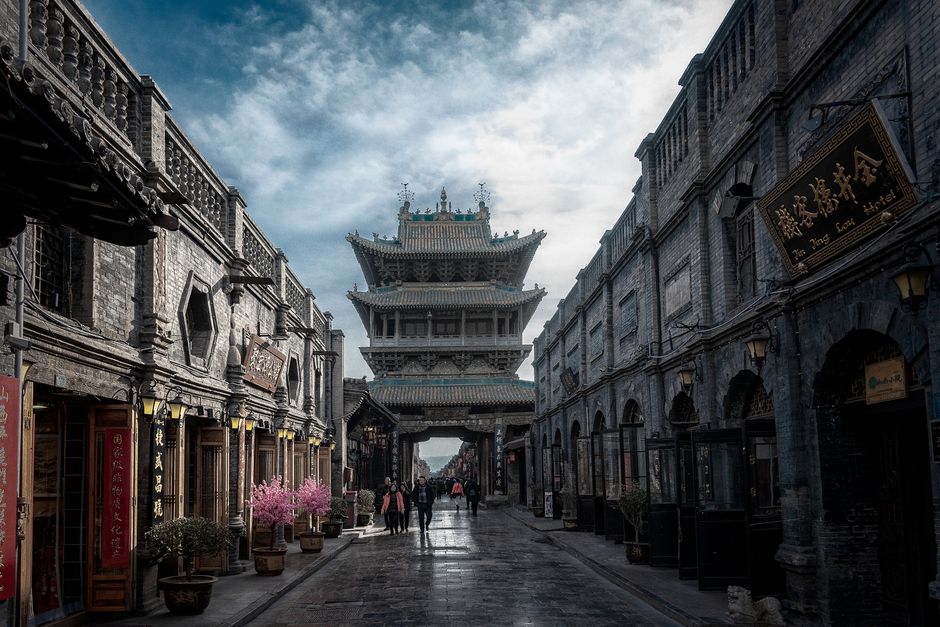
Pingyao, a county town on the plains of central Shanxi province in north China, is the best-preserved walled town of the Ming and Qing dynasties in the country, and one of the few where a complete old Chinese town still lives inside its walls. Its massive gray city wall, about 6 km (3.7 miles) around, with watchtowers, crenellations and fortified gates, encloses a grid of streets, lanes and some 3,000 old courtyard houses, shops, temples and offices. In the 19th century Pingyao was the banking capital of China: the Rishengchang draft bank, founded here in the 1820s, pioneered money transfers across the empire, and dozens of merchant banks followed, leaving grand compounds behind their shopfronts. Today the Ancient City of Ping Yao is a UNESCO World Heritage Site, together with two remarkable temples outside the walls, Shuanglin and Zhenguo, and visitors walk its stone streets, stay in courtyard inns with heated brick beds, climb the wall at sunset and see the immersive show Encore Pingyao. Entry through the gates is free, while the main sights inside share one combined ticket. Pingyao is about 30–40 minutes by high-speed train from Taiyuan, the provincial capital. Spring and autumn are the best seasons.
Right now in Pingyao (Pingyao Ancient City)
- Wed 8–24°C 46–75°F Clear
- Thu 6–24°C 43–75°F Clear
- Fri 10–25°C 50–77°F Clear
Weather: MET Norway (CC BY 4.0)
Top tours in Pingyao
See all tours for Pingyao →
From local operators, with prices and reviews; you check availability and book on Viator, our partner. We may earn a commission at no extra cost to you. How we earn money
Pingyao at a glance
- Best for: the Ming city wall, old banks and courtyard houses, temples with painted sculptures, staying in a historic inn, photography, and Shanxi noodles and vinegar.
- How long: 1–2 days; 3 with the merchant family compounds nearby.
- Best time: April to May and September to October; summers are warm and winters cold and dry.
- Getting there: by high-speed train to Pingyao Ancient City station from Taiyuan (about 30–40 minutes), Xi’an and Beijing, via Taiyuan.
- Getting around: on foot or by bike inside the walls; sightseeing carts and taxis outside.
- Good to know: entering the old town is free, but its 22 main sights are covered by a single combined ticket of 125 yuan.
- Before you go: visa-free entry, the arrival card, payments and general safety are in our China travel guide.
Pingyao’s areas and where to stay
The walled town is compact, about 1.5 km (1 mile) across, and most of what you will want to see is inside or just outside the walls.
Inside the walls: South Street and the center
South Street (Nan Dajie), also called Ming-Qing Street, runs from the south gate to the Market Tower at the center of town, lined with old shopfronts, restaurants, souvenir shops and Pingyao beef stores. Around it, West Street holds the old banks, including Rishengchang, and East Street and Yamen Street lead to the county government office.
The quiet lanes
Away from the main streets, the lanes of the eastern and northern quarters are residential and peaceful, with courtyard homes, small temples and local life, best explored on foot or by bike in the early morning.
Outside the walls
The modern town of Pingyao surrounds the old city, with larger hotels, the high-speed station, restaurants and services. It is practical but lacks atmosphere.
Where to stay in Pingyao
- Courtyard inns inside the walls: restored Qing-era merchant houses with carved wooden rooms around courtyards, often with a kang, a heated brick bed. This is the classic Pingyao experience.
- Near the gates: quieter guesthouses with easy access to taxis.
- Outside the walls: modern hotels near the station or the new town, better value for larger groups.
Book ahead for May Day, Golden Week and the festivals in September and October. Many inns offer free pickup from the stations.
Tickets: the combined ticket
Entering the old town through its gates is free. The 22 main sights inside the walls are not sold separately: you need the combined ticket (through ticket), which costs 125 yuan for adults and 65 yuan for university students and children; children under 6 or under 1.2 m (3 ft 11 in) and visitors aged 60 and over enter free, according to the Shanxi authorities. Buy it at the visitor centers by the gates or book in advance on the old town’s official service platform; it is generally valid for three days, so you can spread your visits. The ticket includes the city wall, Rishengchang and the other banks, the County Government Office, the Confucian Temple, the City God Temple, the Qingxu Taoist Temple and other museums and residences. Sightseeing carts around the old town cost 10 yuan per ride. Shuanglin Temple and Zhenguo Temple, outside the walls, have separate tickets.
Top things to see in Pingyao
The city wall
Rebuilt in brick in 1370 in the early Ming dynasty, the city wall is about 10 m (33 ft) high, with six gates protected by barbican enclosures and 72 watchtowers. Its outline, with a gate at each end like a head and tail and two on each side like legs, is said to resemble a turtle, a symbol of long life. Walk sections of the top for views over the gray tiled roofs, especially at sunset.
Rishengchang Draft Bank
The Rishengchang (Sun Rising Prosperity) bank, opened in 1823 on West Street, was China’s first draft bank, issuing drafts that merchants could cash in branches across China, and it is considered a forerunner of modern Chinese banking. Its courtyards, counters, vaults and offices are now a museum of Pingyao’s banking days.
County Government Office
The County Government Office (Yamen), one of the largest and best preserved in China, shows how a county was governed under the Qing: courtrooms, a prison, offices and the magistrate’s residence. Reenactments of court trials are staged during the day.
The Market Tower
The Market Tower (Shi Lou), a three-story wooden tower straddling South Street, is the town’s landmark; climb it for views over the rooftops.
Confucian Temple and City God Temple
The Confucian Temple, whose Dacheng Hall dates from the 12th century, is one of the oldest buildings in town. The City God Temple and the Kitchen God Temple stand together on the eastern side, and the Qingxu Taoist Temple has fine courtyards on East Street.
Shuanglin Temple
Shuanglin Temple, about 6 km (4 miles) southwest of the old town, holds more than 2,000 painted clay sculptures from the Song to the Ming dynasties, many of them masterpieces of expressive Buddhist art. It is part of the UNESCO listing and well worth a half-day by taxi or bike.
Zhenguo Temple
Zhenguo Temple, about 12 km (7.5 miles) northeast, has the Ten Thousand Buddha Hall, built in 963, one of the oldest surviving wooden buildings in China, with original painted sculptures of the Five Dynasties period.
More classic sights
- Ancient banks: several more draft banks and escort agencies on West and South streets.
- Pingyao Escort Agency Museum: on the armed escort companies that guarded money transports.
- Merchant residences: restored courtyard homes of wealthy families.
- Encore Pingyao: an immersive theater show about the town’s merchant history, staged in a building outside the walls.
- Night lanterns: South Street and the Market Tower lit up after dark.
Other things to do in Pingyao
Cycling the walls and lanes
Rent a bicycle inside the walls to explore the lanes at dawn before the day visitors arrive, or ride out to Shuanglin Temple through the countryside. See our cycling and city sightseeing guides.
Festivals
Pingyao hosts the Pingyao International Photography Festival, usually in September, with exhibitions in old factories and courtyards, and the Pingyao International Film Festival, usually in October. During Chinese New Year, the old town is decorated with lanterns and hosts folk performances.
Walking tour of the old town
A good loop starts at the south gate: climb onto the wall for the view, then walk up South Street to the Market Tower, turn west onto West Street for Rishengchang and the other banks, continue to the County Government Office on Yamen Street, then cross to the City God Temple and the Confucian Temple in the east, finishing back on South Street for dinner. Allow most of a day with stops, and come back after dark, when red lanterns light the shopfronts and the crowds thin out.
Food and drink
Shanxi is the land of noodles and vinegar. Try Pingyao beef, salted and slow-cooked to a deep red, sold in vacuum packs as a souvenir; knife-cut noodles (daoxiao mian); youmian kaolaolao, oat-flour noodles steamed in a honeycomb pattern; wantuo, a jelly of buckwheat flour served cold with vinegar and chili; and dishes seasoned with Shanxi aged vinegar (laochencu). Fenjiu, a clear sorghum liquor, comes from Fenyang, nearby. Many courtyard inns serve home-style meals.
Day trips from Pingyao
- Wang Family Compound: a vast hillside complex of courtyards built by a Qing merchant family, about 35 km (22 miles) south.
- Qiao Family Compound: the courtyard mansion made famous by the film “Raise the Red Lantern,” about 40 km (25 miles) north.
- Zhangbi Ancient Fort: a fortified village with underground tunnels, near Jiexiu.
- Mount Mian: temples built into cliffs near Jiexiu, about 1 hour by road.
- Taiyuan: the Jinci Temple and the Shanxi Museum, about 30–40 minutes by high-speed train.
Nearby destinations
- Luoyang284 km
Getting there and getting around
By train
Pingyao Ancient City station (Pingyao Gucheng), about 3 km (2 miles) east of the walls, is on the Datong–Xi’an high-speed line, with trains to Taiyuan South (about 30–40 minutes), Xi’an North (about 3 hours) and Datong. From Beijing, change at Taiyuan (about 3–4 hours in total). The older Pingyao Station, just outside the walls, has conventional and overnight trains. Book on the 12306 website or app with your passport. From Luoyang, allow about 3–4 hours by train with a change; see our Luoyang guide.
By air
The nearest airport is Taiyuan Wusu International Airport (TYN), about 100 km (62 miles) north. It is a designated port for the 240-hour visa-free transit, but the permitted area in Shanxi covers only Taiyuan and Datong, so transit travelers cannot include Pingyao; you need a visa or visa-free entry.
Around town
Inside the walls, walk or cycle; electric sightseeing carts run around the old town, and motor traffic is restricted. Taxis and buses link the gates with the stations. Many inns arrange transfers.
When to go and how long to stay
Pingyao has a semi-arid continental climate, with dry, sunny weather for much of the year. Spring (April–May) is mild and dry, sometimes windy and dusty. Summer (June–August) is warm, with highs around 29–30 °C (84–86 °F), and most of the year’s rain falls in July and August. Autumn (September–October) is the best season, clear and comfortable, with the photography and film festivals. Winter (December–February) is cold and dry, with nights well below freezing, but crisp days and few visitors make it atmospheric, and Chinese New Year brings lanterns. The table uses the 1991–2020 climate normals for the Taiyuan station of the China Meteorological Administration (CMA), about 60 km (37 miles) to the north at a similar altitude, as submitted to the World Meteorological Organization (WMO): average daily highs and lows, total precipitation, and days with at least 1 mm of rain.
| Month | Average high / low | Rain (days with 1 mm or more) | What to expect |
|---|---|---|---|
| January | 2 °C (36 °F) / −10 °C (14 °F) | 3 mm (0.1 in), 1 day | Cold and dry; quiet |
| February | 7 °C (44 °F) / −7 °C (20 °F) | 5 mm (0.2 in), 1 day | Cold; Chinese New Year lanterns |
| March | 13 °C (56 °F) / −1 °C (31 °F) | 10 mm (0.4 in), 2 days | Cool, dry and windy |
| April | 21 °C (69 °F) / 6 °C (43 °F) | 22 mm (0.9 in), 4 days | Mild; blossoms; occasional dust |
| May | 26 °C (79 °F) / 12 °C (53 °F) | 31 mm (1.2 in), 4 days | Warm and pleasant; May Day crowds |
| June | 30 °C (85 °F) / 16 °C (61 °F) | 48 mm (1.9 in), 6 days | Warm and dry |
| July | 30 °C (87 °F) / 19 °C (66 °F) | 104 mm (4.1 in), 8 days | Warm; the wettest month |
| August | 29 °C (83 °F) / 18 °C (64 °F) | 103 mm (4.0 in), 8 days | Warm with storms |
| September | 24 °C (76 °F) / 12 °C (54 °F) | 60 mm (2.4 in), 5 days | Clear; photography festival |
| October | 18 °C (65 °F) / 5 °C (41 °F) | 30 mm (1.2 in), 4 days | Crisp and clear; Golden Week crowds and film festival |
| November | 10 °C (50 °F) / −2 °C (28 °F) | 13 mm (0.5 in), 2 days | Cool to cold |
| December | 4 °C (38 °F) / −8 °C (17 °F) | 3 mm (0.1 in), 1 day | Cold and dry |
The Taiyuan station receives about 430 mm (17 in) of rain a year, nearly half of it in July and August.
One day in Pingyao
Walk the wall at the south gate, then visit Rishengchang, the County Government Office, the Market Tower, the Confucian Temple and the City God Temple, with Shanxi noodles for lunch and the Encore Pingyao show or the lantern-lit streets at night.
Two to three days
Add Shuanglin Temple and Zhenguo Temple, cycle the quiet lanes at dawn, and take a day trip to the Wang or Qiao family compounds; continue to Xi’an or Beijing by train.
What a trip to Pingyao costs
Prices are approximate, for October 2026, converted at about 6.74 yuan to the US dollar.
| Item | Typical cost |
|---|---|
| Combined ticket, adult (22 sights) | 125 CNY (about US$19) |
| Combined ticket, students and children | 65 CNY (about US$9.60) |
| Sightseeing cart, per ride | 10 CNY (about US$1.50) |
| Shuanglin Temple | about 40 CNY (about US$6) |
| Encore Pingyao show | about 200–300 CNY (about US$30–45) |
| Bowl of knife-cut noodles | 15–25 CNY (about US$2.20–3.70) |
| High-speed train, Taiyuan South–Pingyao Ancient City | about 25–35 CNY (about US$3.70–5.20) second class |
| Courtyard inn double, per night | 200–600 CNY (about US$30–89) |
Practical tips for Pingyao
- Buy the combined ticket once: keep it with your passport; it covers the 22 main sights over its validity period.
- Stay overnight: day-trippers leave by evening, when the town is at its most beautiful.
- Walk the wall early or at sunset: for the light and fewer people.
- Watch for carts and scooters: the stone streets are shared with electric carts.
- Try a kang: heated brick beds are warm in winter but firm; ask for extra bedding if you like.
- Carry your passport: for trains, inns, tickets and checks.
Safety
Pingyao is a safe, small town. The main things to watch are weather, uneven surfaces and crowds. Winters are cold, with nights well below freezing, and older inns can be drafty, so ask about heating. Summer afternoons can be hot and sunny; carry water. The old stone streets, high thresholds and steep stairs on the wall and the Market Tower are uneven, so watch your step, especially at night. Electric carts and scooters move silently through the lanes. During Golden Week and May Day the main streets are very crowded; watch your belongings. Use official taxis or ask your inn to arrange transport. In an emergency, call 110 for police, 120 for an ambulance and 119 for fire.
What to pack for Pingyao
Comfortable walking shoes for stone streets and stairs, a warm jacket for cold evenings in spring and autumn, a down coat in winter, sun protection in summer and a scarf for windy, dusty days. China uses 220 V, with flat two-pin, round two-pin and angled three-pin sockets. See our hiking shoes and travel adapters guides.
Pingyao travel FAQ
Is entry to Pingyao Ancient City free?
Yes, walking into the old town through its gates is free, but its 22 main sights require the combined ticket.
How much is the Pingyao combined ticket?
125 yuan for adults and 65 yuan for university students and children; children under 6 or under 1.2 m (3 ft 11 in) and visitors aged 60 and over are free.
How long is the Pingyao ticket valid?
It is generally valid for three days, so you can visit the sights over several days; check the validity when you buy.
Can I buy tickets for individual sights in Pingyao?
No. The 22 sights inside the walls are only covered by the combined ticket.
How do I get from Taiyuan to Pingyao?
By high-speed train from Taiyuan South to Pingyao Ancient City station in about 30–40 minutes.
How many days do I need in Pingyao?
One full day and a night for the old town; two or three days with the temples and family compounds.
Should I stay inside the walls?
Yes, if you can. Courtyard inns inside the walls are the highlight of a visit, and the town is quiet and atmospheric at night.
Can I use the 240-hour visa-free transit to visit Pingyao?
No. In Shanxi the permitted area covers only Taiyuan and Datong, so Pingyao is outside it.
What is the best time to visit Pingyao?
April to May and September to October; autumn also brings the photography and film festivals.
What food is Pingyao famous for?
Pingyao beef, Shanxi noodles such as knife-cut noodles and youmian kaolaolao, wantuo and Shanxi aged vinegar.
Sources and last review
Researched and last reviewed on 5 October 2026. Free entry through the gates, the combined ticket for the 22 sights at 125 yuan for adults and 65 yuan for students and children, free entry for young children and visitors aged 60 and over, the rule that the sights are not sold separately, booking on the official service platform, sightseeing carts at 10 yuan and the suggested length of stay: Shanxi government holiday information published by the Jincheng Chengqu district government (April 2025); visa-free transit and the Shanxi permitted area of Taiyuan and Datong: the National Immigration Administration; train booking with a passport: China Railway’s official 12306 site; climate normals: the China Meteorological Administration via the World Meteorological Organization’s 1991–2020 normals (Taiyuan station, the nearest in the series); the exchange rate: the CFETS central parity rate; the inscription: the UNESCO World Heritage List. The ticket’s three-day validity, wall dimensions and dates, bank, temple and sculpture details, festival dates, train times, distances and typical prices are general references or estimates, flagged for checking. Prices and rules change, so check locally before you go. For entry rules, money and general safety, see our China travel guide.
Plan your trip
Partner links: TravelerCenter may earn a commission if you book, at no extra cost to you.
🇨🇳 Useful Mandarin Chinese phrases for Pingyao
All 38 Mandarin Chinese phrases: restaurant, hotel, emergencies, romance (printable) →