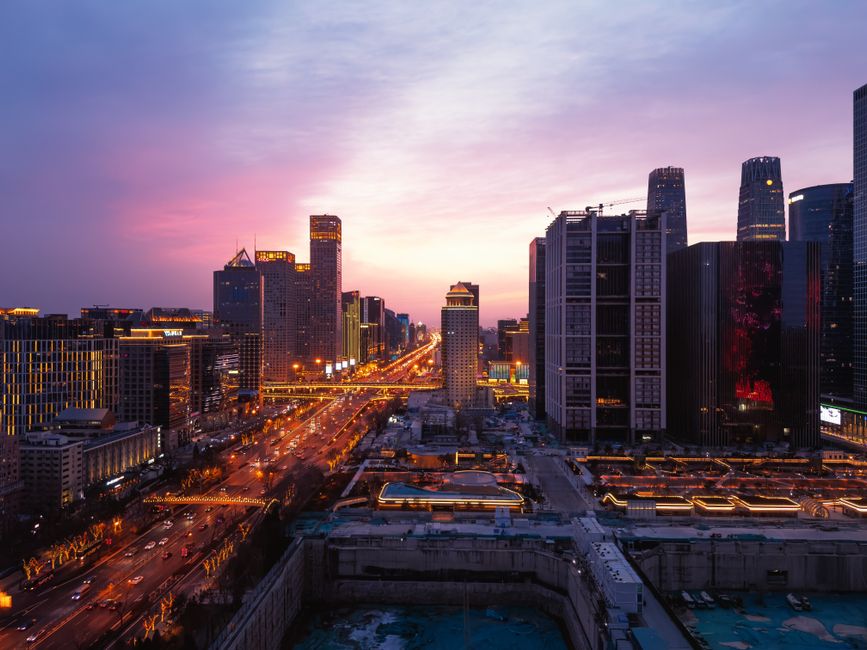
Beijing has been China’s capital for most of the last 800 years, and it shows: few cities hold so much imperial grandeur in one place. At its heart lies the Forbidden City, the vast palace of the Ming and Qing emperors, facing Tiananmen Square across Chang’an Avenue; to the south is the round blue-roofed Temple of Heaven, and to the northwest the lakeside Summer Palace. Between the monuments, the old hutong lanes of courtyard houses survive around the Drum and Bell Towers and the Houhai lakes, and beyond the city, the Great Wall snakes across the mountains, within day-trip reach at Mutianyu, Badaling and Jinshanling. Modern Beijing adds the Olympic Park with the Bird’s Nest, the 798 art district, world-class museums and some of the best food in the north, led by Peking duck. The city’s north–south Central Axis, which runs through the Forbidden City, became a UNESCO World Heritage Site in 2024, joining the palace, the Temple of Heaven, the Summer Palace, the Great Wall and the Ming Tombs. The Forbidden City sells tickets only online, in advance, and is closed on Mondays. The best months are April, May, September and October; summers are hot and wet, winters cold and dry.
Right now in Beijing
- Wed 13–26°C 56–79°F Clear
- Thu 13–25°C 56–77°F Clear
- Fri 16–26°C 61–78°F Clear
Weather: MET Norway (CC BY 4.0)
Top tours in Beijing
See all tours for Beijing →
From local operators, with prices and reviews; you check availability and book on Viator, our partner. We may earn a commission at no extra cost to you. How we earn money
Beijing at a glance
- Best for: imperial palaces and temples, the Great Wall, hutong lanes, museums, Peking duck and modern architecture.
- How long: 3–4 days, including one day on the Great Wall; 5–6 to add the Ming Tombs, a second Wall section or Universal Beijing.
- Best time: April to May and September to October; July and August are hot and rainy, and December to February cold.
- Getting there: by air to Beijing Capital (PEK) or Daxing (PKX), or by high-speed train from Shanghai (about 4.5–6 hours), Xi’an or Harbin.
- Getting around: by metro, which reaches almost every sight, by taxi or DiDi, and by shared bike in the hutongs.
- Good to know: book the Forbidden City and other big sights in advance with your passport number, and carry your passport every day.
- Before you go: visa-free entry, the 240-hour transit, the arrival card, payments and general safety are in our China travel guide.
Beijing’s areas and where to stay
Beijing is laid out in rings around the Forbidden City, with the old city inside the Second Ring Road, where the city walls once stood. The city is huge: allow 30–60 minutes by metro between districts.
Wangfujing and Dongcheng
East of the Forbidden City, Wangfujing is the classic central base: a pedestrian shopping street with big international hotels, malls and a short walk or one metro stop to the palace and Tiananmen Square. The quieter lanes of Dongcheng nearby have courtyard hotels.
Qianmen and Dashilar
South of Tiananmen Square, Qianmen Street and the lanes of Dashilar mix restored old shopfronts, century-old brands and budget and mid-range hotels in hutong buildings, within walking distance of the square and close to the Temple of Heaven.
Houhai, Nanluoguxiang and the Drum Tower
North of the Forbidden City, the lakes of Shichahai (Houhai, Qianhai and Xihai) are ringed by bars, cafés and willow-lined paths, next to the Drum and Bell Towers and the busy hutong of Nanluoguxiang. Courtyard guesthouses and boutique hotels here give the most atmospheric stay, close to the Lama Temple and Jingshan Park.
Sanlitun and Chaoyang
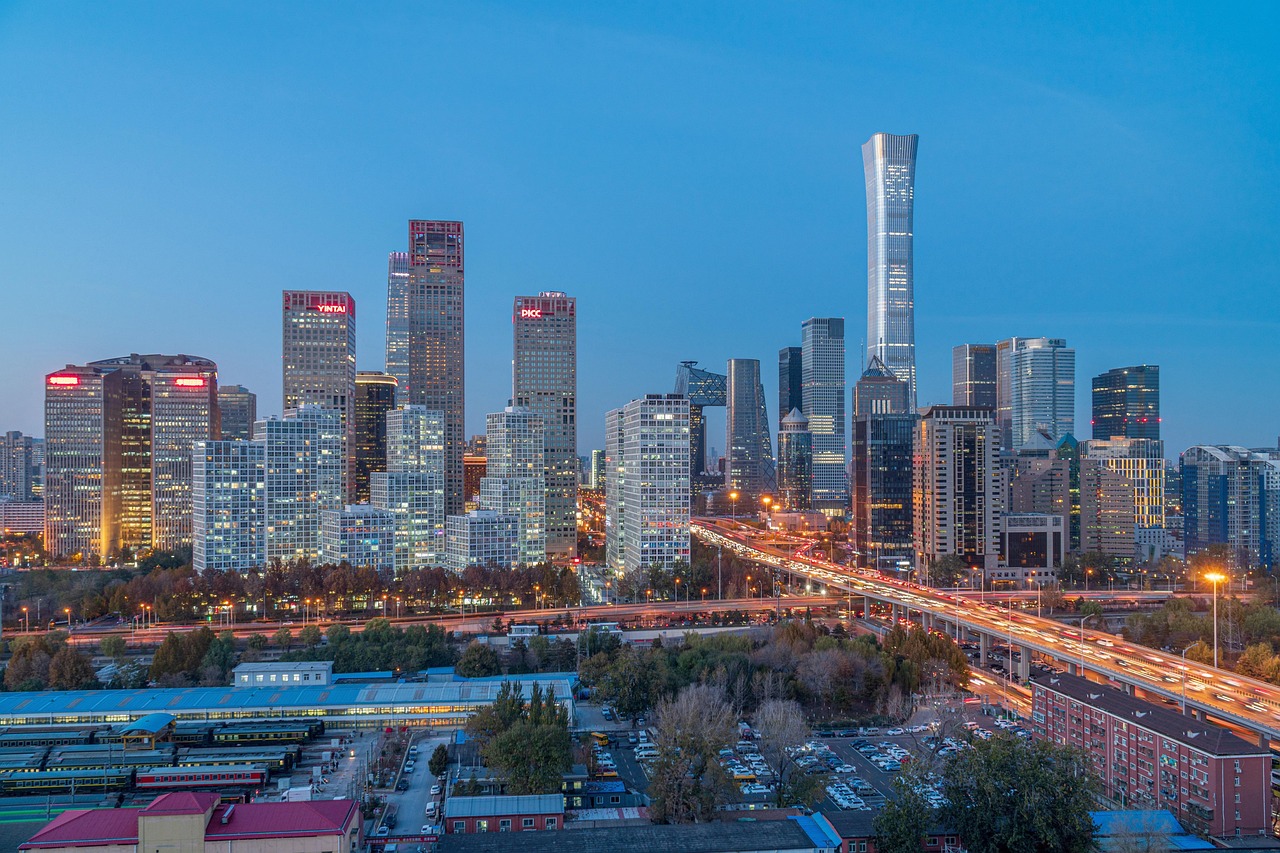
East of the center, Sanlitun and the Central Business District (CBD) around the CCTV tower are modern Beijing: international hotels, embassies, nightlife, shopping and many of the city’s best restaurants, about 20–30 minutes by metro from the palace.
Where to stay in Beijing
- Wangfujing and Dongcheng: international and mid-range hotels close to the Forbidden City.
- Qianmen and Dashilar: budget and mid-range hotels near Tiananmen Square and the Temple of Heaven.
- Houhai and the Drum Tower: courtyard hotels and guesthouses in the hutongs.
- Sanlitun and the CBD: upscale hotels, nightlife and dining.
- Near the Great Wall: guesthouses and boutique lodges in villages around Mutianyu for sunrise on the Wall.
Rooms fill and prices rise during the May Day and National Day holidays and big conferences.
Top things to see in Beijing
The Forbidden City (Palace Museum)
The Forbidden City, now the Palace Museum, was the home of 24 emperors of the Ming and Qing dynasties from its completion in 1420 until 1924. Surrounded by a 52-meter (171-foot) moat and 10-meter (33-foot) walls, it covers 72 hectares (178 acres), with about 9,000 rooms around a sequence of vast courtyards: through the Meridian Gate (Wumen), the main entrance from the south, you pass the great halls of state, led by the Hall of Supreme Harmony, then the inner court of private palaces and the imperial garden, leaving by the Gate of Divine Prowess to the north. According to the museum, it is open from Tuesday to Sunday and closed on Mondays, except on national holidays; hours are 8:30–17:00 from April to October and 8:30–16:30 from November to March, with last entry an hour before closing. Tickets cost 60 yuan from April to October and 40 yuan from November to March, plus 10 yuan each for the Treasure Gallery and the Clock Gallery. The museum does not sell tickets on the day: book online in advance on the official ticketing site, where foreign visitors give their passport number, and bring the same passport. Visitors are capped at 40,000 a day, and tickets sell out days ahead in summer and at holidays, so book as soon as your dates are set. Allow at least three hours. The Gate of Supreme Harmony has been under repair since August 2026.
Tiananmen Square
Directly south of the palace, Tiananmen Square, one of the largest public squares in the world, is lined by the Great Hall of the People, the National Museum of China and the Mausoleum of Mao Zedong, with the Gate of Heavenly Peace (Tiananmen) and its portrait of Mao on the north side. Entry is through security checkpoints with your passport, and a free advance reservation is required. The National Museum of China on the square, free with a booking and closed on Mondays, holds one of the world’s great collections of Chinese art and history.
Jingshan Park
Just north of the Forbidden City, the artificial hill of Jingshan Park gives the classic view over the golden roofs of the palace; come straight after your palace visit, ideally in the late afternoon light.
The Temple of Heaven
In a huge park in the south of the city, the Temple of Heaven (Tiantan), built in 1420, is where emperors prayed for good harvests. Its triple-roofed Hall of Prayer for Good Harvests, built of wood without nails, and the circular stone Altar of Heaven are masterpieces of Ming design. Come early, when local people practice tai chi and dance in the park. A combined ticket covers the main buildings.
The Summer Palace
Northwest of the center, the Summer Palace (Yiheyuan) is an imperial garden of lakes, pavilions and temples around Kunming Lake and Longevity Hill, rebuilt by the Empress Dowager Cixi in the late 19th century. Walk the painted Long Corridor, climb to the Tower of Buddhist Incense, see the marble boat and take a boat across the lake; allow half a day.
The hutongs and the Drum and Bell Towers
Beijing’s hutongs, the alleys of gray-brick courtyard houses, are best explored on foot or by bike around Shichahai, the Drum and Bell Towers (where drummers perform at set times), Nanluoguxiang and the quieter lanes of Wudaoying and Dashilar.
The Lama Temple and the Confucius Temple
The Yonghe Temple, or Lama Temple, is Beijing’s grandest Tibetan Buddhist temple, with incense-filled courtyards and an 18-meter (59-foot) Buddha carved from a single sandalwood trunk. Across the road is the tranquil Temple of Confucius.
More classic sights
- Olympic Park: the Bird’s Nest stadium and the Water Cube from the 2008 Olympics, lit up at night.
- 798 Art District: galleries, studios and cafés in former factories in the northeast.
- Universal Beijing Resort: a theme park in Tongzhou, on the eastern edge of the city.
The Great Wall from Beijing
The Great Wall is not one wall but a network of fortifications built over 2,000 years; the stone and brick sections near Beijing date mainly from the Ming dynasty. Several restored sections are within a day trip, and all require a ticket. Most now use real-name booking with your passport number.
- Mutianyu: about 70 km (45 miles) northeast of the center, the most popular section with independent travelers: restored, with forested hills, 22 watchtowers and a cable car, a chairlift and a toboggan run down. According to the site, tickets are sold by real-name booking up to 30 days ahead, one per passport per day; it opens at 7:30 from mid-March to mid-November.
- Badaling: about 70 km (45 miles) northwest, the most visited section, heavily restored and crowded at weekends and holidays, but easy to reach by high-speed train to Badaling Great Wall station on the Beijing–Zhangjiakou line, in about 30–40 minutes from Qinghe or Beijing North. Book online with your passport.
- Jinshanling: about 130 km (80 miles) northeast in Hebei province, a partly restored, spectacular ridge-top section for a longer walk of 2–4 hours, much quieter than Mutianyu.
- Simatai and Gubei Water Town: a steep, partly original section lit at night, reached through the Gubei Water Town resort; book in advance.
- Juyongguan: a restored pass with a steep circuit, closest to the city, on the way to the Ming Tombs.
Wear good shoes: the steps are steep and uneven, and some sections have long climbs. Don’t walk alone on unrestored “wild” sections such as Jiankou, which are crumbling and, in places, closed. See our hiking and hiking shoes guides.
Other things to do in Beijing
Food and drink
Beijing’s signature dish is Peking duck, roasted until the skin is crisp, carved at the table and eaten in thin pancakes with scallions, cucumber and sweet bean sauce; famous restaurants include old brands such as Quanjude and Bianyifang and newer, refined places. Try zhajiangmian, wheat noodles with fermented soybean paste; jiaozi dumplings; jianbing, a savory breakfast crepe from street stalls; mutton hotpot with sesame sauce in winter; and Muslim lamb skewers.
Performances and shopping
Watch Peking opera at the Liyuan Theater or the Huguang Guild Hall, or an acrobatics show. Panjiayuan antiques market is best on weekend mornings, and Liulichang street sells calligraphy brushes, paper and paintings; at the Silk Market, bargaining is expected.
Festivals
At Chinese New Year, temple fairs fill the Temple of Earth and other parks with food stalls and performances. In spring, the city’s parks bloom with peach and cherry blossom; in late October and early November, the red leaves of the Fragrant Hills draw crowds. See our city sightseeing and cycling guides.
Day trips from Beijing
- The Great Wall: Mutianyu, Badaling, Jinshanling or Simatai, as above.
- The Ming Tombs: the burial valley of 13 Ming emperors, about 50 km (30 miles) north, with the Sacred Way of stone animals and the Changling and Dingling tombs; easily combined with Badaling or Juyongguan.
- Tianjin: a port city with European-style concession districts, about 30 minutes by high-speed train.
- Chengde: the Qing emperors’ summer mountain resort and its Tibetan-style temples, about 1 hour by high-speed train.
Nearby destinations
- Tianjin109 km
Getting there and getting around
By air
Beijing has two international airports. Beijing Capital International Airport (PEK), about 25 km (16 miles) northeast of the center, is linked by the Airport Express metro to Dongzhimen and Sanyuanqiao, in about 20–30 minutes. Beijing Daxing International Airport (PKX), about 45 km (28 miles) south, is linked by the Daxing Airport Express to Caoqiao in about 20 minutes. Both airports are designated ports for the 240-hour visa-free transit. A taxi to the center takes 40–60 minutes from either airport, more at rush hour.
By train
Beijing has several main stations: Beijing South for high-speed trains to Shanghai (about 4.5–6 hours), Tianjin and the east; Beijing West for Xi’an (about 4.5–6 hours), Chengdu and the south; Beijing North and Qinghe for Badaling and Zhangjiakou; Beijing Chaoyang for Harbin and the northeast; and Beijing Station in the center for overnight and international trains, including the Trans-Mongolian to Ulaanbaatar. Book on the 12306 website or app with your passport, and allow time for security checks.
Around town
The metro is the fastest way around: it has more than 25 lines, signs and announcements in English, and fares of a few yuan; pay with Alipay or WeChat Pay QR codes at the gates. Taxis and DiDi are cheap but slow in traffic. Shared bikes are ideal for the hutongs and the lakes.
When to go and how long to stay
Beijing has a continental monsoon climate with four distinct seasons. Spring (April–May) is warm and sunny, with blossom in the parks, though windy and occasionally dusty. Summer (June–August) is hot and humid, with highs of about 31–32 °C (87–89 °F) and most of the year’s rain in heavy downpours in July and August. Autumn (September–October) is the best season: dry, clear and mild, with red leaves in the Fragrant Hills, but the first week of October is the National Day holiday, when sights are packed. Winter (December–February) is cold and very dry, with nights around −5 to −7 °C (20–23 °F); skies are often blue, the sights quiet, and the Great Wall can be dusted with snow. The table uses the 1991–2020 climate normals for the Beijing station of the China Meteorological Administration (CMA), as submitted to the World Meteorological Organization (WMO): average daily highs and lows, total precipitation, and days with at least 1 mm of rain or snow.
| Month | Average high / low | Rain (days with 1 mm or more) | What to expect |
|---|---|---|---|
| January | 2 °C (36 °F) / −7 °C (20 °F) | 2 mm (0.1 in), fewer than 1 day | Cold and very dry; clear skies |
| February | 6 °C (43 °F) / −4 °C (24 °F) | 6 mm (0.2 in), 1 day | Cold; Chinese New Year fairs some years |
| March | 13 °C (56 °F) / 2 °C (35 °F) | 9 mm (0.3 in), 2 days | Cool and windy; first blossom |
| April | 21 °C (70 °F) / 9 °C (48 °F) | 22 mm (0.9 in), 3 days | Mild and sunny; blossom; can be dusty |
| May | 27 °C (81 °F) / 15 °C (59 °F) | 36 mm (1.4 in), 4 days | Warm and pleasant; May Day crowds |
| June | 31 °C (87 °F) / 20 °C (68 °F) | 72 mm (2.9 in), 7 days | Hot; rain begins |
| July | 32 °C (89 °F) / 23 °C (73 °F) | 170 mm (6.7 in), 9 days | The hottest and wettest month |
| August | 31 °C (87 °F) / 22 °C (72 °F) | 113 mm (4.5 in), 7 days | Hot, humid and rainy |
| September | 27 °C (80 °F) / 16 °C (61 °F) | 54 mm (2.1 in), 5 days | Warm and clear; excellent |
| October | 19 °C (67 °F) / 9 °C (48 °F) | 29 mm (1.1 in), 3 days | Mild and golden; Golden Week crowds |
| November | 10 °C (51 °F) / 1 °C (33 °F) | 14 mm (0.5 in), 2 days | Cool; autumn leaves |
| December | 4 °C (39 °F) / −5 °C (23 °F) | 2 mm (0.1 in), 1 day | Cold and dry; quiet |
Beijing receives about 530 mm (21 in) of precipitation a year, two-thirds of it from June to August.
Three days in Beijing
Day one, Tiananmen Square and the Forbidden City in the morning, Jingshan Park for the view, and Peking duck for dinner. Day two, the Great Wall at Mutianyu, back in time for the hutongs and the lakes of Houhai at dusk. Day three, the Temple of Heaven early, the Lama Temple, and the Summer Palace in the afternoon.
Five days or more
Add the Ming Tombs and Badaling or Jinshanling, the National Museum, 798 and the Olympic Park, a Peking opera, or an overnight trip to Chengde; then continue by high-speed train to Xi’an or Shanghai.
What a trip to Beijing costs
Prices are approximate, for October 2026, converted at about 6.74 yuan to the US dollar.
| Item | Typical cost |
|---|---|
| Forbidden City ticket | 60 CNY April–October, 40 CNY November–March (about US$8.90 / US$5.90) |
| Temple of Heaven combined ticket | about 30–35 CNY (about US$4.50–5.20) |
| Mutianyu Great Wall entry, shuttle and cable car or toboggan | about 200–300 CNY (about US$30–45) |
| Metro ride | 3–10 CNY (about US$0.45–1.50) |
| Taxi from Capital Airport to the center | 100–150 CNY (about US$15–22) |
| Peking duck dinner in a good restaurant | 150–350 CNY (about US$22–52) per person |
| Bowl of noodles or dumplings | 20–40 CNY (about US$3–5.90) |
| Mid-range hotel double, per night | 500–1,000 CNY (about US$74–148) |
Practical tips for Beijing
- Book the Forbidden City early: tickets are online only and sell out days ahead; remember the Monday closure.
- Carry your passport: you need it for tickets, security checks at Tiananmen and train stations, and hotels.
- Start early: big sights are calmest at opening time, and the Great Wall is best before the tour buses arrive.
- Download a map app: Amap or Apple Maps work well; Google Maps does not.
- Plan around holidays: avoid the first week of May and October if you can.
Safety
Beijing is very safe, with a heavy police presence and little violent crime. The main problems are scams around Tiananmen Square, Wangfujing and Qianmen, where friendly “students” invite visitors to tea ceremonies or art exhibitions that end with a huge bill, and unofficial guides and drivers offering Great Wall trips; buy tickets and tours only through official channels. Traffic is heavy, and electric scooters move fast and silently, so take care crossing streets, and use metered taxis or DiDi rather than unmarked cars. In summer, heat and sudden heavy rain can flood underpasses and roads; follow local alerts. In winter and spring, check the air quality index, which can be poor on some days, and spring winds can bring dust. On the Great Wall, wear good shoes, carry water and don’t hike alone on wild sections. Carry your passport, as police checks are common. In an emergency, call 110 for police, 120 for an ambulance and 119 for fire.
What to pack for Beijing
Comfortable walking shoes for palaces and the Great Wall, light clothes, a hat and sunscreen from May to September, a light rain jacket in July and August, a warm coat, hat and gloves from December to February, a mask if you are sensitive to dust or pollution, and a power bank. China uses 220 V, with flat two-pin, round two-pin and angled three-pin sockets. See our hiking shoes and travel adapters guides.
Beijing travel FAQ
Do I need to book the Forbidden City in advance?
Yes. The Palace Museum doesn’t sell tickets on the day: book online on the official ticketing site with your passport number, and bring the same passport. Tickets cost 60 yuan from April to October and 40 yuan from November to March.
Is the Forbidden City open on Mondays?
No. It is closed on Mondays except on national holidays, and open Tuesday to Sunday from 8:30.
Which Great Wall section is best from Beijing?
Mutianyu for a restored, scenic section with a cable car and fewer crowds; Badaling for the easiest trip by high-speed train; Jinshanling for a longer, quieter walk.
How do I get from Beijing to the Great Wall?
To Badaling by high-speed train from Qinghe or Beijing North; to Mutianyu by tour bus, private car or taxi in about 1.5 hours; or on a day tour from a reputable operator.
How many days do I need in Beijing?
Three to four days, including a day on the Great Wall; five or more to add the Ming Tombs, Chengde or a second Wall section.
What is the best time to visit Beijing?
April to May and September to October, when the weather is mild and clear. Avoid the first week of October and early May, when national holidays bring huge crowds.
How do I get from Beijing to Shanghai?
By high-speed train from Beijing South to Shanghai Hongqiao in about 4.5–6 hours, or by a two-hour flight.
What is a hutong?
A narrow lane of traditional courtyard houses. The best preserved are around the Drum Tower, Houhai, Nanluoguxiang and Dashilar.
Can I use the 240-hour visa-free transit in Beijing?
Yes. Beijing Capital and Daxing airports are designated ports, if you are from an eligible country and hold an onward ticket to a third country or region.
Where should I stay in Beijing?
Near Wangfujing or Dongcheng for the sights, around Houhai and the Drum Tower for hutong character, or in Sanlitun and the CBD for dining and nightlife.
Sources and last review
Researched and last reviewed on 4 October 2026. Forbidden City hours, Monday closure, ticket prices, the 40,000 daily cap, advance online booking with passport numbers and the Gate of Supreme Harmony repairs: the Palace Museum’s official pages; Mutianyu booking, the 30-day window and hours: the Mutianyu Great Wall’s official site; visa-free transit ports: the National Immigration Administration; train booking with a passport: China Railway’s official 12306 site; climate normals: the China Meteorological Administration via the World Meteorological Organization’s 1991–2020 normals; the exchange rate: the CFETS central parity rate. Tiananmen Square reservations, Badaling booking and train times, Great Wall distances, airport links, the Central Axis inscription, palace history and typical prices are general references or estimates, flagged for checking. Prices and rules change, so check locally before you go. For entry rules, money and general safety, see our China travel guide.
Plan your trip
Partner links: TravelerCenter may earn a commission if you book, at no extra cost to you.
🇨🇳 Useful Mandarin Chinese phrases for Beijing
All 38 Mandarin Chinese phrases: restaurant, hotel, emergencies, romance (printable) →