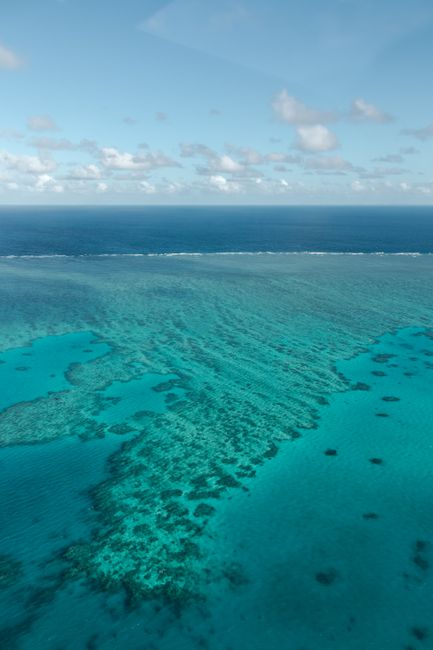
The Great Barrier Reef is the world’s largest coral reef system, a chain of roughly 3,000 individual reefs and hundreds of islands stretching about 2,300 km (1,400 miles) along the coast of Queensland, from the Torres Strait in the north to near Bundaberg in the south. It is so big that it can be seen from space, and it supports thousands of species of fish, corals, turtles, sharks, rays, dolphins and whales. Most of it lies within the Great Barrier Reef Marine Park, about 344,400 km² (133,000 square miles), managed by the Australian Government’s Great Barrier Reef Marine Park Authority (the Reef Authority) with the Queensland Government, and it was inscribed as a UNESCO World Heritage Site in 1981. More than 70 Traditional Owner groups have connections to the reef. You don’t visit “the reef” in one place: you choose a gateway town, such as Cairns, Port Douglas, the Whitsundays or the southern islands, and take a boat, seaplane or helicopter out to it. Northern Queensland is tropical, so the main seasons are a dry season from about May to October and a hot, wet season from about December to April, which is also stinger season.
Right now in Great Barrier Reef (Low Isles)
- Wed22–24°C72–75°FMostly clear
- Thu22–24°C72–76°F1 mm rain
- Fri23–24°C73–76°FPartly cloudy
Top tours in Great Barrier Reef
See all tours for Great Barrier Reef →
From local operators, with prices and reviews; you check availability and book on Viator, our partner. We may earn a commission at no extra cost to you. How we earn money
Great Barrier Reef at a glance
- Best months: June to October for dry, sunny weather, calm seas and good visibility; September to November is often ideal, with warmer water. December to April brings heat, rain, the risk of cyclones and marine stingers.
- Gateways: Cairns and Port Douglas for the northern reef and the rainforest; Airlie Beach and Hamilton Island for the Whitsundays; Townsville and Magnetic Island; and Bundaberg, Agnes Water and Gladstone for the southern coral cays.
- Time needed: at least one full reef day; three to five days lets you combine an outer-reef trip, an island stay and a scenic flight.
- Costs (as of October 2026): every tourist adds the Reef Authority’s environmental management charge, $8.50 per person per day (about US$5.90) for trips of three hours or more, or $4.25 for shorter trips. Full-day outer-reef trips typically cost A$250–300.
- Before you go: visitors need an ETA, eVisitor or visa for Australia; see our Australia travel guide.
The reef charge, zoning and rules
The environmental management charge (EMC)
Almost every commercial tour in the marine park, from snorkel boats and dive trips to scenic flights that land on a pontoon and island day trips, collects the environmental management charge from each visitor on behalf of the Reef Authority, which uses it to manage the marine park. Operators must show it clearly, usually included in the ticket price (“including the EMC”) or added at payment. It is not subject to GST.
| Environmental management charge (per visitor) | Until 31 March 2027 | From 1 April 2027 |
|---|---|---|
| Full day: trips of 3 hours or more in the marine park | $8.50 (about US$5.90) | $9.00 |
| Part day: trips of less than 3 hours | $4.25 (about US$2.95) | $4.50 |
| Extended trips (liveaboards) | Charged for the first three days only | Same rule |
Visitors who have already paid the full-day charge to another operator that day don’t pay again, and children under four who aren’t charged a fare are exempt. Trips that only visit the Queensland Great Barrier Reef Coast Marine Park, along the mainland shore, are also exempt.
Zoning and responsible reef practices
The marine park is divided into zones with different rules. Marine National Park zones (green zones), about a third of the park, are no-take areas: you can swim, snorkel, dive and sail there, but fishing and collecting are not allowed. Other zones allow limited fishing. Tour operators know the rules; if you charter a boat or go fishing, use the official zoning maps. Everywhere on the reef: don’t touch, stand on or kick coral, keep fins up, don’t feed fish, keep your distance from turtles, whales and dugongs, and take all rubbish home. Many island national parks, managed by Queensland Parks and Wildlife Service, need camping permits booked in advance.
Reef health
The reef is a living system under pressure. Since 2016 it has had repeated mass coral bleaching events, caused by marine heatwaves, as well as damage from cyclones, crown-of-thorns starfish outbreaks and poor water quality from the land. Coral can recover between events, and many reefs visited by tour boats remain colorful and full of life, but conditions vary from site to site and year to year. The Reef Authority publishes regular reef health updates; reputable operators choose the best sites on the day and many take part in monitoring and crown-of-thorns control. Choosing an operator with eco-certification and a Master Reef Guide on board is a good way to learn more and support reef care.
Where to visit the reef
Cairns and Port Douglas: the northern reef
The busiest gateways. From Cairns, fast catamarans reach outer-reef pontoons and reefs such as Moore, Norman, Saxon and Hastings in about 1.5 to 2 hours, and ferries run to Green Island, a coral cay with rainforest, and Fitzroy Island. Michaelmas Cay has a seabird colony and excellent shallow snorkeling. Port Douglas, an hour north, has boats to the Agincourt Reefs on the outer edge of the reef and to the Low Isles, a coral cay with a lighthouse. Liveaboards from Cairns reach the remote Ribbon Reefs, Cod Hole (giant potato cod) and Osprey Reef in the Coral Sea. This is also the region where the reef meets the Daintree rainforest. See our Cairns guide.
The Whitsundays
About halfway down the coast, the 74 islands of the Whitsundays sit inside the reef’s sheltered lagoon. From Airlie Beach and Hamilton Island, boats and seaplanes head for the outer reef at Hardy Reef and Knuckle Reef, where pontoons offer snorkeling and semi-submersibles, and scenic flights pass over Heart Reef, a small heart-shaped reef that you can only see from the air. Combine the reef with sailing trips and Whitehaven Beach; see our Whitsunday Islands guide.
Townsville, Magnetic Island and the Yongala
Townsville, a city of about 200,000, is home to the Reef Authority and its aquarium, Reef HQ. Ferries cross to Magnetic Island, with granite boulders, bays, koalas in the wild and fringing reefs to snorkel from the shore. The wreck of the SS Yongala, a passenger ship lost in a cyclone in 1911, lies off the coast near Ayr and is one of the world’s best wreck dives, swarming with rays, sea snakes and giant groupers.
The southern reef: Lady Elliot, Heron and Lady Musgrave
At the southern end, coral cays rise right on the reef, so you can snorkel straight from the beach. Lady Elliot Island, reached by small plane from Bundaberg, Hervey Bay, the Gold Coast or Brisbane, is famous for manta rays and turtles. Heron Island, reached by boat from Gladstone, has a resort and a research station. Lady Musgrave Island, reached by day boat from the Town of 1770, has a huge lagoon. In summer, turtles nest on these islands and at Mon Repos near Bundaberg, which runs ranger-guided turtle encounters.
Ways to experience the reef
- Pontoon day trips: large, stable boats to a moored platform on the outer reef, with snorkeling, introductory dives, an underwater observatory, semi-submersible rides and lunch. Best for families, non-swimmers and those prone to seasickness.
- Smaller snorkel and dive boats: fewer people, two or three sites a day and more time in the water.
- Introductory dives and courses: you can try a supervised dive without a license, or take an open-water course over three to five days.
- Liveaboards: two to seven nights at sea to reach remote reefs, with up to four dives a day.
- Island stays: resorts and national park camping on Fitzroy, Green, Magnetic, Hamilton, Heron, Lady Elliot and others.
- Scenic flights: helicopters and seaplanes give the best view of the reef’s patterns, including Heart Reef; some land on the water or a pontoon.
- Glass-bottom boats and semi-submersibles: for those who don’t want to get wet.
How to choose a reef trip
Decide first what matters most: time in the water, comfort or price. Keen snorkelers and divers get the most from smaller boats that visit two or three outer-reef sites with limited passenger numbers. Families, older travelers and nervous swimmers are usually happier on a big pontoon trip, with shade, toilets, a stable platform and an observatory. Check how long the boat spends at the reef (four to five hours on a full-day trip is good), whether lunch, stinger suits, snorkel gear and the reef charge are included, and whether there is a marine biologist or Master Reef Guide on board. Book a day or two ahead in peak season and keep a spare day in your plans in case wind cancels a trip. If you get seasick easily, choose a fast catamaran to a pontoon or an island close to shore.
Wildlife seasons
- Humpback whales: about June to September, when they come to the warm, sheltered waters of the Whitsundays to give birth.
- Dwarf minke whales: June and July on the Ribbon Reefs, with licensed swim programs on some liveaboards.
- Turtle nesting and hatching: turtles nest from about November to January and hatchlings emerge from about January to March on the southern islands and at Mon Repos.
- Coral spawning: a few nights after full moons, usually between October and December.
- Manta rays: all year at Lady Elliot Island, most common in winter.
Getting there
The main airports are Cairns, Hamilton Island (direct flights from Sydney, Melbourne, Brisbane and Cairns), Whitsunday Coast (Proserpine) for Airlie Beach, Townsville, Mackay, Bundaberg and Gladstone. Queensland Rail’s long-distance trains and coaches run along the coast between Brisbane and Cairns, stopping at Proserpine, Townsville and other towns, and the Bruce Highway links the gateway towns by road; Brisbane to Cairns is about 1,700 km (1,060 miles), so most visitors fly between gateways. Reef boats leave from the Reef Fleet Terminal in Cairns, the Marina in Port Douglas, the Port of Airlie and Coral Sea Marina in Airlie Beach, Hamilton Island Marina, Townsville’s Breakwater, and the Town of 1770 marina. Most tours include pickups from hotels in the gateway towns.
Nearby destinations
- Port Douglas37 km
- Cairns59 km
When to go
Weather on the reef follows the tropical seasons. In the dry season (May to October), days are warm and sunny and humidity is low, but southeasterly trade winds can make seas choppy in winter, especially in June to August; the calmest, clearest conditions often come in September to November. The wet season (December to April) brings heat, humidity and heavy rain, with tropical cyclones possible from about November to April; boats still sail on most days, and the water is warmest, but trips may be canceled in bad weather. Water temperatures range from about 23 °C (73 °F) in winter to about 29 °C (84 °F) in summer in the north. Marine stingers are most common close to the coast from about November to May.
| Month | Average high | Average low | Rain | Rain days (≥1 mm) |
|---|---|---|---|---|
| Jan | 32 °C (90 °F) | 26 °C (78 °F) | 427 mm (16.8 in) | 16 |
| Feb | 32 °C (90 °F) | 26 °C (78 °F) | 438 mm (17.2 in) | 16 |
| Mar | 31 °C (88 °F) | 25 °C (77 °F) | 443 mm (17.4 in) | 17 |
| Apr | 29 °C (85 °F) | 24 °C (76 °F) | 212 mm (8.3 in) | 16 |
| May | 28 °C (82 °F) | 23 °C (73 °F) | 99 mm (3.9 in) | 12 |
| Jun | 26 °C (79 °F) | 22 °C (71 °F) | 54 mm (2.1 in) | 8 |
| Jul | 26 °C (78 °F) | 21 °C (69 °F) | 42 mm (1.6 in) | 6 |
| Aug | 27 °C (80 °F) | 21 °C (69 °F) | 43 mm (1.7 in) | 6 |
| Sep | 29 °C (84 °F) | 22 °C (71 °F) | 33 mm (1.3 in) | 6 |
| Oct | 30 °C (87 °F) | 23 °C (74 °F) | 58 mm (2.3 in) | 6 |
| Nov | 32 °C (89 °F) | 24 °C (76 °F) | 91 mm (3.6 in) | 7 |
| Dec | 33 °C (91 °F) | 25 °C (78 °F) | 244 mm (9.6 in) | 12 |
| Year | 30 °C (85 °F) | 23 °C (74 °F) | 2,178 mm (86 in) | 128 |
Figures are the Bureau of Meteorology’s 1991–2020 averages for Low Isles Lighthouse, a coral cay on the reef off Port Douglas. The Whitsundays are slightly cooler and drier, and the southern reef cooler still in winter.
How long to stay and sample plans
- One day: a full-day outer-reef trip from Cairns, Port Douglas or Airlie Beach.
- Three days: an outer-reef day, a day on Green or Fitzroy Island, and a scenic flight, or in the Whitsundays a reef day plus a Whitehaven Beach cruise.
- Five to seven days: a three-night liveaboard to the Ribbon Reefs or Coral Sea, or split your time between Cairns and the Whitsundays, flying between them.
Where to stay
- Cairns: the widest choice and the most reef boats.
- Port Douglas: boutique resorts, closer to the outer reef and the Daintree.
- Airlie Beach and Hamilton Island: for the Whitsundays, Whitehaven Beach and Heart Reef flights.
- Island resorts: Lizard, Fitzroy, Green, Hamilton, Heron and Lady Elliot islands let you wake up on the reef.
- Liveaboards: the most time in the water and access to remote sites.
Typical reef costs
| Item (as of October 2026) | Australian dollars | About US dollars |
|---|---|---|
| Environmental management charge, full day / part day | $8.50 / $4.25 | $5.90 / $2.95 |
| Outer-reef pontoon or snorkel day trip | about $250–300 | about $175–210 |
| Introductory dive (added to a day trip) | about $100–150 | about $70–105 |
| Green Island return ferry from Cairns | about $100–120 | about $70–85 |
| Scenic helicopter or seaplane flight | about $300–800 | about $210–550 |
| Three-night liveaboard | about $1,500–3,000 | about $1,000–2,000 |
The reef charge is set by the Reef Authority; tour, flight and liveaboard prices are typical ranges, not official prices. Conversions use about US$0.69 to A$1.
Safety on the reef
- Marine stingers: box jellyfish and Irukandji occur in tropical Queensland waters, mainly from about November to May, close to the coast and sometimes on the reef and islands. Wear a full-body stinger suit (most operators provide one), swim inside stinger nets at patrolled mainland beaches, and treat stings with vinegar and an emergency call to 000.
- Snorkeling and swimming fitness: the open sea can be rougher than it looks. Tell the crew about heart, lung or other medical conditions, wear a flotation vest or noodle if you aren’t a strong swimmer, snorkel with a buddy and stay within the lookout’s area. Older travelers and those with heart conditions are most at risk.
- Sun and UV: UV is extreme on the water. Wear a rash vest, a hat and reef-friendly SPF 50+ sunscreen, and drink plenty of water.
- Crocodiles: estuarine crocodiles live in rivers, estuaries and coastal waters from Gladstone north, and occasionally turn up around islands. Obey warning signs and never swim in rivers or estuaries.
- Seasickness: take medication before you board, sit low and in the middle of the boat, and look at the horizon; pontoon trips are more stable.
- Diving: don’t fly within the recommended interval after diving (usually at least 18 to 24 hours), and dive only with reputable operators.
- Cyclones: from about November to April, follow Bureau of Meteorology warnings; operators cancel trips when seas are unsafe.
What to pack for the reef
Pack swimwear, a rash vest or long-sleeved swim shirt, reef-friendly SPF 50+ sunscreen, a wide-brimmed hat with a strap, polarized sunglasses and a light windproof jacket for the boat ride home. Seasickness tablets, a dry bag for your phone and an underwater camera are useful; prescription masks can often be rented on board.
Great Barrier Reef travel FAQ
What is the best time to visit the Great Barrier Reef?
June to October for dry, sunny weather, with September to November often the calmest and clearest. December to April is hot, wet and stinger season, though tours still run.
How much is the Great Barrier Reef environmental management charge?
$8.50 per person for trips of three hours or more and $4.25 for shorter trips, collected by your tour operator. From 1 April 2027 it rises to $9.00 and $4.50.
Where is the best place to see the Great Barrier Reef?
Cairns and Port Douglas have the most choice and the outer reef within two hours; the Whitsundays combine the reef with islands and Whitehaven Beach; Lady Elliot and Heron islands let you snorkel from the beach.
Can you see the Great Barrier Reef without swimming?
Yes. Pontoons have underwater observatories and semi-submersibles, glass-bottom boats run from Green Island, and scenic flights show the reef from the air.
Is the Great Barrier Reef dead?
No. The reef has suffered repeated mass bleaching since 2016, plus cyclones and crown-of-thorns starfish, but corals can recover and many reefs remain colorful and full of fish. Conditions vary between sites and years.
Do I need a stinger suit?
From about November to May, yes; many operators provide them all year. They protect against jellyfish stings and sunburn.
Can I dive on the reef without a license?
Yes. Many day boats offer supervised introductory dives after a briefing, usually to about 12 meters (40 feet). You’ll need to answer a medical questionnaire.
How far is the reef from Cairns?
Green Island is about 45 minutes by fast boat; outer-reef sites take about 1.5 to 2 hours.
Where can I see Heart Reef?
Only from the air, on a seaplane or helicopter flight from Airlie Beach or Hamilton Island.
When can I see turtles nesting?
From about November to January, with hatchlings from about January to March, on the southern coral cays and at Mon Repos near Bundaberg.
Plan your trip
Partner links: TravelerCenter may earn a commission if you book, at no extra cost to you.
Sources · last reviewed 5 October 2026
Researched and last reviewed on 5 October 2026. Environmental management charge rates, the April 2027 increase, the three-hour rule, exemptions and how operators collect and advertise the charge come from the Great Barrier Reef Marine Park Authority (its pages as captured by the Internet Archive on 6 September 2026, because gbrmpa.gov.au was unreachable directly); crocodile habitat from the Queensland Government; Hamilton Island flights from Hamilton Island; climate from the Bureau of Meteorology’s 1991–2020 statistics for Low Isles Lighthouse; area and UNESCO listing from Wikidata. Reef dimensions and numbers of reefs and islands, the share of green zones, reef-health history, Traditional Owner numbers, wildlife seasons, water temperatures, stinger months, diving safety intervals, travel times and all tour prices are general references and flagged for checking. For entry rules, biosecurity and money, see our Australia travel guide.
Data: Weather: MET Norway (CC BY 4.0) · Sea temperature: NOAA CoastWatch · Rates: ECB · Costs: World Bank ICP and price levels · Wikidata (CC0)