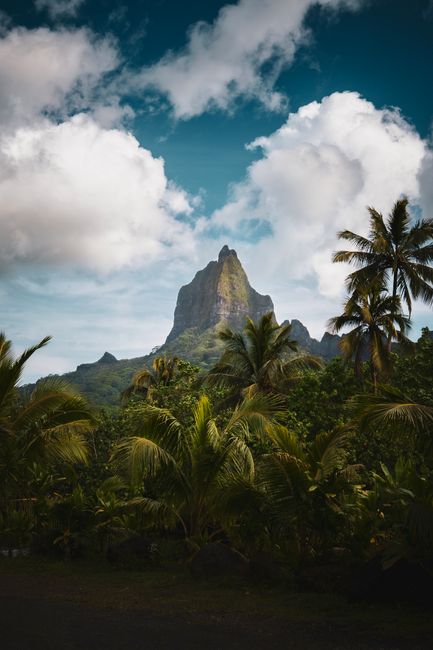
French Polynesia is a French overseas collectivity of 118 islands and atolls scattered across an area of the South Pacific about the size of Western Europe, halfway between California and Australia. Most visitors know it through one name, Tahiti, the largest island and home of the capital, Papeete, or through the image of an overwater bungalow above a turquoise lagoon in Bora Bora. There is much more: Moorea’s jagged green peaks and bays, a 30-minute ferry ride from Papeete; the quiet Leeward Islands of Huahine, Raiatea, Taha’a and Maupiti; the coral atolls of the Tuamotus, with some of the world’s best shark and dolphin diving; and the remote, mountainous Marquesas. Polynesian culture is strong and visible, in the Tahitian language, tattoo, dance, outrigger canoe racing and the great July festival, the Heiva, while French influence shows in the bakeries, wine lists and official life. French Polynesia is not part of the Schengen area and has its own entry rules and currency, the CFP franc (XPF), pegged to the euro. The dry season from about May to October is the most popular time to visit; November to April is hotter and wetter.
Right now in French Polynesia
- Tue 22–27°C 72–80°F 1 mm Partly cloudy
- Wed 22–28°C 72–82°F Partly cloudy
- Thu 23–28°C 73–82°F Partly cloudy
Weather: MET Norway (CC BY 4.0)
Multi-day tours of French Polynesia
Multi-day tours from local operators. You check dates and book on Viator, our partner; we may earn a commission at no extra cost to you. How we earn money
French Polynesia at a glance: a French territory with Polynesian roots
French Polynesia is an overseas collectivity of France with wide internal autonomy: it has its own president, assembly, taxes and currency, while France handles defense, justice, security and foreign affairs. French nationals and people from many other countries visit without a visa, but because the territory is outside the Schengen area and the European Union, a Schengen visa is not valid here and EU travel systems do not apply.
- Capital: Papeete, on the northwest coast of Tahiti. Faa’a International Airport is on the edge of the city.
- Population and size: about 279,000 people on 4,167 km² (1,609 sq miles) of land, about 70% of them on Tahiti. The islands form five archipelagos: the Society, Tuamotu, Marquesas, Austral and Gambier islands.
- Languages: French is official; Tahitian (reo Tahiti) and other Polynesian languages are widely spoken. English is common in hotels and tourism. “Ia ora na” means hello, “māuruuru” thank you.
- Currency: the CFP franc (XPF), fixed at 1,000 XPF = €8.38. In early October 2026, 1,000 XPF was worth about US$9.40.
- Time zone: UTC−10 in the Society, Tuamotu and Austral islands (the same as Hawaii), UTC−9:30 in the Marquesas and UTC−9 in the Gambier Islands. There is no daylight saving time.
- Driving: on the right, as in France.
- Entry: many nationalities, including US, Canadian, UK, EU, Australian, New Zealand and Japanese citizens, can visit visa-free for up to 90 days in any 180-day period.
- Emergency numbers: 15 for medical emergencies, 17 for police, 18 for fire; 112 also works from mobile phones.
French Polynesia’s archipelagos
The Society Islands hold most of the population and visitors. They are divided into the Windward Islands (Îles du Vent), with Tahiti and Moorea, and the Leeward Islands (Îles Sous-le-Vent), with Bora Bora, Huahine, Raiatea, Taha’a and Maupiti. To the northeast, the Tuamotus are a chain of 76 low coral atolls, rings of sand and palms around vast lagoons, including Rangiroa, Fakarava and Tikehau. The Marquesas, far to the northeast, are high, rugged islands with few beaches but dramatic valleys, archaeological sites and the graves of the painter Paul Gauguin and the singer Jacques Brel. The Australs to the south are cooler and known for whale watching, and the remote Gambier Islands for black pearls.
Where to go: Tahiti, Moorea, Bora Bora and beyond
Tahiti and Papeete
Tahiti is the gateway and the most varied island: the busy capital Papeete with its covered market and evening food trucks (roulottes), black-sand beaches, waterfalls and deep green valleys in the interior, the famous surf break of Teahupo’o, which hosted the surfing events of the Paris 2024 Olympic Games, and Tahiti Iti, the wilder peninsula at the island’s southeastern end. Most visitors spend a night or two here on arrival or departure.
Moorea
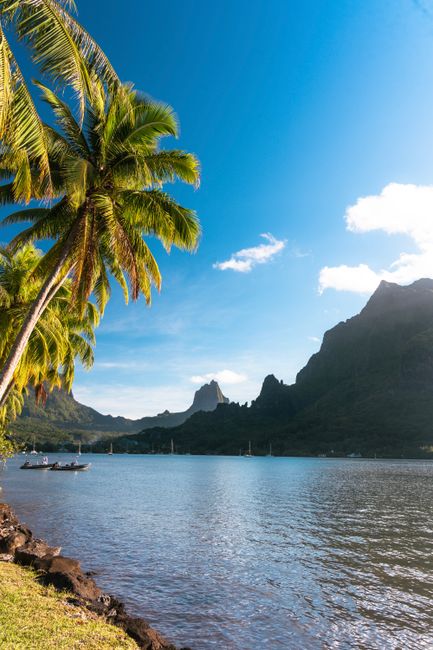
Moorea, just 17 km (11 miles) from Tahiti, is a heart-shaped island of jagged peaks, pineapple fields and two deep bays, Cook’s Bay and Opunohu Bay. It has overwater bungalows, family guesthouses, snorkeling with rays and blacktip reef sharks, hiking trails and whale watching from about August to October, all a short ferry ride from Papeete, which makes it ideal for a first trip or a short stay.
Bora Bora
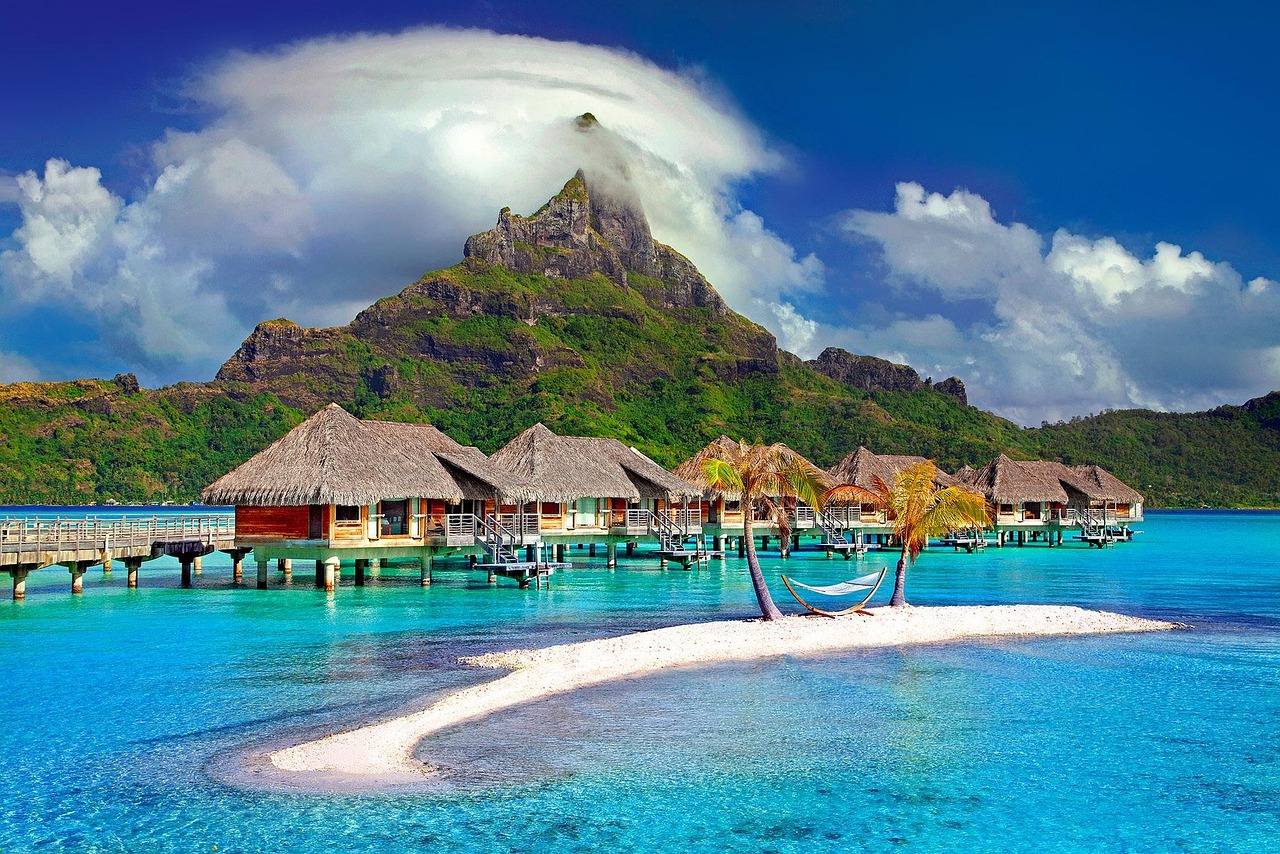
Bora Bora, a 50-minute flight from Tahiti, is the icon: the basalt peak of Mount Otemanu rising from a lagoon of every shade of blue, ringed by motus (islets) where luxury resorts line up their overwater villas. Lagoon tours, snorkeling with rays and sharks, Matira Beach and fine dining fill the days. It is the most expensive island in French Polynesia.
Huahine, Raiatea, Taha’a and Maupiti
These Leeward Islands are quieter and more traditional. Huahine has ancient marae (temple platforms), sacred blue-eyed eels and empty beaches. Raiatea, considered the cradle of Polynesian culture, is home to the Taputapuātea marae complex, a UNESCO World Heritage Site since 2017, and is French Polynesia’s yachting hub. Taha’a, sharing a lagoon with Raiatea, is the vanilla island, with pearl farms and a famous coral garden drift snorkel. Maupiti, Bora Bora’s tiny neighbor, has family guesthouses, manta rays and a lagoon to rival its famous neighbor.
The Tuamotus
The atolls of the Tuamotus are a diver’s paradise. Rangiroa, one of the largest atolls in the world, is known for dolphins and gray reef sharks in the Tiputa Pass; Fakarava, a UNESCO biosphere reserve, has the “wall of sharks” in its south pass; Tikehau has pink-sand beaches and calm lagoons. Accommodation is mainly in small resorts and family guesthouses.
The Marquesas
The Marquesas are for adventurers: steep mountains, waterfalls, wild horses, carved tiki statues and an ancient culture of tattooing. Visitors fly with Air Tahiti or sail on the Aranui, a combined cargo and passenger ship that tours the islands.
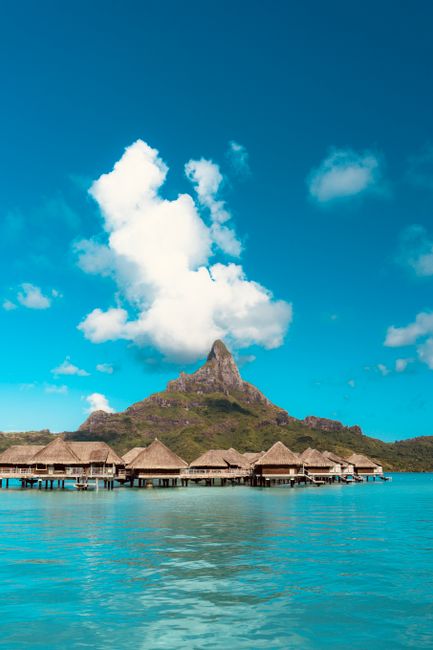
Bora Bora Travel Guide
Plan a trip to Bora Bora, French Polynesia: Air Tahiti flights from Tahiti and the free boat shuttle from the Motu Mute airport, motu…
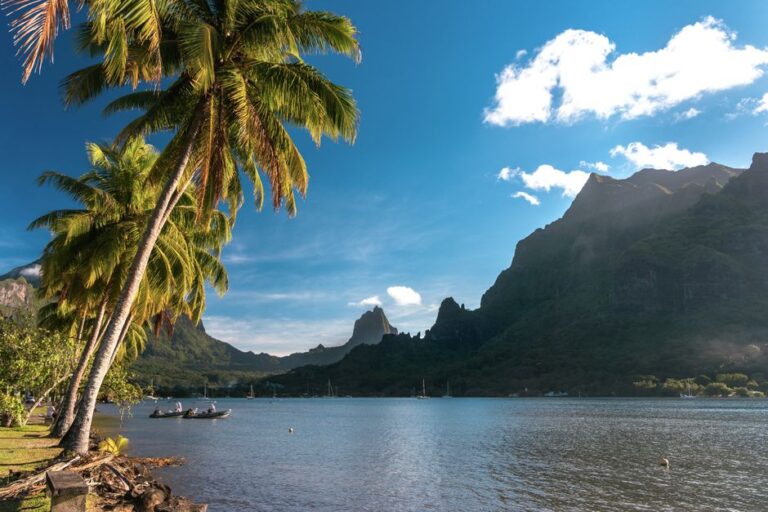
Moorea Travel Guide
Plan a trip to Moorea, French Polynesia: Aremiti and Terevau ferries from Papeete with 2026 fares, Cook's Bay and Opunohu Bay, the Belvedere lookout…
Tahiti Travel Guide
Plan a trip to Tahiti, French Polynesia: Papeete's market and roulottes, Point Venus, the Arahoho blowhole and Faarumai waterfalls, the Museum of Tahiti and…
Where to stay: overwater bungalows, resorts and family guesthouses
- Overwater bungalows: the bungalow on stilts above the lagoon is closely associated with French Polynesia, and Bora Bora and Moorea have the most, along with Tahiti, Taha’a, Huahine, Rangiroa and Tikehau. Many have glass floor panels and ladders straight into the lagoon. They are expensive, especially in Bora Bora, but prices vary a lot between resorts, islands and seasons, and many resorts offer cheaper garden or beach bungalows.
- International resorts: found mainly on Tahiti, Moorea, Bora Bora and Taha’a, often on private motus reached by resort boat.
- Pensions de famille (family guesthouses): run by local families on almost every island, from simple rooms to beachfront bungalows, often with breakfast or half board. They are the best way to meet Polynesians and to visit the islands on a budget.
- Hotels in Papeete: useful for arrival and departure nights near the airport.
- On the water: crewed and bareboat yacht charters from Raiatea, small cruise ships and the Aranui to the Marquesas.
Hotels, guesthouses and boats charge a tourist tax (taxe de séjour) per person per night, set by each commune and shown on your bill.
Best time to visit French Polynesia
French Polynesia has a tropical climate with two seasons. The dry season, from about May to October, is the austral winter: warm and sunny, with lower humidity, cooler nights and steady trade winds. The wet season, from about November to April, is hotter and more humid, with heavy downpours, most of the year’s rain and the risk of tropical cyclones, although cyclones are less frequent here than in the western South Pacific and tend to become more likely in El Niño years.
| Month | Papeete (Faa’a) high / low | Papeete (Faa’a) rain | Bora Bora high / low | Bora Bora rain |
|---|---|---|---|---|
| Jan | 31 / 24 °C (88 / 76 °F) | 268 mm (10.5 in) | 31 / 25 °C (88 / 78 °F) | 245 mm (9.6 in) |
| Feb | 31 / 25 °C (88 / 76 °F) | 245 mm (9.6 in) | 31 / 25 °C (88 / 78 °F) | 212 mm (8.3 in) |
| Mar | 32 / 25 °C (89 / 76 °F) | 167 mm (6.6 in) | 31 / 26 °C (89 / 78 °F) | 168 mm (6.6 in) |
| Apr | 31 / 25 °C (88 / 76 °F) | 99 mm (3.9 in) | 31 / 26 °C (88 / 78 °F) | 144 mm (5.7 in) |
| May | 30 / 24 °C (87 / 74 °F) | 104 mm (4.1 in) | 30 / 25 °C (86 / 77 °F) | 112 mm (4.4 in) |
| Jun | 30 / 23 °C (85 / 73 °F) | 75 mm (2.9 in) | 29 / 25 °C (85 / 76 °F) | 86 mm (3.4 in) |
| Jul | 29 / 22 °C (85 / 72 °F) | 44 mm (1.7 in) | 29 / 24 °C (84 / 75 °F) | 62 mm (2.4 in) |
| Aug | 29 / 22 °C (84 / 71 °F) | 41 mm (1.6 in) | 29 / 24 °C (84 / 75 °F) | 64 mm (2.5 in) |
| Sep | 29 / 22 °C (85 / 72 °F) | 50 mm (2.0 in) | 29 / 24 °C (85 / 75 °F) | 65 mm (2.5 in) |
| Oct | 30 / 23 °C (85 / 73 °F) | 103 mm (4.0 in) | 30 / 25 °C (86 / 76 °F) | 109 mm (4.3 in) |
| Nov | 30 / 24 °C (87 / 75 °F) | 105 mm (4.1 in) | 31 / 25 °C (87 / 77 °F) | 139 mm (5.5 in) |
| Dec | 31 / 24 °C (87 / 76 °F) | 279 mm (11.0 in) | 31 / 25 °C (87 / 77 °F) | 251 mm (9.9 in) |
Figures are Météo-France’s 1991–2020 climate normals for Faa’a (Tahiti International Airport) and Bora Bora’s airport on Motu Mute, as submitted to the World Meteorological Organization and published in Météo-France’s station climate sheets; nights are warmer on Bora Bora’s airport motu, surrounded by the lagoon. Faa’a records about 1,580 mm (62 in) of rain a year and about 2,660 hours of sunshine; Bora Bora about 1,650 mm (65 in). The windward east coast of Tahiti and the mountains are much wetter: Taiarapu, on Tahiti Iti, gets about 3,230 mm (127 in). Each destination guide has its own month-by-month table.
Crowds and prices through the year
July and August, when French families and many Americans travel, and the Christmas and New Year holidays are the busiest and most expensive periods; book flights and overwater bungalows months ahead. April to June and September to October are good shoulder months, with mostly dry weather and better rates. The wet season from December to March has the lowest prices.
Seasons for whales, festivals and races
- Humpback whales: from about July to November, humpbacks come to calve and mate around Moorea, Tahiti, Rurutu in the Australs and other islands. Swimming with them is only allowed with licensed operators following strict rules.
- Heiva i Tahiti (July): French Polynesia’s great cultural festival, with dance and song competitions in Papeete and traditional sports such as stone lifting, fruit-carrying races and outrigger canoe racing.
- Hawaiki Nui Va’a (October or November): a three-day outrigger canoe race between Huahine, Raiatea, Taha’a and Bora Bora.
- Surf season: big swells hit Teahupo’o from about April to October.
How long to stay: sample itineraries
Flights to French Polynesia are long and inter-island flights add time, so plan at least a week, and ideally 10 days to two weeks for three or four islands.
7 days: Tahiti, Moorea and Bora Bora
One night in Papeete, the ferry to Moorea for two or three nights, then fly to Bora Bora for three nights, and return to Tahiti for your international flight.
10 days: the Society Islands
Tahiti (1 night), Moorea (3), Huahine (2) and Bora Bora (3), with a day trip to Taha’a’s coral garden or a vanilla farm from Raiatea, and a final night in Papeete.
2 weeks: lagoons and atolls
Tahiti (1), Moorea (3), Bora Bora or Maupiti (3), Rangiroa or Fakarava (4) for diving and snorkeling, and Tahiti Iti (2) before flying home. An Air Tahiti multi-island pass can make this cheaper.
Entry, money and costs
Entry: outside the Schengen area (as of October 2026)
French Polynesia is French territory, but it is not part of the Schengen area, and it has its own entry rules set by France for the territory. According to the French High Commission in French Polynesia:
- Citizens of EU countries, the European Economic Area and Switzerland, and of countries with which France has a visa-exemption agreement for the territory, including the United States, Canada, the UK, Australia, New Zealand and Japan, can stay up to 90 days in any 180-day period without a visa.
- A Schengen visa is not valid for French Polynesia. Travelers who need a visa must apply specifically for French Polynesia, through a French consulate or the High Commission.
- Visa-exempt visitors should carry proof of means of support (a bank card or cash), a return or onward ticket or other repatriation guarantee, and documents showing the purpose of the trip, such as hotel bookings.
- Days spent in French Polynesia do not count toward the Schengen 90-day limit, and Schengen days do not count here, as the two areas are separate.
Your passport should be valid for your whole stay; airlines and French authorities generally ask for at least three months beyond your planned departure. French citizens can travel with a national ID card. Rules can change, so check the France-Visas website or the High Commission before you book.
ETIAS and the EES: not for French Polynesia
The European Union’s new travel authorization, ETIAS, is scheduled to start in the last quarter of 2026, according to the European Commission; as of early October 2026, the exact start date had not yet been confirmed. ETIAS and the Entry/Exit System (EES) apply only to entry into the 30 European countries of the Schengen area and Cyprus. French Polynesia is outside that area, so you will not need an ETIAS to visit French Polynesia, even after the system starts. You will need one if your trip includes a stop or stay in mainland France or another Schengen country, for example on a flight via Paris.
Money, cards and tipping
The CFP franc (XPF) is used in French Polynesia, New Caledonia and Wallis and Futuna, and the same banknotes, issued by the Institut d’émission d’outre-mer, circulate in all three. Its fixed rate to the euro (1,000 XPF = €8.38) makes conversion easy for Europeans. Cards are widely accepted on Tahiti, Moorea and Bora Bora, and in most hotels; ATMs are found on the main islands, but some smaller islands and atolls have none, so carry cash for guesthouses, roulottes and small shops. Tipping is not expected; rounding up or leaving a little for excellent service is appreciated.
Typical travel costs
French Polynesia is one of the most expensive destinations in the Pacific, mainly because almost everything is imported. Budget travelers can keep costs down by staying in family guesthouses, eating at roulottes and using ferries.
| Item (as of October 2026) | CFP francs | About US dollars |
|---|---|---|
| Aremiti ferry Papeete–Moorea, tourist adult one way / return | 2,350 XPF / 4,700 XPF | US$22 / US$44 |
| Aremiti ferry, small car (category S), one way | 5,440 XPF | US$51 |
| Meal at a roulotte food truck | about 1,500–2,500 XPF | about US$14–24 |
| Restaurant main in Papeete | about 2,500–4,500 XPF | about US$24–42 |
| Hinano beer in a bar | about 700–1,200 XPF | about US$7–11 |
| Family guesthouse room, per night | about 10,000–25,000 XPF | about US$95–235 |
| Hotel room in Papeete, per night | about 20,000–40,000 XPF | about US$190–375 |
| Overwater bungalow in Bora Bora, per night | about 100,000–250,000 XPF and up | about US$940–2,350 and up |
| Inter-island flight, Tahiti to Bora Bora, one way | about 20,000–35,000 XPF | about US$190–330 |
Ferry fares are Aremiti’s published prices as of 19 July 2026. Meals, drinks, rooms and flights are typical ranges, not official figures. Conversions use the euro peg of 119.33 XPF to €1 and the European Central Bank’s euro–dollar rate of 2 October 2026, which give about US$9.40 per 1,000 XPF.
Island hopping: getting there and getting around
Arriving in Tahiti
Faa’a International Airport (PPT), 5 km (3 miles) west of central Papeete, is the only regular international gateway. Air Tahiti Nui, the local international airline, flies to Los Angeles, Seattle, Paris, Tokyo and Auckland; Air France, United, Air New Zealand, French bee and other airlines also fly in. Flights from Los Angeles take about eight hours, from Auckland about five and from Paris about 22 hours with a stop. Many flights arrive at night or in the early morning, so plan your first night near the airport.
Air Tahiti: domestic flights and island passes
Air Tahiti links Tahiti with more than 40 islands in all five archipelagos, using ATR turboprops. Flights to Bora Bora take about 50 minutes. Air Tahiti sells multi-island passes (for trips starting from 1 April 2026, the Maeva, Monoï and Maupiti passes) covering set combinations of Tahiti, Moorea, Huahine, Raiatea, Bora Bora, Maupiti and, on other passes, the Tuamotus; a pass is usually cheaper than separate one-way tickets if you plan to visit three or more islands. The standard checked baggage allowance on most fares is 23 kg (50 lb). Book early for July, August and holidays.
Ferries between Tahiti and Moorea
Fast ferries cross between Papeete and Vaiare on Moorea several times a day in about 30 to 45 minutes. Aremiti (Aremiti 5 and Aremiti 6) carries passengers and cars, with tourist fares of 2,350 XPF one way and 4,700 XPF return for adults; tickets are valid for 360 days. Terevau runs a faster, passenger-focused service several times a day. Buy tickets online or at the ferry terminal on Papeete’s waterfront; book cars ahead on weekends and holidays.
Boats to the Leeward Islands and beyond
Inter-island passenger boats and cargo ships link Raiatea, Taha’a, Huahine and Bora Bora, and the Aranui sails from Papeete to the Tuamotus and Marquesas on long voyages with passenger cabins. Small cruise ships and yacht charters, most based in Raiatea, are other ways to see the islands. Bora Bora limits the number of cruise passengers who can come ashore each day.
Getting around the islands
Tahiti, Moorea, Raiatea and Huahine have rental cars, scooters and bicycles; driving is on the right. Tahiti has a public bus network around Papeete and along the coasts, but services are limited in the evening and on Sundays. On smaller islands, guesthouses and hotels arrange transfers. In Bora Bora, Air Tahiti’s free boat shuttle links the airport, on a motu, with Vaitape, and resorts send their own boats.
Culture, food and everyday etiquette
Polynesian culture
Polynesians settled these islands more than 1,000 years ago, navigating thousands of miles across open ocean in double-hulled canoes, and Raiatea’s Taputapuātea marae was the religious and political center of a vast network of islands. European contact began with Samuel Wallis in 1767, followed by James Cook and Louis-Antoine de Bougainville; the islands became a French protectorate in 1842 and a colony in 1880. Today, Tahitian dance (ori Tahiti), drumming, va’a (outrigger canoe) racing, tattoo (the word itself comes from the Tahitian “tatau”) and tiare flowers tucked behind the ear are everyday expressions of identity. Marae are sacred: walk around them respectfully and don’t climb on the stone platforms.
Food and drink
The national dish is poisson cru, raw tuna marinated in lime and mixed with coconut milk and vegetables. Try ma’a Tahiti, a feast cooked in an underground oven (ahima’a), with pork, fish, breadfruit, taro and fafaru (fermented fish) for the adventurous; chao men and other Chinese-Tahitian dishes; fresh baguettes and French pastries; tropical fruit and vanilla from Taha’a. In Papeete, the roulottes, food trucks on the waterfront at Place Vai’ete, serve crêpes, steak frites, poisson cru and grills in the evening. The local beer is Hinano.
Everyday etiquette
Polynesians are warm and relaxed. Greet people with “ia ora na”, and shake hands or exchange a kiss on the cheek once you know someone. Dress is casual, but swimwear belongs on the beach and topless sunbathing is frowned on outside resorts. Many shops close on Sunday afternoons, and church services, with beautiful hymn singing, are open to respectful visitors.
Safety, health and connectivity
Safety
French Polynesia is generally a safe and welcoming destination. Most risks are natural or in the water.
- Cyclone season (November to April): tropical cyclones are less common than farther west in the Pacific but can bring destructive winds, heavy rain and high seas. Météo-France issues warnings for the territory; follow official and hotel instructions, and expect flights and ferries to stop in bad weather.
- Reef cuts and sea currents: wear reef shoes, don’t stand on coral and treat cuts quickly. Currents in the passes of atolls such as Rangiroa and Fakarava can be very strong; dive and snorkel there with licensed operators. On Tahiti’s black-sand surf beaches, waves and rips can be dangerous.
- Sun: UV is extreme much of the year; use reef-safe sunscreen, a rash vest and a hat, and drink plenty of water.
- Dengue and other mosquito-borne diseases: dengue circulates in French Polynesia, with periodic epidemics. Use repellent day and night.
- Ciguatera: some reef fish can cause food poisoning; ask locally which fish are safe to eat.
- Marine life: don’t touch rays, sharks or coral, and watch for stonefish in shallow water.
- Roads: Tahiti’s coastal road is busy; take care on scooters, especially in rain and at night.
- Theft: petty theft from cars and beaches occurs in Papeete; don’t leave valuables unattended.
Health
Tahiti has modern hospitals in Papeete, including the Centre Hospitalier de la Polynésie Française, but the outer islands have only small medical centers, and serious cases may need evacuation to Papeete or abroad. Travel insurance with medical evacuation is essential. There are no required vaccinations for most travelers.
Connectivity and power
Vini is the main mobile network, with SIM cards and eSIMs at the airport and in Papeete; coverage is good on the main islands and limited on remote atolls. Many hotels have Wi-Fi, sometimes slow. Power is 220 volts, 60 Hz, with European-style two-pin plugs (Type E); some hotels also have US-style outlets.
Things to do: lagoons, diving, hiking and culture
French Polynesia is built around its lagoons. Snorkel with rays and blacktip sharks in Moorea and Bora Bora, dive with dolphins and gray reef sharks in Rangiroa’s Tiputa Pass or the “wall of sharks” in Fakarava, swim with humpback whales with licensed operators from about July to November, drift-snorkel the coral garden of Taha’a, take a lagoon picnic on a motu, paddle a va’a, kitesurf, and watch big-wave surfers at Teahupo’o. On land, hike to Moorea’s Three Coconuts Pass or Tahiti’s Fautaua waterfall, drive 4×4 tracks through the Papenoo Valley, visit marae on Raiatea and Huahine, tour vanilla and pearl farms, and catch a Heiva performance or a Polynesian dance show.
Black pearls and vanilla
French Polynesia’s two signature products make good souvenirs and good excursions. Tahitian cultured pearls, grown in black-lipped oysters in the lagoons of the Tuamotus, the Gambier Islands, Taha’a and Raiatea, come in shades from silver and green to deep peacock. Pearl farms on Taha’a and Raiatea welcome visitors to watch grafting and harvesting, and Papeete has a pearl museum and many jewelers; buy from established shops that grade pearls by size, shape, luster and surface quality and give a certificate. Tahitian vanilla, grown mostly on Taha’a and Raiatea, is prized for its floral aroma; vanilla plantations show how each flower is pollinated by hand and how the pods are cured for months. Pods, extract and vanilla-scented monoï oil are sold at the Papeete market.
What to pack
Light, breathable clothes, swimwear, a rash vest, reef shoes, a mask and snorkel, a wide-brimmed hat, polarized sunglasses and reef-safe sunscreen, insect repellent, a light rain jacket for the wet season, sandals and hiking shoes, a dry bag for boat trips, a pareo (sarong), which you can buy locally, and a Type E plug adapter. Bring a smart-casual outfit for resort dinners.
French Polynesia travel FAQ
Do I need a visa for French Polynesia?
Not if you are a citizen of the EU, the UK, the United States, Canada, Australia, New Zealand, Japan or another visa-exempt country: you can stay up to 90 days in any 180-day period. Carry proof of funds, a return ticket and your accommodation details.
Is French Polynesia part of the Schengen area?
No. Although it is French territory, French Polynesia is outside the Schengen area, so a Schengen visa is not valid there, and days in French Polynesia do not count toward your Schengen limit.
Do I need an ETIAS for French Polynesia?
No. ETIAS, which the EU plans to start in the last quarter of 2026, applies only to the 30 European countries of the Schengen area and Cyprus, not to French Polynesia. You will need one if you stop in mainland France or another Schengen country on the way.
What currency is used in French Polynesia?
The CFP franc (XPF), fixed at 1,000 XPF to €8.38, or about US$9.40 in October 2026. Cards are widely accepted on the main islands, but carry cash for small islands.
When is the best time to visit French Polynesia?
May to October, the dry season, with sunny days and cooler nights. July and August are the busiest. November to April is hotter and wetter and the cyclone season, but cheaper.
How do I get from Tahiti to Moorea?
By fast ferry from Papeete to Vaiare, about 30 to 45 minutes, with Aremiti or Terevau. The Aremiti tourist fare is 2,350 XPF one way.
How do I get from Tahiti to Bora Bora?
Fly with Air Tahiti, about 50 minutes. Bora Bora’s airport is on a motu; Air Tahiti’s free boat shuttle takes you to Vaitape, and resorts send their own boats.
Is an Air Tahiti pass worth it?
Usually, if you plan to visit three or more islands. The passes cover fixed combinations of islands, such as Tahiti, Moorea, Huahine, Raiatea, Bora Bora and Maupiti, and must start and end in Tahiti or Moorea.
Where are the best overwater bungalows?
Bora Bora has the most and the most famous views, of Mount Otemanu. Moorea has more affordable options close to Tahiti, and there are also overwater bungalows in Taha’a, Huahine, Tahiti, Rangiroa and Tikehau.
Is French Polynesia expensive?
Yes, it is one of the most expensive destinations in the Pacific. You can save by staying in family guesthouses, eating at roulottes, using ferries and buying an Air Tahiti pass.
What language is spoken in French Polynesia?
French and Tahitian. English is widely spoken in hotels and tourism businesses on the main islands, less so on remote islands.
Is French Polynesia safe for tourists?
Generally yes. The main risks are natural: strong currents in atoll passes, coral cuts, the tropical sun, dengue and the cyclone season from November to April.
What plug adapter do I need for French Polynesia?
Type E, the European two-pin plug; the supply is 220 volts at 60 Hz. Some hotels also have US-style sockets.
Sources and last review
Researched and last reviewed on 5 October 2026. Entry rules for visa-exempt visitors and the Schengen distinction come from the French High Commission in French Polynesia and France-Visas; the ETIAS timetable and scope from the European Commission; ferry fares and conditions from Aremiti; Air Tahiti’s passes, the Bora Bora shuttle, flight time and baggage allowance from Air Tahiti; the euro peg from the Institut d’émission d’outre-mer and the euro–dollar rate from the European Central Bank; climate from Météo-France’s 1991–2020 normals for Faa’a, Bora Bora and Taiarapu as published by the World Meteorological Organization; area and population from Wikidata. Terevau schedules, international routes and flight times, meal, room and flight prices, festival dates, whale and surf seasons and some health details are general references or estimates. Prices and rules change, so check the official sites before you go. For mainland France, see our France travel guide.
Plugs and power in French Polynesia
French Polynesia uses 220 V, 60 Hz and these plugs (left) and wall sockets (right):
Some hotels also have 110 V outlets.
All plug types and voltages by country → · Check what you need to pack →
Plan your trip
Partner links: TravelerCenter may earn a commission if you book, at no extra cost to you.
🇫🇷 Useful French phrases for French Polynesia
All 38 French phrases: restaurant, hotel, emergencies, romance (printable) →