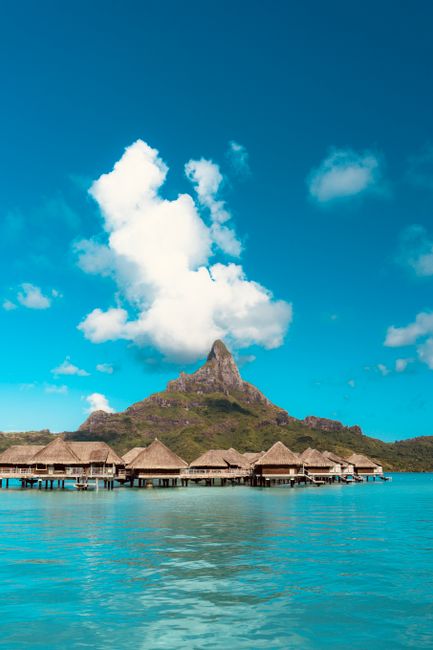
Bora Bora is the island everyone pictures when they think of the South Pacific: the black basalt tower of Mount Otemanu rising from a lagoon that shifts from deep sapphire to pale turquoise, ringed by a necklace of sandy motus where overwater villas stand on stilts above the water. It lies in the Leeward Islands of French Polynesia, about 260 km (160 miles) northwest of Tahiti and a 50-minute flight away. The main island is small, just 32 km (20 miles) around by road, with the village of Vaitape, a few shops and restaurants, the long white sweep of Matira Beach, World War II gun emplacements and ancient marae. Most of the luxury resorts sit on the motus across the lagoon and are reached by boat. Days revolve around the water: lagoon tours to snorkel with stingrays and blacktip reef sharks, coral gardens, diving with manta rays and lemon sharks, paddleboarding, picnics on deserted motus and sunset cruises. Bora Bora is the most expensive island in French Polynesia, but guesthouses on the main island make it possible on a smaller budget. The dry season from May to October is the most popular time to go.
Right now in Bora Bora
- Tue23–24°C74–75°F1 mm rain
- Wed23–24°C74–76°F1 mm rain
- Thu23–24°C74–76°FPartly cloudy
Top tours in Bora Bora
See all tours for Bora Bora →
From local operators, with prices and reviews; you check availability and book on Viator, our partner. We may earn a commission at no extra cost to you. How we earn money
Bora Bora at a glance
- Best months: May to October for drier, sunnier weather; April, May, September and October for a good balance of weather and price. November to April is hotter and wetter.
- Getting there: Air Tahiti flies from Tahiti in about 50 minutes, with direct and connecting flights from Moorea, Raiatea, Huahine and Maupiti. The airport is on Motu Mute, and a free Air Tahiti boat shuttle takes passengers to Vaitape.
- Where to stay: luxury resorts on the motus with overwater villas; mid-range hotels near Matira Point; family guesthouses on the main island.
- Time needed: three to five nights.
- Costs (as of October 2026): a lagoon tour costs about 10,000 to 15,000 XPF (US$95–140); overwater villas from about 100,000 XPF (US$940) a night.
- Before you go: entry rules, ETIAS, money and Air Tahiti passes are covered in our French Polynesia travel guide.
Bora Bora’s areas and who each one suits
Vaitape
The island’s main village, on the west coast facing the pass, has the main dock where the airport shuttle and inter-island boats arrive, a church, small supermarkets, pearl and craft shops, a pharmacy, banks and snack bars. It is practical rather than pretty, and the place to rent cars, bikes and boats.
Matira Point and the south
The southern tip of the main island has Matira Beach, Bora Bora’s best public beach, with soft white sand and shallow, calm water that stays waist-deep far out into the lagoon. Several hotels, guesthouses and restaurants cluster nearby, making it the best base on the main island.
The motus
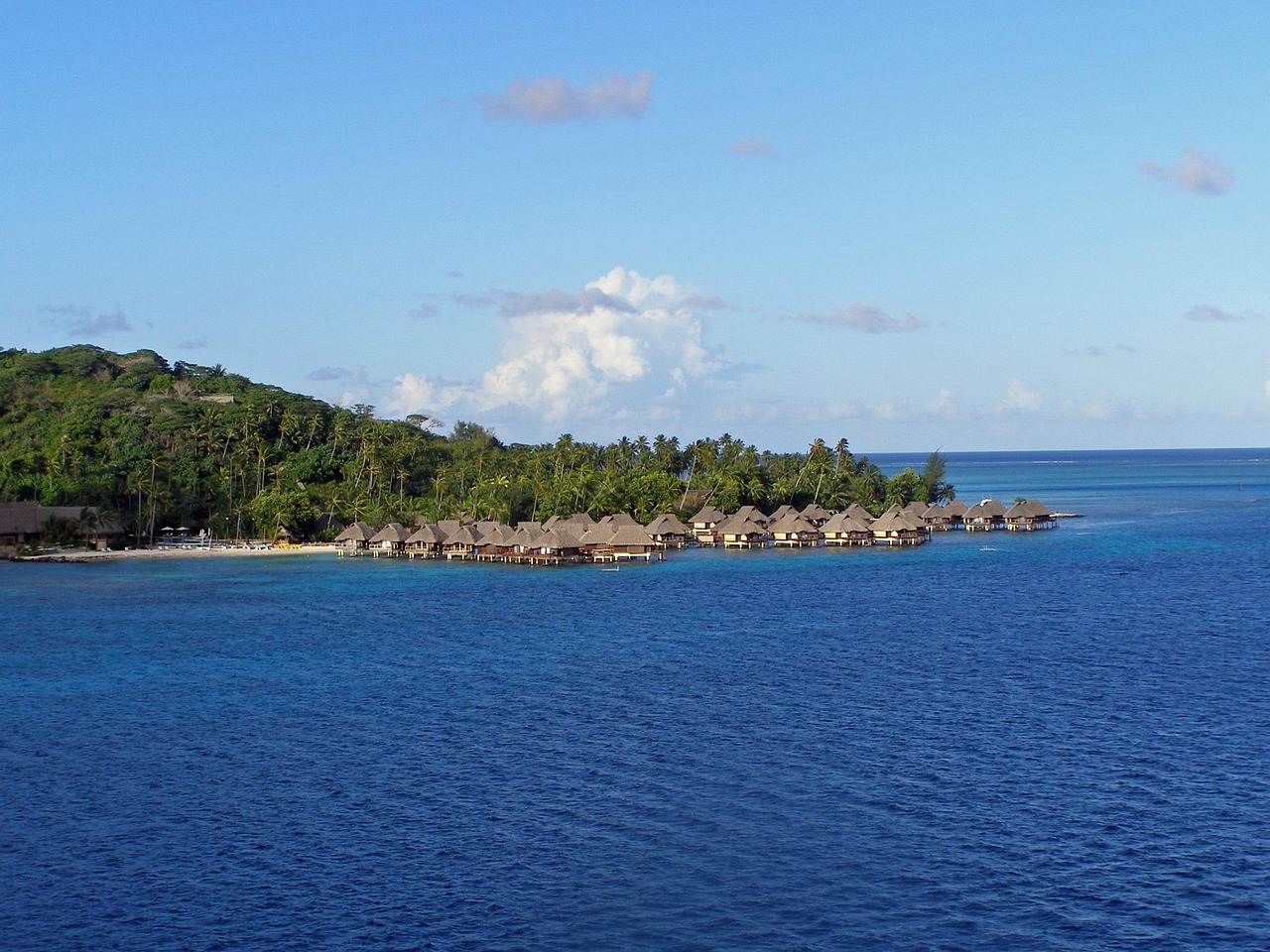
The flat, sandy motus on the barrier reef hold most of the luxury resorts and their overwater villas, with views back to Mount Otemanu. Life on a motu is quiet and self-contained; the resorts run boat shuttles to Vaitape, but you will eat most meals at your hotel.
The north and east coasts
The quieter north and east of the main island, around Faanui and Anau, have villages, World War II sites, guesthouses and views across to Taha’a, and a few resorts face the lagoon’s widest and shallowest sections.
Top things to see on Bora Bora
Mount Otemanu and Mount Pahia
The twin peaks of Otemanu (727 m, 2,385 feet) and Pahia dominate every view. Otemanu’s crumbling rock is unsafe to climb, and its summit is off-limits. Fit hikers can climb partway up Mount Pahia with a local guide for spectacular views over the lagoon, a steep, muddy and sometimes exposed trail that should not be attempted after rain.
Matira Beach
The long public beach at the southern tip is one of the most beautiful in French Polynesia. It is free, with shade from trees, and the shallow water makes it ideal for families. Sunsets from Matira Point look out across the lagoon toward Maupiti.
Lagoon tours: stingrays, sharks and coral gardens
A half-day or full-day lagoon tour by boat or outrigger is the classic Bora Bora experience. Tours usually stop to snorkel with blacktip reef sharks and southern stingrays in shallow water, explore a coral garden off Motu Tapu or Toopua, and finish with a picnic on a motu or a stop at a sandbank. Choose operators who respect the lagoon’s rules and don’t encourage touching or riding the animals.
World War II sites
In 1942, the US military built a supply base on Bora Bora, code-named Bobcat, with about 6,000 personnel. Its legacy includes the runway on Motu Mute, which became the island’s airport, and eight coastal guns, several of which remain on hillsides around Faanui and Fitiiu Point. 4×4 tours visit the guns and lookouts.
Marae and petroglyphs
Bora Bora, once called Vavau, has several restored marae, including Marae Fare Opu near Faanui, with petroglyphs of turtles carved into its stones, and Marae Taianapa. Treat the sites with respect.
Scenic flights and the view from above
Helicopter flights over the lagoon and Mount Otemanu show the full pattern of motus, reef and lagoon, especially beautiful in the morning light.
Other things to do on Bora Bora
- Diving: sites around the Teavanui Pass include Tapu, with lemon sharks and gray reef sharks; Anau, on the east side of the lagoon, is known for manta rays.
- Snorkeling: most motu resorts have house reefs or coral gardens; the Coral Garden off Toopua is a favorite drift.
- Paddleboarding and kayaking: calm water inside the reef is ideal; many resorts include equipment.
- Jet ski tours: guided circuits of the lagoon, with stops on motus.
- 4×4 tours: the island’s interior tracks, viewpoints and WWII guns.
- Sunset cruises and catamaran sails: around the lagoon, some with dinner.
- Day trip to Taha’a or Maupiti: by boat or plane, for vanilla farms, pearl farms and quieter lagoons.
- Polynesian dance shows: at the main resorts, with fire dancing.
Food and drink
Dining on Bora Bora ranges from roadside snacks and food trucks in Vaitape and Matira, serving poisson cru, burgers and grilled fish at reasonable prices, to the fine-dining restaurants of the motu resorts. A few independent restaurants on the main island offer free boat or car pickups. Try poisson cru, mahi-mahi, local tuna, breadfruit and, at resort feasts, a Tahitian ma’a cooked in an underground oven. Supermarkets in Vaitape stock food and drinks for guesthouse kitchens; prices are high because almost everything is imported. Tipping is not expected.
Getting there and getting around
By air
Air Tahiti flies from Tahiti’s Faa’a airport to Bora Bora several times a day in about 50 minutes; some flights stop in Raiatea or Huahine, and there are links with Moorea and Maupiti. On the way in, sit on the left side of the plane from Tahiti for views of the lagoon. Bora Bora’s airport is on Motu Mute, on the northern reef. Air Tahiti’s boat shuttle (navette) to Vaitape is included in the ticket, and resorts meet their guests at the airport with their own boats. The standard checked baggage allowance on most fares is 23 kg (50 lb).
By boat and cruise ship
Inter-island boats link Bora Bora with Raiatea, Taha’a and Maupiti on some days of the week, and cruise ships anchor in the lagoon and tender passengers to Vaitape. The commune limits the number of cruise passengers who can come ashore each day.
Getting around
- Main island: the coast road is about 32 km (20 miles) around. Rent a car, a small electric two-seater, a scooter or a bicycle in Vaitape or Matira; drive on the right. Taxis are few and expensive.
- Between the motus and the main island: resort shuttle boats run on schedules, usually free for guests, and water taxis are available.
- Rental boats: small motorboats that don’t require a license can be rented for exploring the lagoon on your own.
When to go and how long to stay
Bora Bora is warm all year, with highs of 29 to 31 °C (84 to 89 °F) and warm nights. The dry season (May to October) brings less rain, lower humidity and steady trade winds. The wet season (November to April) is hotter, with heavy showers, especially from December to February, and the risk of tropical cyclones.
| Month | Average high | Average low | Rain | Rain days (≥1 mm) |
|---|---|---|---|---|
| Jan | 31 °C (88 °F) | 25 °C (78 °F) | 245 mm (9.6 in) | 17 |
| Feb | 31 °C (88 °F) | 25 °C (78 °F) | 212 mm (8.3 in) | 15 |
| Mar | 31 °C (89 °F) | 26 °C (78 °F) | 168 mm (6.6 in) | 15 |
| Apr | 31 °C (88 °F) | 26 °C (78 °F) | 144 mm (5.7 in) | 12 |
| May | 30 °C (86 °F) | 25 °C (77 °F) | 112 mm (4.4 in) | 11 |
| Jun | 29 °C (85 °F) | 25 °C (76 °F) | 86 mm (3.4 in) | 10 |
| Jul | 29 °C (84 °F) | 24 °C (75 °F) | 62 mm (2.4 in) | 9 |
| Aug | 29 °C (84 °F) | 24 °C (75 °F) | 64 mm (2.5 in) | 9 |
| Sep | 29 °C (85 °F) | 24 °C (75 °F) | 65 mm (2.5 in) | 9 |
| Oct | 30 °C (86 °F) | 25 °C (76 °F) | 109 mm (4.3 in) | 11 |
| Nov | 31 °C (87 °F) | 25 °C (77 °F) | 139 mm (5.5 in) | 12 |
| Dec | 31 °C (87 °F) | 25 °C (77 °F) | 251 mm (9.9 in) | 17 |
| Year | 30 °C (86 °F) | 25 °C (77 °F) | 1,654 mm (65 in) | 147 |
Figures are Météo-France’s 1991–2020 normals for Bora Bora’s airport on Motu Mute, from its station climate sheet and the data it submitted to the World Meteorological Organization. Showers are frequent but often brief: even in the dry season, about nine days a month have at least 1 mm of rain.
Events worth planning around
- Hawaiki Nui Va’a (October or November): the great outrigger canoe race finishes on Bora Bora’s Matira Beach after crossing from Huahine, Raiatea and Taha’a.
- Heiva (July): Bora Bora holds its own Heiva dance and sports festival.
- Honeymoon and holiday peaks: July, August, Christmas and New Year book out early.
How long to stay: 3, 4 and 6 nights
- Three nights: a lagoon tour with sharks, rays and a motu picnic, a day at Matira Beach and a sunset cruise.
- Four nights: add a dive or a 4×4 tour with the WWII guns and marae.
- Six nights: split your stay between a motu resort and a guesthouse near Matira, or add a day trip to Taha’a or Maupiti.
Where to stay on Bora Bora
- Motu resorts with overwater villas: the iconic option, with private decks, glass floors, ladders into the lagoon and views of Mount Otemanu. Check whether your villa faces the mountain, the sunset or the open lagoon, how far it is from the main facilities, and how meal plans and boat transfers are charged.
- Main-island resorts and hotels: around Matira Point, some with overwater bungalows, with easier access to restaurants and the beach.
- Family guesthouses (pensions): on the main island and a few motus, with simple bungalows, kitchens or half board, at a fraction of resort prices.
- Holiday rentals: houses and apartments on the main island.
Book overwater villas many months ahead for July, August and the Christmas holidays. The tourist tax is charged per person per night on top of room rates.
Typical costs on Bora Bora
| Item (as of October 2026) | CFP francs | About US dollars |
|---|---|---|
| Air Tahiti flight from Tahiti, one way | about 20,000–35,000 XPF | about US$190–330 |
| Half-day lagoon tour with snorkeling | about 10,000–15,000 XPF | about US$95–140 |
| Two-tank dive | about 25,000–30,000 XPF | about US$235–280 |
| 4×4 island tour | about 9,000–12,000 XPF | about US$85–115 |
| Bicycle rental, per day | about 2,000–3,000 XPF | about US$19–28 |
| Lunch at a snack bar | about 1,500–2,500 XPF | about US$14–24 |
| Dinner main at a resort restaurant | about 5,000–9,000 XPF | about US$47–85 |
| Family guesthouse room, per night | about 15,000–30,000 XPF | about US$140–280 |
| Overwater villa, per night | about 100,000–250,000 XPF and up | about US$940–2,350 and up |
Prices are typical ranges, not official figures, and vary widely by season and resort. Conversions use the euro peg of 119.33 XPF to €1 and the European Central Bank’s euro–dollar rate of 2 October 2026, about US$9.40 per 1,000 XPF.
Safety on Bora Bora
- Cyclone season (November to April): follow Météo-France warnings and your resort’s instructions; flights and boats may be canceled.
- Boat traffic and currents: the lagoon is busy with boats and jet skis; snorkel in marked areas, use a buoy and stay close to your guide. Currents can be strong near the Teavanui Pass and around the motus.
- Marine life: blacktip reef sharks and stingrays are used to people, but don’t touch or feed them; watch for stonefish and sea urchins in shallow water.
- Reef cuts: wear reef shoes and treat any coral cut promptly.
- Sun: reflection off the lagoon is intense; use reef-safe sunscreen, a rash vest and a hat.
- Hiking: Mount Pahia is steep and slippery; go only with a guide and never after rain. Otemanu is closed to climbers.
- Dengue: mosquito-borne diseases circulate in French Polynesia; use repellent.
- Emergencies: 15 for medical emergencies, 17 for police, 18 for fire; 112 from mobile phones. Bora Bora has a medical center in Vaitape; serious cases are flown to Papeete.
Practical tips for Bora Bora
- Meal plans: motu resorts are isolated, so compare half-board or full-board plans with paying à la carte; a free shuttle to Vaitape lets you try restaurants on the main island for lunch or dinner.
- Cash and cards: ATMs are in Vaitape; cards are accepted at resorts and most restaurants, but snack bars, food trucks and small shops may want cash.
- Supermarkets: shops in Vaitape close early on Saturday and most of Sunday; stock up if you are self-catering.
- Airport timing: be at the Vaitape dock or your resort’s boat in good time for the shuttle to Motu Mute; resorts usually plan departures about two hours before your flight.
- Combining islands: Bora Bora fits easily into an Air Tahiti pass with Moorea, Huahine, Raiatea or Maupiti, and ending your trip on Bora Bora is a popular choice.
- Respect the lagoon: don’t stand on coral, use reef-safe sunscreen and follow your guide’s rules around wildlife.
What to pack for Bora Bora
Swimwear, a rash vest, reef shoes, a mask and snorkel, a waterproof phone pouch, reef-safe sunscreen, a hat and polarized sunglasses, insect repellent, a light rain jacket, a smart-casual outfit for resort dinners, cash for snack bars and small shops and a Type E plug adapter. Pack light: Air Tahiti’s baggage allowance on most fares is 23 kg (50 lb).
Bora Bora travel FAQ
How do I get to Bora Bora?
Fly with Air Tahiti from Tahiti, about 50 minutes. International flights land in Tahiti first; there are no direct international flights to Bora Bora.
How do I get from Bora Bora airport to my hotel?
The airport is on Motu Mute. Air Tahiti’s free boat shuttle runs to Vaitape on the main island, and resorts collect their guests by boat.
What is the best time to visit Bora Bora?
May to October, the dry season. April, May, September and October are often the best balance of weather and price. November to April is wetter, with a cyclone risk.
How much does an overwater bungalow in Bora Bora cost?
Usually from about 100,000 XPF (about US$940) a night, and much more at the most exclusive resorts and in peak season, plus tourist tax, meals and transfers.
Can you visit Bora Bora on a budget?
Yes, up to a point. Stay in a family guesthouse on the main island, eat at snack bars and food trucks, swim at Matira Beach and join a shared lagoon tour.
Can you climb Mount Otemanu?
No. Otemanu’s rock is unstable and the summit is off-limits. Fit hikers can climb part of Mount Pahia with a local guide.
Is Matira Beach free?
Yes. Matira Beach, at the southern tip of the main island, is public and free, with calm, shallow water.
Do I need a car on Bora Bora?
Not if you stay at a motu resort. On the main island, a bicycle, scooter or small rental car is enough to explore the 32 km (20 mile) coast road.
Is it safe to swim with sharks in Bora Bora?
The blacktip reef sharks in the lagoon are small and used to snorkelers, and lagoon tours stop with them every day. Follow your guide’s instructions and don’t touch or feed them.
How many days do you need in Bora Bora?
Three to five nights is enough for a lagoon tour, beach time, a dive or 4×4 tour and some time to relax in your bungalow.
Plan your trip
Partner links: TravelerCenter may earn a commission if you book, at no extra cost to you.
🇫🇷 Useful French phrases for Bora Bora
All 38 French phrases: restaurant, hotel, emergencies, romance (printable) →
Sources · last reviewed 5 October 2026
Researched and last reviewed on 5 October 2026. Flight time, the airport shuttle and baggage allowance come from Air Tahiti; climate from Météo-France’s 1991–2020 normals for Bora Bora’s airport, from its station climate sheet and its submission to the World Meteorological Organization; coordinates, area and population from Wikidata; the euro–dollar rate from the European Central Bank. Descriptions of the island, peaks, WWII history, marae, dive sites, events, the cruise passenger limit, distances and all tour, flight, meal and room prices are general references or estimates and should be checked with Air Tahiti and the operators. For entry rules, ETIAS, money and Air Tahiti passes, see our French Polynesia travel guide.
Data: Weather: MET Norway (CC BY 4.0) · Sea temperature: NOAA CoastWatch · Rates: ECB · Wikidata (CC0)