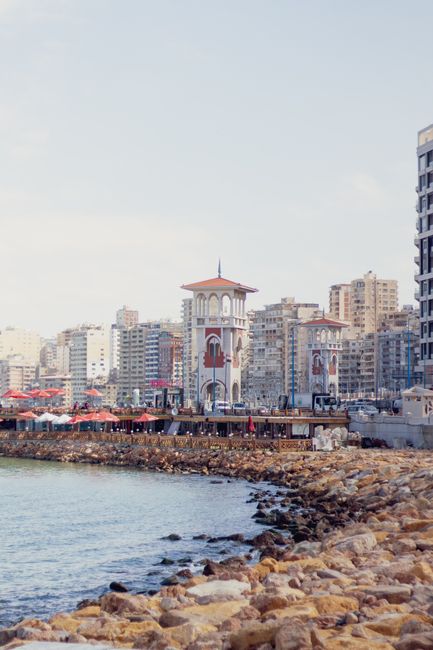
Alexandria, Egypt’s second city, stretches for more than 20 km (12 miles) along the Mediterranean on a narrow strip between the sea and Lake Mariout, about 220 km (137 miles) northwest of Cairo. Founded by Alexander the Great in 331 BC, it was the capital of the Ptolemies and of Cleopatra, the home of the legendary Library and the Pharos lighthouse, one of the Seven Wonders of the Ancient World, and for two thousand years one of the great cosmopolitan ports of the Mediterranean, with Greek, Italian, Jewish, Armenian and Levantine communities. Much of the ancient city lies under the modern one or under the sea, but what survives is fascinating: the Roman catacombs of Kom el-Shoqafa, the Roman theater of Kom el-Dikka, Pompey’s Pillar, the reopened Graeco-Roman Museum, the 15th-century Citadel of Qaitbay built on the site of the lighthouse, and the modern Bibliotheca Alexandrina, a striking tribute to the ancient library. Add the sweeping Corniche, faded Belle Époque cafés and patisseries, seafood restaurants by the harbor and fresh sea air, and Alexandria makes a refreshing contrast to Cairo. It is an easy trip by train, and worth at least one night. Summer, from June to September, is the domestic beach season; spring and autumn are the most pleasant months for sightseeing.

Right now in Alexandria
- Wed22–26°C71–79°F1 mm rain
- Thu22–26°C71–79°FClear
- Fri22–25°C72–78°FMostly clear
- Today Armed Forces Day (عيد القوات المسلحة)
Top tours in Alexandria
See all tours for Alexandria →
From local operators, with prices and reviews; you check availability and book on Viator, our partner. We may earn a commission at no extra cost to you. How we earn money
Alexandria at a glance
- Best for: Graeco-Roman history, the Corniche, seafood, old cafés, the Bibliotheca Alexandrina and Mediterranean air.
- How long: 1–2 days, or 3 with Rosetta or El Alamein.
- Best time: April to June and September to November; summer is hot, humid and crowded with Egyptian holidaymakers, and winter brings rain and storms.
- Getting there: by train from Cairo in about 2.5–3 hours, by bus, or by air to Borg El Arab (HBE).
- Getting around: by taxi, Uber and Careem, the historic tram, and on foot in the center.
- Good to know: carry a card for site tickets; dress more conservatively than in Cairo.
- Before you go: visas, money and general safety are in our Egypt travel guide.
Alexandria’s areas and where to stay
The city follows the curve of the sea. The center lies around the Eastern Harbor, with the Corniche running west to the peninsula of Anfushi and the Citadel of Qaitbay, and east through the long residential seafront districts to Montaza.
Downtown: Raml Station and Saad Zaghloul
The heart of colonial Alexandria, around Raml Station and Saad Zaghloul Square, has historic hotels on the Corniche, old cafés and patisseries, the tram terminus and the Graeco-Roman Museum nearby. It is the best base for sightseeing on foot.
Anfushi and Bahary
The old Turkish quarter on the western peninsula, around the fishing harbor, has the Citadel of Qaitbay, the Abu al-Abbas al-Mursi Mosque, fish restaurants and a lively, traditional atmosphere.
The eastern Corniche: Stanley to Montaza
East of the center, districts such as Stanley, with its landmark bridge, San Stefano and Sidi Bishr have modern hotels, malls and city beaches. At the far end, the gardens of Montaza Palace have resort hotels and quieter beaches.
Where to stay in Alexandria
- Downtown Corniche: historic hotels with sea views, close to the sights and cafés.
- Stanley and San Stefano: modern hotels and malls on the seafront.
- Montaza: resort-style hotels in palace gardens, far from the center.
Rooms with a sea view are worth the extra, but the Corniche is noisy with traffic; ask for a higher floor.
Top things to see in Alexandria
The Bibliotheca Alexandrina
Opened in 2002 near the site of the ancient Library, the Bibliotheca Alexandrina is a huge tilted disc of glass and granite, its outer wall carved with letters from scripts around the world. The vast reading room steps down in terraces under the sloping roof. The complex includes a planetarium and several museums, including antiquities and manuscripts, and hosts exhibitions and concerts. Guided tours in English run through the day; check the current ticket price at the entrance.
The Citadel of Qaitbay
The Mamluk sultan Qaitbay built this fort in the 1470s on the tip of the Pharos peninsula, reusing stones from the ruined lighthouse, which had been toppled by earthquakes. Its battlements look out over the sea and the harbor, and there is a small naval museum. According to the Ministry of Tourism and Antiquities, foreign adults pay EGP 200 (about US$3.80) and students EGP 100; it opens at 9 a.m.
The Catacombs of Kom el-Shoqafa
The catacombs of Kom el-Shoqafa (EGP 200), from the 1st and 2nd centuries AD, descend by a spiral staircase to three levels of tombs carved into the rock. The main tomb mixes Egyptian, Greek and Roman styles: Anubis dressed as a Roman legionary, serpents with Medusa heads and a banquet hall where mourners ate funeral meals. The lowest level is often flooded.
Pompey’s Pillar and the Serapeum
On a hill in the Karmouz district, a 27 m (89 ft) granite column, wrongly named after Pompey, was in fact raised for the Roman emperor Diocletian around AD 297. It stood in the Serapeum, the temple of the god Serapis, which housed a daughter library of the great Library; you can explore underground galleries and see two granite sphinxes (EGP 200).
Kom el-Dikka: the Roman theater
In the center, the excavations of Kom el-Dikka (EGP 200) reveal Egypt’s only Roman theater, a small marble auditorium, plus Roman baths, villas with mosaics, and a display of statues recovered from the sea in the Eastern Harbor.
The Graeco-Roman Museum
Reopened in 2023 after a long renovation, the Graeco-Roman Museum (EGP 400) has one of the world’s best collections of art from Ptolemaic and Roman Egypt: statues of Serapis, portraits of Ptolemaic rulers, mosaics, Tanagra figurines, coins and mummy portraits. According to the ministry, it opens from 9 a.m. to 3 p.m., and until 7 p.m. on Fridays and Saturdays.
The Alexandria National Museum and the Royal Jewelry Museum
The Alexandria National Museum (EGP 220), in an Italianate villa on Fouad Street, tells the city’s story from the pharaohs to modern times, including finds from the sunken royal quarter. The Royal Jewelry Museum (EGP 220), in a palace in Zizinia, displays the dazzling jewels of Egypt’s last royal family.
The Corniche, Montaza and the old city
Walk or ride along the Corniche from Qaitbay past the Eastern Harbor, Saad Zaghloul Square and the Stanley Bridge. At the eastern end, the Montaza Palace gardens, with the turreted palace of the last kings, are a popular place for a stroll by the sea. In the center, look for the Cecil Hotel, the Greek and Armenian churches, the Eliyahu Hanavi Synagogue and the old cafés of Fouad and Saad Zaghloul streets, where Constantine Cavafy, E. M. Forster and Lawrence Durrell set their Alexandria.
A short history of Alexandria
Alexander the Great chose the site, a fishing village called Rhakotis facing the island of Pharos, on his way to consult the oracle at Siwa, but he never saw his city completed. After his death, his general Ptolemy made Alexandria the capital of Egypt, and his descendants built the Library, the Mouseion, a center of scholarship where Euclid and Eratosthenes worked, and the 100 m (330 ft) lighthouse on Pharos, which stood for some 1,600 years. Cleopatra VII, the last Ptolemy, died here in 30 BC, and the city became the second city of the Roman Empire and a great center of early Christianity. It declined after the Arab conquest in 641, when the capital moved to Fustat, near today’s Cairo, but revived in the 19th century, when Muhammad Ali dug a canal to the Nile and the cotton trade brought merchants from all over the Mediterranean. Most of the foreign communities left after the 1956 Suez Crisis, but their churches, villas, cafés and shop signs still give the city its character.
Other things to do in Alexandria
Food and drink
Alexandria is Egypt’s seafood capital. In Anfushi and along the Corniche, you choose fish, prawns, squid and crabs from ice displays and pay by weight for them to be grilled, fried or baked with rice and salads. The city’s own street foods include liver sandwiches (kebda Iskandarani), ful and taameya, and sobia, a sweet coconut milk drink. Old patisseries and cafés from the cosmopolitan era, around Saad Zaghloul Square and Raml Station, serve cakes, ice cream and Turkish coffee. Beer and wine are served in some restaurants and hotels.
Beaches and the sea
City beaches along the Corniche are crowded and mostly used by families in summer; Montaza’s beaches are cleaner, and the best water is along the North Coast to the west. Diving on the sunken remains of the royal quarter and the Pharos in the Eastern Harbor is possible with local dive centers, though visibility is often low. See our beaches and diving guides.
Walking and the tram
The yellow and blue trams of Alexandria, running since the 19th century, are a slow but charming way to travel between Raml Station and the eastern suburbs. See our city sightseeing guide.
Day trips from Alexandria
- Rosetta (Rashid): a Nile-mouth town about 65 km (40 miles) east, where the Rosetta Stone was found in 1799, with Ottoman merchant houses of patterned brick (EGP 120 for the monuments).
- El Alamein: the World War II battlefield and the Commonwealth, German and Italian war cemeteries and military museum, about 110 km (68 miles) west; combine with the beaches of the North Coast.
- Abu Qir: a fishing town and seafood restaurants on the bay where Nelson defeated the French fleet in 1798, about 25 km (16 miles) east.
- Wadi El Natrun: Coptic monasteries on the desert road to Cairo.
- Siwa Oasis: a long trip via Marsa Matruh, best for 3 nights or more; see our Siwa Oasis guide.
Getting there and getting around
By train
Trains from Cairo’s Ramses station arrive at Sidi Gaber station and at Misr station in the center, in about 2.5–3 hours on the fastest services; book first class or the newer air-conditioned trains. According to the Abela sleeper train timetable for October 2026, a sleeper leaves Alexandria at 19:20 for Luxor and Aswan, arriving in Luxor at about 09:00.
By bus
Comfortable buses run from Cairo in about 3 hours, and onward along the coast to El Alamein and Marsa Matruh, with connections to Siwa.
By air
Borg El Arab Airport (HBE), about 45 km (28 miles) southwest of the center, has domestic flights and international routes mainly to the Gulf. The ride into town takes about an hour.
Getting around
Taxis, Uber and Careem are cheap and the easiest way to move between sights. The tram is slow but scenic, and the center is walkable. Traffic on the Corniche can be very heavy, especially on summer evenings.
When to go and how long to stay
Alexandria has a Mediterranean climate, milder than Cairo’s. Spring (April to June) and autumn (September to November) are warm and pleasant, ideal for sightseeing. Summer (July and August) averages highs around 30–31 °C (86–88 °F), with high humidity, and the city fills with Egyptian holidaymakers. Winter (December to February) is cool, with highs around 18–20 °C (65–68 °F), and it is the wettest place in Egypt, with storms called nawat that bring wind, high waves and rain. The table uses the 1991–2020 climate normals for the Alexandria (Nouzha) station of the Egyptian Meteorological Authority (EMA), as published by the World Meteorological Organization (WMO): average daily highs and lows, total precipitation, and days with at least 1 mm of rain.
| Month | Average high / low | Rain (days with 1 mm or more) | What to expect |
|---|---|---|---|
| January | 18 °C (65 °F) / 9 °C (49 °F) | 61 mm (2.4 in), 8 days | The wettest month; cool and stormy |
| February | 19 °C (66 °F) / 10 °C (49 °F) | 35 mm (1.4 in), 5 days | Cool; showers and wind |
| March | 21 °C (70 °F) / 12 °C (53 °F) | 13 mm (0.5 in), 3 days | Mild; spring arrives |
| April | 24 °C (75 °F) / 14 °C (58 °F) | 3 mm (0.1 in), 1 day | Warm and pleasant; very good |
| May | 27 °C (80 °F) / 18 °C (64 °F) | 1 mm (under 0.1 in), 1 day | Warm; excellent sightseeing |
| June | 29 °C (84 °F) / 22 °C (71 °F) | under 1 mm, 0 days | Warm; beach season begins |
| July | 30 °C (87 °F) / 24 °C (75 °F) | under 1 mm, 0 days | Hot and humid; very busy |
| August | 31 °C (88 °F) / 24 °C (76 °F) | under 1 mm, 0 days | Hot and humid; peak holidays |
| September | 30 °C (86 °F) / 23 °C (73 °F) | 1 mm (under 0.1 in), 0 days | Warm sea; crowds thin |
| October | 28 °C (82 °F) / 19 °C (67 °F) | 8 mm (0.3 in), 1 day | Warm and pleasant; very good |
| November | 24 °C (75 °F) / 15 °C (59 °F) | 37 mm (1.4 in), 4 days | Mild; rains return |
| December | 20 °C (68 °F) / 11 °C (52 °F) | 53 mm (2.1 in), 6 days | Cool and wet; quiet |
Alexandria receives about 210 mm (8.3 in) of rain a year, almost all of it from October to March.
One day in Alexandria
Morning at the Graeco-Roman Museum and Kom el-Dikka, lunch on fish in Anfushi, the Citadel of Qaitbay in the afternoon, and a walk along the Corniche to the Bibliotheca Alexandrina at sunset, ending with cake in an old patisserie.
Two to three days
Add the catacombs and Pompey’s Pillar, the National Museum and the Royal Jewelry Museum, Montaza’s gardens, and a day trip to Rosetta or El Alamein.
What a trip to Alexandria costs
Prices are approximate, for October 2026, converted at about EGP 52.3 to the US dollar. Site tickets are the ministry’s foreign adult prices.
| Item | Typical cost |
|---|---|
| Citadel of Qaitbay | EGP 200 (about US$3.80) |
| Graeco-Roman Museum | EGP 400 (about US$7.65) |
| Catacombs of Kom el-Shoqafa | EGP 200 (about US$3.80) |
| Train from Cairo, first class | EGP 150–400 (about US$2.90–7.65) |
| Seafood dinner in Anfushi | EGP 600–1,500 (about US$11.50–29) |
| Taxi or Uber across the city | EGP 80–200 (about US$1.50–3.80) |
| Tram ride | a few pounds |
| Mid-range sea-view hotel double, per night | EGP 2,500–6,000 (about US$48–115) |
Practical tips for Alexandria
- Avoid summer weekends if you can: the Corniche and beaches are packed with domestic visitors from July to September.
- Carry a card: ministry sites take Visa and Mastercard.
- Ask the price of fish first: in seafood restaurants, check the price per kilo and the cooking charge before you order.
- Dress conservatively: Alexandria is more traditional than Cairo’s richer districts; swimwear belongs on private and hotel beaches.
- Cross the Corniche carefully: use footbridges and underpasses where you can.
- Start late on Fridays: some sites and shops open later.
Safety
Alexandria is generally relaxed, with fewer touts than Cairo or Luxor. The main hazard is traffic, especially crossing the fast multi-lane Corniche; use pedestrian bridges and underpasses, and cross with locals. Pickpockets operate on crowded trams and buses and in markets, so keep valuables zipped away. In winter, storms bring heavy rain, flooding of low streets and big waves over the Corniche: stay off the seawall in rough weather. In summer, public beaches are very crowded, lifeguards are few, and there can be rip currents and jellyfish, so swim at supervised beaches and stay within your depth. Women may face verbal harassment on busy beaches and streets; modest dress and taxis or ride-hailing apps at night help. Police and tourist police are present at the main sites, and you should not photograph military areas around the port. In an emergency, call 122 for the police, 123 for an ambulance, 180 for fire and 126 for the tourist police.
What to pack for Alexandria
Comfortable walking shoes for uneven pavements and the catacomb stairs, light clothes that cover shoulders and knees, a light jacket for sea breezes, a rain jacket and warm layers from November to March, sunscreen and a hat in summer, and swimwear for hotel beaches. See our rain jackets and travel adapters guides.
Alexandria travel FAQ
Is Alexandria worth visiting?
Yes, for its Graeco-Roman museums and ruins, the Bibliotheca Alexandrina, the Citadel of Qaitbay, seafood and the Mediterranean atmosphere; one or two nights is ideal.
Can I visit Alexandria as a day trip from Cairo?
Yes, by train in about 2.5–3 hours each way or by road, but it makes a very long day; an overnight stay is more relaxing.
How much is the Citadel of Qaitbay ticket?
According to the Ministry of Tourism and Antiquities, EGP 200 (about US$3.80) for foreign adults and EGP 100 for students.
Is anything left of the ancient Library and lighthouse?
No buildings survive: the Citadel of Qaitbay stands on the lighthouse site, partly built with its stones, and the modern Bibliotheca Alexandrina was built near the site of the ancient Library. Some blocks and statues have been recovered from the sea.
When is the best time to visit Alexandria?
April to June and September to November. Summer is hot, humid and crowded, and winter is cool and the rainiest in Egypt.
Can you swim in Alexandria?
Yes, in summer, at city beaches, Montaza and hotel beaches, but the best Mediterranean beaches are along the North Coast to the west.
What is Alexandria famous for food-wise?
Seafood chosen by weight, liver sandwiches, ful and taameya, and the cakes and ice cream of its historic patisseries.
How do I get from Alexandria to Siwa Oasis?
By bus along the coast to Marsa Matruh (about 4–5 hours) and on to Siwa (about 4 more hours); some buses run directly.
How many days do I need in Alexandria?
One full day for the highlights, two for the museums at a slower pace, and three with Rosetta or El Alamein.
Is the Graeco-Roman Museum open?
Yes. It reopened in 2023 and, according to the ministry, opens from 9 a.m. to 3 p.m., and until 7 p.m. on Fridays and Saturdays.
Plan your trip
Partner links: TravelerCenter may earn a commission if you book, at no extra cost to you.
🇪🇬 Useful Arabic phrases for Alexandria
All 38 Arabic phrases: restaurant, hotel, emergencies, romance (printable) →
Sources · last reviewed 5 October 2026
Researched and last reviewed on 5 October 2026. Ticket prices and hours for the Citadel of Qaitbay, the catacombs of Kom el-Shoqafa, the Serapeum and Pompey’s Pillar, the Roman Amphitheatre at Kom el-Dikka, the Graeco-Roman Museum, the Alexandria National Museum, the Royal Jewelry Museum and Rosetta, and card payment: the Ministry of Tourism and Antiquities (egymonuments.com and egymonuments.gov.eg); the sleeper train: Abela Trains; climate normals: the Egyptian Meteorological Authority via the World Meteorological Organization’s 1991–2020 normals (Alexandria Nouzha station); the exchange rate: the Central Bank of Egypt. The Bibliotheca Alexandrina, the Graeco-Roman Museum’s reopening year, history, train and bus times, airport details and typical prices are general references or estimates, flagged for checking. Prices and rules change, so check locally before you go. For visas, money and general safety, see our Egypt travel guide.
Data: Weather: MET Norway (CC BY 4.0) · Sea temperature: NOAA CoastWatch · Rates: ECB · Holidays: Nager.Date · Costs: World Bank ICP and price levels · Wikidata (CC0)