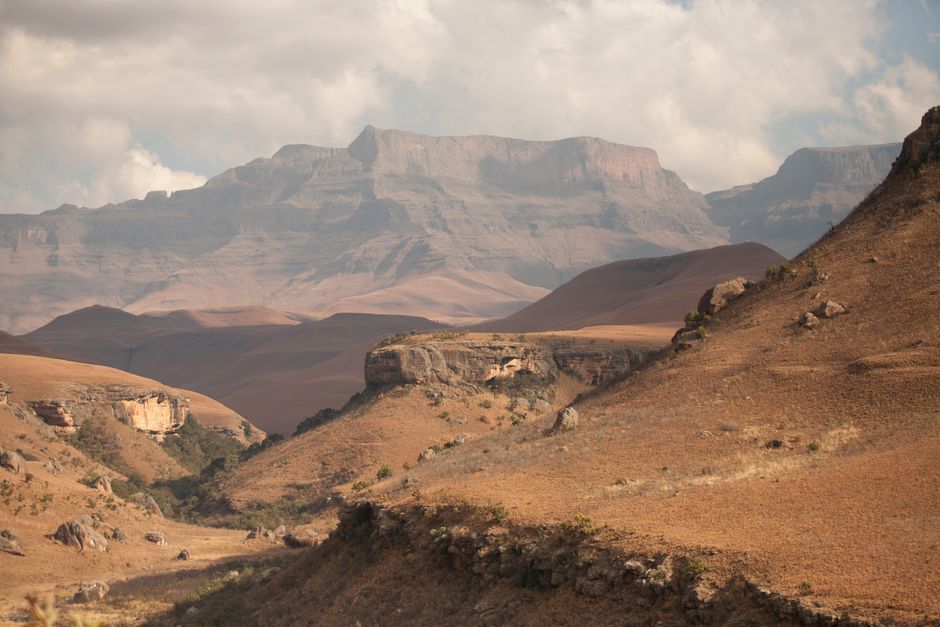
The Drakensberg, the “Dragon Mountains,” is South Africa’s highest and most dramatic mountain range, a wall of basalt cliffs, pinnacles and buttresses that runs for about 200 km (125 miles) along the border between KwaZulu-Natal and the kingdom of Lesotho. The Zulu name, uKhahlamba, means “barrier of spears.” The heart of the range is protected in the uKhahlamba-Drakensberg Park, a UNESCO World Heritage Site since 2000, recognized both for its natural beauty and for the largest concentration of San rock paintings in Africa south of the Sahara, painted over thousands of years by the hunter-gatherers who lived here. Since 2013 it has formed the Maloti-Drakensberg Park together with Sehlabathebe National Park in Lesotho. The escarpment rises above 3,000 m (9,800 ft), with Mafadi, at about 3,450 m (11,320 ft), the highest point in South Africa, while green foothills, rivers, waterfalls and grasslands spread below. It is the country’s best hiking area, from easy walks to rock art shelters and pools to multi-day treks on the high plateau, and the resorts and parks are run mainly by Ezemvelo KZN Wildlife, the province’s conservation authority. Summer (November to March) is green, warm and stormy; winter (June to August) is dry, sunny and cold, with snow on the peaks.
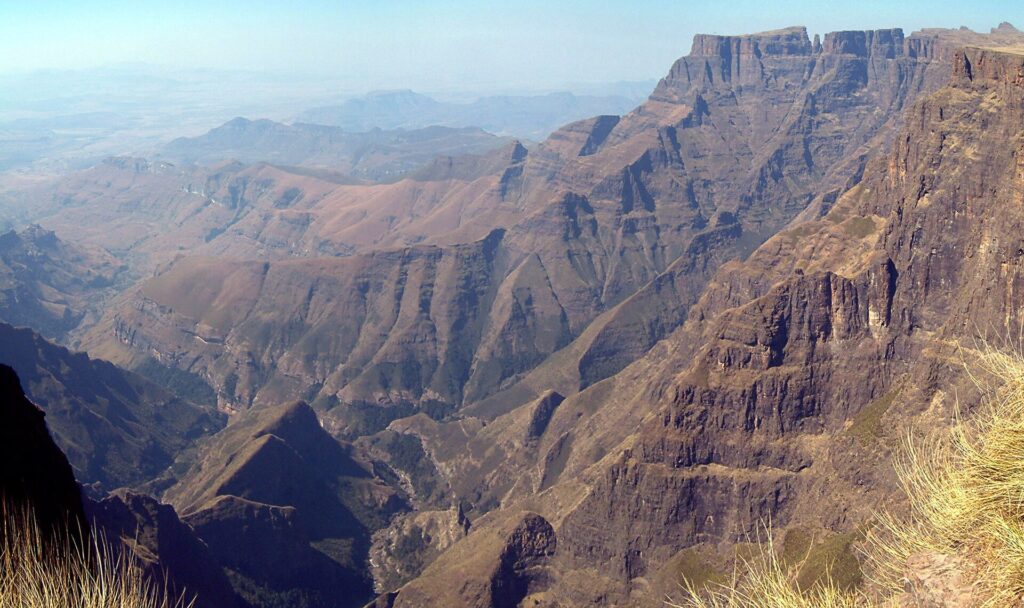
Right now in uKhahlamba-Drakensberg Park (Giant's Castle)
- Wed9–13°C49–56°F3 mm rain
- Thu11–23°C51–74°F1 mm rain
- Fri12–25°C54–77°F5 mm rain
Top tours in uKhahlamba-Drakensberg Park
See all tours for uKhahlamba-Drakensberg Park →
From local operators, with prices and reviews; you check availability and book on Viator, our partner. We may earn a commission at no extra cost to you. How we earn money
Drakensberg at a glance
- Best months: April to May and September to October, when days are clear and mild and afternoon storms are less frequent. Summer is lush, with waterfalls at their best but daily thunderstorms; winter is crisp and sunny with frosty nights and occasional snow.
- Time needed: two nights for one area; four to six nights to combine the Northern, Central and Southern Berg.
- Getting there: about three hours by road from Durban, and four to five hours from Johannesburg; a car is essential.
- Costs (as of October 2026): Ezemvelo charges a daily conservation fee at each reserve, plus overnight hiking permits; check current tariffs with Ezemvelo, as figures change each year.
- Before you go: visas, money and safety basics are covered in our South Africa travel guide.
Permits, fees and the mountain register
Ezemvelo KZN Wildlife
Most of the uKhahlamba-Drakensberg Park is managed by Ezemvelo KZN Wildlife, which runs the gates, camps and chalets at Royal Natal, Thendele, Cathedral Peak (Didima), Monk’s Cowl, Injisuthi, Giant’s Castle, Kamberg, Lotheni, Garden Castle and other areas. Each reserve charges a daily conservation fee per person at the gate, and overnight hikers need a hiking permit, also paid at the gate or office, with fees per person per night for camping or using a cave. Book chalets, camps and popular overnight caves through Ezemvelo’s central reservations or online booking system, well ahead for school holidays and long weekends. Ezemvelo also sells the Rhino Club annual card for its parks, and the SANParks Wild Card international cluster includes some provincial parks; check whether your card is accepted before relying on it.
The mountain rescue register
Before any hike that goes beyond the short trails near camp, and always for overnight hikes, fill in the mountain rescue register at the gate or office with your route, group size and expected return, and sign out when you get back. Rescuers use it to know where to look. Carry a printed map, as phone coverage is unreliable in the mountains.
Hiking rules
Stay on paths, carry out all your litter, don’t light fires except in designated places, and never touch, wet or chalk rock paintings. Several rock art sites, including Game Pass Shelter and Main Caves, can only be visited with a guide.
Drakensberg areas and who each one suits
The Northern Berg: Royal Natal and the Amphitheatre
The Amphitheatre, a curved wall of cliffs about 5 km (3 miles) long and up to 1,200 m (3,940 ft) high, is the most famous view in the range, seen from Royal Natal National Park and its Thendele camp. The Tugela Falls drop off its edge in a series of leaps, among the highest waterfalls in the world. From the Free State side, the Sentinel Peak route climbs from the Witsieshoek area to the top of the Amphitheatre via two famous chain ladders. Best for keen hikers and photographers.
The Central Berg: Cathedral Peak, Champagne Castle and Giant’s Castle
The most developed area, with resorts, guesthouses and Ezemvelo camps. Cathedral Peak has the Didima camp and a rock art center, and trails to Rainbow Gorge. The Champagne Valley has hotels, craft shops and the Drakensberg Boys’ Choir school, with concerts on Wednesday afternoons in term time. Monk’s Cowl and Injisuthi are trailheads for longer walks. Giant’s Castle has the Main Caves rock art site and a hide for viewing bearded vultures. Good for families and first visits.
The Southern Berg: Kamberg, Underberg and Sani Pass
Quieter and more pastoral, with trout streams and farms. Kamberg has the Rock Art Centre and the guided walk to Game Pass Shelter, known as the “Rosetta Stone” of San rock art for the insight it gave into its meaning. From Underberg and Himeville, the Sani Pass climbs to the Lesotho border at about 2,876 m (9,435 ft). Good for slower travel, fly-fishing and adventure drives.
Top things to see in the Drakensberg
The Amphitheatre and Tugela Gorge
From Royal Natal, the Tugela Gorge walk follows the river into the gorge below the Amphitheatre, about 14 km (9 miles) return, ending with a scramble through a rocky tunnel (or a chain ladder when water is high). Allow five to six hours. The views of the cliffs from the camp and the visitor center are stunning at sunrise.
Sentinel Peak and the chain ladders
The classic day hike to the top of the Amphitheatre starts at the Sentinel car park above Witsieshoek, climbs around the Sentinel and up two steel chain ladders to the plateau, and continues to the edge of the Tugela Falls. It’s about 12 km (7.5 miles) return and four to six hours, at altitudes above 3,000 m. Go early, carry warm clothing, and avoid it in mist or storms. Pay the access fee at the gate.
San rock art
The Drakensberg holds tens of thousands of individual rock paintings, many depicting eland, hunters and spiritual scenes from the trance dance. The easiest sites to visit with guides are Main Caves at Giant’s Castle, the Kamberg Rock Art Centre and Game Pass Shelter, and the Didima interpretation center at Cathedral Peak. Guided walks explain the meaning of the art.
Cathedral Peak and Rainbow Gorge
Didima camp sits beneath the freestanding Cathedral Peak (3,004 m / 9,856 ft). Rainbow Gorge is a popular half-day walk through forest to a narrow gorge with a wedged boulder; fit hikers can climb Cathedral Peak itself in a long day with some scrambling.
Giant’s Castle and the vulture hide
Giant’s Castle camp has views of the 3,315 m (10,876 ft) peak and the Lammergeier Hide, where you can watch endangered bearded vultures, Cape vultures and other raptors at close range; book it in advance with Ezemvelo, mainly in the winter months.
Sani Pass and Lesotho
The steep, winding Sani Pass is one of Africa’s great mountain roads. Tours in 4×4 vehicles run from Underberg and Himeville to the Lesotho border post at the top, where you can visit a village and have a drink at a high-altitude pub. Bring your passport; the upper section requires a 4×4.
Other things to do in the Drakensberg
- Day hikes and multi-day treks: from short waterfall walks to the classic Grand Traverse along the escarpment for experienced, self-sufficient hikers. See our hiking guide.
- Horse riding: trails through the foothills from resorts and farms.
- Fly-fishing: trout in the rivers and dams of the Southern Berg.
- Birding: bearded vultures, Cape vultures, ground woodpeckers and endemic grassland birds.
- Canopy tours, ziplines and tubing: at the Drakensberg Canopy Tour near Champagne Castle and in the rivers in summer.
- Battlefields: the Anglo-Zulu and Anglo-Boer war sites of Isandlwana, Rorke’s Drift and Spioenkop are within a couple of hours.
Food and drink
Most visitors eat at their resort or self-cater in Ezemvelo chalets, so stock up in Bergville, Winterton, Estcourt or Underberg. The Champagne Valley and the Midlands Meander on the way from Durban have country restaurants, cheese makers, chocolatiers and craft breweries. Trout is a regional specialty, and a warming curry or a braai under the stars is a Berg tradition.
Day trips and nearby
The Midlands Meander
Between the Berg and Pietermaritzburg, the Midlands Meander links craft studios, farm stalls and pubs, plus the Nelson Mandela Capture Site near Howick, with its striking sculpture of steel poles.
The Battlefields
North of the Central Berg, the battlefields of the Anglo-Zulu War of 1879, including Isandlwana and Rorke’s Drift, and the Anglo-Boer War site of Spioenkop, are best visited with a specialist guide.
Golden Gate Highlands National Park
Over the escarpment in the Free State, this SANParks park has sandstone cliffs glowing gold at sunset, easy hikes and game drives, about two hours from Royal Natal.
Durban
Durban, about three hours away, is the usual gateway, combining Indian Ocean beaches with the mountains.
Nearby destinations
- Durban154 km
Getting there and getting around
By road
There is no public transport into the parks, so you need a car or a tour. From Durban, take the N3 toward Johannesburg; the Central Berg resorts are about 250 km (155 miles) and three hours away, the Southern Berg around Underberg about 2.5 hours, and Royal Natal about 3.5 hours. From Johannesburg, the Northern Berg is about 4 to 4.5 hours via the N3 and Harrismith. Roads to the main resorts are tarred, but some access roads to camps and trailheads are gravel and can be rough after rain.
Getting around the Berg
The Northern, Central and Southern Berg are separate valleys, linked only via the foothills, not across the mountains, so moving between areas takes two to three hours. Plan your stay by area rather than trying to see everything from one base.
Flying
The nearest major airport is King Shaka International in Durban, about three hours away; Johannesburg’s OR Tambo is about four to five hours.
When to go and how long to stay
The Drakensberg has a summer-rainfall mountain climate. Summer (November to March) brings warm days in the valleys, lush green grass, full waterfalls and almost daily afternoon thunderstorms with lightning and hail. Autumn (April and May) is clear, calm and golden, the favorite season for hiking. Winter (June to August) is dry and sunny with cold nights; frost is common in the valleys and snow falls on the high peaks, sometimes closing Sani Pass. Spring (September and October) brings warming days, wind and the first storms.
| Month | Average high | Average low | Rain | Rain days |
|---|---|---|---|---|
| Jan | 30 °C (85 °F) | 17 °C (62 °F) | 145 mm (5.7 in) | 14 |
| Feb | 28 °C (83 °F) | 16 °C (62 °F) | 106 mm (4.2 in) | 12 |
| Mar | 28 °C (82 °F) | 15 °C (59 °F) | 90 mm (3.5 in) | 11 |
| Apr | 25 °C (77 °F) | 11 °C (52 °F) | 39 mm (1.5 in) | 6 |
| May | 23 °C (73 °F) | 6 °C (44 °F) | 14 mm (0.6 in) | 3 |
| Jun | 20 °C (68 °F) | 2 °C (36 °F) | 6 mm (0.2 in) | 1 |
| Jul | 21 °C (69 °F) | 2 °C (36 °F) | 5 mm (0.2 in) | 1 |
| Aug | 23 °C (73 °F) | 6 °C (43 °F) | 26 mm (1.0 in) | 3 |
| Sep | 25 °C (78 °F) | 10 °C (50 °F) | 38 mm (1.5 in) | 5 |
| Oct | 26 °C (79 °F) | 12 °C (54 °F) | 77 mm (3.0 in) | 10 |
| Nov | 27 °C (81 °F) | 14 °C (58 °F) | 91 mm (3.6 in) | 12 |
| Dec | 29 °C (85 °F) | 16 °C (61 °F) | 112 mm (4.4 in) | 14 |
| Year | 25 °C (78 °F) | 11 °C (51 °F) | 749 mm (29 in) | 94 |
Figures are the South African Weather Service’s 1981–2010 normals for Ladysmith, in the foothills about 60 km (37 miles) east of the Central Berg at about 1,000 m (3,300 ft), the nearest station in the WMO’s World Weather Information Service. The resorts at 1,200–1,500 m are a few degrees cooler and wetter, and on the escarpment above 3,000 m temperatures can drop well below freezing at any time of year.
Events worth planning around
- Drakensberg Boys’ Choir concerts: usually on Wednesday afternoons during school terms.
- Snowfalls (June to August): draw visitors to the Southern Berg and Sani Pass.
- School holidays and Easter: the resorts and Ezemvelo camps fill up; book early.
Dates change each year; check with the organizers.
How long to stay: 2, 4 and 6 nights
- Two nights: stay in one area, such as Cathedral Peak or Royal Natal, with one long hike and one rock art walk.
- Four nights: two nights in the Northern Berg (Amphitheatre and Sentinel) and two in the Central Berg (Giant’s Castle or Cathedral Peak).
- Six nights: add the Southern Berg for Kamberg’s rock art and Sani Pass.
Where to stay in the Drakensberg
- Ezemvelo camps: chalets and campsites at Thendele (Royal Natal), Didima (Cathedral Peak), Giant’s Castle, Injisuthi, Monk’s Cowl and Kamberg, right at the trailheads.
- Resorts and hotels: family resorts with pools and activities in the Champagne Valley and near Cathedral Peak and Royal Natal.
- Guesthouses and self-catering cottages: in the foothills and around Underberg and Himeville.
- Mountain caves and huts: basic overnight shelters for hikers, booked with a permit.
Typical costs in the Drakensberg
| Item (as of October 2026) | Rand | About US dollars |
|---|---|---|
| — | — | — |
| Ezemvelo chalet for two, per night | about R1,000–2,000 | about $60–120 |
| Resort hotel, half board, per person per night | about R1,500–3,000 | about $90–180 |
| Guided rock art walk | about R150–300 | about $9–18 |
| Sani Pass 4×4 day tour | about R1,200–1,800 | about $72–108 |
| Fuel for a 400 km round trip from Durban | about R1,000–1,400 | about $60–84 |
All are typical ranges, not official prices; Ezemvelo’s daily conservation fees and hiking permits are extra. Conversions use about R16.60 to US$1.
Safety in the Drakensberg
- Weather: the biggest danger is the weather. In summer, start hikes at dawn and be off exposed ridges and peaks by early afternoon, before lightning storms; mist can roll in within minutes at any time of year. Carry a waterproof jacket and warm layers even on sunny days.
- Cold and altitude: on the escarpment, nights are below freezing for much of the year; hypothermia is a real risk for unprepared hikers.
- Rivers: streams can rise quickly after storms; don’t cross flooded rivers.
- Navigation: carry a map and compass or offline GPS, stay on marked paths, and fill in the mountain rescue register.
- Hiking in groups: hike with others; on remote routes and the high plateau near the Lesotho border, use a registered local guide and don’t leave valuables in parked cars at trailheads.
- Wildlife: baboons raid camps and cars, and snakes such as puff adders are found in summer; watch your step.
- Malaria: none; the Drakensberg is malaria-free.
- Emergencies: call 10111 for the police and 10177 for an ambulance, or 112 from a mobile; tell the Ezemvelo office or your resort in an emergency on the mountain.
Practical tips for the Drakensberg
- Stock up: shops are limited near the camps; buy food and fuel in the towns.
- Cash and cards: Ezemvelo offices and resorts take cards; carry some cash for guides and farm stalls.
- Lesotho: take your passport for Sani Pass; check Lesotho’s entry rules for your nationality.
- Power: national load-shedding has been suspended, but rural lines can trip in storms; carry a flashlight.
What to pack for the Drakensberg
Bring sturdy hiking boots, a waterproof and windproof jacket, warm fleece, hat and gloves (even in summer for high routes), sun hat, sunglasses and SPF 50 sunscreen, a daypack, at least two liters of water per person, snacks, a map, a headlamp and a first-aid kit. Overnight hikers need a warm sleeping bag and a stove. See our hiking shoes and rain jackets guides.
Drakensberg travel FAQ
Do I need a permit to hike in the Drakensberg?
Day hikers pay Ezemvelo’s daily conservation fee at the reserve gate; overnight hikers also need a hiking permit, and everyone on longer hikes should fill in the mountain rescue register.
What is the best time to hike in the Drakensberg?
April to May and September to October, when days are clear and storms are fewer. In summer, hike early to avoid afternoon thunderstorms; in winter, be ready for cold and snow.
How far is the Drakensberg from Durban?
About three hours by road to the Central Berg resorts, and about 3.5 hours to Royal Natal in the north.
Can I see the Amphitheatre on a day trip?
From Durban or Johannesburg it’s a very long day; stay at least one night near Royal Natal or Witsieshoek to hike the Tugela Gorge or Sentinel Peak.
Where can I see San rock art in the Drakensberg?
At Main Caves (Giant’s Castle), the Kamberg Rock Art Centre and Game Pass Shelter, and around Cathedral Peak’s Didima center, on guided walks.
Do I need a 4×4 for Sani Pass?
Yes, for the upper section of the pass to the Lesotho border. Most visitors join a 4×4 tour from Underberg or Himeville. Bring your passport.
Is the Drakensberg malaria-free?
Yes. The whole Drakensberg region is free of malaria.
Does it snow in the Drakensberg?
Yes, on the high peaks and escarpment in winter (June to August), and occasionally in the valleys; snow can close Sani Pass.
What is the highest point in the Drakensberg?
Mafadi, about 3,450 m (11,320 ft), on the Lesotho border, is the highest point in South Africa; Thabana Ntlenyana in Lesotho is slightly higher.
How many days do I need in the Drakensberg?
Two nights for one area; four to six nights to see the Northern, Central and Southern Berg.
Plan your trip
Partner links: TravelerCenter may earn a commission if you book, at no extra cost to you.
Sources · last reviewed 5 October 2026
Researched and last reviewed on 5 October 2026. Ezemvelo KZN Wildlife’s role, conservation fees, hiking permits and the mountain rescue register: Ezemvelo KZN Wildlife (current fee amounts not confirmed); World Heritage status: UNESCO; load-shedding status: Eskom; exchange rate: the European Central Bank; climate: the South African Weather Service’s 1981–2010 normals for Ladysmith via the World Meteorological Organization’s World Weather Information Service. Heights, distances, trails, rock art sites, Sani Pass, events and typical prices are general references and flagged for checking. For entry rules and money, see our South Africa travel guide.
Data: Weather: MET Norway (CC BY 4.0) · Rates: ECB · Costs: World Bank ICP and price levels · Wikidata (CC0)