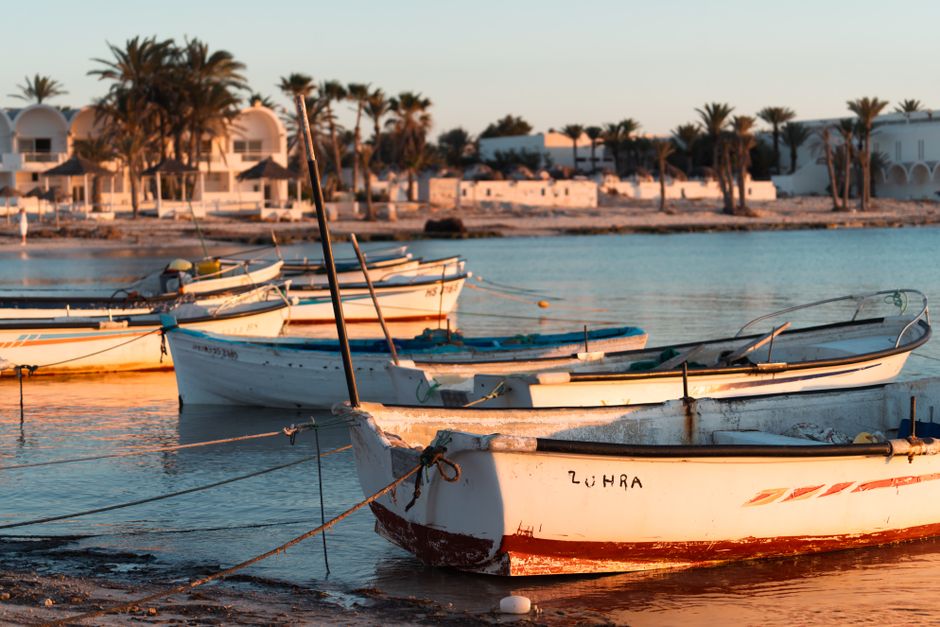
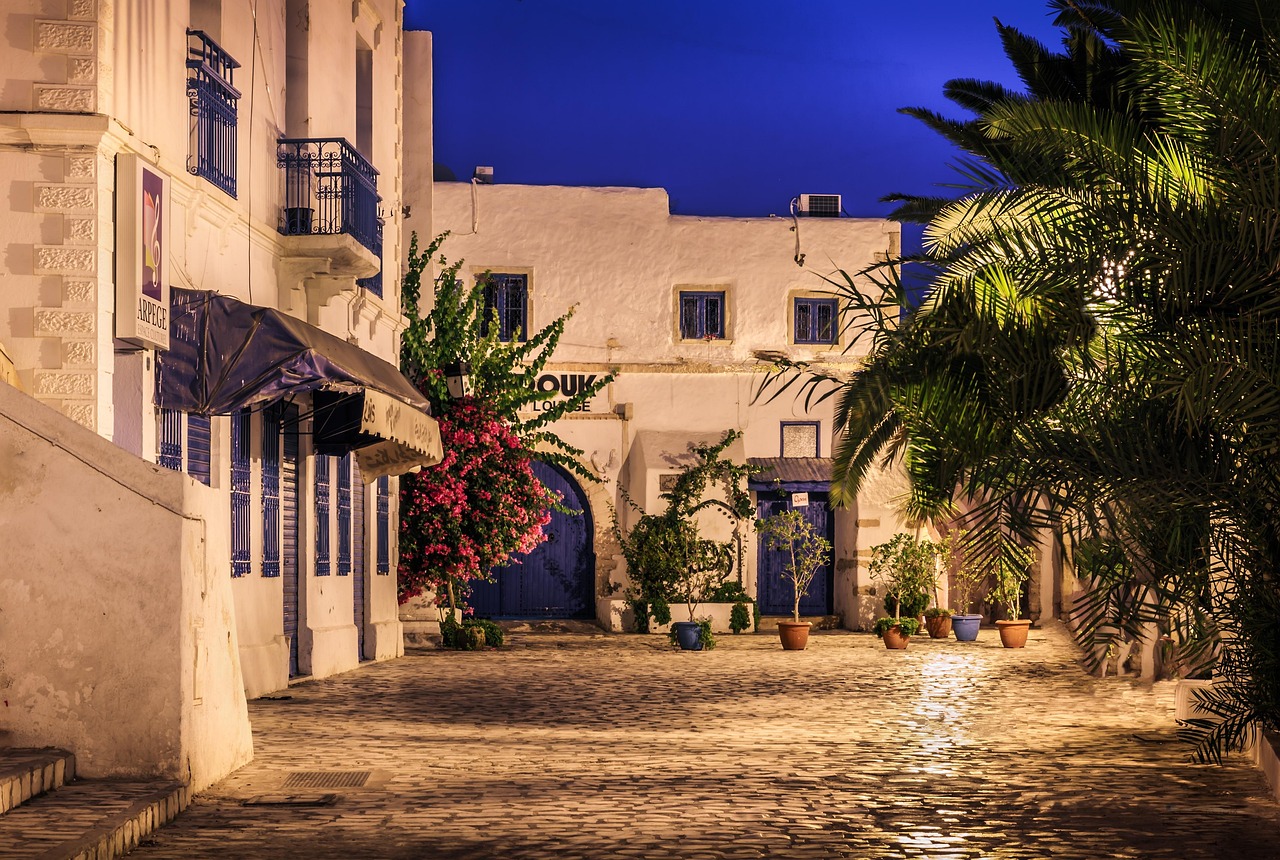
Djerba, off Tunisia’s southern coast in the Gulf of Gabès, is the largest island in North Africa: about 514 km² (198 square miles) of flat land covered in olive groves, palm trees and low white houses, ringed by sandy beaches and shallow turquoise water. Legend makes it the island of the lotus-eaters from Homer’s Odyssey, and its calm, unhurried pace still fits the story. Djerba’s beaches on the northeast coast, around Sidi Mahrez and Aghir, are lined with resort hotels, while the interior is a patchwork of farms and villages where traditional houses, called menzels, stand within walled gardens, and small whitewashed mosques with buttressed walls dot the countryside. This distinctive way of settling an island, spread out across the land rather than in towns, earned Djerba a place on UNESCO’s World Heritage List in 2023. The island’s main town, Houmt Souk, has a market, old fondouks (caravan inns) and a seaside fort; Guellala is known for its pottery; and Erriadh has the El Ghriba synagogue and the street art of Djerbahood. Muslim, including Ibadi, and Jewish communities have lived side by side here for centuries. About 175,000 people live on Djerba, which is linked to the mainland by an ancient causeway and a short ferry and has its own international airport. Djerba has a mild, dry climate: warm, sunny summers with average highs of about 33–34 °C (91–93 °F) tempered by sea breezes, and mild winters with average highs of about 17–18 °C (63–64 °F).
Right now in Djerba
- Wed 23–34°C 73–93°F Partly cloudy
- Thu 22–35°C 72–94°F Mostly clear
- Fri 23–31°C 73–88°F Cloudy
Weather: MET Norway (CC BY 4.0) · Sea temperature: NOAA CoastWatch
Top tours in Djerba
See all tours for Djerba →
From local operators, with prices and reviews; you check availability and book on Viator, our partner. We may earn a commission at no extra cost to you. How we earn money
Djerba at a glance
- Best months: April to June and September to October for warm weather and a warm sea; July and August are peak season; winter is mild and quiet.
- Time needed: three days for Houmt Souk, Guellala, Erriadh and a beach day; a week for a beach holiday with a trip to the mainland’s desert and ksour.
- Getting there: Djerba-Zarzis International Airport (DJE) has flights from Tunis and, in season, many European cities. Citizens of many countries can visit Tunisia for up to 90 days without a visa.
- Costs (as of October 2026): the Borj Ghazi Mustapha fort and the Djerba Traditional Heritage Museum each cost TND 8 (about US$2.70) for non-residents.
- Before you go: visas, the closed dinar, the hotel tax and laws are covered in our Tunisia travel guide.
Djerba’s areas and sights
Houmt Souk
The island’s main town, on the north coast, has a covered market and souqs, old fondouks where merchants once stayed, cafes on shady squares, the Borj Ghazi Mustapha fort by the sea and a fishing harbor with a daily fish auction. Budget hotels and converted fondouks make it a good base for independent travelers.
The Zone Touristique (Sidi Mahrez to Aghir)
A long strip of beach hotels, pools and water sports along the northeast and east coasts, from Sidi Mahrez through Midoun’s coast to Aghir. Best for beach holidays and families, with all-inclusive resorts.
Midoun
The island’s second town, inland from the resort coast, has a busy weekly market and restaurants, and is close to the golf course.
Erriadh (Hara Sghira)
A village in the center of the island, home to the El Ghriba synagogue and the Djerbahood open-air gallery of murals painted by artists from around the world on its houses and walls.
Guellala
On the south coast, the village of Guellala has made pottery for centuries, with workshops and shops along the main road and a museum of the island’s traditions on a hilltop.
Ajim and the south
The fishing port of Ajim, on the southwest coast, has the ferry to the mainland, sponge fishermen and quiet coves; the south has olive groves and traditional menzels.
Where to stay in Djerba
- Zone Touristique: beach resorts, many all-inclusive, with pools, spas and thalasso centers.
- Houmt Souk: small hotels and restored fondouks within walking distance of the souqs.
- Menzels and guesthouses: traditional country houses in the interior, converted into small guesthouses.
- Midoun and Aghir: quieter resorts and apartments.
July and August are the busiest and most expensive months; book early. A tourist tax of TND 8 to 12 per person per night is added to hotel bills.
Top things to see in Djerba
Houmt Souk’s souqs and fondouks
Wander the covered souqs for pottery, carpets, jewelry and spices, have mint tea in a shady square, and look into the old fondouks, two-story caravan inns built around courtyards, some now hotels. Mornings are busiest.
Borj Ghazi Mustapha
The seaside fortress at Houmt Souk, built and rebuilt by successive rulers to guard the island’s harbor, has thick walls and views over the sea. Non-residents pay TND 8; it opens from 9:30 a.m. to 4:30 p.m. in winter and 8 a.m. to 7 p.m. in summer, and is closed on Fridays.
The Djerba Traditional Heritage Museum
In Houmt Souk, the museum displays the island’s traditional costumes, jewelry, pottery, agriculture and fishing. Non-residents pay TND 8; it opens from 9:30 a.m. to 4:30 p.m. in winter and 9 a.m. to 5 p.m. in summer, and is closed on Fridays.
The El Ghriba synagogue
In Erriadh, El Ghriba is one of the oldest synagogues in Africa and a place of pilgrimage, with a richly tiled and painted interior. Visitors are welcome outside services; dress modestly, cover your head inside, remove your shoes where asked and expect security checks. During the annual spring pilgrimage, access may be restricted.
Djerbahood
Since 2014, artists from many countries have painted murals on the walls, doors and domes of Erriadh, turning the village into an open-air gallery. Walk the lanes freely, and respect residents’ privacy.
The fortified mosques
Djerba’s small, whitewashed mosques, many of them Ibadi, have thick walls, buttresses and low minarets, and some once served as lookouts. The Fadhloun Mosque near Midoun, a fine example, is open to visitors in the mornings (non-residents TND 5; closed on Fridays).
Guellala pottery
Watch potters at work in Guellala’s workshops, where the island’s clay has been used for jars and dishes for centuries, and visit the hilltop museum of traditional life.
The menzels and the countryside
The heart of the UNESCO listing is the countryside itself. Djerba’s people traditionally lived not in towns but in menzels, family compounds of white, flat-roofed or domed buildings around a courtyard, set in their own fields and olive groves and surrounded by earth walls or cactus hedges. Wells, cisterns that collect rainwater from the roofs, oil presses dug into the ground, weaving workshops and small neighborhood mosques were spread across the island, so that farms, homes and places of worship formed a single network. Rent a bike or car and drive the back roads between Midoun, Guellala and Erriadh to see menzels, old olive presses and mosques among the palms, and stay in a restored menzel if you can.
Ras R’mel (Flamingo Island)
A sandy spit off the island’s north coast, reached by boat trips from Houmt Souk, with shallow water and, in the cooler months, flamingos. Boat trips often include a fish lunch.
Other things to do in Djerba
- Beaches: Sidi Mahrez and the east coast have long sandy beaches with shallow water, good for children.
- Thalasso and spas: many resort hotels have seawater therapy centers.
- Golf: an 18-hole course near Midoun.
- Water sports: windsurfing, kitesurfing, jet skis and parasailing from the resort beaches; kitesurfing is popular in the lagoons in the south.
- Cycling and horse riding: quiet roads through olive groves and along the coast.
- Markets: weekly markets in Houmt Souk and Midoun.
Food and drink
Djerba’s cooking is based on fish and seafood: grilled fish, octopus, couscous with fish, and riz djerbien, rice steamed with fish, vegetables, herbs and spices. Brik, lablabi and harissa-spiced dishes are everywhere, and pastries and dates make good snacks. Restaurants in Houmt Souk and around the harbor serve the freshest fish; the resorts have buffets and international menus. Alcohol is served in hotels and licensed restaurants.
Day trips and nearby
Zarzis
On the mainland across the causeway, Zarzis has more beaches, resort hotels and olive groves, and its own small museum.
Matmata
About 2 hours by road, Matmata’s underground troglodyte houses, dug into the hillsides, are famous as a Star Wars filming location; some can be visited, and one is a hotel.
Ksar Ghilane and Douz
Two- or three-day desert tours from Djerba visit Douz and the oasis of Ksar Ghilane, with its hot spring at the edge of the dunes, and include camel treks and nights in camps. Book with licensed operators.
Tataouine and the ksour
The fortified granaries (ksour) of the Tataouine region, such as Ksar Ouled Soltane, stand on hilltops in the south. Some areas closer to the Libyan border are closed to visitors or restricted, so check access and travel with a licensed guide.
Gabès
About 1.5 hours away on the mainland, Gabès is unusual for a coastal oasis where palm groves run down almost to the sea, and its market sells henna and spices. It makes a stop on the way to Matmata.
Getting there and getting around
By air
Djerba-Zarzis International Airport, near Mellita in the northwest of the island, has domestic flights from Tunis and international flights, many seasonal, from European cities. It’s about 15–20 minutes by taxi to Houmt Souk and 30–40 minutes to the resorts.
By road and ferry
The El Kantara causeway, built on ancient foundations, links the southeast of the island with Zarzis and the mainland, while a short car ferry crosses between Ajim and Jorf in the southwest. Louages and buses connect Houmt Souk with Gabès, Sfax, Tunis and the south.
Getting around
Taxis are plentiful and cheap; agree fares or use the meter. Buses link Houmt Souk with Midoun, Guellala, Ajim and the resort coast, and many hotels run shuttles to Houmt Souk. Renting a car, scooter or bike is the best way to explore the interior’s villages and mosques.
When to go and how long to stay
Spring (April to June) and autumn (September to October) are the best seasons, with warm days and a pleasant sea. Summer (July and August) is hot but tempered by sea breezes, with average highs of about 33–34 °C (91–93 °F), and is peak season. Winter (November to March) is mild and sunny much of the time, with average highs of 17–23 °C (63–73 °F), good for walking and cycling but cool for swimming. Djerba is dry, with about 209 mm (8.2 in) of rain a year, falling mostly from September to January.
| Month | Average high / low | Rain (days with 1 mm or more) | What to expect |
|---|---|---|---|
| January | 17 °C (63 °F) / 10 °C (49 °F) | 23 mm (0.9 in), 3 days | Mild, sunny spells |
| February | 18 °C (64 °F) / 10 °C (50 °F) | 18 mm (0.7 in), 3 days | Mild; quiet |
| March | 21 °C (69 °F) / 12 °C (54 °F) | 22 mm (0.9 in), 3 days | Mild to warm; good |
| April | 24 °C (74 °F) / 15 °C (58 °F) | 10 mm (0.4 in), 2 days | Warm; very good |
| May | 27 °C (81 °F) / 18 °C (65 °F) | 6 mm (0.2 in), 1 day | Warm; excellent |
| June | 30 °C (87 °F) / 21 °C (71 °F) | 2 mm (0.1 in), 0 days | Hot; beach season |
| July | 33 °C (92 °F) / 24 °C (75 °F) | under 1 mm, 0 days | Hot; peak season |
| August | 34 °C (93 °F) / 25 °C (77 °F) | 6 mm (0.2 in), 0 days | Hottest; peak season |
| September | 31 °C (89 °F) / 24 °C (74 °F) | 25 mm (1.0 in), 2 days | Hot; warm sea |
| October | 28 °C (83 °F) / 20 °C (68 °F) | 31 mm (1.2 in), 3 days | Warm; excellent |
| November | 23 °C (73 °F) / 15 °C (59 °F) | 34 mm (1.3 in), 3 days | Mild; good |
| December | 18 °C (65 °F) / 11 °C (53 °F) | 33 mm (1.3 in), 4 days | Mild; quiet |
The figures are the 1991–2020 climate normals that Tunisia’s National Institute of Meteorology submitted to the World Meteorological Organization for its Djerba station: average daily highs and lows, average monthly rainfall and days with at least 1 mm of rain.
Events worth planning around
- The El Ghriba pilgrimage: held each spring, about a month after Passover, when pilgrims gather at the synagogue; access for other visitors may be restricted.
- Summer festivals: music and folklore events in July and August.
- Ramadan: in 2027 expected from about 8 February to 9 March; resort hotels carry on as usual.
Dates change each year; check locally.
How long to stay: 3, 5 and 7 days
- Three days: Houmt Souk’s souqs, fort and museum; Erriadh’s synagogue and Djerbahood; Guellala; and a beach afternoon.
- Five days: add a boat trip to Ras R’mel, a bike ride through the interior and the fortified mosques.
- Seven days: add a two-day desert trip to Matmata, Douz and Ksar Ghilane.
Typical costs in Djerba
Prices are approximate, for October 2026, converted at about TND 3.00 per US dollar.
| Item | Typical cost |
|---|---|
| Borj Ghazi Mustapha, non-resident | TND 8 (about US$2.70) |
| Djerba Traditional Heritage Museum, non-resident | TND 8 (about US$2.70) |
| Fadhloun Mosque, non-resident | TND 5 (about US$1.70) |
| Hotel tax per person per night (3-star / 4–5-star) | TND 8 / 12 (about US$2.70 / 4) |
| Taxi from the airport to the resorts | about TND 20–35 (about US$7–12) |
| Boat trip to Ras R’mel with lunch | about TND 40–70 (about US$13–23) |
| Grilled fish dinner in Houmt Souk | about TND 30–60 (about US$10–20) |
| Mid-range beach hotel, per night for two | about TND 200–450 (about US$65–150) |
Site fees are those published by the Agency for the Development of Heritage and Cultural Promotion (AMVPPC); other prices are typical ranges.
Safety in Djerba
Djerba is relaxed and generally safe, with a visible police presence and low crime. The main risks are the sun, the sea and petty theft.
- Sun and heat: summer sun is strong, even with the breeze; wear a hat and sunscreen and drink plenty of water.
- Sea safety: follow beach flags and lifeguards, and take care where there are none; watch for jet skis near swimming areas.
- Petty theft: keep valuables out of sight in Houmt Souk’s market and on beaches.
- Dress codes: swimwear is fine at the resorts and beaches; cover shoulders and knees in towns, villages and at religious sites, and cover your head inside the synagogue.
- Desert trips: go with licensed operators, and check access before traveling toward the Libyan border, where some areas are closed or restricted.
- Summer power cuts: during heatwaves, temporary power cuts can affect air-conditioning and ATMs.
- Emergencies: ambulance 190, police 197, National Guard 193, fire 198.
Practical tips for Djerba
- Time zone: UTC+1 all year.
- Fridays: the fort, the museum and the Fadhloun Mosque are closed.
- Money: ATMs are in Houmt Souk, Midoun and the resorts; keep exchange receipts, as dinars can’t be taken out of Tunisia.
- Getting around the island: distances are short, about 25 km (16 miles) across, so a rental bike or scooter is practical in the cooler months; carry water and sunscreen.
- Power: 230 V, with two-pin European sockets.
What to pack for Djerba
Pack swimwear, beach cover-ups, sandals, a hat, sunglasses and sunscreen, plus light clothes that cover shoulders and knees for Houmt Souk and the villages. Add a warm layer for winter evenings and desert nights, comfortable shoes for cycling and walking, and a plug adapter.
Djerba travel FAQ
Is Djerba a UNESCO World Heritage Site?
Yes. In 2023, UNESCO listed “Djerba: Testimony to a settlement pattern in an island territory,” recognizing its spread-out villages, menzels, mosques and farms.
How do I get to Djerba?
Fly to Djerba-Zarzis International Airport, or drive via the El Kantara causeway or the Ajim–Jorf ferry.
What is the best time to visit Djerba?
April to June and September to October; July and August are hot and busy.
Can I visit the El Ghriba synagogue?
Yes, outside services. Dress modestly, cover your head inside and expect security checks; access may be restricted during the spring pilgrimage.
What is Djerbahood?
An open-air gallery of murals painted since 2014 by artists from around the world on the walls of the village of Erriadh.
Is Djerba good for a beach holiday?
Yes. The northeast and east coasts have long sandy beaches with shallow water and many resorts.
Can I visit the Sahara from Djerba?
Yes, on two- or three-day tours to Matmata, Douz and Ksar Ghilane with licensed operators.
How much does the Borj Ghazi Mustapha fort cost?
TND 8 for non-residents. It’s closed on Fridays.
Is it easy to get around Djerba?
Yes. Taxis are cheap, buses link the towns, and renting a bike, scooter or car is the best way to explore the interior.
Do I need a visa for Djerba?
Citizens of many countries, including the US, Canada, the UK and EU countries, can visit Tunisia for up to 90 days without a visa. See our Tunisia guide.
Sources and last review
Researched and last reviewed on 5 October 2026. The UNESCO listing (2023) comes from UNESCO; the fees, hours and Friday closures of Borj Ghazi Mustapha, the Djerba Traditional Heritage Museum and the Fadhloun Mosque from the Agency for the Development of Heritage and Cultural Promotion (AMVPPC); the island’s menzels, fondouks, Guellala museum and airports from the Tunisian National Tourist Office; the hotel tax, currency rules, beach flags, summer power cuts and emergency numbers from GOV.UK’s Tunisia travel information (updated 24 July 2026), used for practical facts only; climate normals from Tunisia’s National Institute of Meteorology via the World Meteorological Organization; area, population and coordinates from Wikidata. El Ghriba’s visiting arrangements and pilgrimage dates, Djerbahood, the lotus-eaters legend, Ras R’mel, the causeway’s history, food, festivals, distances, Ramadan 2027 dates and taxi, boat, meal and hotel prices are general references and flagged for checking. For entry rules and money, see our Tunisia travel guide.
Plan your trip
Partner links: TravelerCenter may earn a commission if you book, at no extra cost to you.
🇪🇬 Useful Arabic phrases for Djerba
All 38 Arabic phrases: restaurant, hotel, emergencies, romance (printable) →