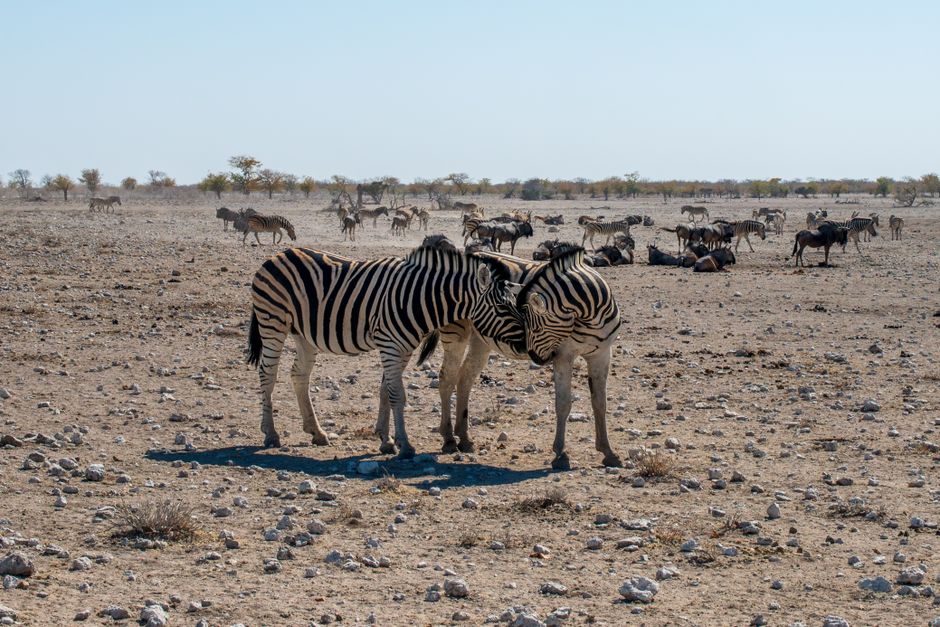
Etosha National Park is Namibia’s great wildlife park and one of the easiest places in Africa for a self-drive safari. At its heart lies the Etosha Pan, a shimmering white salt flat so large it can be seen from space, which only rarely holds water after good rains. Around it, grassland, mopane woodland and scrub are dotted with waterholes, natural springs and boreholes, and in the dry season these are where the action is: elephants coated in white dust, black and white rhinos, lions, giraffes, zebras, huge herds of springbok, gemsbok and wildebeest, all coming to drink while you watch from your car. Etosha’s rest camps, run by Namibia Wildlife Resorts (NWR), each have a floodlit waterhole next to the camp fence, so after dinner you can sit on a bench and watch rhinos and elephants drink under the lights. The park covers roughly 22,000 km² (8,500 square miles) in northern Namibia, about four to five hours’ drive from Windhoek on paved roads, and the main roads inside are good gravel, suitable for an ordinary car. The best months are the dry ones, from about June to October, when animals have to come to the waterholes.
Right now in Etosha National Park (Okaukuejo)
- Wed 15–34°C 59–93°F Clear
- Thu 19–36°C 65–98°F Clear
- Fri 22–34°C 72–94°F 1 mm Clear
Weather: MET Norway (CC BY 4.0)
Top tours in Etosha National Park
See all tours for Etosha National Park →
From local operators, with prices and reviews; you check availability and book on Viator, our partner. We may earn a commission at no extra cost to you. How we earn money
Etosha at a glance
- Best months: June to October for waterhole game viewing; September and October are the hottest and best for sightings. November to April is green, with newborn animals, migrant birds and flamingos when the pan holds water.
- Time needed: at least two nights; three to four nights to cover both the Okaukuejo and Namutoni sides.
- Getting there: Okaukuejo is about 432 km (268 miles) from Windhoek through Andersson Gate; Namutoni is about 110 km (68 miles) from Tsumeb through Von Lindequist Gate.
- Costs (as of October 2026): foreign visitors pay N$280 (about US$17) per adult per day and N$60 per vehicle, under fees in force since April 1, 2026.
- Before you go: visas, money and driving tips are covered in our Namibia travel guide.
Park fees, gate times and rules
Daily park fees
You pay a park entrance and conservation fee per person and per vehicle for each 24 hours in the park, at the gate or at your camp’s reception. Rates from April 1, 2026, set by the Ministry of Environment, Forestry and Tourism and published by NWR:
| Visitor category | Adult, per day | Child (over 8 and under 16), per day |
|---|---|---|
| — | — | — |
| Other foreign nationals | N$280 (about US$17) | N$180 (about US$11) |
| SADC nationals | N$180 (about US$11) | N$100 (about US$6) |
| Namibians | N$60 (about US$4) | free |
| Vehicle, up to 10 seats | N$60 (about US$4) | — |
Children aged 8 and under enter free. Fees are valid for 24 hours from entry, per park, and are non-refundable. Keep your permit: you’ll show it when you leave.
Gate times
Etosha’s gates open at sunrise and close at sunset, and NWR publishes the exact times for each week; they change every Monday. You must be inside a rest camp or out of the park by closing time, and you can’t leave a camp before opening time. Times for 2026, according to NWR:
| Period (2026) | Gates open | Gates close |
|---|---|---|
| — | — | — |
| Early January | 06:23 | 19:37 |
| Early April | 07:03 | 18:55 |
| Early July | 07:29 | 18:30 |
| Early September | 07:02 | 18:48 |
| October 5–11 | 06:31 | 18:55 |
| October 26–31 | 06:17 | 19:02 |
| Early December | 06:09 | 19:22 |
Allow plenty of time to reach camp: average speeds in the park are slow, and you’ll stop for animals. Arriving late can lead to a fine.
Park rules
- Stay in your vehicle except inside the fenced camps and at designated toilets and picnic stops.
- Keep to the roads: don’t drive onto the pan or off the tracks, and observe the speed limit, generally 60 km/h (37 mph).
- No feeding animals, and no littering.
- Respect the waterholes: switch off your engine, keep quiet and don’t block other cars.
- Drones are not allowed without a permit.
Road works
The Ministry of Environment, Forestry and Tourism has begun upgrading the gravel tourist road from Okaukuejo toward the northern King Nehale Gate to a low-volume sealed road, with traffic diverted along the Gemsbokvlakte road toward Halali during works. Check at the gate for current detours.
Etosha areas and who each one suits
Okaukuejo and the southwest
Okaukuejo, 17 km (11 miles) inside Andersson Gate, is the park’s headquarters and its most famous camp, thanks to a floodlit waterhole that regularly draws black rhinos, elephants and lions at night. The open plains around it, with waterholes such as Okondeka, Nebrownii and Gemsbokvlakte, are excellent for lions, springbok and gemsbok. It suits first-time visitors coming from Windhoek and the south.
Halali and the center
Halali, midway between Okaukuejo and Namutoni, has a floodlit waterhole (Moringa) under a rocky hill, where leopards are sometimes seen. Nearby waterholes such as Rietfontein, Goas and Salvadora are good for elephants and rhinos. Halali is a convenient base for exploring the whole southern side.
Namutoni and the east
Namutoni, near Von Lindequist Gate, is built around a whitewashed German fort from the early 1900s. The eastern side has more woodland and some of the park’s busiest waterholes, including Chudop, Klein Namutoni and Kalkheuwel, and the Fischer’s Pan loop, good for birds. It suits travelers coming from Tsumeb, the Zambezi Region or the north. Onkoshi, a small upmarket NWR camp on the pan’s eastern edge, is reached from Namutoni.
Dolomite and the west
The western section, opened more recently to tourists, has rocky dolomite hills, black rhinos, Hartmann’s mountain zebras and far fewer visitors. Dolomite Camp, perched on a ridge, is reached through Galton Gate or a long drive from Okaukuejo.
Private reserves around Etosha
Private reserves on the park’s borders, near Andersson and Von Lindequist gates and to the west, have lodges with guided drives, night drives, walking and rhino tracking, and swimming pools. They are a good choice if you prefer guided activities or can’t get a room inside the park.
Top things to see and do in Etosha
Self-drive game viewing
Driving yourself between waterholes is the essence of Etosha. Pick a few waterholes, park with a good view, switch off the engine and wait: in the dry season, a steady procession of zebras, springbok, kudus, giraffes and elephants comes to drink, with lions often lying nearby. The main gravel roads are suitable for any car in the dry season. Buy the park map at the gate; each camp has a sightings board.
Floodlit waterholes at night
The floodlit waterholes at Okaukuejo, Halali and Namutoni are among Etosha’s greatest assets. Bring a warm jacket and sit quietly on the benches after dinner; black rhinos are often seen here, sometimes several at once, along with elephants, lions and hyenas.
Guided game drives and night drives
NWR runs guided morning, afternoon and night drives from its camps in open vehicles. Night drives are the only way to explore the park after the gates close and can reveal lions hunting, hyenas, aardwolves and owls.
The Etosha Pan
Several loops lead to viewpoints on the edge of the pan, such as the Etosha Lookout near Halali, where a short road runs out onto the salt flat. In wet years, the pan fills with shallow water and thousands of flamingos come to breed.
Rhinos and big cats
Etosha is one of the best places in Africa to see the endangered black rhino. Lions are common around the plains waterholes; leopards and cheetahs are seen less often.
Birding
More than 300 bird species have been recorded, from ostriches, kori bustards and secretary birds on the plains to raptors, crimson-breasted shrikes and, in summer, migrant birds and flamingos.
Other things to do in Etosha
Food and drink
Each NWR camp has a restaurant, bar and small shop with basic groceries, frozen meat for braais, and firewood. Many travelers self-cater on the campsite braai stands; stock up in Outjo, Otjiwarongo or Tsumeb before entering. Lodges outside the park serve game such as oryx and kudu, Namibian beef and lamb, and good South African wines.
History
Namutoni’s fort, restored after it was destroyed in fighting in 1904, now houses part of the camp. Okaukuejo’s stone tower, once a military lookout, gives views over the plains at sunset.
Day trips and nearby
Waterberg Plateau Park
About three hours south of Okaukuejo, the Waterberg Plateau rises dramatically above the plains, with hiking trails, rare antelope and a well-located NWR camp. It’s a good stop between Windhoek and Etosha.
Tsumeb, Otjikoto Lake and the Hoba meteorite
Tsumeb, east of Namutoni, has a mining museum; nearby, Otjikoto Lake is a sinkhole lake, and near Grootfontein lies the Hoba meteorite, the largest known single meteorite on Earth.
Damaraland and Twyfelfontein
West of Etosha, through Galton Gate or via Kamanjab and Outjo, lie Damaraland’s mountains, the rock engravings of Twyfelfontein and the desert-adapted elephants.
The coast
Swakopmund is a long day’s drive away, about 500–600 km (310–370 miles) depending on the camp and route. See our Swakopmund guide.
Getting there and getting around
By road
From Windhoek, the paved B1 runs north through Okahandja and Otjiwarongo; take the C38 via Outjo to Andersson Gate and Okaukuejo (about 432 km, 268 miles, according to NWR), or continue on the B1 via Otavi and Tsumeb to Von Lindequist Gate and Namutoni (about 486 km, 302 miles). King Nehale Gate on the north side connects with Ondangwa and the B1. Galton Gate in the west opens the route to Dolomite Camp and Kamanjab. Allow five to six hours from Windhoek with stops.
By air
Ondangwa Airport, north of the park, has domestic flights from Windhoek. Charter flights serve airstrips at some private lodges and near Okaukuejo and Mokuti. Most visitors, however, drive from Windhoek’s Hosea Kutako International Airport.
Getting around inside the park
The main gravel roads between Okaukuejo, Halali and Namutoni are generally good; side loops can be rougher. A sedan is fine in the dry season, while a high-clearance vehicle is more comfortable and better on wet roads after rain. There is fuel at Okaukuejo, Halali and Namutoni, but supplies can run short, so fill up before entering. Driving is only allowed between the gate opening and closing times.
When to go and how long to stay
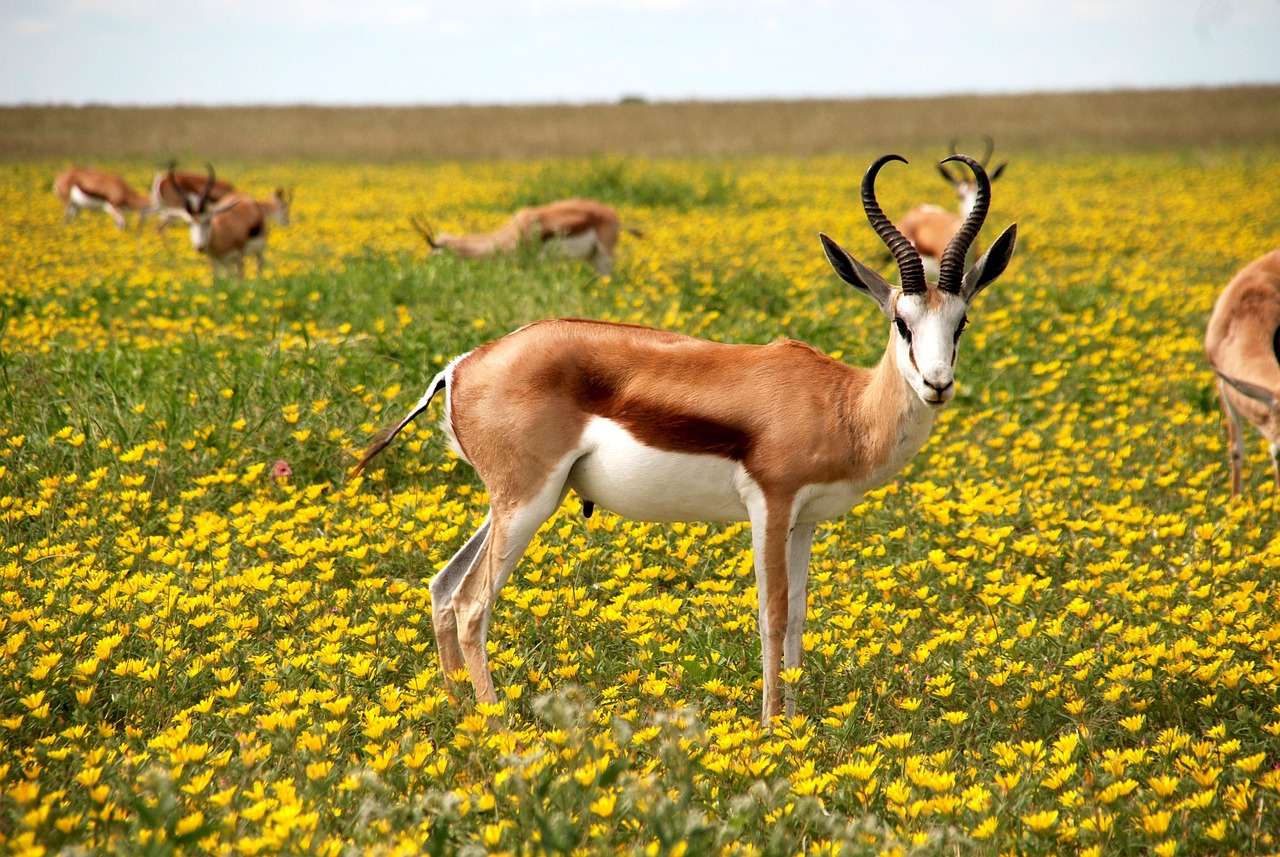
Etosha has a summer-rainfall climate. The dry season (May to October) is the best time for game viewing, as surface water dries up and animals concentrate around waterholes; days are warm and sunny, nights in June and July can be close to freezing, and September and October get very hot. The rainy season (November to April) brings afternoon storms, green grass and newborn springbok, attracts migrant birds and sometimes fills the pan with water, but animals spread out and are harder to find.
| Month | Average high | Average low | Rain | Rain days |
|---|---|---|---|---|
| Jan | 30 °C (87 °F) | 18 °C (64 °F) | 86 mm (3.4 in) | 12 |
| Feb | 29 °C (84 °F) | 17 °C (63 °F) | 91 mm (3.6 in) | 12 |
| Mar | 27 °C (81 °F) | 16 °C (61 °F) | 70 mm (2.7 in) | 11 |
| Apr | 26 °C (78 °F) | 13 °C (55 °F) | 35 mm (1.4 in) | 7 |
| May | 23 °C (74 °F) | 10 °C (50 °F) | 6 mm (0.2 in) | 2 |
| Jun | 21 °C (69 °F) | 7 °C (44 °F) | 2 mm (0.1 in) | 0 |
| Jul | 21 °C (70 °F) | 7 °C (44 °F) | 0 mm (0 in) | 0 |
| Aug | 24 °C (75 °F) | 9 °C (48 °F) | 1 mm (0 in) | 0 |
| Sep | 28 °C (82 °F) | 12 °C (54 °F) | 4 mm (0.2 in) | 1 |
| Oct | 29 °C (85 °F) | 15 °C (58 °F) | 13 mm (0.5 in) | 3 |
| Nov | 30 °C (86 °F) | 16 °C (61 °F) | 29 mm (1.2 in) | 6 |
| Dec | 31 °C (89 °F) | 17 °C (63 °F) | 31 mm (1.2 in) | 7 |
| Year | 27 °C (80 °F) | 13 °C (55 °F) | 368 mm (14 in) | 62 |
Figures are the Namibia Meteorological Service’s 1961–1990 averages for Windhoek, as published by the World Meteorological Organization; there is no Etosha station in the WMO’s World Weather Information Service. Etosha lies at about 1,100 m (3,600 ft), lower than Windhoek’s 1,700 m (5,600 ft), so it is usually a few degrees warmer by day, often above 35 °C (95 °F) in October and November, with somewhat more summer rain in the north and east of the park.
How long to stay: 2, 3 and 5 nights
- Two nights: one night each at Okaukuejo and Namutoni, driving through the park via Halali between them.
- Three nights: Okaukuejo, Halali and Namutoni, with a guided night drive.
- Five nights: add Dolomite Camp in the west or a private reserve with guided rhino tracking.
Where to stay in Etosha
- Okaukuejo: NWR’s largest camp, with rooms, chalets (some facing the waterhole), a campsite, restaurant, pool, shop and fuel.
- Halali: mid-park NWR camp with chalets, a campsite, pool and floodlit waterhole.
- Namutoni: rooms in and around the old fort, a campsite and the King Nehale waterhole.
- Dolomite and Onkoshi: smaller, more upmarket NWR camps with dinner, bed and breakfast.
- Private reserves and lodges outside the gates: from campsites to luxury lodges, many with their own waterholes and guided drives.
NWR camps are fenced and open only during gate hours. Book early for July to October and school holidays.
Typical costs in Etosha
| Item (as of October 2026) | Namibian dollars | About US dollars |
|---|---|---|
| — | — | — |
| Park fee, foreign adult, per day (official, from April 2026) | N$280 | $17 |
| Vehicle fee, up to 10 seats, per day (official) | N$60 | $4 |
| Okaukuejo double room, B&B, per person sharing, July–Oct 2026 (NWR) | N$2,380 | $143 |
| Okaukuejo double room, B&B, per person sharing, Nov 2026–June 2027 (NWR) | N$1,900 | $114 |
| Halali campsite, per person, July–Oct 2026 (NWR) | N$550 | $33 |
| Guided morning or afternoon drive, per person (NWR) | N$650 | $39 |
| Guided night drive, per person (NWR) | N$750 | $45 |
| Private lodge outside the park, per person per night, half board | about N$2,500–8,000 | about $150–480 |
Park fees are official MEFT rates and camp and activity prices are NWR’s published rates; lodge prices are typical ranges. Conversions use about N$16.60 to US$1.
Safety in Etosha
- Wildlife: stay in your vehicle outside the camps; lions often rest in the shade close to roads and waterholes. Keep a respectful distance from elephants and rhinos, and never get between an elephant and its calf.
- In camp: camps are fenced, but jackals and honey badgers raid rubbish and food at night; lock food away in your car.
- Heat: in October and November, temperatures can exceed 35 °C (95 °F); carry plenty of water in the car.
- Gravel roads: drive slowly, watch for animals crossing, and keep to the speed limit; on the long gravel and paved roads outside the park, avoid driving at night, when cattle and wildlife stand on the roads.
- Tires: check pressures each morning, carry a working spare and know how to change it; sharp stones cause punctures.
- Malaria: Etosha has a seasonal malaria risk, mainly in the rainy months from about November to April; use repellent from dusk and ask a travel-health professional about prevention, especially if continuing to the northeast.
- Emergencies: contact your camp reception; the national police number is 10111. Carry travel insurance with evacuation cover.
Practical tips for Etosha
- Book early: NWR rooms and campsites sell out months ahead for July to October.
- Get going early: leave camp as the gate opens, when animals are most active and the light is soft.
- Sightings boards: check the books at camp receptions for recent sightings.
- Cash and cards: NWR camps take cards, but carry some cash in case card machines are down.
- Signal: mobile coverage is available near the main camps but patchy elsewhere.
What to pack for Etosha
Pack light clothes in neutral colors, a warm fleece and jacket for chilly mornings and evenings at the waterholes, a sun hat, sunglasses and SPF 50 sunscreen, binoculars for each person, a camera with a zoom lens and a beanbag to rest it on the car window, a headlamp, a cooler bag, insect repellent, and a field guide to mammals and birds. See our travel adapters guide for type M sockets.
Etosha National Park travel FAQ
How much is the Etosha entrance fee?
From April 1, 2026, foreign visitors pay N$280 (about US$17) per adult per day, N$180 per child aged 9 to 15, and N$60 per vehicle with up to 10 seats. Children aged 8 and under are free.
What time do the Etosha gates open and close?
At sunrise and sunset, changing every Monday. In early October 2026 they open around 06:30 and close around 18:55; in July, around 07:29 and 18:30. You must be in a camp or out of the park by closing time.
Can I drive myself in Etosha?
Yes. Etosha is ideal for self-drive safaris. The main gravel roads are suitable for an ordinary car in the dry season, and you stay in fenced rest camps with floodlit waterholes.
When is the best time to visit Etosha?
From June to October, when it is dry and animals gather at waterholes. The rainy season, from November to April, is greener, with baby animals and birds but more dispersed wildlife.
How far is Etosha from Windhoek?
About 432 km (268 miles) to Okaukuejo via Andersson Gate, or about 486 km (302 miles) to Namutoni via Von Lindequist Gate, mostly on paved roads; allow five to six hours.
Which is the best camp in Etosha?
Okaukuejo is the most popular for its floodlit waterhole with frequent rhinos; Halali is central; Namutoni has a historic fort and busy eastern waterholes. Many visitors stay at two camps.
Do I need a 4×4 for Etosha?
No. A sedan is fine on the main gravel roads in the dry season, but a higher vehicle gives better views and handles rough side loops and wet roads more easily.
Is there malaria in Etosha?
There is a seasonal risk, mainly in the rainy season from about November to April. Use repellent and ask a travel-health professional about prevention.
Can I see rhinos in Etosha?
Yes. Etosha is one of the best places to see black rhinos, especially at the floodlit waterholes at Okaukuejo and Halali after dark. White rhinos are also present.
How many days do you need in Etosha?
At least two nights; three to four nights let you explore both the Okaukuejo and Namutoni sides and add a guided night drive.
Sources and last review
Researched and last reviewed on 5 October 2026. Park fees: the Ministry of Environment, Forestry and Tourism’s revised schedule from April 1, 2026, as published by Namibia Wildlife Resorts; gate times for 2026, camp rates, activity prices and distances: Namibia Wildlife Resorts; road works: the Ministry of Environment, Forestry and Tourism; the exchange rate: the European Central Bank (the Namibian dollar is pegged to the rand); climate: the Namibia Meteorological Service’s 1961–1990 averages for Windhoek via the World Meteorological Organization. The park’s size, speed limit, waterhole names, wildlife details, malaria seasons, airport details and typical lodge prices are general references or estimates, flagged for checking. For entry rules and money, see our Namibia travel guide.
Plan your trip
Partner links: TravelerCenter may earn a commission if you book, at no extra cost to you.