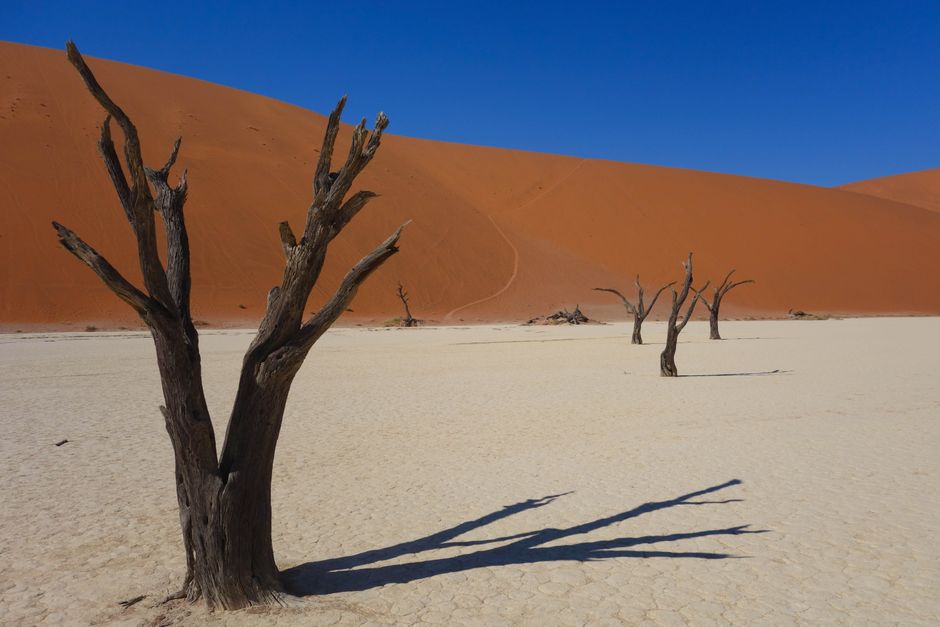
Namibia is a country of vast horizons and astonishing landscapes, and one of the best places in Africa for a road trip. On the Atlantic coast, the Namib, one of the oldest deserts on Earth, rolls inland in towering red dunes, culminating at Sossusvlei and the ghostly dead camelthorn trees of Deadvlei. In the north, Etosha National Park surrounds a great white salt pan, with waterholes where elephants, lions, rhinos and giraffes come to drink in the dry season, watched from floodlit viewpoints in the rest camps. Between them lie the fog-cooled seaside town of Swakopmund, with its German colonial buildings and adventure sports; the rock engravings and desert-adapted elephants of Damaraland; the shipwreck coast of the Skeleton Coast; the Fish River Canyon in the south; and the green rivers of the Zambezi Region in the far northeast. Namibia has just over three million people in a country larger than Texas, good paved highways and well-maintained gravel roads, campsites and lodges in spectacular settings, and remarkably clear night skies. Since April 2025, visitors from the United States, the United Kingdom, Canada, Germany and many other countries need a visa, available online or on arrival. Plan around the dry season, from about May to October, for game viewing, and book Etosha and Sossusvlei accommodation early.
Right now in Namibia
- Wed 13–30°C 55–86°F Clear
- Thu 15–31°C 58–88°F Clear
- Fri 19–31°C 67–87°F Mostly clear
Weather: MET Norway (CC BY 4.0)
Multi-day tours of Namibia
Multi-day tours from local operators. You check dates and book on Viator, our partner; we may earn a commission at no extra cost to you. How we earn money
Namibia at a glance
Namibia covers about 825,600 km² (318,800 square miles), more than twice the size of Germany, its former colonial ruler. Its landscape falls into broad bands: the Namib Desert along the Atlantic coast, cooled by the cold Benguela Current and often wrapped in fog; the Great Escarpment, rising to the central highlands around Windhoek at about 1,700 m (5,600 ft); and the Kalahari sandveld to the east. The north is flatter and greener, with the Etosha Pan, the Owambo floodplains and, in the northeast, the rivers of the Kavango and Zambezi regions. Namibia borders Angola, Zambia, Botswana and South Africa, and its narrow Zambezi Region (formerly the Caprivi Strip) reaches almost to Victoria Falls. The population is about three million, according to the 2023 census, with roughly half a million in and around the capital, Windhoek.
English is the official language; Oshiwambo, Afrikaans, Otjiherero, Damara/Nama, German and other languages are widely spoken. Namibia uses Central Africa Time (UTC+2) all year, with no daylight saving. Electricity is 230 V with the large three-round-pin type M sockets, as in South Africa, and older type D sockets, so bring an adapter that covers type M. Driving is on the left.
Namibia’s regions for travelers
- Central Namibia: Windhoek, the main gateway, with nearby guest farms and the Daan Viljoen and Waterberg Plateau parks.
- The Namib and Sossusvlei: the dunes of the Namib-Naukluft Park, Sesriem Canyon, the NamibRand Nature Reserve and the Naukluft Mountains.
- The coast: Swakopmund and Walvis Bay, with the lagoon, Sandwich Harbour and the dune belt, and the Skeleton Coast to the north.
- Damaraland and Kunene: Spitzkoppe, the Brandberg, the UNESCO-listed rock engravings of Twyfelfontein, desert-adapted elephants and the Himba region.
- The north: Etosha National Park and the private reserves around it, Tsumeb and Grootfontein.
- The northeast: the Kavango and Zambezi regions, with Bwabwata, Mudumu and Nkasa Rupara national parks and access to Chobe and Victoria Falls.
- The south: the Fish River Canyon, Lüderitz, the ghost town of Kolmanskop and the Kalahari.
Where to go: dunes, coast and wildlife
The classic first trip is a loop from Windhoek: Sossusvlei, Swakopmund, Damaraland and Etosha, driving yourself in a rental car or 4×4 over 10 to 14 days. See our guides to each place:
- Sossusvlei and the Namib-Naukluft: red dunes, Deadvlei, Sesriem Canyon and some of the clearest night skies in the world.
- Swakopmund: the coastal adventure town for sandboarding, quad-biking, Walvis Bay lagoon cruises and Sandwich Harbour.
- Etosha National Park: self-drive safari around the Etosha Pan, with floodlit waterholes at the rest camps.
Other highlights include the Fish River Canyon, Lüderitz and Kolmanskop, Twyfelfontein, Spitzkoppe, the Skeleton Coast, the Waterberg Plateau and the Zambezi Region. Our Chobe and Victoria Falls guides cover the neighbors reached from the northeast.
Windhoek deserves a night at the start or end of a trip. The compact capital sits in a highland valley, with the Christuskirche, the Tintenpalast parliament building and its gardens, the Independence Memorial Museum, craft markets, good restaurants serving game meat and German-style beer, and guest farms in the hills around it. It is also where most rental companies, tour operators and outdoor shops are based, so it is the place to stock up before heading into the desert.
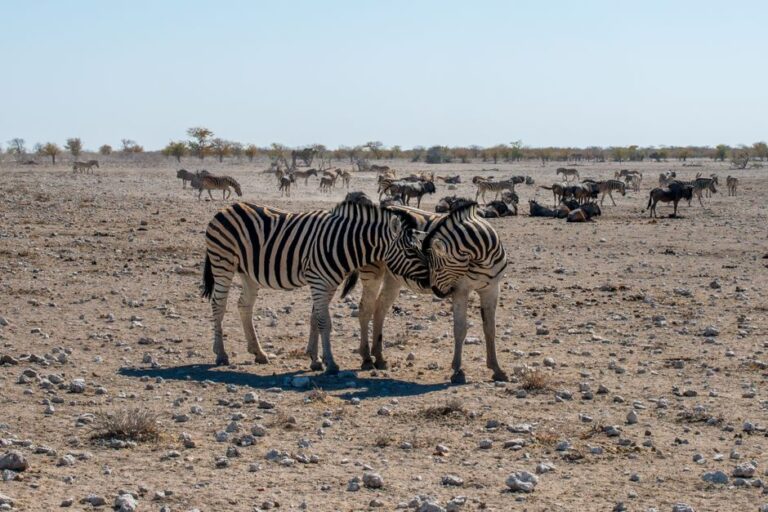
Etosha National Park Travel Guide
Plan an Etosha safari: park fees from April 2026, NWR gate times for 2026, self-drive rules, Okaukuejo, Halali, Namutoni and Dolomite camps, floodlit waterholes…
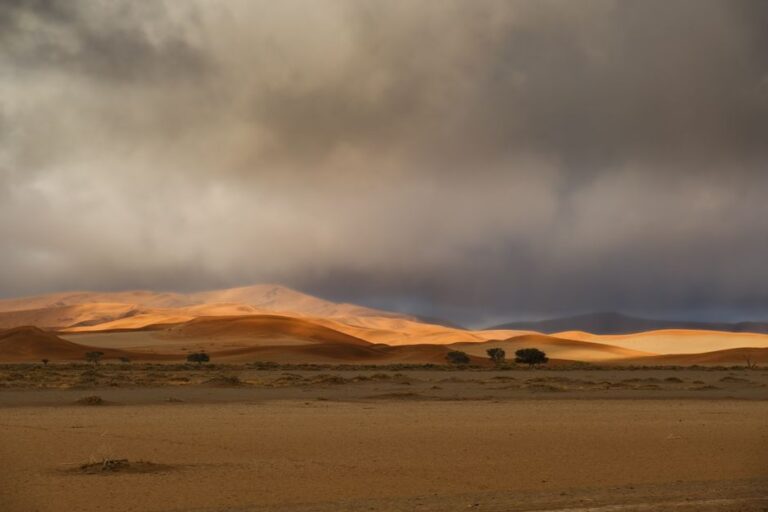
Sossusvlei Travel Guide
Plan a trip to Sossusvlei in the Namib-Naukluft Park: park fees from April 2026, Sesriem gate times and in-park early access, the 2×4 parking…
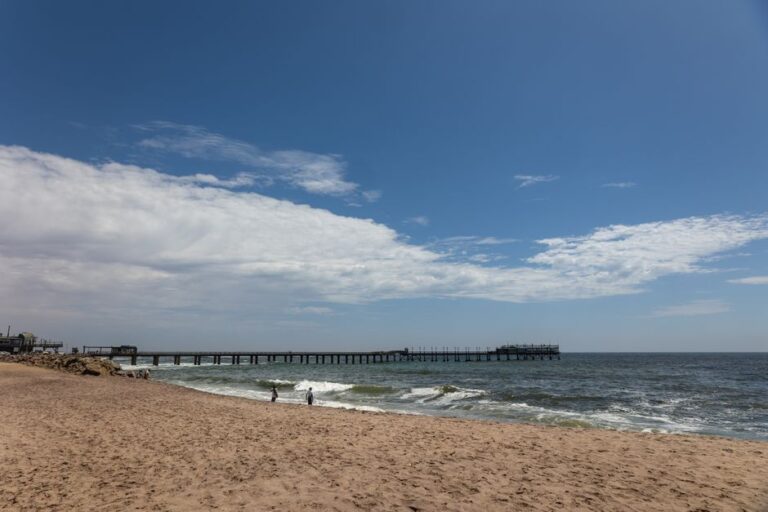
Swakopmund Travel Guide
Plan a trip to Swakopmund on Namibia's coast: the colonial town center and jetty, sandboarding, quad-biking and Living Desert tours, Walvis Bay cruises, lagoon…
Best time to visit Namibia
Namibia is dry and sunny for most of the year. Inland, rain falls mainly as summer thunderstorms from about November to April, with most in January to March, and the north and northeast are wetter than the south. Winter (May to September) is dry, with warm, sunny days and cold nights; on the central plateau and in the desert, early mornings can drop near freezing. October and November are hot before the rains. The coast is different: Swakopmund and Walvis Bay stay mild all year, often foggy in the mornings, and almost rainless. The figures below are the Namibia Meteorological Service’s 1961–1990 averages for Windhoek, as published by the World Meteorological Organization (WMO); it is the only Namibian station in the WMO’s World Weather Information Service.
| Month | Windhoek average high | Average low | Rain |
|---|---|---|---|
| — | — | — | — |
| January | 30 °C (87 °F) | 18 °C (64 °F) | 86 mm (3.4 in) |
| April | 26 °C (78 °F) | 13 °C (55 °F) | 35 mm (1.4 in) |
| July | 21 °C (70 °F) | 7 °C (44 °F) | 0 mm (0 in) |
| October | 29 °C (85 °F) | 15 °C (58 °F) | 13 mm (0.5 in) |
| Year | 27 °C (80 °F) | 13 °C (55 °F) | about 370 mm (14 in) |
Elsewhere, expect higher temperatures at lower altitudes: the Namib dunes and Etosha are often several degrees warmer than Windhoek by day, and the Namib can exceed 40 °C (104 °F) in summer, while the coast rarely goes above the low 20s °C (low 70s °F) except during hot east-wind (“berg wind”) days in autumn and winter.
Safari season: the dry months from June to October are best in Etosha, when animals gather at waterholes. The rainy season brings green grass, newborn animals, migrant birds and dramatic skies, and the Etosha Pan may hold water, attracting flamingos, but animals disperse and some gravel roads may flood after storms. Sossusvlei is good all year; rare good rains can briefly fill the vlei with water.
Namibia month by month
| Month | Weather | Highlights | Crowds and prices |
|---|---|---|---|
| — | — | — | — |
| January | Hot; summer storms inland | Green landscapes; birding; baby animals | Moderate; South African holidays early in the month |
| February | Hot; wettest month inland | Flowers in the desert after rain | Low |
| March | Warm; storms easing | Etosha Pan may hold water; flamingos | Low |
| April | Warm days, cool nights | End of the rains; clear air | Moderate; busy at Easter |
| May | Dry; pleasant | Good all round; quiet before the peak | Moderate |
| June | Dry; cold nights | Game viewing improves in Etosha | Rising |
| July | Coolest; frosty mornings inland | Excellent waterhole sightings | High; book months ahead |
| August | Dry; warming; windy | Peak game viewing; clear night skies | High |
| September | Warm to hot | Peak season in Etosha and Sossusvlei | High |
| October | Hot | Dramatic waterhole action; heat in the desert | High to moderate |
| November | Hot; first storms | Migrant birds; rates fall | Moderate |
| December | Hot; storms | Festive season; green north | Busy over the holidays |
Public holidays and school holidays
Namibia’s public holidays include New Year’s Day, Independence Day (March 21), Good Friday and Easter Monday, Workers’ Day (May 1), Cassinga Day (May 4), Ascension Day, Africa Day (May 25), Genocide Remembrance Day (May 28), Heroes’ Day (August 26), Human Rights Day (December 10), Christmas Day and Family Day (December 26). Namibian and South African school holidays, especially in July, around Easter and from mid-December to mid-January, fill campsites in Etosha and Sossusvlei.
How long to stay: sample itineraries
- 7 days: Windhoek (1 night), Sossusvlei (2), Swakopmund (2) and back to Windhoek, or Windhoek and Etosha (3 nights) with the Waterberg.
- 10 days: Windhoek (1), Sossusvlei (2), Swakopmund (2), Damaraland (2) and Etosha (3).
- 14 days: add the Fish River Canyon and Lüderitz in the south (4 nights) or the Zambezi Region (3 nights) on the way to Chobe and Victoria Falls.
- Three weeks: a full loop: the south, Sossusvlei, the coast, Damaraland, the Kunene region, Etosha and the Zambezi Region.
Entry, money and costs
Entry and visas (last reviewed October 2026)
Since April 1, 2025, nationals of 33 countries that had not offered Namibians reciprocal visa-free entry need a visa to visit Namibia, which they can get on arrival or apply for online in advance through the Ministry of Home Affairs, Immigration, Safety and Security’s e-services portal (eservices.mhaiss.gov.na). The list published by Namibia’s embassy in Geneva includes the United States, Canada, the United Kingdom, Ireland, Australia, New Zealand, Japan, Germany, France, Italy, Spain, Portugal, the Netherlands, Belgium, Austria, Switzerland, the Nordic countries and several Central Asian and Eastern European states. The visa on arrival costs N$1,600 (about US$96) for non-African Union nationals and is valid for up to 90 days a year. It is issued at Hosea Kutako International Airport (Windhoek), Walvis Bay International Airport and main border posts, including Trans-Kalahari, Noordoewer, Oranjemund, Oshikango, Katima Mulilo, Ngoma, Mohembo and Impalila Island. The ministry encourages online applications to avoid queues, and later in 2025 it was reported to have extended visa on arrival to more nationalities and to plan a higher fee for applications made in person at the border, so apply online and check the current fee before you travel. Nationals of many African countries and a number of others remain visa-exempt for tourist stays of up to three months in a calendar year.
All visitors need a passport valid for at least six months beyond the intended stay, with enough blank pages for entry and exit stamps, and a return ticket, according to the ministry. The embassy also lists proof of accommodation and travel insurance among the documents for the visa.
Customs and what not to bring
Namibia is part of the Southern African Customs Union. Declare large amounts of cash. Fresh meat and dairy products are controlled at veterinary fences north of Etosha (the “red line”), so you may need to hand them over at checkpoints when driving south. Collecting rocks, plants and fossils, and removing anything from national parks, is prohibited; diamonds can only be bought from licensed dealers. Drones need permission from the Namibia Civil Aviation Authority, and flying them in national parks is prohibited without a permit.
Money, cards and cash
The currency is the Namibian dollar (NAD, N$), pegged one-to-one to the South African rand, which is also legal tender in Namibia; Namibian dollars are not accepted in South Africa, so spend them before you leave. On October 5, 2026, European Central Bank reference rates put the rand, and therefore the Namibian dollar, at about N$16.60 to the US dollar, the rate used on this page. Cards are accepted at most hotels, lodges, supermarkets and restaurants, and at Namibia Wildlife Resorts camps; ATMs are found in all towns. Carry cash for fuel at small stations, park gates, campsites on farms and tips: in remote areas, card machines may not work and some fuel stations only accept cash.
National parks: entry and conservation fees
The Ministry of Environment, Forestry and Tourism (MEFT) charges a daily park entrance and conservation fee per person and per vehicle. New fees took effect on April 1, 2026, and Namibia Wildlife Resorts (NWR) publishes the schedule. For foreign visitors from outside the Southern African Development Community (SADC):
| Park group (other foreign nationals) | Adult, per day | Child (over 8 and under 16), per day | Vehicle (up to 10 seats), per day |
|---|---|---|---|
| — | — | — | — |
| Etosha, Namib-Naukluft (Sossusvlei), Skeleton Coast, Dorob, Cape Cross, Ai-Ais/Fish River Canyon, Tsau //Khaeb, Waterberg | N$280 (about US$17) | N$180 (about US$11) | N$60 (about US$4) |
| Bwabwata, Mudumu, Khaudum, Nkasa Rupara, Mangetti, Popa Falls, Daan Viljoen, Hardap, Naute, Von Bach | N$200 (about US$12) | N$150 (about US$9) | N$60 (about US$4) |
| Namib-Naukluft Park, Sandwich Harbour area | N$150 (about US$9) | N$100 (about US$6) | N$50 (about US$3) |
Children aged 8 and under enter free. SADC nationals pay N$180 per adult per day in the first group, and Namibians N$60. Fees are valid for 24 hours from the time of entry, per park, and are non-refundable.
Taxes and tipping
Prices include VAT at 15%. Tipping is customary: about 10% in restaurants, a few Namibian dollars for fuel attendants, N$10–20 for informal car guards in towns, and on guided activities and at lodges, a tip for guides, trackers and staff at the end of a stay.
What a trip costs
Prices are typical ranges for October 2026, converted at about N$16.60 to the US dollar; official fees and rates are noted.
| Item | Typical cost |
|---|---|
| — | — |
| Etosha or Sossusvlei park fee, foreign adult, per day (official, from April 2026) | N$280 (about US$17) |
| Okaukuejo (Etosha) double room, B&B, per person sharing, July–October 2026 (NWR) | N$2,380 (about US$143) |
| Guided game drive in Etosha, per person (NWR) | N$650 (about US$39) |
| Shuttle from the 2×4 parking to Deadvlei, per person (NWR) | N$180 (about US$11) |
| Coffee in a café in Windhoek or Swakopmund | N$30–45 (about US$2–3) |
| Main course in a mid-range restaurant | N$150–300 (about US$9–18) |
| Sedan rental, per day | N$600–1,200 (about US$36–72) |
| 4×4 with camping gear, per day | N$1,800–3,500 (about US$108–210) |
| Mid-range guesthouse or lodge, double, per night | N$1,500–4,000 (about US$90–240) |
A self-drive trip with a rental car, guesthouses and lodges, meals, fuel and park fees costs roughly US$150–250 per person per day; camping cuts this sharply. Upmarket lodges with guided activities start at about US$300–600 per person per night.
Getting there and getting around
Airports
Hosea Kutako International Airport (WDH), about 45 km (28 miles) east of Windhoek, is the main gateway, with direct flights from Frankfurt, Johannesburg, Cape Town and other African cities, and connections via Addis Ababa, Doha and Luanda. Walvis Bay (WVB) has flights from Johannesburg and Cape Town and is the airport for Swakopmund. Domestic and charter flights serve Ondangwa (for northern Etosha), Katima Mulilo and Lüderitz, and fly-in safari operators use dozens of lodge airstrips.
Driving
Most visitors explore Namibia by rental car. The main routes, such as Windhoek–Swakopmund, Windhoek–Etosha and the road south to South Africa, are paved, but the roads to Sossusvlei’s lodges, Damaraland and many lodges are gravel. A 2WD sedan is enough for paved roads and good gravel; a high-clearance vehicle or 4×4 gives more comfort and safety on rough gravel and is essential for Sandwich Harbour, the Kaokoveld and parts of the Zambezi Region. Distances are long and fuel stations sparse in the south and west, so fill up whenever you can. A license printed in English with a photo is generally accepted; carry an International Driving Permit otherwise. Drive on the left, keep to the speed limits, and see the safety section for gravel-road driving.
Organized tours and fly-in safaris
Guided small-group tours, from camping trips to lodge-based tours, cover the classic loop with a guide-driver. Fly-in safaris link Windhoek with lodges in Sossusvlei, Damaraland, the Skeleton Coast and Etosha by light aircraft, ideal if time is short.
Buses and trains
Intercity buses connect Windhoek with Swakopmund, Walvis Bay, the north and South Africa, and shuttles run between Windhoek, the airport and the coast. Public transport doesn’t reach the national parks, so you need a rental car or tour to visit them.
Culture, food and everyday etiquette
Food and drink
Namibia’s food reflects its mix of cultures and its love of meat. Try game such as oryx (gemsbok), kudu and springbok steaks, braai (barbecue), biltong (dried meat) and potjiekos (stew cooked in a cast-iron pot). German heritage shows in bakeries with apple strudel and Black Forest cake, sausages, and lagers brewed under the old German purity law. On the coast, Walvis Bay oysters and fresh kingklip are excellent. In the north, people eat oshifima, a stiff millet porridge, with stews; and you might be offered mopane worms. The bakery at Solitaire, on the road to Sossusvlei, is famous for its apple pie. Tap water in towns is generally treated, though most travelers prefer bottled water on long drives.
Where to stay
Options include city hotels and guesthouses, guest farms, lodges in dramatic settings, NWR rest camps in the national parks, private reserves around Etosha, and excellent campsites, many with private ablutions. Namibia is one of Africa’s best countries for camping with a rooftop-tent 4×4.
Camping and self-drive essentials
Namibia’s campsites are among the best in Africa: many have a private shaded pitch with its own tap, braai (barbecue) stand, electricity point and even a private shower block, and some sit under huge camelthorn trees or among granite boulders. Rental companies supply 4x4s with one or two rooftop tents, a fridge, gas cooker, cooking gear and bedding, plus two spare wheels and a compressor. Collect your vehicle in Windhoek, stock up at the city’s supermarkets, and plan to arrive at each campsite by mid-afternoon so you can set up in daylight. Book campsites inside Etosha and at Sesriem well ahead for July to October, and remember that most rental contracts exclude driving at night and on certain roads; read the conditions carefully.
Conservancies and community tourism
More than 80 communal conservancies cover a large share of Namibia’s rural land. In these areas, local communities manage wildlife and earn income from tourism through joint-venture lodges, campsites and guiding, a model that has helped desert-adapted elephants, black rhinos and lions recover in the northwest. Staying at a conservancy lodge or campsite, hiring a local guide at Twyfelfontein or Spitzkoppe, or joining rhino tracking with community rangers puts money directly into these areas. Ask your operator which lodges are community partnerships.
Traveling with children
Namibia is excellent for families: distances are long, but roads are quiet, accommodation is varied, and dunes, waterholes and sandboarding delight children. Many lodges offer family rooms, NWR camps have swimming pools, and the main tourist route through Sossusvlei, Swakopmund and Etosha needs no special 4×4 skills. Some guided activities and private reserves set minimum ages. Ask a doctor about malaria prevention if you’ll visit the north and northeast, and plan shorter driving days with young children.
Etiquette
- Greetings: greet people before asking questions; handshakes are common.
- Photos: always ask before photographing people, including in Himba and San communities; visit through community-run projects or guides who share income fairly.
- In the parks: stay in your vehicle except at fenced camps and marked spots, keep quiet at waterholes, and don’t feed animals.
- On the road: wave back at other drivers on remote roads, and stop to help if you safely can; help is often far away.
Safety, health and connectivity
Namibia is one of the most relaxed countries in southern Africa for independent travelers. The biggest risks are on the road and from nature, rather than from people.
- Gravel-road driving: single-vehicle rollovers on gravel are the most common serious accident involving visitors. Keep to about 80 km/h (50 mph) or less on gravel even where higher limits apply, slow down for corners, sand patches, dips and corrugations, don’t brake hard or swerve, and keep both hands on the wheel. Pull well over and slow down when passing other vehicles because of dust and flying stones.
- Tires: check tire pressure every morning and adjust it for gravel as your rental company advises; carry two spare tires on remote routes, and know how to change a wheel. Sharp stones cause frequent punctures.
- Night driving: avoid it; animals such as kudu, cattle and donkeys stand on the roads after dark.
- Distances and fuel: plan fuel stops carefully; carry extra water and food, and tell your lodge when you expect to arrive.
- Heat and desert: in the Namib, temperatures can exceed 40 °C (104 °F) in summer; climb dunes early in the morning, carry at least 2 liters (half a gallon) of water per person, and wear a hat.
- Wildlife: stay in your vehicle in Etosha and other parks except at designated places; the rest camps are fenced, but many private campsites and lodges are not. Elephants and other wildlife roam freely in Damaraland and the northeast.
- Malaria: the north and northeast, including the Zambezi and Kavango regions, are malaria areas, with the highest risk in the rainy season from about November to April; Etosha has a lower, seasonal risk. Windhoek, Sossusvlei, Swakopmund and the south are generally malaria-free. Talk to a travel-health professional before you go.
- Towns: in Windhoek and the coastal towns, keep valuables out of sight, don’t leave bags in parked cars, use ATMs inside banks or shopping centers, and use taxis recommended by your accommodation at night.
- Sea: the Atlantic is cold, with strong currents; swim only at sheltered beaches and with care.
- Emergencies: call 10111 for the police; ask your accommodation for the nearest ambulance and clinic numbers. Private hospitals in Windhoek and Swakopmund are of a good standard; carry travel insurance with evacuation cover.
Connectivity: prepaid SIM cards from MTC and Paratus are sold at the airport and in towns; registration requires your passport. Coverage is good in towns and along main roads but absent across large parts of the desert, Damaraland and the parks, so download offline maps.
Things to do: dunes, safari and coast
- Dunes and desert: climb Dune 45 or Big Daddy at sunrise, walk into Deadvlei, take scenic flights over the Namib, and stargaze in the NamibRand Nature Reserve.
- Safari: self-drive game viewing in Etosha, rhino tracking in private reserves and conservancies, and boat trips in the Zambezi Region. See our boat trips guide.
- Adventure: sandboarding, quad-biking, skydiving and paragliding around Swakopmund.
- Hiking: the Fish River Canyon trail (in the cooler months only), the Naukluft trails, the Waterberg Plateau and guided walks at Spitzkoppe. See our hiking guide.
- Coast: seal and dolphin cruises on Walvis Bay, the flamingos of the lagoon, Cape Cross seal colony and shipwrecks on the Skeleton Coast.
- Culture and history: Twyfelfontein’s rock engravings, Windhoek’s Independence Memorial Museum, Swakopmund’s colonial architecture and community-run cultural villages. See our city sightseeing guide.
What to pack for Namibia
Pack for heat by day and cold at night. Bring light, breathable clothes in neutral colors, a warm fleece, a down or insulated jacket, hat and gloves for winter mornings and evenings (and for the foggy coast), a sun hat, sunglasses and SPF 50 sunscreen, sturdy shoes for dunes and hikes, a reusable water bottle, a headlamp, binoculars, a camera with a zoom lens, a dust-proof bag for camera gear, insect repellent for the north, a 12 V car charger, and an adapter for type M sockets. See our travel adapters, hiking shoes and rain jackets guides.
Namibia travel FAQ
Do I need a visa to visit Namibia?
Since April 1, 2025, nationals of 33 countries, including the United States, Canada, the United Kingdom, Australia, New Zealand, Japan and most Western European countries, need a visa. It is available on arrival at the main airports and borders or online in advance, for N$1,600 for non-African Union nationals.
How do I apply for Namibia’s visa on arrival online?
Through the Ministry of Home Affairs, Immigration, Safety and Security’s e-services portal (eservices.mhaiss.gov.na), before you travel. The ministry encourages online applications to shorten queues at the airport and borders.
When is the best time to visit Namibia?
From May to October for dry, sunny weather and the best game viewing in Etosha, especially from July to October. The rainy months from November to April are hotter and greener, with fewer visitors and lower rates.
How much are Namibia’s park fees?
From April 1, 2026, foreign visitors pay N$280 per adult per day (about US$17) for Etosha, the Namib-Naukluft (Sossusvlei), the Skeleton Coast and other main parks, N$180 per child aged 9 to 15, and N$60 per vehicle.
Do I need a 4×4 in Namibia?
Not for the classic route on paved and good gravel roads, where a sedan or SUV will do. A 4×4 is needed for Sandwich Harbour, the final sand stretch to Sossusvlei (unless you take the shuttle), the Kaokoveld and remote camping.
Is it safe to drive in Namibia?
Yes, if you drive carefully. The main risk is rolling over on gravel roads, so keep to 80 km/h (50 mph) or less on gravel, check tire pressure daily, and avoid driving at night.
What currency is used in Namibia?
The Namibian dollar, pegged one-to-one to the South African rand, which is also accepted everywhere. On October 5, 2026, it was about N$16.60 to the US dollar. Cards are widely accepted, but carry cash for fuel in remote areas.
Is Namibia malaria-free?
Not entirely. The north and northeast, including the Zambezi and Kavango regions, have malaria, mostly from November to April, and Etosha has a lower seasonal risk. Sossusvlei, Swakopmund, Windhoek and the south are generally malaria-free.
How many days do I need in Namibia?
At least 10 days for Sossusvlei, Swakopmund, Damaraland and Etosha; two weeks or more to add the south or the Zambezi Region.
Can I visit Namibia and Victoria Falls on the same trip?
Yes. From the Zambezi Region, the Ngoma bridge leads into Botswana’s Chobe National Park, about an hour from Victoria Falls, or you can fly from Windhoek to Victoria Falls. See our Chobe and Victoria Falls guides.
Is Namibia expensive?
It’s mid-priced for southern Africa. Self-drive camping trips are good value; lodges in prime locations such as Sossusvlei and around Etosha can be expensive in high season, and park fees rose in April 2026.
Can I use South African rand in Namibia?
Yes. The rand is legal tender in Namibia at par with the Namibian dollar, but Namibian dollars aren’t accepted in South Africa, so ask for change in rand near the end of your trip.
Do I need an international driving permit for Namibia?
A license printed in English with a photo is generally accepted for visitors, but carrying an International Driving Permit avoids problems, especially if your license is not in English.
Sources and last review
Researched and last reviewed on 5 October 2026. Visa rules: the Ministry of Home Affairs, Immigration, Safety and Security (fee schedule and visa-exemption page) and the Namibian embassy in Geneva’s notice on the visa on arrival from April 1, 2025; park entrance and conservation fees: the Ministry of Environment, Forestry and Tourism’s revised schedule from April 1, 2026, as published by Namibia Wildlife Resorts; NWR camp rates and activity prices: Namibia Wildlife Resorts; the exchange rate: the European Central Bank (the Namibian dollar is pegged to the rand); climate: the Namibia Meteorological Service’s 1961–1990 averages for Windhoek via the World Meteorological Organization. The later extension of the visa on arrival and the planned border-fee change were reported by news sources and are flagged for checking. The population, customs, driving, airport and flight details, malaria areas, public holidays, tipping and typical prices are general references or estimates, flagged for checking. Rules and prices change, so check official sites before you go.
Plan your trip
Partner links: TravelerCenter may earn a commission if you book, at no extra cost to you.