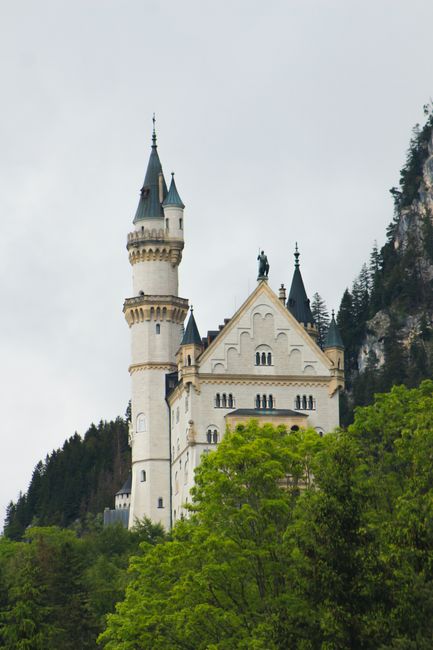
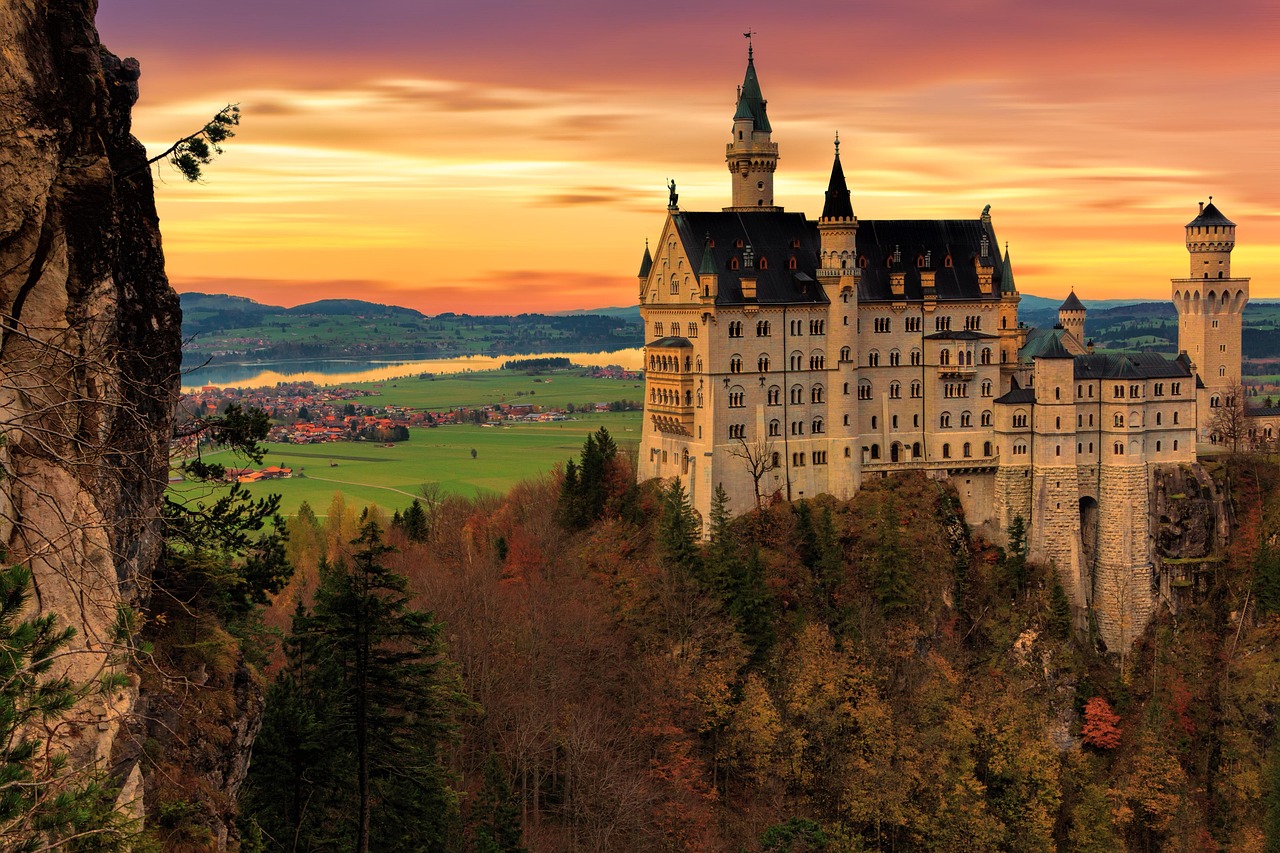
Short answer: Bavaria (Bayern) is the Germany of postcards: fairy-tale castles, Alpine peaks and clear mountain lakes, beer gardens and Oktoberfest, half-timbered towns and the country’s most famous Christmas markets. Start with Munich, then add Neuschwanstein Castle and the Bavarian Alps to the south, and Nuremberg and Rothenburg ob der Tauber to the north. One week covers the highlights; ten days to two weeks lets you slow down in the mountains and the small towns.
Bavaria is Germany’s largest state by area, about 70,500 square kilometers, roughly the size of Ireland, and home to about 13.25 million people, according to the Bavarian State Office for Statistics. It reaches from the vineyards of Franconia along the river Main in the north to the Alps on the Austrian border in the south. Officially a “Free State” (Freistaat Bayern), it has a strong identity of its own, with its own dialects, its own white-and-blue flag and plenty of regional pride. Historically it has three parts that still feel quite different: Old Bavaria (Upper and Lower Bavaria and the Upper Palatinate) in the south and east, Swabia in the south-west and Franconia in the north. For entry rules, money, tipping and the Deutschlandticket, see our Germany travel guide.
Where to go in Bavaria
Most first trips are built around two bases: Munich for the south (the city, the castles, the lakes and the Alps) and Nuremberg for the north (Franconia and the Romantic Road towns). Direct trains link the two, so you can easily see both on one trip.
Munich
Bavaria’s capital is prosperous, green and easy to enjoy: Marienplatz and the Glockenspiel in the New Town Hall, the onion-domed Frauenkirche, the Residenz palace of the Bavarian kings, the Pinakothek art galleries, Nymphenburg Palace and the English Garden, where surfers ride a standing wave on the Eisbach. Beer halls and leafy beer gardens are part of daily life, not just a tourist show. Munich is also the easiest base for day trips to Neuschwanstein, the lakes and the mountains. Our Munich travel guide has neighborhoods, ticket prices and airport transport.
The Bavarian Alps
The mountains begin about an hour south of Munich and run along the Austrian border from the Allgäu in the west to Berchtesgaden in the east. Garmisch-Partenkirchen sits below the Zugspitze, Germany’s highest mountain at 2,962 meters; Berchtesgaden has Lake Königssee and the only Alpine national park in Germany; and near Füssen, Neuschwanstein and Hohenschwangau castles look out over the Alpine foothills. In between are painted villages such as Oberammergau and Mittenwald, the Partnach Gorge and the Baroque Ettal Abbey. Read our Bavarian Alps travel guide for castle tickets, cable cars and where to stay.
The Romantic Road and Franconia
Created in 1950, the Romantic Road (Romantische Straße) is Germany’s best-known scenic route: about 460 km from Würzburg on the Main to Füssen at the foot of the Alps. Highlights along the way are Würzburg’s Residence, a UNESCO-listed Baroque palace with a famous Tiepolo ceiling fresco; the walled town of Rothenburg ob der Tauber, best seen early in the morning or after the day-trippers leave; Dinkelsbühl and Nördlingen, built inside a meteorite crater; and Augsburg, one of Germany’s oldest cities. Further north and east, Franconia has the UNESCO-listed old town of Bamberg, known for its smoked beer, and the wine villages along the Main, where dry Franconian wine comes in a flat, round bottle called a Bocksbeutel.
Nuremberg
Franconia’s main city was largely rebuilt after the Second World War, but its sandstone old town, ringed by walls, still feels medieval. Climb to the Imperial Castle for the view, visit the house where Albrecht Dürer lived and worked, and eat the city’s small grilled sausages, Nürnberger Rostbratwürste. The Documentation Center at the former Nazi Party Rally Grounds and the Memorium Nuremberg Trials are sobering, essential visits. From late November, the Christkindlesmarkt fills the main square. See our Nuremberg travel guide.
The lakes
Bavaria is full of lakes, most of them clean enough to swim in during summer. Lake Starnberg and the Ammersee are a short S-Bahn ride from Munich. The Chiemsee, the largest lake entirely in Bavaria, has King Ludwig II’s Herrenchiemsee palace, a copy of Versailles, on an island reached by boat. In the mountains, the Tegernsee, Schliersee, Walchensee and Eibsee are framed by peaks, and the fjord-like Königssee near Berchtesgaden is reached by quiet electric boats only. In the far south-west, the island town of Lindau sits on Lake Constance, which Bavaria shares with Baden-Württemberg, Austria and Switzerland.
Regensburg, Passau and eastern Bavaria
Regensburg, on the Danube, has one of the best-preserved medieval city centers in Germany, a UNESCO World Heritage Site with a 12th-century Stone Bridge and a Gothic cathedral. Downstream, Passau stands where the Inn and Ilz rivers meet the Danube, close to the Austrian border. North of it, the Bavarian Forest is a quiet, wooded upland with Germany’s first national park, good for hiking and cross-country skiing away from the crowds.
Top things to do in Bavaria
Visit King Ludwig II’s castles
King Ludwig II of Bavaria spent his fortune on dream palaces, and in 2025 four of them, Neuschwanstein, Linderhof, Herrenchiemsee and the King’s House on Schachen, were added to the UNESCO World Heritage List together. Neuschwanstein is the most famous: visits are by guided tour with a timed ticket only, and as of October 2026 adult tickets cost €21 (under-18s free, but children still need a ticket), plus a €2.50 online booking fee per ticket. From May to October, book well ahead on the official ticket site, because the remaining same-day tickets usually sell out early. Linderhof, the smallest and only palace Ludwig saw completed, costs €11 for the palace alone, and Herrenchiemsee on the Chiemsee has a combined palace and museum ticket for €14 (the boat to the island is extra).
If you plan to visit several palaces, look at the Bavarian Palace Administration’s 14-day ticket: €40 for one person or €80 for a family or partner ticket in 2026. It covers more than 40 state-run palaces and castles, including Neuschwanstein, Linderhof and Herrenchiemsee; check the list of included sights on the Palace Administration’s site before you buy. It does not cover Hohenschwangau Castle, which is privately run, and you still need to reserve a time slot for Neuschwanstein.
Sit in a beer garden
The beer garden is Bavaria’s great summer institution: long wooden tables under chestnut trees, a one-liter Mass of beer and a pretzel. Bavaria’s 1999 beer garden ordinance even describes the tradition that you may bring your own food. In practice, at a traditional beer garden you can unpack a picnic at the tables without tablecloths, as long as you buy your drinks there. Munich has dozens, from the Chinese Tower in the English Garden to the huge Hirschgarten. Outside the cities, monastery breweries such as Andechs, above the Ammersee, and Weltenburg on the Danube combine a walk with a beer and a view.
Hike, ski and ride up the mountains
From late spring to autumn, the Bavarian Alps are made for hiking, with marked trails, mountain huts serving lunch, and cable cars that do much of the climbing for you. The Zugspitze can be reached by cogwheel train and cable car from Garmisch-Partenkirchen or Grainau; as of October 2026, the summer round-trip ticket costs €78 for an adult. The Partnach Gorge near Garmisch, the Breitachklamm near Oberstdorf and the Königssee boat to St. Bartholomä are easier outings with big rewards. In winter, Garmisch-Partenkirchen, Oberstdorf and the Zugspitze glacier are the main ski areas; the Zugspitze expects to open for skiing on 27 November 2026, weather permitting. Bavaria’s ski resorts are smaller than the big Austrian ones, but they are close to Munich and good value for a few days.
Go to the Christmas markets
From late November to Christmas Eve, almost every Bavarian town has a Christmas market, with mulled wine (Glühwein), gingerbread, roasted almonds and handmade decorations. In 2026, the municipal Christkindlmarkt on Munich’s Marienplatz runs from 20 November to 24 December, and Nuremberg’s Christkindlesmarkt, perhaps the most famous in Germany, runs from 27 November to 24 December, opening with the Christkind’s prologue on the evening of 27 November. Rothenburg’s Reiterlesmarkt and the market in front of Regensburg’s Thurn und Taxis palace are among the most atmospheric smaller ones. Most markets close early on 24 December, so do not plan a market visit for Christmas Eve evening.
Oktoberfest
Munich’s Oktoberfest, held on the Theresienwiese, is the world’s best-known folk festival, with huge beer tents, fairground rides and traditional dress. Despite its name, it starts in September. The 2026 festival ran from 19 September to 4 October; the official dates for 2027 are 18 September to 3 October. Entry to the grounds is free. Hotels in Munich fill up and get much more expensive during the festival, so book early, or stay in a nearby town with a good train connection. If crowds are not your thing, the Gäubodenvolksfest in Straubing, the Nuremberg folk festivals and countless village fairs offer a smaller taste of the same tradition.
Explore palaces, churches and old towns
Beyond Ludwig’s castles, Bavaria has some of Europe’s finest Baroque and Rococo buildings: the Würzburg Residence (€10 for adults as of 2026, under-18s free), the pilgrimage church of Wies in a meadow near Steingaden (a UNESCO World Heritage Site), Ettal Abbey and the Munich Residence. The medieval old towns of Bamberg and Regensburg are also on the UNESCO list, and Rothenburg, Dinkelsbühl and Nördlingen still have their complete town walls.
When to go to Bavaria
Bavaria has four clear seasons. Summers are warm and fairly wet, with afternoon thunderstorms, especially near the Alps; winters are cold, with snow likely in the mountains and frost in the towns. The Alps are much wetter than the north: Garmisch-Partenkirchen gets about 1,370 mm of rain and snow a year, Munich about 940 mm and Nuremberg about 600 mm. The figures below are 1991–2020 averages from the German Weather Service (DWD) for Munich (München-Stadt station) and Garmisch-Partenkirchen.
| Season | Munich: average high / low | Garmisch: average high / low | What it’s like | Good for |
|---|---|---|---|---|
| Winter (Dec–Feb) | 4–6 °C / −2 to −1 °C | 3–6 °C / −6 to −5 °C | Cold and often gray in the lowlands, snowy in the mountains | Christmas markets, skiing, museums, palace visits with no lines |
| Spring (Mar–May) | 10–19 °C / 2–9 °C | 10–18 °C / −2 to 6 °C | Changeable March and April, green and blooming May; snow lingers high up | Beer gardens reopening, castles before the summer crowds, valley walks |
| Summer (Jun–Aug) | 23–25 °C / 13–15 °C | 22–23 °C / 10–11 °C | Warm and sunny, the wettest months, with afternoon storms | Hiking, swimming in the lakes, beer gardens, festivals |
| Autumn (Sep–Nov) | 20 °C falling to 8 °C / 10 °C falling to 2 °C | 19 °C falling to 8 °C / 8 °C falling to −1 °C | Golden, often clear September and October; foggy November | Oktoberfest, hiking, autumn color, wine festivals in Franconia |
Best overall: late May to June and September to early October, when the weather is usually pleasant, the mountain trails and lake boats are running, and the castles are a little less crowded than in July and August. For skiing: January to March. For Christmas markets: late November to 23 December. Remember that hotels in Munich are at their busiest and most expensive during Oktoberfest and big trade fairs, and that German school holidays fill the Alps and lakes in August.
Getting there and getting around
Airports
Munich Airport (MUC) is Bavaria’s main gateway, with flights from across Europe and nonstop routes from North America and Asia. S-Bahn lines S1 and S8 run to Munich’s main station in about 40 minutes; together they give a train about every 10 minutes for most of the day. Nuremberg Airport (NUE) is smaller, with mainly European flights, and the U2 subway reaches Nuremberg’s main station in 12 minutes. Salzburg Airport, just across the Austrian border, is handy for Berchtesgaden, and some travelers fly into Frankfurt and take the train, which is useful for Würzburg and the northern end of the Romantic Road.
Trains and the Bayern-Ticket
Deutsche Bahn’s ICE trains link Munich, Nuremberg and Würzburg with each other and with the rest of Germany; check current journey times on bahn.de, as works can lengthen some trips. Regional trains reach Füssen (for Neuschwanstein), Garmisch-Partenkirchen, Berchtesgaden, the lakes and most small towns.
For day trips, the Bayern-Ticket is one of the best deals in Germany. As of October 2026, it costs €34 for one person in second class, plus €10 for each extra person, up to five people (€74 for five). It is valid for a day on all regional trains in Bavaria, plus most local buses, trams, U-Bahn and S-Bahn, and some routes into neighboring states and Austria. On weekdays it is valid from 9:00 to 3:00 the next morning; on weekends and public holidays, from midnight. Children under 6 travel free, and up to three children aged 6 to 14 can travel free with the ticket holder. It is not valid on ICE or IC long-distance trains. Buy it at bahn.de, in the DB Navigator app or at station machines. If you are staying for a while, the monthly Deutschlandticket (see our Germany guide) covers the same regional trains and local transport across the whole country.
Driving
A car is the easiest way to follow the Romantic Road, explore the Alpine valleys and reach smaller villages, but you do not need one in Munich or Nuremberg, where parking is expensive and both cities have environmental zones that require a green emissions sticker. German Autobahns have no tolls for cars, but if your route crosses into Austria, for example on the way to Berchtesgaden or Lake Constance, you will need an Austrian motorway vignette. In winter, cars must have winter tires in wintry road conditions, and some mountain roads close. Near Neuschwanstein, the roads are not open to private cars beyond the parking lots, so plan to walk, take the shuttle bus or ride a horse-drawn carriage up.
Food and drink in Bavaria
Bavarian food is hearty, generous and best enjoyed in an inn (Wirtshaus) or a beer garden. In the south, try a soft pretzel (Breze) with Obatzda, a spiced cheese spread; roast pork (Schweinebraten) or crispy pork knuckle (Schweinshaxe) with potato dumplings; and Leberkäse, a meatloaf usually eaten in a roll. The Munich white sausage (Weißwurst) is traditionally eaten as a late breakfast with sweet mustard, a pretzel and a wheat beer, and by tradition before noon. In the Allgäu, look for Kässpatzen, cheesy noodles with fried onions; in the mountains, Kaiserschmarrn, a torn, sugared pancake, is the classic hut lunch.
Franconia has its own kitchen: Nuremberg’s finger-sized grilled sausages, served six or more at a time; Schäufele, roast pork shoulder; and Nuremberg gingerbread (Lebkuchen), especially at Christmas. Rothenburg is known for Schneeballen, balls of fried pastry. Bavaria is famous for beer, from Munich’s lagers and wheat beers to the smoked beer (Rauchbier) of Bamberg and the many small village breweries of Franconia. The region along the Main also makes white wines, mainly Silvaner and Müller-Thurgau, sold in the distinctive Bocksbeutel. Vegetarian dishes are easy to find in the cities and increasingly in country inns too.
Plan your trip
Tell our AI trip planner how many days you have and what you enjoy, and it will build a Bavaria itinerary from our guides, for example Munich, Neuschwanstein and the Alps, or Nuremberg and the Romantic Road. Check the forecast and monthly averages for each stop with our Destination weather tool, and use the packing list to pack for both the city and the mountains: layers, a rain jacket and good walking shoes are useful in every season.
Frequently asked questions
What is the best time to visit Bavaria?
Late May to June and September to early October are the best all-round months, with mild weather, open mountain trails and fewer crowds than midsummer. Come from late November to 23 December for the Christmas markets, and from January to March for skiing.
How many days do you need in Bavaria?
One week is enough for Munich, Neuschwanstein, a day in the Alps and a day or two in Nuremberg or Rothenburg. With ten days to two weeks, you can add Berchtesgaden and the Königssee, a lake, Bamberg or Regensburg, and more of the Romantic Road.
Can I visit Neuschwanstein Castle as a day trip from Munich?
Yes. Take a regional train to Füssen, then a local bus to Hohenschwangau, or drive. Book your timed tour ticket in advance, especially from May to October, and arrive in good time, because the walk up to the castle takes 30 to 40 minutes. A Bayern-Ticket covers the regional train and most local buses for a day, and for a group it is good value.
What is the Bayern-Ticket and is it worth it?
It is a one-day ticket for regional trains and most local transport across Bavaria, costing €34 for one person plus €10 for each extra person, up to five, as of October 2026. It does not cover ICE or IC trains. It is usually worth it for any day trip, especially for couples and families.
When is Oktoberfest in 2027?
Oktoberfest 2027 runs from 18 September to 3 October on the Theresienwiese in Munich, according to the official Oktoberfest website. Entry to the grounds is free, but book your hotel early.