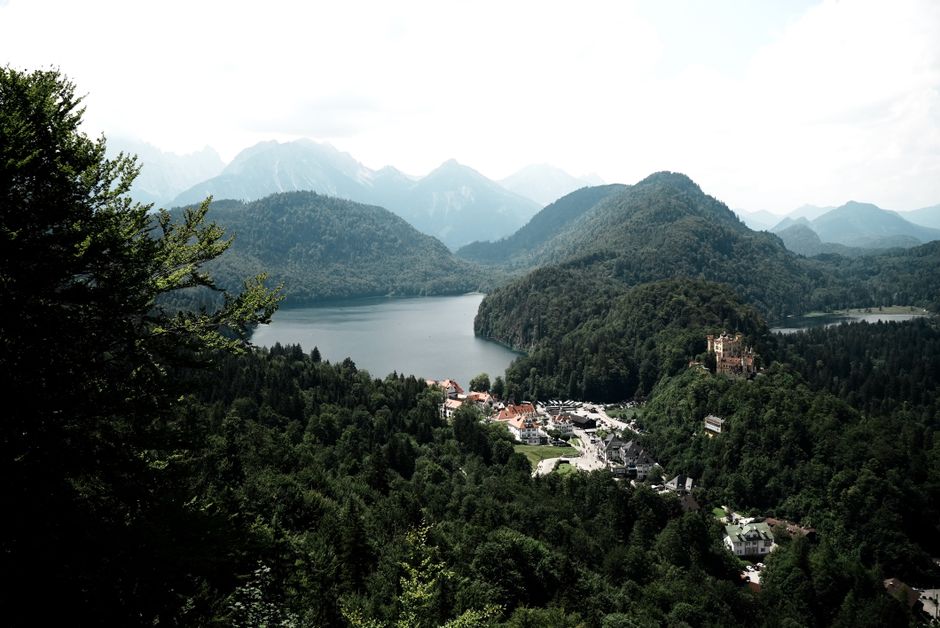
The Bavarian Alps are Germany’s slice of the Alps: a band of limestone peaks, green pastures, emerald lakes and onion-domed churches along the Austrian border, from the Allgäu in the west to Berchtesgaden in the east. You come for King Ludwig II’s fairy-tale castles at Neuschwanstein and Linderhof, the ride up the Zugspitze, Germany’s highest mountain, a boat on the Königssee, walks through roaring gorges, and beer gardens with a mountain view. Everything is within two or three hours of Munich, so it works as a day trip, but the region deserves four days to a week.
Right now in Bavarian Alps (Garmisch-Partenkirchen)
- Wed 8–21°C 47–71°F Mostly clear
- Thu 11–18°C 52–64°F 33 mm Heavy rain
- Fri 6–12°C 42–54°F 2 mm Partly cloudy
Weather: MET Norway (CC BY 4.0) · Rates: ECB
Top tours in Bavarian Alps
See all tours for Bavarian Alps →
From local operators, with prices and reviews; you check availability and book on Viator, our partner. We may earn a commission at no extra cost to you. How we earn money
The Bavarian Alps at a glance
- Best for: royal castles, Alpine lakes, hiking and hut-to-hut walks, mountain railways and cable cars, gorges, skiing and Bavarian food and beer.
- How long: 3–4 days for the castles, the Zugspitze and one lake; a week to add Berchtesgaden and some proper hiking.
- Best time: June to early October for hiking, lakes and open passes; mid-December to March for snow; September for clear days and fewer crowds.
- Getting in: Munich airport, then regional trains to Garmisch-Partenkirchen, Füssen or Berchtesgaden; Salzburg is the closest airport for Berchtesgaden.
- Book ahead: Neuschwanstein and Hohenschwangau tickets online. On-site tickets are same-day only and usually sell out by late morning.
- Before you go: entry rules, money and general safety are in our Germany travel guide.
The Bavarian Alps, area by area
The Bavarian Alps (Bayerische Alpen) run along Bavaria’s southern border with Austria. There is no single centre: pick a base in one of four areas and link them by train or car through the foothills.
Füssen and Schwangau (Allgäu)
At the western end, the old town of Füssen and the village of Hohenschwangau sit between lakes (the Forggensee, Alpsee and Schwansee) under the castles of Neuschwanstein and Hohenschwangau. Further west in the Allgäu, Oberstdorf is a hiking and ski resort under the Nebelhorn, with the Breitachklamm gorge nearby. Best for: the castles, lakeside cycling and a first visit.
Garmisch-Partenkirchen and the Werdenfels country
Garmisch-Partenkirchen, two old villages joined for the 1936 Winter Olympics, lies under the Zugspitze and the Alpspitze. Its painted houses, the Olympic ski jump (home of the New Year’s jump) and the Partnachklamm gorge are close together, with Grainau and the Eibsee, Mittenwald, Oberammergau, Ettal and Linderhof nearby. Best for: mountains, hiking and skiing, with good train links.
Tegernsee, Schliersee and the Chiemgau
Between Garmisch and Berchtesgaden, the Tegernsee, Schliersee and Walchensee are weekend escapes from Munich, with promenades, swimming spots and gentle summits. On the Chiemsee, the “Bavarian Sea”, boats go to King Ludwig’s Herrenchiemsee Palace. Best for: lakes, easy walks and short trips from Munich.
Berchtesgaden
The south-eastern corner is a pocket of Bavaria wrapped by Austria, 30 km from Salzburg. It holds Germany’s only Alpine national park, the Watzmann (2,713 m), the fjord-like Königssee, the historic salt mine and the Eagle’s Nest. Best for: scenery, the national park and history; pair it with a day in Salzburg.
King Ludwig’s castles
In July 2025, UNESCO listed the Palaces of King Ludwig II of Bavaria (Neuschwanstein, Linderhof, the King’s House on Schachen and Herrenchiemsee) as a World Heritage Site. Prices, dates and rules below were checked on the official sites in October 2026. They change, so check before you go.
Neuschwanstein Castle
The white castle on a crag above the Pöllat gorge was built for Ludwig II from 1869 and never finished. You can only see the inside on a timed guided tour of about 30 minutes, in German or English or with an audio guide; late arrivals cannot join. There are about 350 steps, a lift for wheelchair users (book ahead), and no photos inside.
Tickets and the Ticket Center. As of October 2026, admission is €21 for adults (€20 reduced). Under-18s go free, but every child still needs a ticket for safety reasons. Tickets are sold in the official online shop of the Hohenschwangau Ticket Center, with a €2.50 booking fee per ticket, including free children’s tickets. Online tickets cannot be changed or refunded. A limited number of extra tickets go on sale each morning from 8:00 at the Ticket Center in Hohenschwangau, but only for the same day, first come first served, and they usually sell out by late morning. Reservations by phone or email are not possible. The castle opens 9:00–18:00 from 28 March to 15 October, and 10:00–16:00 from 16 October to 27 March. It is closed on 1 January and 24, 25 and 31 December.
Getting up and the Marienbrücke. No private cars are allowed on the castle road. Park in one of the four village car parks (€12 for up to 6 hours as of October 2026) and walk up: 1.5 km and 30–40 minutes, steep. Horse-drawn carriages leave from Hotel Müller and stop about 10–15 minutes’ walk below the castle. A shuttle bus from the P4 car park climbs to the “Jugend” viewpoint above the castle (€3.50 up or €5 return as of October 2026); from there it is 5 minutes to the Marienbrücke, the iron bridge over the gorge with the classic view of the castle, and about 15 minutes downhill to the entrance. Neither the bus nor the carriages can be booked. As of early October 2026 the Marienbrücke was open, but it closes temporarily in winter when there is snow or ice, and the bus does not run in snow or ice either. The castle tours carry on in all weathers. The Ticket Center says to arrive in the village 1.5–2 hours before your Neuschwanstein tour.
Road works. Schwangau’s through road is closed from 15 September to about mid-December 2026, with a detour via Hohenschwangau; allow extra time.
Hohenschwangau Castle and the Museum of the Bavarian Kings
The yellow castle opposite Neuschwanstein is where Ludwig II grew up. His father, Maximilian II, rebuilt it from a ruin in the 1830s. It is still owned by the Wittelsbach family’s foundation, so Bavarian palace passes are not valid here. Tours last about 45 minutes and involve about 180 steps, with no lift. As of October 2026, an adult ticket costs €23.50, children aged 7–17 pay €12 and under-7s go free, plus the €2.50 online fee. From 16 October 2026 the castle is open 10:00–16:00. By the Alpsee, the Museum of the Bavarian Kings tells the story of the dynasty (€14.50, with an audio guide included). The Swan Ticket combines both castles and the museum on one day for €56, plus a €7.50 online fee.
Linderhof Palace
Ludwig’s smallest palace, the only one he saw finished, stands in a quiet valley near Ettal, 30 minutes from Garmisch, with a gilded interior, terraced gardens and the Venus Grotto, an artificial cave with a lake. As of October 2026, the palace costs €11, the grotto €9 and the combined ticket €18. Children under 18 go free, and some tickets are sold online. From 16 October to 14 April only the palace is open (10:00–16:30), and the grotto and park buildings are closed. The Moorish Kiosk is under scaffolding, and the palace administration hopes to reopen it in 2028. In summer 2026 a water shortage stopped the fountain in front of the palace, while the other water features kept running.
The Zugspitze and Garmisch-Partenkirchen
At 2,962 m, the Zugspitze is Germany’s highest mountain, with the border with Austria running across its summit and views over four countries on a clear day. There are two ways up from the German side. The cogwheel train (Zugspitzbahn) leaves from its own station next to Garmisch-Partenkirchen’s main station and climbs through Grainau and a long tunnel to the Zugspitzplatt glacier plateau in about 75 minutes. There, the Gletscherbahn cable car takes you the last few hundred metres to the summit. The faster way is the Seilbahn Zugspitze cable car from the Eibsee, which reaches the top in about 10 minutes. Most people ride up one way and down the other.
Prices and dates. As of October 2026, the summer Ticket Zugspitze (one ascent and one descent by any combination of railway and cable cars, including the round trip) costs €78 for adults, €62.50 for youths aged 16–18 and €39 for children aged 6–15. Children aged 6–18 travelling with a parent pay the family rate of €12.50, and under-6s ride free. A one-way ticket is €46. Summer rates apply until 22 November 2026, and winter rates from 27 November. The whole Zugspitze is closed for maintenance on 9–13, 16–20 and 23–26 November 2026, and the cogwheel train’s valley section is replaced by buses on 9–20 November. The glacier ski season was expected to run from 27 November 2026 to 2 May 2027.
Tips. Go early on a clear day: the Eibsee car park fills up and the single access road jams in summer. Parking there was reported at €20 for 4 hours, with a discount for lift customers. The Deutschland-Ticket covers only the cogwheel train’s valley section from Garmisch to Grainau, not the mountain section or the cable cars. It is cold on top: the summit’s average high is only about 6–7 °C in July and around −7 °C in January.
Partnachklamm
About 25–30 minutes’ walk from Garmisch’s Olympic ski stadium, the Partnach Gorge path runs through rock tunnels above a torrent between walls up to 80 m high. As of October 2026, entry costs €10 for adults (€9.50 with a local guest card) and €5 for children aged 6–17. Tickets are sold at the ticket office, at machines or online (download yours before you go, as there is no phone signal in the gorge). It is open 8:00–20:00 from June to September and 8:00–18:00 from October to May, with last entry 30 minutes before closing. It can close at short notice for safety. Pushchairs and walkers are not allowed, so bring a waterproof layer. From 21 September to 20 November 2026, the trail past the gorge towards Vordergraseck is closed for works, but the gorge itself is open.
Berchtesgaden, the Königssee and the Eagle’s Nest
Königssee boats
The Königssee is a narrow green lake (about 8 km long and 190 m deep) between sheer walls in the national park. Electric boats run from Schönau to St. Bartholomä, the red-domed chapel under the Watzmann, in about 35 minutes, with a trumpet stop to show off the echo. Boats continue to Salet, from where a 15-minute walk leads to the smaller Obersee and on to the Röthbach waterfall, about 400 m high. As of October 2026, an adult return to St. Bartholomä costs €23.40 and to Salet €29.80. The Salet boats ran until 11 October 2026; the trip to St. Bartholomä runs all year, though the lake can occasionally freeze in January or February. On busy summer days, the operator advises arriving before 10:30 and heading back by 14:30 to avoid long queues.
The Eagle’s Nest (Kehlsteinhaus)
The Kehlsteinhaus (1,834 m), built for the Nazi leadership and undamaged in the war, is now a restaurant with views up to 200 km. Private cars are banned from its 6.5 km road. Special buses run from the Obersalzberg (Hintereck) about every 25 minutes, then a 124 m tunnel leads to a brass lift that climbs 124 m inside the mountain. The season runs from early or mid-May to late October or early November, depending on the weather, and buses can be suspended at short notice for snow, storms or rockfall. Plan about two hours for the visit; your return bus is booked automatically. From about late September the buses run shorter hours (first up 9:20, last down 15:35). Tickets are sold online or at the bus station, and holders of a Berchtesgaden guest card get a discount. The Obersalzberg Documentation Centre nearby explains the site’s history.
Also in Berchtesgaden: the salt mine tour with miners’ slides, the Jenner cable car, and national park walks to the Wimbachklamm gorge and the Hintersee.
Palaces
- Hohenschwangau Castle
- Linderhof Palace
- Neuschwanstein Castle
Peaks and mountains
- Zugspitze
Monuments
- Wieskirche
Nature
- Königssee
Other sights
- Kehlsteinhaus
Hiking, lakes and skiing
Marked trails, signposted with walking times, link mountain huts (Hütten) and pasture inns (Almen), many run by the German Alpine Club (DAV). The season runs from June to mid-October; high paths can hold snow into June.
- Easy: the Eibsee loop, the Alpsee shore, the Tegernsee promenade, the Partnachklamm.
- Classic day hikes: through the Partnachklamm to the Eckbauer, the Osterfelderkopf under the Alpspitze, the Wank, the Tegelberg above Neuschwanstein, and the Jenner.
- Bigger days: the Höllental route up the Zugspitze (with a glacier and via ferrata sections, for experienced climbers or with a guide), and the Watzmann traverse.
Safety. Summer afternoons bring thunderstorms: start early and be off ridges by early afternoon. Carry a rain jacket and a warm layer even on hot days. In an emergency, call 112. See our hiking guide.
Lakes and swimming. The Eibsee, Alpsee, Tegernsee and Walchensee have bathing spots from June to early September; the water is clear but cold. Rowing boats and paddle boards can be hired. See our boat trips guide.
Skiing. Bavarian ski areas are smaller than Austria’s but easy to reach. The Zugspitze glacier has the most reliable snow, and Garmisch-Classic (expected season mid-December to 29 March 2027) has the Kandahar run. Oberstdorf and the Sudelfeld are also popular.
More things to do
- Oberammergau and Ettal: painted house fronts (Lüftlmalerei), wood-carving shops and the great Baroque abbey of Ettal, which brews its own beer.
- Cycling: the flat loop around the Forggensee near Füssen, lakeside paths at Tegernsee and Chiemsee, and e-bike tours to pasture inns. See our cycling guide.
- Food and beer: roast pork with dumplings, Weisswurst before noon, Kaiserschmarrn (torn pancake), cheese spätzle in the Allgäu, and monastery beer at Ettal or Andechs.
Activities and best months
- Boat tripsQuiet electric boats cross the Konigssee in Berchtesgaden National Park to St. Bartholoma's pilgrimage church in about 35 minutes, and the boatman plays a trumpet to show off the famous echo. Boats run to St. Bartholoma all year, but to Salet (a short walk from the Obersee) only from the end of April to mid-October; 2026 sailings to Salet end on 11 October. · source
- HikingBerchtesgaden National Park has 260 km of hiking trails and alpine paths, colour-coded blue (easy), red (medium, some wire-rope sections) and black (difficult, exposed climbing). Berchtesgaden's tourism office lists 98 routes, from short walks to all-day summit hikes. At Garmisch-Partenkirchen, Germany's highest peak, the Zugspitze (2,962 m), can be climbed via the easier Reintal or the harder Hollental, best from mid-June to mid-September. · source
Getting to the Bavarian Alps
By air. Munich airport is the main gateway, about 1.5 hours by car to Garmisch-Partenkirchen and about 2 hours to Füssen or Berchtesgaden. Salzburg airport, in Austria, is only about 30 km from Berchtesgaden, and Innsbruck is about an hour from Garmisch. Memmingen airport is closest to the Allgäu.
By train. From Munich, regional trains reach Garmisch-Partenkirchen in about 1 hour 20 minutes and Füssen in about 2 hours. From Füssen station, regional buses go to the stop for the castles at Hohenschwangau. Berchtesgaden is about 2.5–3 hours from Munich, changing at Freilassing. The Deutschland-Ticket (€63 a month in 2026) is valid on all regional trains and local buses in Germany, but not on cable cars or mountain railways, apart from the Zugspitze valley section mentioned above. Many hotels give guests a local card with free buses.
By car. A car makes it easy to combine the castles, Linderhof and the Zugspitze, and the German Alpine Road links the range from Lindau to Berchtesgaden. Expect summer weekend traffic. Austrian motorways need a vignette, and winter tyres are required in snow.
When to go and how long to stay
Expect warm, showery summers and cold, snowy winters; this is one of Germany’s wettest areas. The table uses the 1991–2020 normals of the German Weather Service (DWD) for Garmisch-Partenkirchen (719 m). At the Zugspitze summit, average highs are about 10 °C lower in winter and 17 °C lower in summer.
| Season | Average high / low | Rain per month | What it’s like |
|---|---|---|---|
| Spring (Mar–May) | 10–18 °C / −2 to 6 °C | 85–145 mm | Snow lingers up high into May; valleys turn green; some lifts and huts close between seasons |
| Summer (Jun–Aug) | 21–23 °C / 10–11 °C | 170–190 mm | Hiking and lake season; warm days, frequent afternoon thunderstorms; busiest in August |
| Autumn (Sep–Nov) | 19 °C falling to 8 °C / 8 °C falling to −1 °C | 80–115 mm | Clear, settled September and golden October; cattle drives; lifts close for maintenance in November |
| Winter (Dec–Feb) | 3–6 °C / −6 to −5 °C | 65–80 mm | Snowy and cold; ski season from December; Christmas markets; the Marienbrücke may close in ice |
At Garmisch, summer brings some rain on 18–20 days a month, mostly short showers. September is often the most settled month.
The Bavarian Alps in 4 days
Day 1: Neuschwanstein (booked) and Hohenschwangau, the Marienbrücke and the Alpsee; stay in Füssen. Day 2: drive via the Wieskirche (a UNESCO-listed rococo church) to Oberammergau and Linderhof; stay in Garmisch. Day 3: the Zugspitze up by cogwheel train and down by cable car to the Eibsee, then the Partnachklamm late in the day. Day 4: a hike to the Eckbauer or the Wank, or a day by the Walchensee.
A week in the Bavarian Alps
Add the Tegernsee and two or three days in Berchtesgaden (the Königssee, the salt mine, the Eagle’s Nest and an evening in Salzburg), returning via Herrenchiemsee to Munich.
Weather month by month
Averages from DWD normals 1991–2020, Garmisch-Partenkirchen · Last reviewed 4 Oct 2026
Where to stay in the Bavarian Alps
- Füssen or Schwangau: walk or bus to the castles before the day crowds arrive; good value.
- Garmisch-Partenkirchen: the best all-round base, with trains to Munich, the Zugspitze and the gorge, and the most hotels and restaurants.
- Oberammergau or Mittenwald: village charm, close to Linderhof and the Karwendel.
- Berchtesgaden or Schönau am Königssee: for the national park, the lake and Salzburg.
Book early for July, August and Christmas. Most towns charge a small tourist tax that gets you a guest card with free local buses.
Practical tips for the Bavarian Alps
- Book the castles: buy Neuschwanstein and Hohenschwangau tickets online as soon as your dates are fixed, and add every child to the same order.
- Leave big bags behind: large backpacks and pushchairs are not allowed in the castles, and the Ticket Center has no luggage storage.
- Start early: parking at the Eibsee, Hohenschwangau and the Königssee fills by mid-morning in summer.
- Check the webcams: skip the Zugspitze in cloud.
- Cash: cards are widely accepted, but carry some cash for huts, pasture inns and small car parks.
What to pack for the Bavarian Alps
In summer: walking shoes or light hiking boots with good grip (gorge paths are wet), a waterproof jacket, a warm fleece for the Zugspitze summit, sunglasses and high-factor sunscreen, a day pack and a refillable bottle. Bring a swimsuit for the lakes. In winter: warm layers, waterproof boots with grip for icy paths, a hat and gloves, and snow chains or winter tyres if you drive. See our guides to hiking shoes and rain jackets.
What to pack
- Day packs and anti-theft bagsA 20–30 litre pack carries layers, water, a head torch and snacks on full-day levada walks.
- Dry bags and phone pouchesSpray soaks phones and cameras on open boats to the Algarve caves and on whale-watching trips.
- Fleeces and warm layersIt is cooler at sea than on land, especially on morning whale-watching trips.
- HeadlampsLevada routes such as PR1 and PR9 pass through long, dark, wet tunnels.
- Hiking shoes and bootsMadeira's levadas and the Azores' crater rims are wet, rocky and slippery, so grippy shoes matter more than anywhere else in Portugal.
- Rain jacketsA windproof, waterproof shell keeps you warm on open boats, where wind and spray cool you quickly.
- Reef-friendly sunscreenSun reflects off the water on cruises and cave tours.
- Trekking polesLong stone staircases and steep descents on Madeira's peaks and the Azores' crater rims are easier on the knees with poles.
- Water bottles and hydration packsAlgarve and Alentejo trails are hot and exposed with few refill points.
- Water shoesKayak and small-boat trips to the Algarve grottoes land on rock and wet sand.
Bavarian Alps travel FAQ
Do I need to book Neuschwanstein tickets in advance?
Yes, ideally. Tickets are sold online for a timed guided tour, with a €2.50 fee per ticket. A small number of same-day tickets go on sale at the Ticket Center in Hohenschwangau from 8:00, but they usually sell out by late morning.
How much does it cost to visit Neuschwanstein Castle?
As of October 2026, €21 for adults and €20 reduced, plus €2.50 per ticket online. Under-18s go free but still need a ticket. Parking in the village is €12 for up to 6 hours.
Is the Marienbrücke open?
As of early October 2026, yes. It closes temporarily in winter when there is snow or ice, and the Hohenschwangau Ticket Center posts its daily status on its home page. Castle tours run even when the bridge is closed.
Can I visit Neuschwanstein and Hohenschwangau on the same day?
Yes. Book tours at least two to three hours apart to allow for the walk between them. The Swan Ticket (€56 plus a €7.50 online fee as of October 2026) covers both castles and the Museum of the Bavarian Kings.
How much is the Zugspitze ticket?
The summer Ticket Zugspitze cost €78 for adults as of October 2026 (youths €62.50, children €39), covering one way up and one way down by cogwheel train or cable car. Winter prices apply from 27 November 2026.
Is the Zugspitze open in November?
Partly. In 2026 the whole Zugspitze closes for maintenance on 9–13, 16–20 and 23–26 November. The ski season was expected to start on 27 November 2026.
When is the Eagle’s Nest open?
From early or mid-May to late October or early November, depending on snow. Buses from the Obersalzberg run about every 25 minutes, with shorter hours from late September.
Do the Königssee boats run in winter?
Yes, boats to St. Bartholomä run all year, unless the lake freezes or storms or fog stop them. Boats to Salet and the Obersee run only from late April to mid-October.
Is the Partnachklamm worth it?
Yes, it is one of the most dramatic short walks in the Alps, and it is open all year. Entry was €10 for adults as of October 2026. Expect spray and wet paths, and visit early or late to avoid groups.
What is the best base in the Bavarian Alps?
Garmisch-Partenkirchen, for its trains, the Zugspitze, the gorge and day trips to Linderhof. Add a night in Füssen for the castles, and two in Berchtesgaden if you have time.
Can I visit the Bavarian Alps without a car?
Yes. Trains run from Munich to Garmisch, Füssen and Berchtesgaden, and buses link the castles, the Eibsee and the Königssee. Linderhof and some valleys are slower to reach by bus.
When is the best time to visit the Bavarian Alps?
June to early October for hiking, lakes and open lifts, with September often the clearest month. Come from mid-December to March for snow and Christmas markets.
Nearby destinations
- Zillertal35 km
- Innsbruck50 km
- Kitzbühel51 km
- Munich57 km
- Zell am See-Kaprun85 km
- Salzburg97 km
- Dolomites118 km
- Cortina d'Ampezzo126 km
Sources
- © OpenStreetMap contributors · ODbL · fetched 4 Oct 2026
- Wikidata · CC0 · fetched 4 Oct 2026
Sources and last review
Researched and last reviewed on 4 October 2026. Neuschwanstein and Linderhof hours, prices and access: the Bavarian Palace Administration; Hohenschwangau, the Ticket Center, the Marienbrücke, the shuttle bus and parking: the official Hohenschwangau Ticket Center; Zugspitze prices, hours and maintenance dates: Bayerische Zugspitzbahn Bergbahn AG; Partnachklamm: GaPa Tourismus; Königssee boats: Bayerische Seenschifffahrt; Eagle’s Nest season and buses: Berchtesgaden tourism (Bergerlebnis Berchtesgaden) and the Kehlsteinhaus; Deutschland-Ticket: the official Deutschland-Ticket site; climate: German Weather Service (DWD) 1991–2020 normals for Garmisch-Partenkirchen and the Zugspitze from the WMO climate normals collection. Prices, timetables and rules change, so check the official links before you go. For entry rules, money and general safety, see our Germany travel guide; for city time, see our Munich guide.
Plan your trip
Partner links: TravelerCenter may earn a commission if you book, at no extra cost to you.
🇩🇪 Useful German phrases for Bavarian Alps
All 38 German phrases: restaurant, hotel, emergencies, romance (printable) →