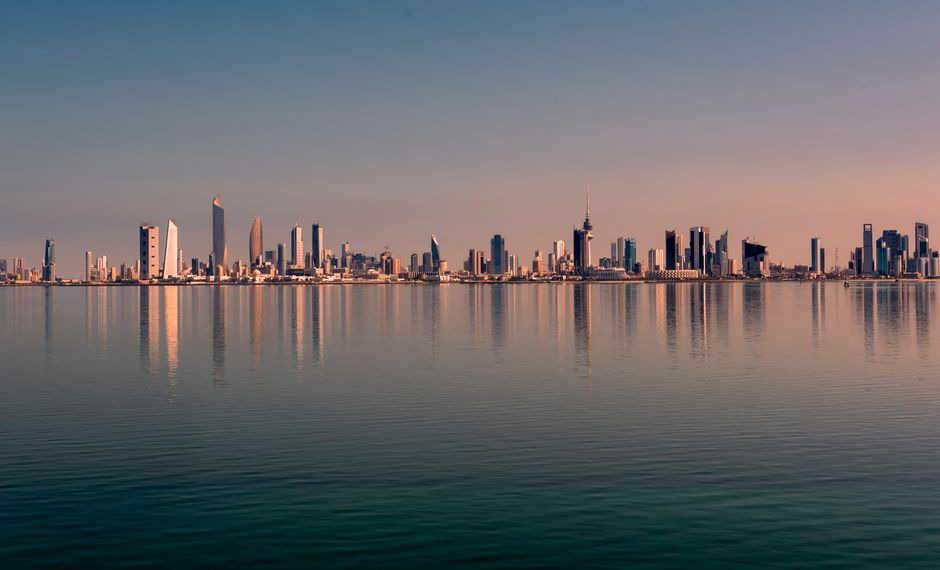
Kuwait City, the capital of the State of Kuwait, curves around the southern shore of Kuwait Bay at the northern end of the Arabian Gulf. It grew from a small 18th-century trading and pearling port into a modern city of highways, towers and seafront promenades, and its metropolitan area is home to almost all of Kuwait’s roughly 4.5 million people. Visitors come to see the Kuwait Towers, the city’s symbol since 1979, the Grand Mosque, the old market of Souq Al Mubarakiya and Sadu House’s Bedouin weaving, and a new cultural district along the corniche with the museums of the Sheikh Abdullah Al Salem Cultural Centre and the opera house of the Sheikh Jaber Al-Ahmad Cultural Centre. Kuwait City is also a place to eat well, from machboos in the souk to Indian, Lebanese and Iranian restaurants and a busy specialty-coffee scene, and to shop in some of the largest malls in the Gulf. Offshore, Failaka Island has the country’s most important ancient sites. Many visitors arrive on a stopover with Kuwait Airways or Jazeera Airways, on business, or to visit family. Kuwait has a hot desert climate: winters are mild and pleasant, while summers are among the hottest on Earth.
Right now in Kuwait City
- Wed32–40°C89–104°FClear
- Thu31–40°C88–104°FPartly cloudy
- Fri32–40°C90–105°FClear
Top tours in Kuwait City
See all tours for Kuwait City →
From local operators, with prices and reviews; you check availability and book on Viator, our partner. We may earn a commission at no extra cost to you. How we earn money
Kuwait City at a glance
- Best months: November to March, with days of about 20–27 °C (68–80 °F) and cool nights. June to August averages 46–47 °C (114–116 °F) by day.
- Time needed: two days for the towers, the mosque, the souk and the museums; three or four days with Failaka Island and the coast.
- Getting there: Kuwait International Airport (KWI) is about 15 km (10 miles) south of the center; airport taxis charge a fixed KWD 8 to Kuwait City.
- Costs (as of October 2026): the Kuwaiti dinar is the world’s highest-valued currency unit, worth about US$3.24; a casual meal costs about KWD 2 to KWD 5 (US$6.50 to US$16).
- Before you go: tourist eVisas, visas on arrival, customs rules and local laws are covered in our Kuwait travel guide.
Kuwait City areas and who each one suits
The city center (Sharq, Qibla and Mirqab)
Inside the line of the old city wall, the center has the Seif Palace, the Grand Mosque, Souq Al Mubarakiya, the National Assembly, office towers such as Al Hamra Tower, and the Liberation Tower. Business hotels here suit short stays and sightseeing on foot in winter.
Arabian Gulf Street and the corniche
The coastal road runs from the Kuwait Towers past Sharq’s marina and Souq Sharq mall to the cultural district and Shuwaikh. Its promenades, beaches and seafront hotels are the best place for evening walks, especially in winter.
Salmiya
East of the center, Salmiya is the busiest seaside district, with the Scientific Center, the Marina Crescent and Marina Mall, cafes, restaurants and many mid-range hotels and serviced apartments. It suits visitors who want street life and the sea.
Hawalli and Jabriya
Inland from Salmiya, these dense residential districts have inexpensive restaurants, the Tareq Rajab Museum in Jabriya and the Bayt Al-Othman museum in Hawalli.
Shuwaikh and the cultural district
West of the center, the Sheikh Abdullah Al Salem and Sheikh Jaber Al-Ahmad cultural centers, Al Shaheed Park and the Kuwait National Museum area mark Kuwait’s new cultural quarter; Shuwaikh port and its industrial area lie beyond.
The southern suburbs and The Avenues
Most residents live in suburbs along the highways to the south and west. The Avenues, one of the largest malls in the region, is in Al Rai, about 15 minutes from the center.
Top things to see in Kuwait City
The Kuwait Towers
Three slender towers stand on a headland on Arabian Gulf Street. The main tower, about 187 m (614 feet) high, carries two spheres: the upper one has a revolving viewing deck with views over the city and bay, and the lower one has a restaurant. Their blue, green and silver tiles echo traditional Islamic designs, and the towers, opened in 1979, are on Kuwait’s UNESCO tentative list. Come at sunset and stay for the lights along the corniche; the towers have a small entrance fee, so check current hours before you go.
The Grand Mosque
Kuwait’s largest mosque, completed in 1986 near the Seif Palace, has a main prayer hall under a dome decorated with the names of God, carved teak doors and Islamic calligraphy throughout. The mosque usually offers free guided tours for non-Muslim visitors, in English and Arabic, from Sunday to Thursday outside prayer times; women are lent a cover at the entrance, and everyone should wear long sleeves and long trousers or skirts. Check the current tour times before you go.
Souq Al Mubarakiya
The city’s oldest market, near the Seif Palace and the Grand Mosque, is a maze of covered lanes selling dates, spices, honey, incense, perfume, gold, textiles and traditional clothing. Its courtyards are full of small restaurants serving grilled fish, kebabs and Kuwaiti dishes, and its tea and coffee stalls are a good place to watch city life in the evening.
Sadu House
In a traditional courtyard house on Arabian Gulf Street, run by the Al Sadu Society, Sadu House keeps alive the Bedouin weaving tradition of al sadu, with its geometric patterns in red, black and white. Its museum displays textiles, tools and photographs, weavers sometimes work on looms, and the shop sells woven pieces and souvenirs. The society also offers guided tours and workshops.
Kuwait National Museum
Next to Sadu House, the national museum covers Kuwait’s history from the ancient finds of Failaka Island to the pearling and seafaring era, with reconstructions of old Kuwaiti streets and houses. Traditional wooden dhows displayed along the corniche recall the city’s boat-building past.
Sheikh Abdullah Al Salem Cultural Centre
One of the largest museum complexes in the world, opened in 2018 on Arabian Gulf Street, it groups a natural history museum with dinosaur skeletons and Kuwaiti wildlife, a science and technology museum, a space museum, an Arabic Islamic science museum, a fine arts center and a theater. Plan at least half a day, and buy tickets online on busy days.
Sheikh Jaber Al-Ahmad Cultural Centre
Kuwait’s national cultural center, opened in 2016 and known as the opera house, has concert halls, theaters and a large outdoor area. Its season of concerts, opera, ballet and Arabic music runs from autumn to spring; the buildings and grounds are worth seeing even if you don’t attend a show.
Al Shaheed Park
Kuwait’s largest urban park, a green belt along the old city wall line between the cultural district and the center, has landscaped gardens, a lake, walking and running tracks, and museums of Kuwait’s natural habitats and of remembrance.
Other things to do in Kuwait City
- Scientific Center: an aquarium with sharks, rays and Gulf sea life, a discovery center and an IMAX cinema on the waterfront in Salmiya, with dhows moored outside.
- Dar al-Athar al-Islamiyyah: the al-Sabah collection of Islamic art, shown in galleries at the Amricani Cultural Centre, a former American mission hospital.
- Tareq Rajab Museum: a private museum of Islamic arts, calligraphy, jewelry and costumes in Jabriya.
- Bayt Al-Othman: a traditional house in Hawalli turned into a museum of Kuwaiti life and the drama and music of the past.
- Liberation Tower and Al Hamra Tower: Kuwait’s tallest structures, best seen from the corniche; Al Hamra, with its twisting facade, is the tallest building in the country.
- The Mirror House: an artist’s home covered inside and out in mirror mosaics, in Qadsiya; visits are by appointment.
- Malls: The Avenues, 360 Mall and Marina Mall, with restaurants, cinemas and family attractions.
- Boat trips: dhow and speedboat trips on Kuwait Bay and to the islands with licensed operators.
Food and drink
Try Kuwaiti dishes such as machboos (spiced rice with chicken, lamb or fish), mutabbaq zubaidi (pomfret on rice), marabyan (rice with shrimp) and gabout, and sweets such as gers ogaily (saffron cake) and lugaimat (fried dough balls with date syrup). Souq Al Mubarakiya has traditional restaurants and stalls; Salmiya, the malls and the corniche have every kind of international restaurant, and Kuwaitis love their specialty-coffee shops. Alcohol is illegal in Kuwait, including in hotels, so the evening scene revolves around cafes, restaurants and shisha lounges.
Day trips from Kuwait City
Failaka Island
About 20 km (12 miles) offshore, Failaka has Bronze Age Dilmun settlements, a Hellenistic fortress and temple, an early Christian monastery and a village abandoned after 1990. Boats run from the coast; schedules depend on the operator and the tides. See our Failaka Island guide.
Ahmadi, Fahaheel and the south coast
About 40 minutes south, the oil town of Ahmadi has garden suburbs built for the Kuwait Oil Company and on Kuwait’s UNESCO tentative list since 2026. Nearby Fahaheel has a seafront and a fish market, and beyond, weekend chalets and marinas line the coast to Khiran.
Jahra and the Red Fort
About 40 minutes west, Jahra has the Red Fort (Al Qasr Al Ahmar), a mud-brick fort linked to the battle of Jahra in 1920. On the way back, the Sheikh Jaber Al-Ahmad Al-Sabah Causeway crosses Kuwait Bay to Subiya and gives sweeping views of the water.
Bahrain, Qatar and the UAE
Short flights link Kuwait City with Manama, Doha and Dubai. See our Manama, Doha and Dubai guides.
Getting there and getting around
Kuwait International Airport (KWI)
The airport is about 15 km (10 miles) south of the center, about 20–30 minutes by road. It is the base of Kuwait Airways and Jazeera Airways. As of August 2026, it was operating through Terminals 4 and 5, with Terminal 1 closed and flight schedules reduced, so check your terminal and flight with your airline.
Taxis, ride-hailing and buses
Airport taxis charge fixed fares by district, published by the airport: KWD 8 to Kuwait City and Salmiya. In the city, use call taxis or ride-hailing apps and agree the fare or pay through the app. Kuwait Public Transport Company buses serve main roads, including airport lines 13, 99 and 501, for about 250 fils, but they are slow and aimed at commuters.
Driving
A rental car is the easiest way to reach Ahmadi, Jahra and the southern coast. Kuwait drives on the right; highways are fast and driving can be aggressive. Fines are high, there is zero tolerance for drink-driving, and you must carry third-party insurance. See our Kuwait guide for license rules.
| Getting around (as of October 2026) | Typical time | Notes |
|---|---|---|
| Airport to the city center | about 20–30 min | Fixed taxi fare KWD 8 |
| City center to the Kuwait Towers | about 10 min | Taxi or ride-hailing |
| City center to Salmiya | about 20 min | Along the coast |
| City center to Ahmadi or Fahaheel | about 40 min | Via the coastal highways |
| Coast to Failaka Island by boat | about 30 min to 1 hour or more | Depends on the boat |
When to go and how long to stay
November to March is the best time, with sunny days of about 20–27 °C (68–80 °F), cool evenings and most of the year’s rain in short showers. January nights fall to about 9 °C (47 °F). April and October are hot, with spring thunderstorms and dust. May to September is extremely hot, with average highs of 41–47 °C (106–116 °F) and humid spells from late July; plan sightseeing for early morning and evening and spend the middle of the day in museums and malls.
| Month | Average high | Average low | Rain | Rain days |
|---|---|---|---|---|
| Jan | 20 °C (67 °F) | 9 °C (47 °F) | 30 mm (1.2 in) | 5 |
| Feb | 22 °C (71 °F) | 10 °C (50 °F) | 11 mm (0.4 in) | 3 |
| Mar | 27 °C (80 °F) | 14 °C (57 °F) | 18 mm (0.7 in) | 3 |
| Apr | 34 °C (93 °F) | 20 °C (67 °F) | 12 mm (0.5 in) | 3 |
| May | 41 °C (106 °F) | 25 °C (78 °F) | 0 mm (0 in) | 1 |
| Jun | 46 °C (114 °F) | 29 °C (84 °F) | 0 mm (0 in) | 0 |
| Jul | 47 °C (116 °F) | 31 °C (87 °F) | 0 mm (0 in) | 0 |
| Aug | 47 °C (116 °F) | 30 °C (85 °F) | 0 mm (0 in) | 0 |
| Sep | 44 °C (111 °F) | 26 °C (79 °F) | 0 mm (0 in) | 0 |
| Oct | 37 °C (98 °F) | 22 °C (71 °F) | 1 mm (0.1 in) | 1 |
| Nov | 28 °C (82 °F) | 15 °C (58 °F) | 19 mm (0.7 in) | 3 |
| Dec | 22 °C (71 °F) | 10 °C (50 °F) | 26 mm (1.0 in) | 3 |
| Year | 34 °C (94 °F) | 20 °C (68 °F) | 116 mm (4.6 in) | 19 |
Figures are the averages for the Kuwait City station (1994–2008) published by Kuwait’s Meteorological Department through the World Meteorological Organization’s World Weather Information Service; rain days count days with at least 0.1 mm. Rainfall varies a lot from year to year, and blowing dust and haze are common.
Events worth planning around
- National Day and Liberation Day (25 and 26 February): flags, lights, fireworks and parades along Arabian Gulf Street.
- Hala February: concerts, shopping promotions and family events around the national holidays.
- Ramadan: in 2027 expected from about 8 February to 9 March; quiet days and busy evenings.
- Cultural season: concerts, opera and theater at the Sheikh Jaber Al-Ahmad Cultural Centre from autumn to spring.
Dates change each year; check with the organizers.
How long to stay: 1, 2 and 4 days
- One day: the Grand Mosque, Souq Al Mubarakiya, Sadu House and the National Museum, and sunset at the Kuwait Towers.
- Two days: add the Sheikh Abdullah Al Salem Cultural Centre, Al Shaheed Park and an evening at the opera house or the Marina Crescent.
- Four days: add a day on Failaka Island, the Scientific Center and the Tareq Rajab Museum, and a drive to Ahmadi and Fahaheel or to Jahra.
Where to stay in Kuwait City
- City center (Sharq and Qibla): business hotels near the mosque, the souk and the towers.
- Arabian Gulf Street: seafront hotels, many with beaches and pools, close to the cultural district.
- Salmiya: mid-range hotels and serviced apartments near restaurants and the sea.
- Near the airport and The Avenues: convenient for short stopovers and shopping.
Unmarried couples are not allowed to share a hotel room in Kuwait, and hotels may ask for a marriage certificate.
Typical costs in Kuwait City
| Item (as of October 2026) | Kuwaiti dinars | About US dollars |
|---|---|---|
| Tourist eVisa (most nationalities) | KWD 3 | $10 |
| Airport taxi to Kuwait City (official fixed fare) | KWD 8 | $26 |
| Public bus ride | from KWD 0.250 | from $0.80 |
| Casual restaurant meal | about KWD 2–5 | about $6.50–16 |
| Specialty coffee | about KWD 1–2 | about $3.25–6.50 |
| Mid-range hotel room, per night | about KWD 30–60 | about $97–195 |
The visa fee and airport taxi fare are official and the bus fare comes from the airport’s published tariff; the rest are typical ranges, not official prices. Conversions use the Central Bank of Kuwait’s rate of about KWD 0.308 to US$1.
Safety in Kuwait City
Violent crime against visitors is rare, and Kuwait City is generally safe to walk around, day and night. Be aware of the heat, the traffic and the laws.
- Heat: from June to August, average highs are around 46–47 °C (114–116 °F); drink water often, avoid the midday sun and never leave anyone in a parked car.
- Traffic: roads are fast and lane changes sudden; cross only at crossings and use taxis or apps rather than walking along highways.
- Dress code: dress modestly in public; women should avoid shorts and tight or revealing clothing. Swimwear is for pools and beaches.
- Alcohol and drugs: alcohol is illegal, including in hotels, and there is zero tolerance for drugs, including residual amounts.
- Ramadan: don’t eat, drink, smoke or chew gum in public during daylight, including in your car.
- ID and photography: carry your passport at all times. Don’t photograph government, military or oil sites, or people without their consent.
- Demonstrations: stay away from crowds and follow the instructions of the authorities.
- Flight times: schedules can change at short notice, so check your flight with your airline before you travel.
- Emergencies: police, ambulance and fire 112.
Practical tips for Kuwait City
- Time zone: Arabia Standard Time (UTC+3) all year.
- Weekend: Friday and Saturday; many museums and the Grand Mosque’s tours have shorter hours or close on Fridays.
- Money and plugs: cards and contactless payments are accepted almost everywhere; the dinar is divided into 1,000 fils. Sockets are type G (British three-pin), 240 V.
What to pack for Kuwait City
Pack light, modest clothes that cover shoulders and knees, long sleeves and long trousers or a skirt for the Grand Mosque, swimwear for hotel pools and beaches, a hat, sunglasses and high-SPF sunscreen. Add a warm layer for winter evenings and air-conditioning, a scarf or mask for dusty days, comfortable shoes for the souk, and medicines with a doctor’s letter and any prior approval Kuwait requires.
Kuwait City travel FAQ
Do I need a visa for Kuwait?
Yes, unless you are a GCC citizen. Citizens of 54 countries, including the US, UK, Canada, Australia and almost all EU countries, can get a tourist visa online at kuwaitvisa.moi.gov.kw or on arrival. See our Kuwait guide.
How much is the Kuwait tourist visa?
The Ministry of Interior lists the tourist visa fee as KWD 3, about US$10; it can vary by nationality and some nationalities are exempt.
How far is the airport from Kuwait City?
About 15 km (10 miles), or 20–30 minutes by road. Airport taxis charge a fixed KWD 8 to the city.
Can tourists drink alcohol in Kuwait City?
No. Alcohol is illegal throughout Kuwait, including in hotels, and you can’t bring any into the country.
Can non-Muslims visit the Grand Mosque?
Yes. The mosque usually offers free guided tours for non-Muslims from Sunday to Thursday outside prayer times; dress modestly, and women are lent a cover.
Can you go up the Kuwait Towers?
Yes. The main tower’s upper sphere has a revolving viewing deck, and the lower sphere has a restaurant; there is a small entrance fee.
What is the best time to visit Kuwait City?
November to March, when days are warm and sunny. Summer is extremely hot.
What should I wear in Kuwait City?
Dress modestly in public: cover shoulders and knees, and women should avoid tight or revealing clothing. Swimwear is for pools and beaches.
What currency is used in Kuwait?
The Kuwaiti dinar (KWD), worth about US$3.24 and divided into 1,000 fils.
Plan your trip
Partner links: TravelerCenter may earn a commission if you book, at no extra cost to you.
🇪🇬 Useful Arabic phrases for Kuwait City
All 38 Arabic phrases: restaurant, hotel, emergencies, romance (printable) →
Sources · last reviewed 5 October 2026
Researched and last reviewed on 5 October 2026. Tourist visa eligibility, the official portal and the fee come from the Ministry of Interior’s Kuwait Visa portal; laws on dress, alcohol, drugs, relationships, ID, photography, demonstrations and Ramadan, the airport’s terminal operations as of August 2026, and emergency numbers from GOV.UK’s Kuwait travel information (updated 20 August 2026); airport taxi fares and bus lines from Kuwait International Airport (Directorate General of Civil Aviation); the Kuwait Towers’ and Ahmadi’s tentative-list status from UNESCO; Sadu House from the Al Sadu Society; the exchange rate from the Central Bank of Kuwait; climate from Kuwait’s Meteorological Department and the World Meteorological Organization; population from Wikidata. Museum and attraction details, the Grand Mosque’s tour arrangements, the Kuwait Towers’ height and fee, opening years, journey times, events, Ramadan 2027 dates and typical prices are general references and flagged for checking. For entry rules and money, see our Kuwait travel guide.
Data: Weather: MET Norway (CC BY 4.0) · Sea temperature: NOAA CoastWatch · Air quality: OpenAQ · Rates: ECB · Wikidata (CC0)