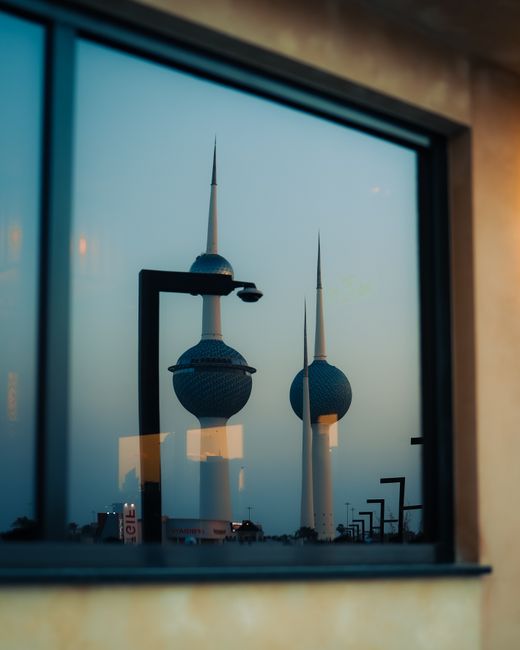
Kuwait is a small, wealthy country at the northern tip of the Arabian Gulf, wedged between Iraq and Saudi Arabia and centered on the wide natural harbor of Kuwait Bay. Almost everything a visitor wants is in and around Kuwait City: the blue-and-green tiled spheres of the Kuwait Towers above the corniche, the Grand Mosque, the lanes of Souq Al Mubarakiya, a new cultural district of museums and a world-class opera house, long seafront promenades and some of the biggest shopping malls in the region. Before oil, Kuwait lived from the sea, from pearling, dhow building and long-distance trade, and that heritage survives in Sadu House’s Bedouin weaving, the old dhows on display and the archaeological sites of Failaka Island, a short boat ride offshore, where Bronze Age Dilmun settlers and Hellenistic Greeks both left their mark. Kuwait suits travelers interested in Gulf culture, food, architecture and modern Arab life, stopovers and visits to friends and family. Many nationalities can get a tourist visa online or on arrival. The best time to come is November to March; summers are among the hottest on Earth.
Right now in Kuwait
- Wed32–39°C89–101°FClear
- Thu31–40°C88–105°FClear
- Fri32–40°C90–105°FClear
Multi-day tours of Kuwait
Multi-day tours from local operators. You check dates and book on Viator, our partner; we may earn a commission at no extra cost to you. How we earn money
Kuwait at a glance
Kuwait covers about 17,800 km² (6,900 square miles), slightly smaller than New Jersey, most of it flat, gravelly desert rising gently toward the west. Its coastline wraps around Kuwait Bay and runs south along the Gulf, and the country includes nine offshore islands, the largest being Bubiyan, which is uninhabited, and Failaka, the only one with a history of settlement. Roughly 4.5 million people live in Kuwait, and around two thirds of them are foreign residents, many from South Asia, Egypt and the Philippines, which gives Kuwait City its mix of Indian canteens, Arab coffee houses and Filipino bakeries. Kuwait is a constitutional emirate, ruled by the Al Sabah family since the 18th century, with an elected National Assembly, and Arabic is the official language; English is the second most widely used language and is spoken in hotels, malls and most shops. Islam is the state religion, and the many non-Muslim residents worship freely in churches and temples.
Time and the weekend: Kuwait uses Arabia Standard Time (UTC+3) all year, with no daylight saving time. The weekend is Friday and Saturday.
A short history
Long before Kuwait City existed, people settled on Failaka Island: around 4,000 years ago it was part of the trading civilization of Dilmun, and in the 3rd century BCE Greek settlers built a fortress and temple there and called the island Ikaros. Modern Kuwait began in the early 18th century, when families of the Bani Utbah tribe settled on the bay; the Al Sabah family has led the community since about 1752. The town grew rich on pearling, boat building and the caravan and sea trade between India, Iraq and Arabia, and its dhow builders were famous across the Gulf. An agreement with Britain in 1899 made Kuwait a British protectorate. Oil was discovered at Burgan in 1938, exports began after the Second World War, and the wealth that followed transformed the old mud-brick town into a modern city. Kuwait became independent in 1961 and in 1962 adopted a constitution with an elected parliament, the first in the Gulf. Iraq occupied the country from August 1990 until its liberation in February 1991, which is why National Day (25 February) and Liberation Day (26 February) are celebrated together.
Kuwait’s governorates
- Capital Governorate (Al Asimah): central Kuwait City, with the Kuwait Towers, the Grand Mosque, Souq Al Mubarakiya, the National Museum, Sadu House, the cultural district, Shuwaikh, and Failaka Island.
- Hawalli Governorate: the busy seafront districts of Salmiya and Hawalli, with the Scientific Center, Marina Crescent, Tareq Rajab Museum and many hotels and restaurants.
- Farwaniya Governorate: inland suburbs around the airport and Kuwait’s largest mall, The Avenues.
- Mubarak Al-Kabeer Governorate: residential suburbs on the coast south of the city.
- Ahmadi Governorate: the oil town of Ahmadi, the seaside towns of Fahaheel and Mangaf, chalets and beaches down the coast to Khiran near the Saudi border.
- Jahra Governorate: the large northern and western desert, the Red Fort in Jahra town, Kuwait Bay’s northern shore, and the Sheikh Jaber Al-Ahmad Al-Sabah Causeway area at Subiya.
Where to go: Kuwait City, Failaka and beyond
Kuwait is compact and most visitors stay in Kuwait City or Salmiya and see the rest on day trips; outside the city the attractions are spread out, so a car or taxi is the easiest way to get around.
Kuwait City
The capital has the Kuwait Towers, the Grand Mosque, the Seif Palace waterfront, Souq Al Mubarakiya and the old Souq Al Watiya area, the Kuwait National Museum, Sadu House, the Sheikh Abdullah Al Salem Cultural Centre and Sheikh Jaber Al-Ahmad Cultural Centre, Al Shaheed Park and the long Arabian Gulf Street corniche. See our Kuwait City guide.
The Kuwait Towers
Kuwait’s landmark, opened in 1979, is a group of three slender towers on a headland north of the center. The tallest carries two spheres, one with a revolving viewing deck and restaurant, and their tiled surfaces in blue, green and silver were designed to evoke traditional Islamic architecture. The towers are on Kuwait’s tentative list for UNESCO World Heritage. They are lit up in the evening, when the corniche below is at its liveliest.
Failaka Island
About 20 km (12 miles) off the coast at the mouth of Kuwait Bay, Failaka has the country’s most important archaeological sites: Bronze Age Dilmun settlements, a Hellenistic fortress and temple, an early Christian monastery complex and a village abandoned after 1990. It is on Kuwait’s UNESCO tentative list, and boats run from the mainland. See our Failaka Island guide.
Salmiya and the coast
East of the center, Salmiya is Kuwait’s busiest seaside district, with the Scientific Center and its aquarium, the Marina Crescent waterfront, malls, cafes and many mid-range hotels. Farther along the coast are the Tareq Rajab Museum in Jabriya, the beaches and corniches of Mesila and Fintas, and the seafront at Fahaheel.
The cultural district
Along Arabian Gulf Street, the Sheikh Abdullah Al Salem Cultural Centre brings together natural history, science, space, Arabic Islamic science and fine arts museums, while the Sheikh Jaber Al-Ahmad Cultural Centre, Kuwait’s opera house, stages concerts, theater and touring productions.
Ahmadi, Jahra and the south
The oil town of Ahmadi was built from the 1940s for the Kuwait Oil Company, with garden suburbs that were added to Kuwait’s UNESCO tentative list in 2026. Farther south, the coast is lined with weekend chalets down to the resort area of Khiran, near the Saudi border. West of the bay, Jahra has the Red Fort (Al Qasr Al Ahmar), a mud-brick fort linked to the battle of Jahra in 1920.
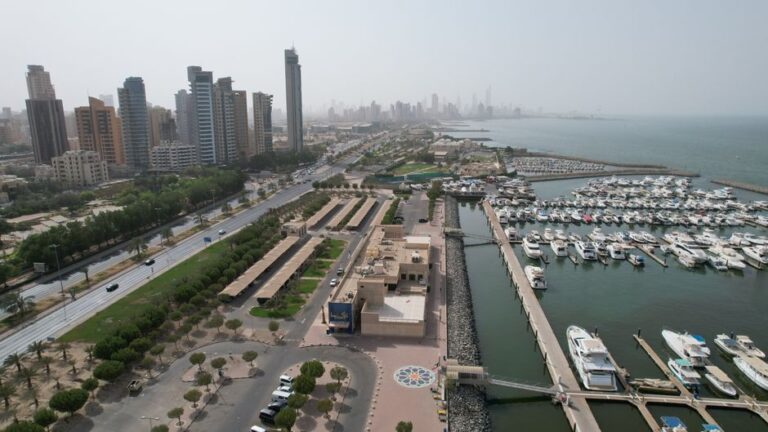
Failaka Island Travel Guide
Plan a trip to Failaka Island, Kuwait: the Hellenistic fortress and temple of Ikaros, the Bronze Age Dilmun settlement at Tell Sa'ad and Tell…
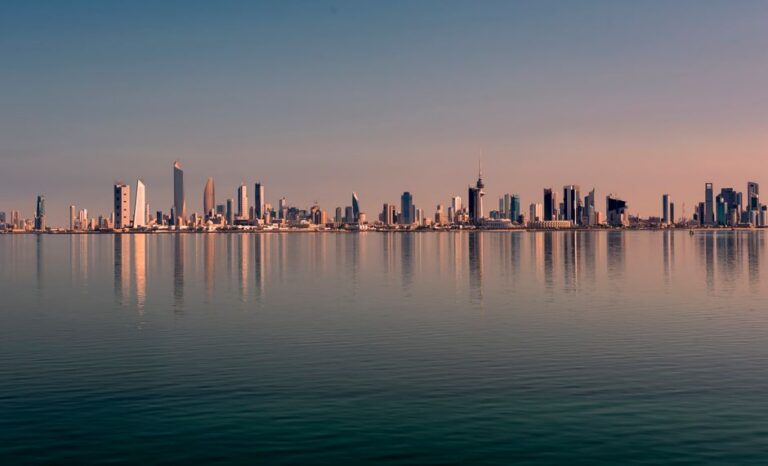
Kuwait City Travel Guide
Plan a trip to Kuwait City: the Kuwait Towers, the Grand Mosque's tours, Souq Al Mubarakiya, Sadu House and the National Museum, the Sheikh…
Best time to visit Kuwait
Kuwait has a hot desert climate with a short, mild winter. November to March is the best time to visit, with sunny days of about 18–27 °C (65–80 °F), cool to chilly nights and most of the year’s little rain; January nights can drop close to freezing in the desert. March and April are pleasant but can bring thunderstorms and dust storms. May to September is extremely hot: average highs reach 44–46 °C (111–114 °F) in June, July and August, and Kuwait International Airport recorded 51.3 °C (124 °F) in August 1998. From late July into October, humid sea winds can make the heat feel even more oppressive. Dust and haze are common, especially from spring to midsummer.
| Month | Average high | Average low | Rain | Rain days |
|---|---|---|---|---|
| Jan | 18 °C (65 °F) | 8 °C (46 °F) | 29 mm (1.1 in) | 6 |
| Feb | 21 °C (70 °F) | 9 °C (48 °F) | 17 mm (0.6 in) | 5 |
| Mar | 26 °C (78 °F) | 13 °C (56 °F) | 16 mm (0.6 in) | 5 |
| Apr | 32 °C (90 °F) | 19 °C (66 °F) | 13 mm (0.5 in) | 4 |
| May | 39 °C (102 °F) | 24 °C (76 °F) | 15 mm (0.6 in) | 2 |
| Jun | 44 °C (111 °F) | 28 °C (82 °F) | 0 mm (0 in) | 0 |
| Jul | 46 °C (114 °F) | 30 °C (85 °F) | 0 mm (0 in) | 0 |
| Aug | 45 °C (114 °F) | 29 °C (84 °F) | 0 mm (0 in) | 0 |
| Sep | 42 °C (108 °F) | 25 °C (77 °F) | 0 mm (0 in) | 0 |
| Oct | 36 °C (96 °F) | 20 °C (68 °F) | 6 mm (0.2 in) | 1 |
| Nov | 27 °C (80 °F) | 14 °C (57 °F) | 19 mm (0.7 in) | 4 |
| Dec | 20 °C (68 °F) | 9 °C (48 °F) | 26 mm (1.0 in) | 5 |
| Year | 33 °C (91 °F) | 19 °C (66 °F) | 141 mm (5.5 in) | 32 |
Figures are the long-term averages (1962–2008) for Kuwait International Airport published by Kuwait’s Meteorological Department through the World Meteorological Organization’s World Weather Information Service. Rainfall varies a lot from year to year: the airport measured 32 mm in 2021 and 344 mm in 2018. The Meteorological Department also counts 50 to 90 days of blowing dust a year at the airport, and haze on most days.
Crowds and prices through the year
- Peak (November to March): the best weather, the desert camping season, and the busiest time for events, conferences and family visits; hotels are fullest around National Day and Liberation Day in late February.
- Low (May to September): extreme heat; many residents leave in summer, hotel prices fall and life moves indoors to the malls.
Festivals and events
- National Day and Liberation Day (25 and 26 February): flags, lights, fireworks and car parades along Arabian Gulf Street.
- Hala February: a month of concerts, shopping promotions and family events built around the national holidays.
- Ramadan (in 2027 expected from about 8 February to 9 March): evening iftar and late-night gatherings; daytime life slows down.
- Cultural seasons: the Sheikh Jaber Al-Ahmad Cultural Centre publishes a season of concerts, theater and touring shows each year, from autumn to spring.
Public holidays
Public holidays include New Year’s Day, Isra and Mi’raj, National Day (25 February), Liberation Day (26 February), Eid al-Fitr (about 10 March 2027), Arafat Day and Eid al-Adha (about 16–18 May 2027), the Islamic New Year and the Prophet’s Birthday. Islamic dates follow the lunar calendar and are confirmed shortly before; the government sometimes moves or extends holidays.
How long to stay: sample itineraries
1 day: stopover
Start at the Grand Mosque for a morning tour, walk through Souq Al Mubarakiya for lunch, visit Sadu House and the National Museum, and end at the Kuwait Towers for sunset over the Gulf, followed by dinner on the corniche or in Salmiya. Kuwait Airways and Jazeera Airways connect Kuwait with the Gulf, the Middle East, South Asia and Europe, which makes a one- or two-night stopover easy to add.
2 days: Kuwait City in depth
Day one: the Grand Mosque, Souq Al Mubarakiya, Sadu House and the Kuwait Towers. Day two: the Sheikh Abdullah Al Salem Cultural Centre, Al Shaheed Park and an evening performance or a walk at the Sheikh Jaber Al-Ahmad Cultural Centre, then the Marina Crescent in Salmiya.
4 days: city, island and coast
Add a full day on Failaka Island, a morning at the Scientific Center and the Tareq Rajab Museum, and a drive to Ahmadi, Fahaheel and the southern coast, or to the Red Fort in Jahra.
Combining Kuwait with its neighbors
Short flights link Kuwait with Bahrain, Qatar, the UAE and Saudi Arabia, and there are land crossings into Saudi Arabia for travelers with a Saudi visa. See our Bahrain, Qatar, Saudi Arabia and United Arab Emirates guides.
Entry, money and costs
Entry: tourist eVisa and visa on arrival (last reviewed October 2026)
Everyone except citizens of the other GCC states (Saudi Arabia, Bahrain, Qatar, the UAE and Oman) needs a visa for Kuwait. Your passport must be valid for at least six months from the date you enter.
- Who can get a tourist visa online or on arrival: citizens of 54 countries, according to Kuwait’s Ministry of Interior, including the United States, Canada, the United Kingdom, Ireland, Australia, New Zealand, Japan, South Korea, China, Hong Kong, Singapore, Malaysia, Brunei, Türkiye, Georgia, Switzerland, Norway, Iceland and almost all EU countries. Some GCC residents in listed professions are also eligible.
- Official website: the Ministry of Interior’s eVisa portal is kuwaitvisa.moi.gov.kw, also available as the Kuwait Visa app. You upload a passport copy, a recent face photo, a confirmed return ticket and a hotel reservation; tourist visas are typically processed in one to two business days.
- Validity and stay: the tourist visa is single entry, must be used within one month of issue, and allows a stay of up to three months from the date of entry.
- Fee: the ministry lists the tourist visa fee as KWD 3 (about US$10); the fee can vary by nationality, some nationalities are exempt, and the exact amount is shown before you pay. Fees are non-refundable once a visa is approved.
- Other nationalities: travelers not on the list apply through a Kuwaiti embassy, or with a sponsor in Kuwait for family and business visits.
Overstaying costs KWD 10 per day and can lead to a ban on returning. At the border, you may be asked for a return or onward ticket and proof of accommodation.
Customs and medicines
Kuwait has strict customs rules. It is illegal to bring in alcohol, narcotics, pork and pork products, gambling machines and pornographic material. Declare cash or travelers’ checks worth KWD 3,000 or more on arrival. Visitors must obtain permission from the Kuwaiti authorities before arrival to carry certain prescription medicines, including many commonly prescribed ones, so check with a Kuwaiti embassy, carry a doctor’s letter and bring only what you need.
Money and cards
The Kuwaiti dinar (KWD, KD) is divided into 1,000 fils and is the world’s highest-valued currency unit. At the Central Bank of Kuwait’s rate of about KWD 0.308 to the US dollar, KWD 1 is about US$3.24. Cards and contactless phone payments are accepted almost everywhere, including taxis booked through apps, and ATMs are common; carry some cash for the souk and small shops. Kuwait has no VAT or sales tax.
Tipping
Tipping is appreciated but not expected. In restaurants, about 10% is generous where no service charge has been added; round up taxi fares, and give a small tip to porters, valets and drivers.
Typical travel costs
| Item (as of October 2026) | Kuwaiti dinars | About US dollars |
|---|---|---|
| Tourist eVisa (most nationalities) | KWD 3 | $10 |
| Airport taxi to Kuwait City or Salmiya (official fixed fare) | KWD 8 | $26 |
| Public bus ride | from KWD 0.250 | from $0.80 |
| Arabic coffee or karak tea | about KWD 0.200–1.500 | about $0.65–5 |
| Casual restaurant meal | about KWD 2–5 | about $6.50–16 |
| Mid-range hotel room, per night | about KWD 30–60 | about $97–195 |
| Rental car, per day | about KWD 10–18 | about $32–58 |
The visa fee and airport taxi fare are official; the bus fare comes from the airport’s published tariff, and the rest are typical ranges, not official prices. Conversions use the Central Bank of Kuwait’s rate.
Getting there and getting around
Kuwait International Airport
Kuwait International Airport (KWI) lies about 15 km (10 miles) south of central Kuwait City, about 20–30 minutes by road. It is the base of Kuwait Airways and the low-cost Jazeera Airways, with flights across the Gulf and the Middle East, to the Indian subcontinent, Europe and Asia. As of August 2026, the airport was operating through Terminals 4 and 5, serving Kuwait Airways, Jazeera Airways and foreign airlines, with Terminal 1 closed and flight schedules reduced; check which terminal you need with your airline.
Airport taxis charge fixed fares by area, published by the airport: KWD 8 to Kuwait City, Salmiya and most central and coastal districts, and KWD 5–7 to nearer suburbs. Kuwait Public Transport Company buses link the airport with the city on lines 13, 99 and 501 from early morning until about midnight, for 250 to 300 fils.
Getting around
Kuwait is built for cars. Most visitors use taxis, ride-hailing apps or a rental car; public buses are cheap and cover the main roads but are slow and aimed at commuters.
| Getting around Kuwait (October 2026) | How it works | Typical cost |
|---|---|---|
| Public buses | Kuwait Public Transport Company and private operators on main corridors | from KWD 0.250 per ride |
| Taxis and ride-hailing | Call taxis and app-based rides; agree the fare or use the app | about KWD 2–5 across the city |
| Airport taxis | Fixed fares by district | KWD 8 to Kuwait City or Salmiya |
| Rental car | Best for Ahmadi, Jahra and the south coast | from about KWD 10 per day |
| Ferry to Failaka Island | From the mainland coast; schedules vary | see our Failaka guide |
Driving
Kuwait drives on the right on wide, fast highways. Visitors with a visit visa can drive on a UK photocard license; other nationalities should check whether they need an International Driving Permit. You must have third-party insurance, usually included with a rental car, and keep the document with you. Traffic laws are strict and fines are high: speeding, using a phone while driving and running red lights can lead to heavy fines, prison or deportation, and any alcohol in your system is an offense. Driving can be fast and aggressive, so drive defensively. If you have an accident, call 112; after a minor accident with no injuries, photograph the damage and move your car out of the traffic. When driving in the desert, stay on marked tracks. Use only official border crossings into Saudi Arabia (Nuwaiseeb on the coast and Salmi in the west), with a Saudi visa and your rental company’s permission, and don’t go near border areas otherwise.
Culture, food and everyday etiquette
Islam and local customs
Kuwait is a Muslim country with conservative social values and a lively, sociable culture. Kuwaiti men meet in the diwaniya, a reception room or tent where friends gather in the evening to talk over tea and coffee; foreign visitors are sometimes invited. Greet with “as-salaam alaykum,” use your right hand to eat and pass things, and accept Arabic coffee (gahwa) with dates when it is offered; shake the small cup gently when you have had enough.
Food and drink
Kuwaiti cuisine is built around rice, fish and spices. Try machboos (spiced rice with chicken, lamb or fish), mutabbaq zubaidi (pomfret, Kuwait’s favorite fish, on rice), marabyan (rice with shrimp), gabout (stuffed dumplings in stew), harees in Ramadan, and sweets such as gers ogaily (saffron and cardamom cake), lugaimat (fried dough balls with date syrup) and balaleet. Souq Al Mubarakiya has traditional restaurants and stalls, and the city has every international cuisine, especially Indian, Lebanese, Iranian and Filipino. Alcohol is illegal throughout Kuwait, including in hotels: buying, selling, bringing in or drinking it can lead to fines, prison and deportation. Instead, Kuwait has a big cafe culture, with specialty coffee, fresh juices and mocktails.
Laws visitors need to know
- Dress: dress modestly in public, especially in the old city and conservative areas; women should avoid shorts and tight or revealing clothing, and both men and women should cover shoulders and knees. Swimwear is for hotel pools and beaches. Visible tattoos that could be seen as offensive, such as Quranic verses, can cause problems.
- ID: visitors must carry their passport at all times; keep copies of the photo page and your visa separately.
- Alcohol and drugs: alcohol is illegal. Kuwait has zero tolerance for drugs, including small or residual amounts, and penalties are among the toughest in the world; even clothing with drug-related logos can bring a fine.
- Behavior: insulting anyone, including with rude gestures, is a criminal offense, and public displays of affection are frowned upon. Unmarried couples are not allowed to share a hotel room or live together, and hotels may ask for a marriage certificate.
- Photography: don’t photograph or film government, military, industrial or oil buildings, borders or oil fields, or people without their consent.
- Fines and bills: traffic fines and bills must be paid before you leave; unpaid fines or commercial disputes can stop you from leaving the country.
Safety, health, accessibility and connectivity
Safety
Violent crime against visitors is rare, and Kuwait City is generally safe to walk around, day and night. The practical risks are the heat, the roads and the rules above.
- Summer heat: highs of 44–46 °C (111–114 °F) from June to August, with humid spells from late July, make heat exhaustion a real risk; drink plenty of water, keep outdoor sightseeing for early morning and evening, and never leave anyone in a parked car.
- Dust storms: blowing dust can cut visibility on roads and affect people with asthma; check the Meteorological Department’s warnings.
- Desert: stay on marked tracks, don’t pick up unusual objects, and carry water and a charged phone.
- Ramadan etiquette: don’t eat, drink, smoke or chew gum in public during daylight, including in your car; play music quietly and dress conservatively.
- Sea: parts of the northern Gulf are sensitive and maritime boundaries are not all marked, so use licensed operators for boat trips, and check that dhows and boats carry life jackets.
- Demonstrations: public protests are for Kuwaiti citizens only and must be approved; stay away from crowds and follow the instructions of the authorities.
- Flight times: schedules can change at short notice, so check your flight with your airline before you travel. Check your flight with your airline before you travel and follow instructions from the local authorities.
- Emergencies: police, ambulance and fire 112.
Health and insurance
Kuwait has a state medical service and good private hospitals and clinics, but fees for visitors are high and have recently increased, so travel insurance with medical cover and repatriation is essential. Pharmacies are common. Outdoor air quality can be poor, especially in dust and haze. Tap water is desalinated; most people drink bottled water.
Accessibility
The airport, malls, newer hotels and the cultural centers are accessible; the old souk, older sidewalks and Failaka’s archaeological sites are harder to navigate, so ask in advance.
Connectivity and power
Mobile coverage and 5G are excellent in populated areas; prepaid SIMs and eSIMs from Zain, Ooredoo and stc are sold at the airport and in malls. Power is 240 V, 50 Hz, with type G sockets (British three-pin); some buildings also have type C sockets.
Things to do: heritage, culture and the Gulf
Kuwait’s highlights are its modern landmarks and its sea-faring heritage: the Kuwait Towers at sunset, a guided tour of the Grand Mosque, Souq Al Mubarakiya, Sadu House, the National Museum, the museums of the Sheikh Abdullah Al Salem Cultural Centre and a concert at the Sheikh Jaber Al-Ahmad Cultural Centre. Add a walk or run in Al Shaheed Park, the aquarium at the Scientific Center, the Islamic arts of Dar al-Athar al-Islamiyyah and the Tareq Rajab Museum, an evening on the Marina Crescent, and a day trip to Failaka Island’s ancient sites.
On the water
Kuwait Bay and the coast are best enjoyed from the corniche, a beach club or a boat. Licensed operators run dhow and speedboat trips, fishing outings and trips to Failaka and the southern islands of Kubbar, Qaruh and Umm Al Maradim, known for clear water, coral and diving. Book only with licensed operators, check sea conditions, and remember that summer water is very warm and winter winds can make the sea rough.
Kuwait with children
Families will enjoy the Scientific Center’s aquarium, the dinosaur and space exhibits of the Sheikh Abdullah Al Salem Cultural Centre, Al Shaheed Park, the Kuwait Towers’ revolving sphere and the malls’ indoor play areas and ice rinks; keep outdoor activities for winter.
Responsible travel
Kuwait’s coast and islands matter for migratory birds, sea turtles and coral reefs. Choose boat operators who keep their distance from wildlife, don’t take shells or coral, take litter home from beaches and desert camps, and on Failaka don’t climb on ruins or remove anything.
What to pack
Pack light, modest clothes that cover shoulders and knees, long trousers or a long skirt for the Grand Mosque (women are lent a cover), swimwear for pools and beaches, a hat, sunglasses and high-SPF sunscreen. In winter add a warm sweater and a light jacket for chilly evenings and air-conditioning, plus a scarf or mask for dusty days. Bring comfortable shoes for the souk and Failaka’s sites, a type G plug adapter, your passport (always carried), and a doctor’s letter and any prior approval for prescription medicines.
Kuwait travel FAQ
Do I need a visa for Kuwait?
Yes, unless you are a GCC citizen. Citizens of 54 countries, including the US, UK, Canada, Australia, New Zealand and almost all EU countries, can get a tourist visa online or on arrival; others apply through a Kuwaiti embassy.
How much does a Kuwait tourist visa cost?
The Ministry of Interior lists the tourist visa fee as KWD 3, about US$10; it can vary by nationality, some nationalities are exempt, and the exact fee is shown when you apply.
What is the official website for the Kuwait eVisa?
kuwaitvisa.moi.gov.kw, run by Kuwait’s Ministry of Interior, also available as the Kuwait Visa app. Other websites are not official.
Can tourists drink alcohol in Kuwait?
No. Alcohol is illegal throughout Kuwait, including in hotels, and it is illegal to bring any into the country.
What is the best time to visit Kuwait?
November to March, when days are warm and sunny. Summer is extremely hot, with average highs around 45 °C (113 °F).
What is the weekend in Kuwait?
Friday and Saturday.
Does Kuwait have UNESCO World Heritage Sites?
Not yet. Kuwait’s tentative list includes Failaka Island, the Kuwait Towers, the Sheikh Abdullah Al-Jabir Palace, the Bubiyan Island and Mubarak Al-Kabeer Marine Reserve, and the Ahmadi company town.
How do I get from the airport to Kuwait City?
By taxi, at a fixed fare of KWD 8 to Kuwait City or Salmiya, by ride-hailing, or by public bus.
What currency is used in Kuwait?
The Kuwaiti dinar (KWD), divided into 1,000 fils and worth about US$3.24, the highest-valued currency unit in the world.
What plug adapter do I need for Kuwait?
Type G, the British three-pin plug, at 240 V and 50 Hz.
Are flights to Kuwait ever disrupted?
Sometimes. Check your flight with your airline before you travel.
Plugs and power in Kuwait
Kuwait uses 240 V, 50 Hz and these plugs (left) and wall sockets (right):
Type G (British three-pin) is standard; some buildings also have type C sockets.
All plug types and voltages by country → · Check what you need to pack →
Plan your trip
Partner links: TravelerCenter may earn a commission if you book, at no extra cost to you.
🇪🇬 Useful Arabic phrases for Kuwait
All 38 Arabic phrases: restaurant, hotel, emergencies, romance (printable) →
Sources · last reviewed 5 October 2026
Researched and last reviewed on 5 October 2026. Visa types, eligible nationalities, the official portal, documents, processing time, validity, stay, fees and overstay fines come from the Ministry of Interior’s Kuwait Visa portal; passport validity, customs rules, the cash declaration threshold, prescription-medicine permission, laws on dress, ID, alcohol, drugs, behavior, relationships, photography, fines and bills, driving rules and licenses, accidents, sea safety, the airport’s terminal operations as of August 2026, flight disruptions, health care and emergency numbers from GOV.UK’s Kuwait travel information (updated 20 August 2026); airport taxi fares and bus lines from Kuwait International Airport (Directorate General of Civil Aviation); the exchange rate from the Central Bank of Kuwait; climate averages, the temperature record, rainfall by year and dust days from Kuwait’s Meteorological Department and the World Meteorological Organization; the tentative list from UNESCO; Failaka sea transport from Kuwait Government Online; area, population and coordinates from Wikidata. History, holidays and 2027 Ramadan and Eid dates, events, cuisine, attraction details, plug types, mobile operators, the land border names and typical prices are general references and flagged for checking. Entry rules can change at short notice, so check official sources before you travel.
Data: Weather: MET Norway (CC BY 4.0) · Air quality: OpenAQ · Rates: ECB · Wikidata (CC0)