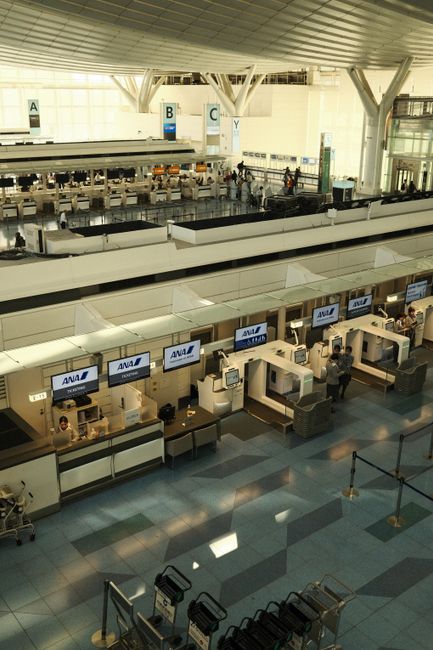
Short answer: Tokyo Haneda (HND) is the closer of Tokyo’s two big airports, on Tokyo Bay in Ota City, with direct trains into the city from every terminal. The quickest rail route is the Keikyu Line: about 11 minutes from Terminal 3 (14 from Terminals 1 and 2) to Shinagawa for ¥330, or ¥327 with an IC card. The Tokyo Monorail runs to Hamamatsucho, where you change to the JR Yamanote Line, for ¥520 (¥519 by IC card). Airport Limousine buses go to Shinjuku for ¥1,400, and a taxi to Chiyoda City costs a flat ¥7,600 plus tolls during the day (all as of October 2026).
- IATA code
- HND
- ICAO code
- RJTT
- Serves
- Tokyo, Hakone, Fuji Five Lakes, Yokohama, Nikko, Kamakura
Find flights to Tokyo (HND)
Results open on our flights page, comparing airlines and agencies; Kiwi.com opens in a new tab. Leave Return empty for a one-way trip. TravelerCenter may earn a commission when you book, at no extra cost to you.
Travel guides for places this airport serves
Haneda has three passenger terminals. Terminals 1 and 2 handle domestic flights (Terminal 2 also has an international section), and Terminal 3 is the main international terminal. Japan Airport Terminal, the company that runs the terminal buildings, says about 91 million passengers used them in the year to March 2026. That’s a lot of people, but the airport is well signposted in English and transport runs from early morning to past midnight.
Getting from Haneda Airport to central Tokyo
Haneda is linked to the city by two rail lines, a large airport bus network and taxis. Fares below are the operators’ official prices as of October 2026. Japanese train fares are slightly lower with an IC card (Suica, PASMO and similar) than with a paper ticket.
Keikyu Line (to Shinagawa, Asakusa and Yokohama)
- Stations: Haneda Airport Terminal 1·2 (platforms on B1F, between the two terminals) and Haneda Airport Terminal 3. At Terminal 3 the ticket gates for central Tokyo and Yokohama are in the 2nd-floor Arrival Lobby.
- Journey times (Keikyu’s estimates): to Shinagawa about 11 minutes from Terminal 3 and 14 from Terminals 1·2; Tokyo Station 20/23 minutes, Shimbashi 21/24, Higashi-ginza 23/26, Shibuya 23/26, Shinjuku 30/33 and Asakusa 34/37 minutes (with changes or through trains). Yokohama is 23 minutes from Terminal 3.
- Through trains: many Keikyu trains continue onto the Toei Asakusa subway line, so you can reach Higashi-ginza and Asakusa without changing. At the ticket machine, choose the Toei Line button for subway stations, or “Transfer to JR Lines” at Shinagawa for JR stations.
- Fare: Haneda Airport to Shinagawa is ¥330 with a paper ticket or ¥327 with an IC card, from either airport station.
- Hours: the first train leaves Terminal 3 for Shinagawa at 5:26 a.m.; the last leaves Terminal 3 at 12:08 a.m. and reaches Shinagawa at 12:20 a.m.
- Tap to ride: Keikyu accepts contactless Visa, Mastercard, JCB, American Express, Diners Club, Discover and UnionPay cards, or a phone with one of them, at gates with the tap-payment reader. Children pay adult fares this way, the Toei transfer discount does not apply, and it doesn’t work at transfer gates such as Shinagawa, so an IC card is simpler if you are changing lines.
- Combined subway pass: the KEIKYU Hanetoku Ticket & Tokyo Subway Ticket bundles the airport ride (to Sengakuji) with unlimited Tokyo Metro and Toei subway travel: ¥1,600 for 24 hours, ¥2,100 for 48 and ¥2,600 for 72 (adults). You have to buy it online before you arrive (through ANA, JAL or Tokyo Skytree sites) and exchange it at Haneda.
Tokyo Monorail (to Hamamatsucho)
- Stations: Haneda Airport Terminal 1 and Terminal 2 (both on B1F) and Haneda Airport Terminal 3 (gates on the 2nd-floor Arrival Lobby and the 3rd-floor Departure Lobby).
- Route: the monorail runs along the bay to Monorail Hamamatsucho, where you change to the JR Yamanote Line for Tokyo Station, Akihabara, Ueno, Shibuya and Shinjuku. Hamamatsucho is also the closest station to Zojo-ji Temple and Tokyo Tower.
- Journey time and frequency: about 13 minutes to Hamamatsucho according to Tokyo Monorail (the airport says about 20). Trains run on average every 5 minutes. The monorail lists about 19 minutes to Tokyo Station, 30 to Shibuya and 37 to Shinjuku including the Yamanote change.
- Fare: Hamamatsucho to any Haneda station costs ¥520 (¥519 with an IC card), plus the JR fare onward. Monorail tickets to the airport stations are valid for 10 days.
Airport Limousine and express buses
- Where: bus stops are on the 1st floor of Terminals 1 and 2. At Terminal 3, follow the bus signs from the 2nd-floor access hall down to lane 3 on the 1st floor (stops 1 to 11). Buy your ticket at the machines (or, at Terminal 3, the bus counters too) before you board.
- Fares (Airport Limousine, adult/child): Shinjuku area ¥1,400/¥700, Ikebukuro ¥1,400/¥700, Shibuya ¥1,300/¥650, and Tokyo City Air Terminal (T-CAT, Nihonbashi Hakozaki) ¥1,000–¥1,200. Pay with cash, credit card or a transport IC card, or book online.
- Journey times: the airport estimates about 35 minutes to Shinjuku Station West Exit and about 35 minutes to Tokyo Station when roads are clear. Rush-hour traffic can add a lot more.
- Good for: heavy luggage, hotels near a bus stop, or areas without a direct train. Some routes (to Akasaka and Roppongi, Ginza, Akihabara and Otemachi, for example) were listed as suspended in October 2026, so check the timetable before you count on one.
- Late at night: a separate late-night and early-morning Haneda Airport access bus leaves from stops 3 and 7 at Terminal 3.
Taxi: flat fares into Tokyo
- Where: taxi ranks are on the 1st floor (Arrival Lobby) of Terminals 1 and 2. At Terminal 3, follow the taxi signs from the 2nd- or 3rd-floor access hall down to the 1st floor (lane 2, stop 21). Ranks are split by destination, with separate lines for Kawasaki and Yokohama, so check the sign.
- Flat fares: Tokyo’s taxi association sets fixed fares from Haneda to most of Tokyo’s 23 wards, plus expressway tolls. From 20 April 2026, examples are Chiyoda City ¥7,600, Shibuya City ¥8,500, Shinjuku City ¥9,000 and Taito City (Ueno, Asakusa) ¥9,100.
- Late night: between 10 p.m. and 5 a.m. the late-night flat fares apply: Chiyoda ¥9,000, Shibuya ¥10,000, Shinjuku ¥10,700 and Taito ¥10,800.
- Metered areas: wards closer to the airport, such as Minato and Chuo, are not on the flat-fare chart, so the meter applies.
- App taxis: pick-ups booked through taxi apps use dedicated stands on the 2nd floor (Departure level): near Exit 7 at Terminal 1, near Exit 2 at Terminal 2, and on the 8th floor of car park P5 at Terminal 3. Check the pick-up point in the app.
A pre-booked transfer is worth considering for families, groups with lots of luggage or late arrivals when trains have stopped; you can book one from the box near the top of this page.
Terminals
Your terminal depends on your airline and whether the flight is domestic or international. Haneda Airport lists the usual split as follows (codeshare flights can be different, so always check your booking):
- Terminal 1 (domestic only): Japan Airlines (JAL), Skymark Airlines, StarFlyer and Japan Transocean Air.
- Terminal 2: domestic flights of ANA, AIRDO and Solaseed Air, plus some ANA international flights. Domestic check-in is on the 2nd floor; international departures are on the 3rd floor.
- Terminal 3 (international only): JAL’s international flights and the foreign airlines. The terminal runs around the clock, and its departure-level “Edo Koji” area of restaurants and shops is built to look like an old Tokyo street.
Moving between terminals
- Free shuttle bus: links all three terminals, every 4 minutes from 5:00 a.m. to 8:00 p.m. and every 8 minutes from 8:00 p.m. to midnight, with the first buses before 5 a.m. and the last around 1:15–1:30 a.m. Stops: Terminal 1 bus stop 8 and Terminal 2 bus stop 9 (both on the 1st floor, Arrival Lobby), and Terminal 3 bus stop 0 on the 1st floor. Staff help wheelchair users on board without booking.
- Trains for connecting passengers: if you are transferring between a domestic and an international flight, or between two international flights, the information counters (Terminal 1 and 2 on B1F, Terminal 3 on 2F) give out free transit tickets for the Keikyu Line or Tokyo Monorail between Terminal 3 and Terminals 1 or 2. Show your passport and boarding pass.
- Terminal 1 to Terminal 2 on foot: the 400-meter underground passage with moving walkways was out of service for construction in October 2026, so use the shuttle bus.
Arriving: immigration, Visit Japan Web, customs and SIM/eSIM
- Immigration: international arrivals go through quarantine, immigration, baggage claim, animal and plant quarantine, and customs, in that order. Have your passport ready (take it out of its cover). Foreign visitors need an arrival card, either on paper or done online in advance.
- Visit Japan Web: the Japanese government’s free online service lets you enter your immigration and customs details before you fly and get a QR code. It works at seven major airports, Haneda included. Japan’s tourism board says registration is not required but makes arrival easier, and it is also where you can set up tax-free shopping. Use the official site (vjw.digital.go.jp) only.
- Customs e-Gates: with the Visit Japan Web QR code and an IC passport, you can declare at an electronic terminal while waiting for your bags, then walk through the customs e-Gate. Customs may still inspect bags. Without the QR code, fill in the paper Declaration of Personal Effects.
- Food and plants: meat products, fruit and plants may need quarantine procedures when brought into Japan; the quarantine counters are just after baggage claim.
- Entry rules: many nationalities can visit Japan visa-free for short stays. Japan passed a law in 2026 creating JESTA, an online pre-travel authorization for visa-exempt visitors, but it is not in force yet; the start date will be set later (by March 2029 at the latest). Check the details on our Japan travel guide.
- Phone and data: mobile and Wi-Fi rental counters and SIM cards are sold in the terminals, and free airport Wi-Fi (below) covers you until you are set up. An eSIM bought before you fly usually works the moment you land, and our packing list tool links to one.
- Money: banks, ATMs and currency exchange counters are in the terminals. Some small shops and restaurants in Japan still prefer cash, so it’s handy to have some yen.
Departing: check-in, security and tax-free
- Check-in: international departures are on the 3rd floor of Terminals 2 and 3; domestic departures are on the 2nd floor of Terminals 1 and 2. Check-in times depend on your airline, and counters can change on the day, so check the flight information screens.
- Face Express: on some airlines and flights, you can register your face at check-in and go through bag drop, security and boarding without showing your passport and boarding pass again.
- Liquids: on international flights, liquids must be in containers of up to 100 ml in one clear resealable bag of up to 1 liter per person. Domestic flights are more relaxed: drinks are allowed, and toiletries are limited to 500 ml per container and 2 liters in total per person.
- Customs and passport control: if you are carrying ¥1 million or more in cash (or the equivalent), declare it to customs before departure. Departing foreign visitors with an IC passport and short-term stay can use the ePassport gates; you won’t get a stamp unless you ask for one.
- Tax-free shopping changes on 1 November 2026: until 31 October 2026, eligible shops take the consumption tax off at the till. For purchases from 1 November 2026, you pay the full price and get the tax back after customs checks your passport and goods when you leave Japan (within 90 days of purchase). At Haneda the check happens before you check in your bags, and the refund then comes from the shop or its refund agent. Keep tax-free purchases where you can show them, and allow extra time.
Facilities
- Wi-Fi: free in all three terminals. Choose the “HANEDA-FREE-WIFI” network, open your browser and follow the on-screen steps. It may not reach inside some shops.
- Baggage storage: staffed counters in Terminal 1 (B1F, south) and Terminal 2 (B1F, north), open 8:00 a.m. to 7:30 p.m., and in Terminal 3 (2nd-floor Arrival Lobby and 3rd-floor Departure Lobby), open 24 hours. Prices per item per day go by size: ¥800 (small), ¥1,000 (medium) or ¥2,000 (large, up to 300 cm in total dimensions and 30 kg), for up to 2 weeks. Coin lockers and same-day hotel delivery services are also available.
- Observation decks: watch planes on Haneda’s four runways from the decks at Terminals 1 and 2 (6:30 a.m. to 10:00 p.m.) or Terminal 3 (5th floor, open 24 hours). Decks can close in bad weather.
- Lounges: airline lounges for premium passengers and status members, and credit-card lounges in the terminals; check your card’s benefits.
- Accessibility: Haneda’s trained “Care-Fitter” staff help passengers with reduced mobility and older travelers. Reserve online through the airport’s Special Assistance Reservation page or call +81 3-5757-8111; you can also ask at any information desk.
- Food and shops: every terminal has Japanese restaurants, noodle and sushi counters, cafés and souvenir shops, and Terminal 3 has duty-free after security. Terminal 2’s indoor “Flight Deck Tokyo” viewing floor is open 5:00 a.m. to 11:00 p.m.
Car rental and parking
Car rental: rental counters are in the Arrival Lobbies of Terminal 1 (1st floor), Terminal 2 (1st floor, north) and Terminal 3 (2nd floor), generally open 8:00 a.m. to 8:00 p.m. Companies include Times, Orix, Nissan, Nippon and Toyota, and at Terminal 3 also National and Hertz. Japan drives on the left; check the driving-license rules on our Japan guide before you book. A car makes sense for trips to Hakone or the Fuji Five Lakes, not for central Tokyo, where trains are faster and parking is scarce. You can compare rental prices from the box near the top of this page.
Parking: there are five car parks. P1 and P2 serve Terminal 1, P3 and P4 serve Terminal 2, and P5 serves Terminal 3. The airport warns that at busy times (Fridays to Sundays and holidays, 5:30 a.m. to 8:00 p.m., and especially Golden Week, Obon and New Year) the car parks can be full, with waits of several hours that can make you miss your flight. It asks drivers to use trains and buses where possible, and posts live occupancy on its website. Advance parking reservations are available for some car parks.
Hotels near the airport
There are hotels inside the terminals themselves: a compact cabin-style hotel in the Terminal 1 Arrival Lobby, a hotel inside Terminal 2, and a hotel at Terminal 3 with rooms both landside (3rd-floor Departure Lobby) and airside for transit passengers who don’t want to enter Japan. They are handy for very early flights or late arrivals. For most trips it is better to stay in the city: Shinagawa is only 11–14 minutes away by Keikyu, and Hamamatsucho 13–20 minutes by monorail, so hotels near those stations are a good middle ground. You can search hotels near HND from the box near the top of this page.
Plan your trip: our Tokyo travel guide covers neighborhoods, temples, food and day trips, and the Japan travel guide has entry rules, money and getting around the country. Haneda is also a quick start for Yokohama (23 minutes by Keikyu) and Kamakura. Let our AI trip planner build a day-by-day itinerary, check the Destination weather tool for your travel dates, and use the Money exchange tool to see what ¥330 or ¥7,600 means in your own currency.
Frequently asked questions
How do I get from Haneda Airport to central Tokyo?
Take the Keikyu Line to Shinagawa (11–14 minutes, ¥330 or ¥327 by IC card) and change there, or ride through to Higashi-ginza and Asakusa; take the Tokyo Monorail to Hamamatsucho (about 13–20 minutes, ¥520) and change to the JR Yamanote Line; ride an Airport Limousine bus to Shinjuku (¥1,400) or Shibuya (¥1,300); or take a taxi at a flat fare plus tolls, for example ¥7,600 to Chiyoda City in the daytime (fares as of October 2026).
How much is a taxi from Haneda to Shinjuku or Shibuya?
Under the flat-fare system in force since 20 April 2026, a taxi from Haneda to Shinjuku City costs ¥9,000 and to Shibuya City ¥8,500 between 5 a.m. and 10 p.m., plus expressway tolls. Late at night (10 p.m. to 5 a.m.) it is ¥10,700 and ¥10,000. The fare is per taxi, not per person.
Which terminal does my airline use at Haneda?
JAL domestic flights, Skymark, StarFlyer and Japan Transocean Air use Terminal 1. ANA, AIRDO and Solaseed Air domestic flights use Terminal 2, as do some ANA international flights. JAL international flights and foreign airlines use Terminal 3. Codeshares can differ, so check your booking.
Do I need Visit Japan Web to enter Japan?
No, it isn’t required, but it’s free and makes arrival easier. You enter your immigration and customs details online before the flight and show one QR code at Haneda, where it also lets you use the customs e-Gates. Without it, fill in the paper arrival card and customs declaration.
What time do trains stop running at Haneda?
The last Keikyu train from Terminal 3 to Shinagawa leaves at 12:08 a.m., and the first leaves at 5:26 a.m. Overnight, use the late-night airport access bus from Terminal 3 or a taxi at the late-night flat fare.
How do I get between Haneda’s terminals?
Take the free shuttle bus, which links all three terminals every 4 minutes during the day and every 8 minutes in the evening. If you are connecting between domestic and international flights, the information counters give out free transit tickets for the Keikyu Line or Tokyo Monorail.
Is there free Wi-Fi at Haneda Airport?
Yes. Connect to “HANEDA-FREE-WIFI” in any terminal, open your browser and follow the steps on screen. It’s enough for messages, maps and booking a ride.
Researched and last reviewed on 6 October 2026. Sources: Haneda Airport’s official site (transport, terminals, shuttle bus, services, parking, procedures), Japan Airport Terminal (passenger figures), Keikyu Corporation (journey times, last trains, fares, tap-to-ride, passes), Tokyo Monorail (fares, times), Airport Transport Service (Airport Limousine fares), the Tokyo Hire-Taxi Association (flat taxi fares), Japan Customs and the Digital Agency (Visit Japan Web), the Immigration Services Agency (JESTA) and the Japan Tourism Agency (tax-free shopping). Fares, hours and terminal assignments change, so check the official links before you travel.
Before you go: guidebooks and travel gear
Affiliate links: we may earn a commission at no extra cost to you. As an Amazon Associate we earn from qualifying purchases. We pick items for the place, not for the commission. How we earn money