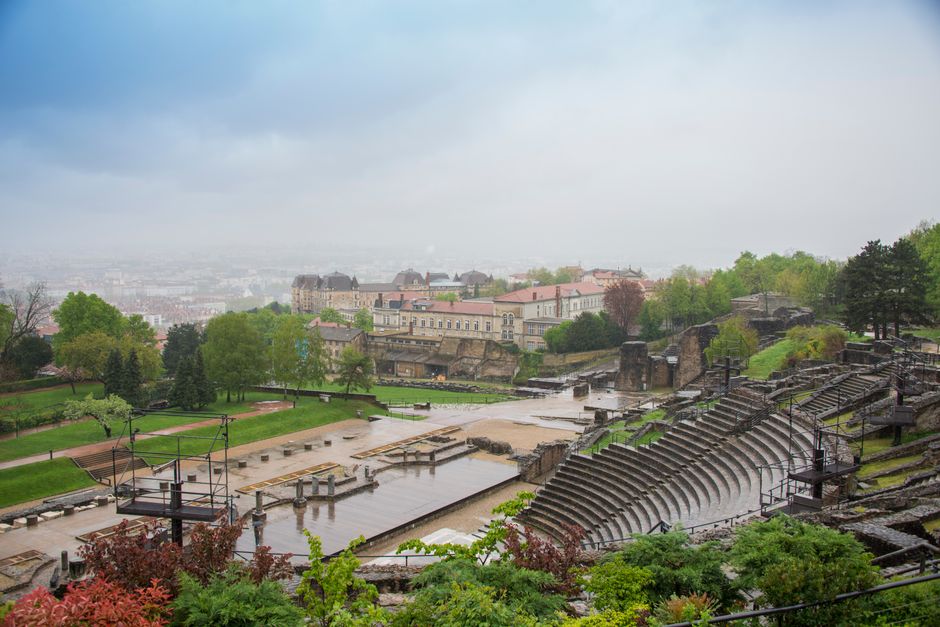
The Ancient Theatres of Fourvière are two Roman theatres cut into the hillside of Fourvière, the oldest theatre in Roman Gaul and a smaller odeon, with the Lugdunum museum of Roman Lyon built into the slope beside them. The theatre site is free and open every day, 7:00–19:00 from October to April and 7:00–21:00 from May to September (as of October 2026). The museum costs €4, or €7 during a temporary exhibition, and is free for everyone on the first Sunday of the month. Take the F1 funicular to Minimes – Théâtres Romains and allow 1½–2 hours for both.
Right now in Roman Theatres of Fourvière
- Wed15–18°C58–65°F15 mm rain
- Thu11–15°C52–60°F13 mm rain
- Fri9–14°C48–58°FClear
Tickets and tours for Roman Theatres of Fourvière
See all tours for Roman Theatres of Fourvière →
From local operators, with prices and reviews; you check availability and book on Viator, our partner. We may earn a commission at no extra cost to you. How we earn money
Why the Roman theatres matter
Lugdunum was founded on Fourvière hill in 43 BC and grew into the capital of the Roman province of Gaul. The emperor Claudius was born here, and the city held the yearly assembly of the Gaulish peoples at the sanctuary on the Croix-Rousse slope. The big theatre was built at the end of the 1st century BC; Lugdunum’s official museum describes it as the oldest theatre in Roman Gaul. It first held about 5,000 spectators and was later enlarged with a third tier of seats to about 10,000, with a diameter of 108 metres.
Next to it stands the odeon, a smaller theatre for music and readings that seated about 3,000 and still has its pavement of coloured marbles brought from across the empire. In late antiquity both buildings were used as quarries. They were listed as Historic Monuments in 1905, excavated and partly rebuilt in the first half of the 20th century, and are part of the Historic Site of Lyon on the UNESCO World Heritage List.
What you’ll see
- The great theatre: climb the stone tiers for a view over the stage, the old town and the Presqu’île. In summer the stage hosts the Nuits de Fourvière festival, so you may see seating and sound equipment going up.
- The odeon: smaller and more intimate, with the original marble floor of the orchestra in geometric patterns.
- Lugdunum museum: a raw-concrete building by architect Bernard Zehrfuss, opened in 1975 and buried in the hillside, with a spiral ramp running down past mosaics, sculpture, inscriptions and everyday objects. Two big windows look out onto the theatres.
- Star pieces: the Claudian Table, a bronze tablet carrying Emperor Claudius’s speech to the Senate in AD 48 asking that Gauls be allowed to sit in it; the Coligny calendar, a rare Gaulish calendar engraved in bronze; and a large mosaic of chariot races in the circus.
- For families: activity booklets, treasure hunts, 3D models of 2nd-century Lyon and costume corners during school holidays.
Tickets and hours
From Lugdunum’s official website, as of October 2026:
- Theatre site: free. Daily 7:00–19:00 from 1 October to 30 April, and 7:00–21:00 from 2 May to 30 September. Entrances at 6 rue de l’Antiquaille and 17 rue Cléberg.
- Museum hours: Tuesday to Friday 11:00–18:00, Saturday and Sunday 10:00–18:00. Closed on Mondays and on 1 January, 1 May and 25 December. During heat alerts the museum opens earlier on weekdays, from 9:00.
- Museum prices: €4 full and €2.50 reduced outside temporary exhibitions; €7 and €4.50 during one. Guided tours add €4 per adult.
- Free days: museum entry is free for everyone on the first Sunday of every month.
- Lyon City Card: Lugdunum is included. The card costs €29.90 for 24 hours (adult, as of October 2026, tourist office shop) and also covers the funiculars.
How long to allow and when to go
Give the theatres 30–45 minutes and the museum an hour or more. The tiers have no shade, so on summer afternoons visit the museum first and the theatres in the early morning or evening light, when the stone glows. From June to July the Nuits de Fourvière festival puts on concerts, theatre and dance here at night; check its programme if you want to see a show in a 2,000-year-old setting.
Accessibility
The museum is built around a long spiral ramp rather than separate rooms, which makes it easier to visit with limited mobility; ask at the desk about lifts and seating. The theatre site is on a steep slope with uneven Roman stone and steps, so wheelchair users can see the theatres from the upper levels but not move freely around them. The Minimes – Théâtres Romains funicular station is just below the entrance.
Getting there
Take metro D to Vieux Lyon – Cathédrale Saint-Jean, then the F1 funicular towards Saint-Just and get off at Minimes – Théâtres Romains, a couple of minutes from the site. The F2 funicular to Fourvière also works: walk five minutes downhill from the basilica. Both funiculars take a standard TCL ticket (€2.10 for an hour, as of October 2026). There is a Vélo’v bike station (Théâtres Romains) and a public car park on Rue Roger Radisson.
Combine it with
The Basilica of Notre-Dame de Fourvière and its viewpoint are five minutes’ walk uphill; then go down through the gardens to Vieux Lyon. If Roman history is your thing, Vienne, about half an hour south by train, has a Roman temple and its own theatre; see our Lyon travel guide. Further south, Roman Gaul continues in Provence.
Roman Theatres of Fourvière FAQ
Are the Roman theatres in Lyon free?
Yes. The theatre site is free and open every day, from 7:00 to 19:00 in October to April and to 21:00 from May to September (as of October 2026). Only the Lugdunum museum charges entry.
How much is the Lugdunum museum?
€4 full price and €2.50 reduced, or €7 and €4.50 during a temporary exhibition, as of October 2026. It is free for everyone on the first Sunday of each month and with the Lyon City Card.
When is the Lugdunum museum closed?
On Mondays and on 1 January, 1 May and 25 December. It opens Tuesday to Friday 11:00–18:00 and weekends 10:00–18:00.
How old are the Roman theatres of Fourvière?
The great theatre was built at the end of the 1st century BC, a few decades after Lugdunum was founded in 43 BC. The odeon came later, at the end of the 1st century AD.
How do I get to the Roman theatres?
Take the F1 funicular from Vieux Lyon to Minimes – Théâtres Romains, or the F2 to Fourvière and walk five minutes downhill. A normal TCL ticket is valid on both.
Can you see a show in the Roman theatres?
Yes. Every June and July the Nuits de Fourvière festival holds evening concerts, theatre, dance and circus in the great theatre and the odeon. Book through the festival’s own ticket office.