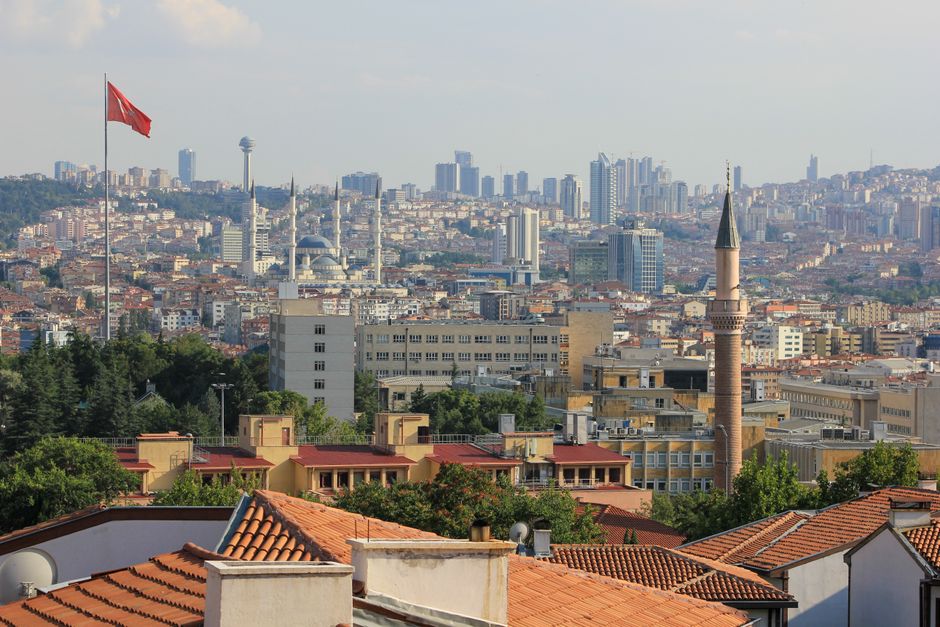
Ankara, Türkiye’s capital since 1923, is a city most visitors skip, and they miss two of the country’s essential sights. Anıtkabir, the monumental mausoleum of Mustafa Kemal Atatürk, founder of the Republic, is the most important national shrine in Türkiye and a moving introduction to the modern country. The Museum of Anatolian Civilizations, in an old Ottoman covered market below the citadel, holds one of the world’s great collections of Hittite, Phrygian and Bronze Age treasures. Around them you will find the old walled citadel with its wooden houses, the Roman Temple of Augustus, lively student neighbourhoods and an easy-going, very Turkish city of ministries, universities and good restaurants. With high-speed trains to Istanbul and Konya and buses to Cappadocia, Ankara makes a natural stop between them. One full day covers the highlights; two let you add the Republic’s early history and a day trip.
Right now in Ankara
- Wed9–20°C47–69°FMostly clear
- Thu9–23°C48–73°FPartly cloudy
- Fri10–22°C50–72°FClear
Top tours in Ankara
See all tours for Ankara →
From local operators, with prices and reviews; you check availability and book on Viator, our partner. We may earn a commission at no extra cost to you. How we earn money
Ankara at a glance
- Best for: Atatürk and the Republic’s history, ancient Anatolian civilisations, a real Turkish city without the tourist crowds.
- How long: 1 day for Anıtkabir, the Museum of Anatolian Civilizations and the citadel; 2 days to add more museums and a day trip.
- Best time: April to June and September to October. Summers are hot and dry; winters are cold, with frequent frost and snow.
- Getting in: high-speed train from Istanbul (about 4½ hours) or Konya; flights to Esenboğa airport (ESB); buses from all over the country to the AŞTİ terminal.
- Tickets (October 2026): Anıtkabir is free; the Museum of Anatolian Civilizations costs €12 for foreign visitors.
- Before you go: visas, money and transport around the country are in our Türkiye travel guide.
Why Ankara matters
Ankara was a small Anatolian town of mohair weavers when Mustafa Kemal (later Atatürk) made it the headquarters of the national resistance in 1919–20, safely out of reach of the occupied Ottoman capital. The Grand National Assembly first met here in April 1920, led the War of Independence, and on 13 October 1923 chose Ankara as the capital; the Republic was proclaimed on 29 October 1923. The new government planned a modern capital from scratch, with boulevards, parks, ministries and a railway station in the 1930s style, many of which still stand around Ulus and along Atatürk Boulevard. To understand modern Türkiye, its secular state, its alphabet reform, its national holidays and its devotion to Atatürk, a visit to Ankara is the best place to start.
Long before that, the city was Ancyra, capital of the Roman province of Galatia, and earlier still a Phrygian settlement; the Hittite heartland lies just to the east. That deep history is what fills the Museum of Anatolian Civilizations.
Anıtkabir: Atatürk’s mausoleum
Anıtkabir (“memorial tomb”) stands on a hill in the centre of Ankara, finished in 1953, fifteen years after Atatürk’s death. You approach along the Road of Lions, a 262-metre avenue lined with 24 stone lions, to a vast ceremonial square, and climb to the Hall of Honour, a colonnaded temple-like hall where Atatürk’s symbolic sarcophagus, a 40-tonne block of red marble, faces Ankara; his body lies in a burial chamber below. Under the hall, the Atatürk and War of Independence Museum displays his personal belongings, cars, gifts, and dioramas and panoramic paintings of the battles of Gallipoli and the War of Independence. Allow at least two hours.
Opening hours and entry
Entry is free, and Anıtkabir is open every day of the year, including weekends and national and religious holidays. The official opening hours are:
| Period | Opening hours |
|---|---|
| 1 February – 14 May | 09:00–16:30 |
| 15 May – 31 October | 09:00–17:00 |
| 1 November – 31 January | 09:00–16:00 |
The museum below the Hall of Honour may close earlier than the grounds. The main pedestrian entrance is at Tandoğan, near the Anadolu/Anıtkabir metro station on the M1 line; the main road gate is on Akdeniz Caddesi.
Rules for visitors
Anıtkabir is a place of national respect, and soldiers enforce the rules politely but firmly. Expect an airport-style security check at the entrance. Don’t eat or drink as you walk around the monument, don’t shout, sing or chant slogans, and remove your hat in the Hall of Honour (except uniformed personnel). Photography and filming are not allowed inside the Atatürk and War of Independence Museum, though you may photograph the grounds and the hall. Dress neatly; shorts are tolerated outside but not ideal. Many Turkish visitors come in families and school groups, and on national days such as 29 October (Republic Day) and 10 November, the anniversary of Atatürk’s death, huge crowds come to pay their respects, with official ceremonies; at 09:05 on 10 November the whole country stops for a minute’s silence. The changing of the guard at the mausoleum takes place regularly through the day, and is worth watching quietly.
Top things to see in Ankara
The Museum of Anatolian Civilizations
Housed in a restored 15th-century covered bazaar and caravanserai, this museum (European Museum of the Year in 1997) traces Anatolia from the Palaeolithic to the Roman era. Highlights include the wall paintings and mother-goddess figurines from Çatalhöyük, one of the oldest towns in the world; Bronze Age gold and the bronze standards of Alacahöyük; the Hittite reliefs from Carchemish and other cities; and Phrygian treasures from Gordion, the city of King Midas. As of October 2026 the ticket is €12 for foreign visitors, open daily 08:30–17:30 (ticket office until 16:45). Note: the Ankara Hall and the Classical Hall are closed for maintenance from 14 September 2026 to 2 March 2027, so part of the collection is out of view until then.
Ankara Citadel (Ankara Kalesi)
Just above the museum, the Byzantine walls (reusing Roman stones and inscriptions) enclose a village of restored Ottoman wooden houses, carpet and spice shops, cafés and the Alaeddin Mosque. Climb to the top of the walls for a view over the whole city, best at sunset. The lanes leading up from the museum, around Atpazarı and Samanpazarı, are full of copper, antiques and dried-fruit shops.
The Temple of Augustus and Rome in Ankara
The ruined Temple of Augustus and Rome in the Hacı Bayram district carries the most complete surviving copy of the Res Gestae, Augustus’s own account of his deeds, carved in Latin and Greek on its walls. Next to it stands the Hacı Bayram Veli Mosque, one of the most visited shrines in Ankara. The Roman Baths, a short walk north, show the brick foundations of a large bath complex.
The Republic’s early history
The first parliament buildings on Ulus Square tell the story of the War of Independence and the early Republic: the War of Independence Museum in the First Grand National Assembly building, where the new parliament met from 1920, and the Museum of the Republic in the second parliament building (€6). Nearby, the Ethnography Museum has a fine collection of Turkish folk art and was Atatürk’s temporary resting place before Anıtkabir. The Atatürk House at Çankaya, his residence on the presidential estate, opens only at limited times.
Hamamönü and the old quarters
Below the citadel to the south-east, the Hamamönü district is a pocket of restored 19th-century wooden houses around the 15th-century Karacabey bath and mosque, now full of craft shops, tea gardens, gözleme stalls and small restaurants. It is a lovely place for an evening stroll and a Turkish coffee, and it is busiest on weekend afternoons with local families. Nearby, the Erimtan Archaeology and Arts Museum, inside the citadel, displays a private collection of Anatolian antiquities with good English labels.
Kocatepe Mosque and modern Ankara
The huge Kocatepe Mosque in Kızılay, completed in 1987 in classical Ottoman style, is one of the largest mosques in the city and open outside prayer times. Kızılay and Tunalı Hilmi Street in Kavaklıdere are the shopping, café and nightlife districts; Kuğulu Park, with its swans, is a popular meeting place. CerModern, an arts centre in an old railway workshop, hosts contemporary art exhibitions.
Monuments
- Anıtkabir
Museums
- Ankara Painting and Sculpture Museum
- Museum of Anatolian Civilizations
Archaeological sites
- Roman Baths of Ankara
- Temple of Augustus in Ankara
Castles and forts
- Ankara Castle
Other sights
- Kocatepe Mosque
Other things to do in Ankara
- Eat: Ankara’s speciality is Ankara tava (lamb and rice) and the döner-style İskender. Try the traditional restaurants near the citadel and the student cafés of Kızılay and Bahçelievler.
- Shop: the Hamamönü quarter of restored wooden houses has craft shops, tea houses and gözleme stalls.
- Parks: Gençlik Park, between the station and Ulus, has a lake, a fairground and summer concerts; the Atatürk Forest Farm is a large green area in the west.
- Concerts: the Presidential Symphony Orchestra performs in its modern concert hall (CSO Ada Ankara).
Day trips from Ankara
- Hattusa: the capital of the Hittite Empire and a UNESCO World Heritage Site, with the Lion Gate and the rock sanctuary of Yazılıkaya, about 2½ hours east by car.
- Gordion: the Phrygian capital with the great tumulus attributed to King Midas’s father, about 1½ hours west.
- Konya: about 1 hour 45 minutes by high-speed train, the city of Rumi and the whirling dervishes, with the Mevlana Museum.
- Cappadocia: about 3½–4½ hours by road; better as a two-night stay than a day trip.
- Beypazarı: an Ottoman town of half-timbered houses and silver workshops about 1½ hours west.
Activities and best months
- City sightseeingStart at Anıtkabir, Atatürk's mausoleum in the city centre; the Museum of Anatolian Civilizations, on the south side of Ankara Castle, holds finds from Anatolia's major sites; the castle has views over the old town's red roofs.
Nearby destinations
- Cappadocia222 km
Getting there and getting around
By high-speed train (YHT)
Ankara is the hub of Türkiye’s high-speed rail network. YHT trains run from the Ankara YHT Garı (the modern station beside the historic 1937 station) to Istanbul (Söğütlüçeşme on the Asian side, Pendik, or through the Marmaray tunnel to Halkalı on the European side) in about 4½ hours, to Eskişehir in about 1½ hours, to Konya in about 1 hour 45 minutes, and to Sivas. About 15 trains a day link Ankara and Istanbul. Fares were raised in August 2026; an economy seat between Ankara and Istanbul is reported at ₺990 and Ankara–Konya ₺458. Book through TCDD Taşımacılık’s website or app; trains sell out on Fridays, Sundays and around holidays.
By air
Esenboğa International Airport (ESB) is about 28–30 km north of the city, with flights from Istanbul (about 1 hour), Izmir and Antalya, and international flights. Airport buses (the city’s EGO line 442 and private coaches) run to the AŞTİ bus terminal and Kızılay in about 45–60 minutes; a taxi takes about 30–35 minutes.
By bus
Long-distance buses arrive at AŞTİ, the big bus terminal west of the centre, linked to Kızılay by the Ankaray metro line. Buses run around the clock to Istanbul (about 5–6 hours), Cappadocia (Nevşehir or Göreme, about 4½ hours), Konya, İzmir and Antalya.
Getting around
Ankara’s metro and Ankaray lines link AŞTİ, Kızılay, Ulus and the suburbs; buses fill the gaps. Pay with an AnkaraKart, a rechargeable card sold at stations; a standard full fare is reported at ₺40 since August 2026. Ulus, the citadel and the Museum of Anatolian Civilizations are walkable from each other; take the metro or a taxi to Anıtkabir (Tandoğan) and Kızılay. Taxis are metered and reasonably priced.
When to go and how long to stay
Ankara sits on the Anatolian plateau at about 900 m, so it has a dry continental climate: hot summers (average highs around 30–31 °C in July and August, cool nights) and cold winters (around 4–5 °C by day in January, frequently below freezing at night, with snow). Spring and autumn are pleasant for walking. The city is at its most moving on 29 October (Republic Day) and 10 November, when millions mark Atatürk’s death; expect crowds and road closures around Anıtkabir. Unlike resort areas, Ankara is a working city all year.
Ankara in 1 day
Morning at Anıtkabir; lunch in Ulus or Hamamönü; afternoon at the Museum of Anatolian Civilizations and the citadel for sunset.
Ankara in 2 days
Add the Temple of Augustus and the Hacı Bayram Mosque, the War of Independence Museum and the Museum of the Republic, the Ethnography Museum and an evening in Kızılay or Tunalı Hilmi; or take a day trip to Hattusa or Konya.
Weather month by month
Where to stay and eat
Kızılay is the most practical base, with business hotels, transport links and restaurants; Ulus is cheaper and close to the museum and the citadel but quieter at night. Kavaklıdere and Çankaya have upmarket hotels near the embassies. Hotels are generally good value compared with Istanbul. Hotel bills include Türkiye’s accommodation tax (cut to 1% until the end of 2026).
Practical tips for Ankara
- Respect Anıtkabir: follow the rules, keep your voice down and watch the guards’ instructions.
- Check the museum halls: two halls of the Museum of Anatolian Civilizations are closed until 2 March 2027.
- Carry your passport: there are frequent security checks around government buildings.
- Don’t photograph soldiers, police or government buildings unless clearly allowed.
- Book trains ahead: high-speed trains to Istanbul and Konya sell out at weekends.
- Dress warmly in winter: the plateau is much colder than the coast.
What to pack for Ankara
Comfortable walking shoes for the citadel’s cobbles and the long Anıtkabir avenue, neat clothes for Anıtkabir and mosques, a scarf, a sun hat and water in summer, and a warm coat, hat and gloves from November to March.
What to pack
- City walking shoesLisbon and Porto are steep, with polished limestone cobbles that get slippery, so grippy soles matter.
- Day packs and anti-theft bagsA small zipped or anti-theft bag makes crowded trams and viewpoints less stressful.
- Rain jacketsFrom October to April Porto and Lisbon see rain on roughly a third of days.
- Travel adapters and convertersPortugal uses Type C and F sockets at 230 V, so most visitors from outside Europe need an adapter.
Ankara travel FAQ
Is Anıtkabir free to visit?
Yes. Entry to Anıtkabir and its museum is free, and it is open every day of the year, including weekends and holidays.
What are Anıtkabir’s opening hours?
09:00–16:30 from 1 February to 14 May, 09:00–17:00 from 15 May to 31 October, and 09:00–16:00 from 1 November to 31 January.
What are the rules at Anıtkabir?
Pass the security check, don’t eat or drink around the monument, don’t shout or chant, remove hats in the Hall of Honour, and don’t photograph or film inside the museum.
What happens at Anıtkabir on 10 November?
Thousands of people come to lay flowers and pay their respects on the anniversary of Atatürk’s death in 1938, and at 09:05, the moment he died, sirens sound and the whole country stops for a minute’s silence. Expect large crowds, official ceremonies and security queues.
How much is the Museum of Anatolian Civilizations?
As of October 2026 foreign visitors pay €12. It is open daily from 08:30 to 17:30. The Ankara Hall and the Classical Hall are closed for maintenance until 2 March 2027.
Can I take photos at Anıtkabir?
Yes, in the grounds, on the Road of Lions, in the ceremonial square and in the Hall of Honour. Photography and filming are not allowed inside the Atatürk and War of Independence Museum.
Where should I stay in Ankara?
Kızılay for transport links, restaurants and nightlife; Ulus for the citadel and the Museum of Anatolian Civilizations; Kavaklıdere and Çankaya for upmarket hotels.
How many days do you need in Ankara?
One full day covers Anıtkabir, the Museum of Anatolian Civilizations and the citadel. Two days let you add the Republic’s museums, Hamamönü and a day trip to Hattusa or Konya.
Is Ankara worth visiting?
Yes, for a day or two. Anıtkabir and the Museum of Anatolian Civilizations are among the most important sights in Türkiye, and Ankara is a convenient stop between Istanbul and Cappadocia.
How do I get from Istanbul to Ankara?
By high-speed train in about 4½ hours, by plane in about an hour (plus airport transfers), or by bus in about 5–6 hours.
How do I get from Ankara to Cappadocia?
By bus from the AŞTİ terminal to Nevşehir or Göreme in about 4½ hours, or by car in about 3½ hours.
How do I get from Esenboğa airport to the city centre?
Take the EGO 442 bus or a private airport coach to Kızılay or the AŞTİ bus terminal (about 45–60 minutes), or a taxi (about 30–35 minutes).
Plan your trip
Partner links: TravelerCenter may earn a commission if you book, at no extra cost to you.
🇹🇷 Useful Turkish phrases for Ankara
All 38 Turkish phrases: restaurant, hotel, emergencies, romance (printable) →
Sources · last reviewed 4 October 2026
Researched and last reviewed on 4 October 2026. Anıtkabir opening hours: the official Anıtkabir site (anitkabir.tsk.tr). Museum prices, hours and the hall closures: the Ministry of Culture and Tourism’s official ticketing site (muze.gov.tr). High-speed train fares, the EGO fare and airport bus details come from Turkish press and secondary sources and are flagged for checking against TCDD Taşımacılık and EGO. For visas, money and safety, see our Türkiye travel guide.
Also: goturkiye.com · MGM normals 1991–2020, Ankara (regional station) (climate)
Data: Weather: MET Norway (CC BY 4.0) · Rates: ECB · Costs: World Bank ICP and price levels · © OpenStreetMap contributors (ODBL) · Wikidata (CC0)