Vatican City is the smallest country in the world: an independent state of 0.44 km², ruled by the Pope, sitting on a low hill on the west bank of the Tiber and completely surrounded by Rome. It has no border checks, no airport and almost no residents, yet it holds some of the most visited sights on the planet: St Peter’s Basilica with Michelangelo’s dome and Pietà, the Vatican Museums and the Sistine Chapel, and St Peter’s Square, where crowds gather for the Pope’s Sunday Angelus and Wednesday audiences. Most visitors see it as part of a trip to Rome, walking in from the Prati or Borgo districts. This guide covers both sides of the visit: what the Vatican is and how it works as a state, and the practical details of tickets, opening hours, queues, dress code and security, checked against the official Vatican websites as of October 2026. Give it one full day, two if you want the Scavi under the basilica, the Vatican Gardens or a trip to the papal palace at Castel Gandolfo.
Right now in Vatican City
- Wed 18–25°C 64–76°F 1 mm Partly cloudy
- Thu 18–22°C 65–72°F 23 mm Showers
- Fri 18–22°C 64–71°F 1 mm Mostly clear
Weather: MET Norway (CC BY 4.0)
Multi-day tours of Vatican City
Multi-day tours from local operators. You check dates and book on Viator, our partner; we may earn a commission at no extra cost to you. How we earn money
Vatican City at a glance: what it is and how it works
Vatican City State was created on 11 February 1929 by the Lateran Treaty between the Holy See and Italy, which ended almost 60 years of dispute after the Papal States were absorbed into the new Kingdom of Italy in 1870. The Pope is its sovereign, with full legislative, executive and judicial power; day-to-day running is handled by the Governorate. Strictly speaking, two things share the same small territory: the Holy See, the government of the worldwide Catholic Church, which is the body that has diplomatic relations with other countries, and Vatican City State, the territory that guarantees its independence. Since May 2025 the Pope has been Leo XIV, the former Cardinal Robert Prevost, the first pope born in the United States.
The Vatican’s own Governorate puts the state’s area at 44 hectares, partly enclosed by walls. Its figures (to 31 December 2024) count 882 residents, citizens and non-citizens, and 673 Vatican citizens, many of whom live abroad as diplomats. Around 120 members of the Pontifical Swiss Guard live inside the walls. There are five entrances to the state, guarded by the Swiss Guard and the Vatican Gendarmerie. Several Holy See buildings in Rome itself, such as the papal basilicas of St John Lateran, St Mary Major and St Paul Outside the Walls, the papal palace at Castel Gandolfo and offices around Via della Conciliazione, are not part of the state but enjoy extraterritorial status under the Lateran Treaty, much like embassies. The whole of Vatican City has been a UNESCO World Heritage Site since 1984.
History runs much deeper than 1929. In Roman times this was the Ager Vaticanus, a marshy area outside the city with villas, gardens and a circus built by Caligula and used by Nero, where tradition says St Peter was crucified around AD 64. He was buried in a cemetery beside it, and Emperor Constantine built the first St Peter’s Basilica over his tomb from about AD 324. Pope Leo IV walled the area in the 9th century after Saracen raids; from the 14th century the popes lived here rather than at the Lateran. Old St Peter’s was pulled down from 1506 and the new basilica, the work of Bramante, Raphael, Michelangelo, Maderno and Bernini, was consecrated in 1626. Bernini’s colonnade around the square followed in the 1650s and 1660s.
Time zone: the Vatican runs on Central European Time (UTC+1, UTC+2 in summer), the same as Italy. Italian is the everyday language; Latin remains the official language of the Holy See.
The areas you can visit
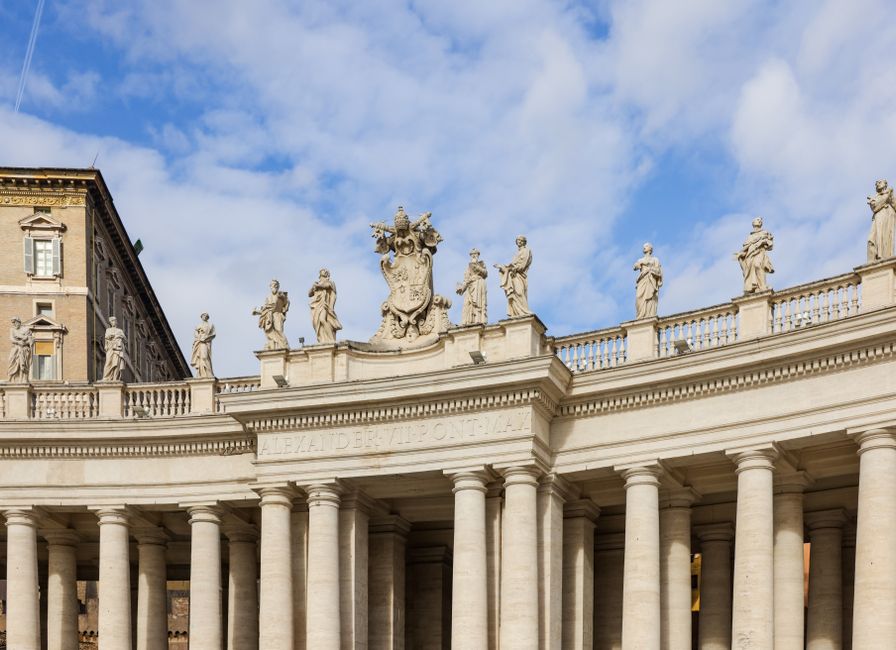
- St Peter’s Square: Bernini’s oval piazza with its colonnades, Egyptian obelisk and two fountains. It is Vatican territory but open to everyone and patrolled by the Italian police. Security checks for the basilica are under the right-hand colonnade as you face the church.
- St Peter’s Basilica, the Grottoes and the dome: free to enter; the dome climb and the guided tours of the necropolis below are ticketed.
- The Vatican Museums and the Sistine Chapel: entered from Viale Vaticano on the north side of the walls, a 10–15 minute walk from the square. Ticketed.
- The Vatican Gardens: about half the state’s area, visitable only on tours booked through the Vatican Museums.
- The rest: the Apostolic Palace, the Governorate, offices, the railway station and the Pope’s residence are closed to visitors. Swiss Guards at the gates will politely turn you away.
- Outside Rome: the Pontifical Villas at Castel Gandolfo in the Alban Hills, about 25 km south-east, where the Papal Palace and gardens are open as a museum on a seasonal calendar.
Where to go: the main sights of Vatican City
St Peter’s Basilica
The largest church in the Christian world stands over the traditional site of St Peter’s tomb. Inside, the scale is hard to take in: the nave is more than 180 m long, and the letters around the base of the dome are almost 2 m high. Highlights are Michelangelo’s Pietà (1499), behind glass in the first chapel on the right; Bernini’s bronze baldachin over the papal altar; the Chair of St Peter in the apse, framed by Bernini’s gilded glory; the bronze statue of St Peter whose foot has been worn smooth by pilgrims; and the papal tombs and monuments by Canova, Bernini and others. Below the floor, the Vatican Grottoes hold the tombs of many popes, entered from inside the basilica.
Entry to the basilica is free, with no booking needed, through the security check under the right-hand colonnade. The basilica is open every day from 7:00 to 20:00, with last entry by 19:15 depending on the queue at security, a timetable the Fabbrica di San Pietro (the office that runs the basilica) introduced on 1 June 2026. If you want to skip some of the wandering, you can book a timed visit with a digital audio guide on the official booking site for €7, or a guided tour in several languages. Masses are said throughout the morning at side altars, with Mass at the Altar of the Chair at 17:00 on weekdays.
A few rules from the basilica’s own visitor pages: trousers and skirts must reach below the knee and shoulders must be covered (no sleeveless tops, no hats); no food, drink or smoking; phones on silent. The basilica also asks visitors not to take photographs, so as not to disturb worship. There is no cloakroom in the basilica, and suitcases and bulky bags are not welcome, so travel light. The Treasury Museum is temporarily closed for a new layout as of October 2026.
The dome of St Peter’s
Climbing Michelangelo’s dome is one of the best things to do in Rome. You first reach the walkway inside the base of the drum, looking down into the basilica from high above the baldachin and close to the mosaics, then continue up narrow, sloping stairs between the inner and outer shells to the lantern terrace, with the best view of St Peter’s Square and the city. A lift saves the first part of the climb, but there are still a little over 300 steps from the terrace to the top; the final section is steep and tight, so skip it if you are claustrophobic or have heart or mobility problems.
The official online tickets, which include entry to the basilica with the digital audio guide, cost €17 with the stairs and €22 with the lift per person on booking.basilicasanpietro.va (as of October 2026). Your basilica entry is timed an hour before or after your dome slot, so read the confirmation carefully. The dome is open from 7:00 to 18:00 in the summer period (until 25 October 2026) and was open from 7:30 to 17:00 in the last winter period (late October to late March); check the hours for 2026/27 before you go.
The Vatican Museums and the Sistine Chapel
The Vatican Museums are a chain of collections built up by the popes over five centuries, with something like 7 km of rooms. Most visitors head for the Sistine Chapel, with Michelangelo’s ceiling (1508–1512) and his Last Judgement (1536–1541) on the altar wall, plus wall frescoes by Botticelli, Perugino and Ghirlandaio. Don’t rush the rest: the Raphael Rooms with the School of Athens; the Pio-Clementino Museum with the Laocoön and the Apollo Belvedere; the Gallery of Maps; the Pinacoteca with Raphael’s Transfiguration, Leonardo’s unfinished St Jerome and Caravaggio’s Deposition; and the Egyptian and Etruscan museums. The route is largely one-way and ends at the Sistine Chapel.
Prices and hours from the official Vatican Museums site, as of October 2026:
- Hours: Monday to Saturday 8:00–20:00, last entry 18:00. Staff start clearing the galleries 30 minutes before closing.
- Tickets: €20 full price at the door, or €25 online with the €5 booking fee that lets you skip the ticket queue. Reduced €10 (€15 online) for young people aged 7–18, students and some other groups. Children under 7 go free, as do visitors with a certified disability of at least 67% and one companion.
- Free last Sunday: on the last Sunday of each month the Museums open free from 9:00 to 14:00, last entry 12:30, unless that Sunday is a holiday. Expect very long queues. Remaining dates in 2026: 25 October, 29 November and 27 December.
- Closed: all other Sundays, plus the Vatican’s holidays. Remaining 2026 closures: 8, 25 and 26 December; on 24 and 31 December the Museums open 8:00–15:00, last entry 13:00. In 2027 they also close on 1 and 6 January, 11 February, 19 March, Easter Sunday and Monday (28–29 March), 1 May, 29 June, 14 and 16 August, 1 November, and 8, 25 and 26 December.
- Official tickets only at tickets.museivaticani.va. The Museums warn about look-alike websites charging much more.
Inside, you may photograph the collections for personal use without flash, but not in the Sistine Chapel, where photos and filming are forbidden and guards ask for silence. Selfie sticks, tripods and drones are banned. Large bags, rucksacks and any knives or scissors go in the free cloakroom, and you have to collect them at the Museums’ exit, so don’t plan to carry on to St Peter’s with luggage. The same dress code as the basilica applies: no sleeveless or low-cut tops, shorts above the knee, miniskirts or hats.
The Vatican Gardens
Around half of Vatican City is gardens, laid out since the 13th century: Renaissance and Baroque fountains, grottoes, lawns, woods, the Vatican radio tower and views of the dome you can’t get from anywhere else. You can only enter on a booked visit through the Vatican Museums’ ticket site, usually a guided walk combined with entry to the Museums. The gardens are always closed on Sundays and Vatican holidays. Prices vary by type of tour, so check the official site.
The Scavi: the necropolis and St Peter’s tomb
Under the Grottoes lies a Roman cemetery of the 1st to 4th centuries, excavated in the 1940s, with streets of family tombs leading to the shrine that the Vatican identifies as the grave of St Peter. It is one of the most remarkable visits in Rome, and one of the hardest to get: only about 250 people a day go down, in groups of about 12 with a guide, for one hour. As of October 2026 the official booking page of the Fabbrica di San Pietro lists:
- Price: €20 full, €14 for ages 10–17, guide included; payment by credit card only.
- Minimum age: 10. Not advised if you suffer from claustrophobia; it is warm and humid underground.
- Hours: Monday to Friday 9:00–16:30 (last visit 16:15), Saturday 9:00–13:00 (last visit 12:15). Closed on Sundays and Vatican holidays.
- How to book: send a request through the official necropolis booking page (linked from basilicasanpietro.va), choosing your language and a preferred date. The date and time are not guaranteed until the office confirms; book weeks or months ahead for spring and autumn.
St Peter’s Square and the Swiss Guard
The square is free and open around the clock except during ceremonies. Look for the two round stones set in the paving between the obelisk and each fountain: stand on one and the four rows of Bernini’s columns line up into one. The Apostolic Palace rises to the right; the window from which the Pope prays the Angelus is on its top floor. You will see the Pontifical Swiss Guard, in their blue, red and yellow uniforms, at the Bronze Door at the end of the right colonnade and at the Arco delle Campane to the left of the basilica. The corps was founded in 1506 under Pope Julius II and is recruited from young Catholic Swiss men; new recruits are sworn in each year on 6 May, the anniversary of the Sack of Rome in 1527, when most of the guard died defending Pope Clement VII. The ceremony is not open to the general public.
Best time to visit Vatican City
The Vatican is open all year, and since almost everything is indoors, the weather matters less than the crowds. The quietest times are November to early March (except the Christmas and New Year holidays) and weekday mornings in late spring and autumn. The busiest are Easter week, the summer, Saturdays, Mondays (when many Rome museums are closed) and the free last Sunday of the month.
Rome has a Mediterranean climate. Long-term averages for Rome Ciampino (1981–2010) give highs of about 12 °C and lows of about 3 °C in January, highs around 23 °C in May, 31 °C in July and August, and 22 °C in October, with most rain from October to December. In July and August, queues in the open square can be gruelling: go early, carry water and a hat for outside, and remember that you’ll have to take the hat off inside.
Crowds and timing through the week
- Vatican Museums: book the first entry slots (8:00) or late afternoon. Tuesday to Thursday are usually calmer than Monday, Friday and Saturday.
- St Peter’s Basilica: the queue at security is shortest before about 9:00 and after 17:00. It closes or gets very busy during papal Masses and big ceremonies, and the square fills on Wednesday mornings during the general audience.
- Sundays: the Museums are closed (except the last Sunday), so it is a good day for the basilica and the Angelus at noon.
Papal events and the church year
Easter, Christmas, Pentecost and the feast of Saints Peter and Paul (29 June) bring big papal liturgies in the square or basilica, and Christmas Eve midnight Mass. Tickets are free but needed for most seated places. The 2025 Jubilee ended when Pope Leo XIV closed the Holy Door of St Peter’s on 6 January 2026, so the extra Jubilee crowds have gone. In summer the Pope usually takes a break at Castel Gandolfo; in July 2026 he prayed the Sunday Angelus there instead of in St Peter’s Square.
How long to stay: sample plans
Half a day: St Peter’s only
Arrive at the square at 7:00–7:30, pass security quickly and see the basilica while it is calm. Climb the dome next (book a slot online), visit the Grottoes on the way out, and finish with coffee in Borgo or a walk down Via della Conciliazione to Castel Sant’Angelo.
One full day: the classic Vatican day
- 8:00: Vatican Museums at opening, with a timed ticket bought on the official site. Walk the Pio-Clementino, the Gallery of Maps and the Raphael Rooms before the crowds build, then the Sistine Chapel. Allow 3–4 hours.
- 12:30: lunch in Prati, around Via Cola di Rienzo or the Trionfale market.
- 14:30: walk round the walls to St Peter’s Square (about 15 minutes), through security and into the basilica.
- 16:00: climb the dome for the late-afternoon light (book ahead), then the Grottoes.
- Evening: back across the Tiber at sunset by Ponte Sant’Angelo, and dinner in the centre near the Pantheon.
Two days: add the Scavi, the Gardens or Castel Gandolfo
On a second day, book the Scavi tour in the morning, the Vatican Gardens on a separate slot, or a Wednesday general audience. Alternatively, take the regional train from Roma Termini to Castel Gandolfo (roughly 40 minutes) to see the Papal Palace, the Barberini Gardens and Lake Albano. The Vatican fits easily into a 3- to 5-day Rome trip; see our Rome guide for the rest of the city.
Entry, money, fees and costs
Entry and borders (last reviewed October 2026)
There is no border control between Italy and Vatican City; you simply walk into St Peter’s Square. In practice, the entry rules that matter are Italy’s: you reach the Vatican through Rome, so you need whatever you need to enter Italy and the Schengen area. Citizens of EU and EEA countries and Switzerland need a passport or national ID card. Visitors from many other countries, including the United States, Canada, the UK and Australia, can stay without a visa for up to 90 days in any 180-day period across the Schengen area. Others need a Schengen visa from an Italian consulate. See our Italy guide for the details.
- Entry/Exit System (EES): the EU’s digital border system has been fully running at all Schengen external borders since 10 April 2026. Non-EU visitors arriving from outside Schengen, for example at Rome Fiumicino on a flight from London or New York, have their passport details, a photo and fingerprints recorded at their first entry instead of getting a stamp; children under 12 are not fingerprinted. Registration is free and lasts three years. There is no EES check when you walk into the Vatican.
- ETIAS: the EU’s planned online travel authorisation (fee €20) is not in operation as of October 2026. No start date has been published and press reports point to 2027. Ignore websites selling “ETIAS applications” before the EU confirms a date.
- Passports: for non-EU visitors, your passport should have been issued less than 10 years before you arrive in Schengen and be valid for at least 3 months after the day you plan to leave.
- Security checks: the basilica, the Museums and papal events all have airport-style screening. Leave knives, scissors and large bags at your hotel.
There is no Vatican passport stamp for tourists. If you want a souvenir, post a card with Vatican stamps (see below).
The euro, Vatican coins and stamps
Vatican City uses the euro. Under its monetary agreement with Italy on behalf of the European Union, it has the right to use the euro as its official currency and to issue its own euro coins, which are minted for it by Italy’s state mint. These coins, with papal designs, are legal tender anywhere in the euro area but are made in small numbers and mostly sold to collectors in sets, so you are unlikely to get one in your change. The Vatican also issues its own postage stamps. Cards and letters with Vatican stamps must be posted in Vatican post boxes, for example at the Vatican post office by St Peter’s Square or inside the Museums, not in Italian ones. Cards are accepted at the Museums, the dome ticket office and in shops; carry a little cash for cafés in Borgo and Prati.
Tickets and fees in one place (October 2026)
| What | Price | Notes |
|---|---|---|
| St Peter’s Basilica | Free | Optional timed entry with digital audio guide €7 online |
| Dome, stairs | €17 | Online, includes basilica entry with audio guide |
| Dome, lift to terrace | €22 | Online; still a little over 300 steps to the top |
| Vatican Museums and Sistine Chapel | €20 / €25 online | Reduced €10 / €15; free under 7 and on the last Sunday |
| Scavi (necropolis) tour | €20 / €14 ages 10–17 | Request in advance; minimum age 10 |
| Papal Palace, Castel Gandolfo | €12 | Family rates available |
| Papal audiences and Masses | Free | Tickets from the Prefecture of the Papal Household |
Typical travel costs
You can’t stay overnight in Vatican City, so your costs are really Rome’s. Hotels in Prati and Borgo are generally a bit cheaper than in the historic centre. As a planning guide per person per day in October 2026: budget travellers can manage on about €80–120 with a hostel or simple room, the free basilica and pizza al taglio; mid-range about €180–280 with a 3- or 4-star room shared by two, the Museums and the dome, and restaurant meals; high-end €400 and up. Rome also charges a city tax per person per night on accommodation, which varies with the type of lodging. These figures are our estimates, not official statistics.
Getting there and getting around
From the airports
From Rome Fiumicino, the Leonardo Express train runs to Roma Termini in 32 minutes for €14 (as of October 2026); from Termini, metro line A takes you to Ottaviano in about 15 minutes. White taxis from Fiumicino charge a fixed €55 to anywhere inside the Aurelian Walls; the Vatican and Prati are just outside the walls, so the meter may be used, so ask the driver before you set off. From Ciampino, take a coach or a bus to Ciampino station for a train to Termini, then the metro.
Within Rome
- Metro: line A to Ottaviano (about 10 minutes’ walk to St Peter’s Square or the Museums) or Cipro (closest to the Museums entrance). A standard BIT ticket costs €1.50 and lasts 100 minutes, with one metro ride; you can also tap a contactless card at the gates.
- Buses: lines 40 and 64 run from Termini and Piazza Venezia to the Borgo near St Peter’s. Bus 64 is notorious for pickpockets.
- Tram: line 19 stops at Piazza del Risorgimento, between the square and the Museums.
- Train: regional trains stop at Roma San Pietro station, a short walk south of the square.
- On foot: from the Pantheon or Piazza Navona it is a pleasant 20–30 minute walk across Ponte Sant’Angelo and down Via della Conciliazione.
The basilica’s own site notes there is no Vatican charge on public transport to and from the area. Inside Vatican City you walk everywhere; between the Museums exit and St Peter’s Square allow about 15 minutes round the outside of the walls. Don’t count on the shortcut from the Sistine Chapel straight into the basilica; it is reserved for certain groups and may be closed.
Papal audiences, the Angelus and Masses
Many visitors want to see the Pope. There are three main ways:
- Wednesday General Audience: held most Wednesday mornings in St Peter’s Square, or indoors in the Paul VI Hall or the basilica in bad weather or winter. The Pope gives a short teaching (catechesis), summarised in several languages, and greets groups. Tickets are free; request them through the Prefecture of the Papal Household’s online booking system, linked from vatican.va under “Tickets for Papal Audiences and Celebrations”. Arrive early for security.
- Sunday Angelus: at noon on Sundays the Pope prays the Angelus and gives a short reflection from the window of the Apostolic Palace overlooking St Peter’s Square. No ticket is needed; just be in the square before 12:00.
- Papal Masses: on major feasts, with free tickets from the same Prefecture system. Priests and bishops who want to concelebrate use a separate office.
Vatican News publishes the Pope’s programme, and audiences are suspended or moved during the summer break and on some special days, so check the calendar on vatican.va the week before. Tickets for papal events are always free; anyone selling them is a scam, though tour companies may charge for a guide or a seat on a coach.
Castel Gandolfo and the Pontifical Villas
The papal summer residence stands above Lake Albano in the Alban Hills, about 25 km south-east of Rome, on land that once belonged to Emperor Domitian’s vast villa. The estate, larger than Vatican City itself, includes the Papal Palace, the Barberini Gardens with Roman ruins, and a farm. Pope Leo XIV has revived the tradition of spending summer here.
The Papal Palace is run as a museum by the Vatican Museums. A full ticket costs €12 (as of October 2026), with a family rate. The 2026–2027 calendar shows it open on weekdays except Tuesdays from 9:00 (last entry 13:00, closing 14:30), with longer hours at weekends, and closed through July and on some August days while the Pope is in residence. Visits to the gardens are booked separately through the same official ticket site. Regional trains from Roma Termini stop at Castel Gandolfo station, below the town; the walk up is short but steep. Combine it with a lakeside lunch and the hill towns of the Castelli Romani.
Safety, health and connectivity
Safety
The Vatican itself is very safe and heavily policed. The problems are around it: pickpockets on metro line A, buses 40 and 64 and in the crowds at security and in the Museums; and touts along the walls of Viale Vaticano offering “skip-the-line” tickets and tours, often at high mark-ups. Buy only from the official sites. Keep an eye on bags during the free last Sunday and papal events. Emergency number in Rome and the Vatican: 112. The basilica has its own first-aid and ambulance service, called through its staff.
Heat, health and accessibility
In summer the queue at basilica security is in full sun; carry water, which you can refill at the public fountains around the square. Wear comfortable shoes: a Museums visit means several kilometres of walking and many stairs. The Vatican Museums have a wheelchair route and lifts, and free entry for visitors with a certified disability of at least 67% and a companion; the basilica publishes its own services for disabled visitors. The dome and the Scavi are not suitable for wheelchairs. For medical help, Rome’s large hospitals, including Santo Spirito next to the Vatican, have emergency departments; EU visitors should carry their European Health Insurance Card.
Connectivity and power
Italian mobile networks cover the Vatican, and EU roaming rules apply. Phones must be silent in the basilica and Sistine Chapel. Sockets are Italian types F and L, 230 V; bring a travel adapter if you come from outside Europe.
Food, wine and culture around the Vatican
There are no restaurants open to the public inside Vatican City apart from the cafeterias and café inside the Vatican Museums and a small bar on the basilica roof near the start of the dome climb. For proper meals, walk into Prati or Borgo. The streets just north of the Museums, such as Via Cola di Rienzo and the covered Trionfale market, are good for picnic supplies, pizza al taglio and simple trattorias. Borgo Pio, the pedestrian lane between the square and Castel Sant’Angelo, has cafés and restaurants that cater to pilgrims; prices drop a block or two away from the square. Order Roman classics such as cacio e pepe, carbonara, saltimbocca and artichokes in season.
Vatican culture is religious and ceremonial: the liturgy in St Peter’s, the Sistine Chapel Choir, the Swiss Guard, and the art patronage of the popes. Dress and behave as you would in any church: covered shoulders and knees, low voices, no eating in the basilica, and no flash or photos where they are forbidden. Shops on Via della Conciliazione and around the square sell rosaries, icons, Vatican stamps and coin sets.
Things to do in Vatican City
- See the Pietà, the baldachin and the Chair of St Peter in St Peter’s Basilica, ideally first thing in the morning.
- Climb the dome for the finest view of Rome and the square.
- Spend a morning in the Vatican Museums: the Sistine Chapel, the Raphael Rooms, the Laocoön and the Gallery of Maps.
- Book the Scavi to stand near St Peter’s tomb in the Roman necropolis.
- Walk the Vatican Gardens on an official tour.
- Join the Sunday Angelus or a Wednesday audience with Pope Leo XIV.
- Send a postcard with Vatican stamps from the Vatican post.
- Visit the Papal Palace at Castel Gandolfo and Lake Albano.
- Combine with Rome: Castel Sant’Angelo at the end of Via della Conciliazione, the Pantheon, the Trevi Fountain, the Spanish Steps, the Colosseum and the Roman Forum, and the Borghese Gallery. See our city sightseeing guide for more.
Where to stay near the Vatican
- Prati: the grid of wide 19th-century streets north and east of the Vatican. Calm, safe, well served by metro line A, with good-value mid-range hotels, shops and restaurants. The best all-round base for an early start at the Museums.
- Borgo: the old streets between St Peter’s Square and Castel Sant’Angelo, including Borgo Pio. Steps from the basilica, with many small hotels, B&Bs and religious guesthouses; quiet at night.
- Across the river: the historic centre around Piazza Navona and Campo de’ Fiori is a 20–30 minute walk away and better for evenings out.
- Religious houses: many convents and institutes near the Vatican take guests at fair prices; some have curfews.
Rome’s city tax is charged per person per night on top of your room rate; check your booking.
Practical tips
- Book the Museums and the dome on the official sites only, and print or save the QR codes.
- Dress for both places in one go: below-knee trousers or skirt and covered shoulders. A light scarf works in summer.
- Travel light: there is no cloakroom in the basilica and the Museums’ cloakroom returns bags at the Museums’ exit only.
- Check the calendar for Vatican holidays, papal events and the last Sunday before you plan.
- Don’t buy from touts along the walls; papal audience tickets are always free.
- Allow time for security at both the basilica and the Museums.
What to pack
Comfortable walking shoes for hours on marble floors and the dome stairs, a scarf or light layer to cover your shoulders, a refillable water bottle, sun protection for the queue in summer and a compact rain jacket from October to April. Leave large bags, knives and selfie sticks at your hotel.
Vatican City travel FAQ
Is Vatican City a country?
Yes. It is the world’s smallest independent state, created by the Lateran Treaty of 1929, with the Pope as its sovereign. It covers 0.44 km² inside Rome.
Do I need a passport to visit the Vatican?
There is no border control between Rome and the Vatican. You need whatever documents you need to enter Italy and the Schengen area; carry ID, as security staff may ask for it.
Is St Peter’s Basilica free?
Yes. Entry is free through the security check in St Peter’s Square. The dome climb, guided tours and the Scavi are paid.
What are St Peter’s Basilica’s opening hours?
Every day from 7:00 to 20:00, with last entry by 19:15 depending on the security queue (from 1 June 2026). It may close at short notice for papal ceremonies.
How much does it cost to climb St Peter’s dome?
Official online tickets cost €17 with the stairs and €22 with the lift to the terrace, including basilica entry with an audio guide (October 2026). Even with the lift you climb a little over 300 steps.
How much are Vatican Museums tickets?
€20 at the door or €25 online, reduced €10/€15, free under 7 and on the last Sunday of the month from 9:00 to 14:00. Buy only at tickets.museivaticani.va.
When are the Vatican Museums closed?
On Sundays (except the last Sunday of the month) and Vatican holidays. The remaining 2026 closures are 8, 25 and 26 December, with short days on 24 and 31 December.
What is the dress code for the Vatican?
Shoulders covered and trousers or skirts below the knee, no hats, no sleeveless or low-cut tops. It applies in the basilica, the Museums, the Sistine Chapel and the Gardens.
Can I take photos in the Sistine Chapel?
No. Photography and filming are forbidden in the Sistine Chapel. In the rest of the Museums, personal photos without flash are allowed.
How do I see the Pope?
Come to St Peter’s Square for the Sunday Angelus at noon (no ticket), or request free tickets for a Wednesday general audience or a papal Mass from the Prefecture of the Papal Household via vatican.va.
How do I visit the tomb of St Peter (the Scavi)?
Send a request through the official necropolis booking page of the Fabbrica di San Pietro well in advance. Tours cost €20 (€14 for ages 10–17), last an hour and are not open to under-10s.
Can I go from the Sistine Chapel straight to St Peter’s?
Don’t count on it. The internal passage is reserved for certain groups and may be closed. Plan to walk round the walls to the square, about 15 minutes.
How long do I need for the Vatican?
Half a day for the basilica and dome, a full day to add the Museums, two days for the Scavi, the Gardens or Castel Gandolfo.
What currency does Vatican City use?
The euro. The Vatican also issues its own euro coins and postage stamps, sold mostly to collectors.
Is the Holy Door still open?
No. The 2025 Jubilee ended when Pope Leo XIV closed the Holy Door of St Peter’s Basilica on 6 January 2026.
Sources and last review
Researched and last reviewed on 4 October 2026. Basilica hours, rules, dress code and services come from the Fabbrica di San Pietro (basilicasanpietro.va), and dome, audio-guide and necropolis prices from its official booking pages; Vatican Museums prices, hours, closing calendars, rules and the Castel Gandolfo calendar and price from museivaticani.va; state facts (area, population, coins and stamps, history, gardens, Castel Gandolfo) from the Governorate of Vatican City State (vaticanstate.va); audience tickets from vatican.va; the Angelus and summer programme from Vatican News; entry rules from the European Commission; Rome transport from Trenitalia, ATAC and Aeroporti di Roma. The climate averages, the closing of the Holy Door, the dome step count, the Castel Gandolfo train time and the Sistine Chapel passage come from secondary sources and are flagged for checking. Daily costs are estimates. Prices, timetables and rules change, so check the official sites before you travel.
Plugs and power in Vatican City
Vatican City uses 230 V, 50 Hz and these plugs (left) and wall sockets (right):
All plug types and voltages by country → · Check what you need to pack →
Plan your trip
Partner links: TravelerCenter may earn a commission if you book, at no extra cost to you.
🇮🇹 Useful Italian phrases for Vatican City
All 38 Italian phrases: restaurant, hotel, emergencies, romance (printable) →