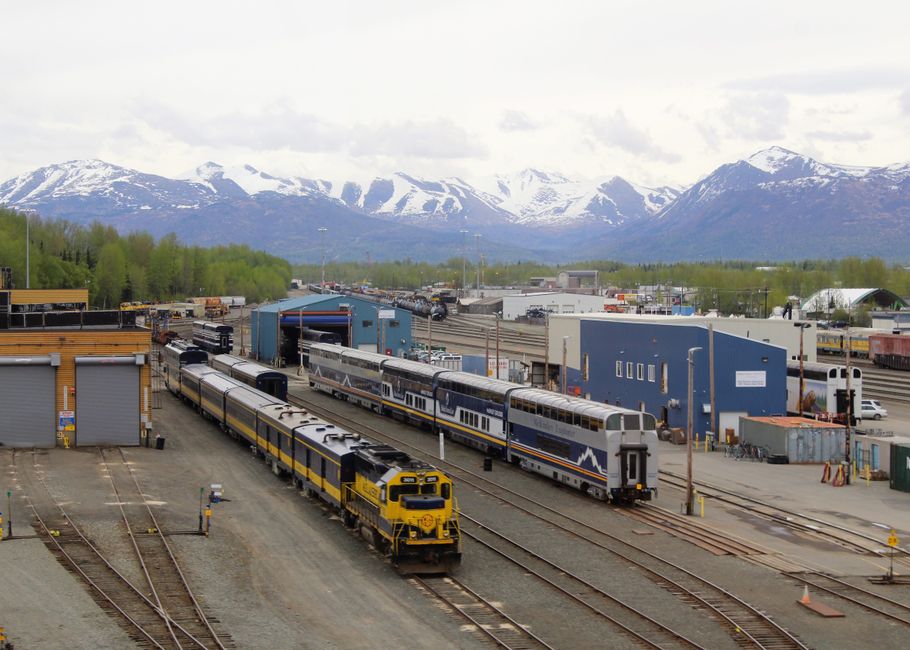
Anchorage, home to about 40% of Alaska’s people, sits between the Chugach Mountains and the tidal waters of Cook Inlet, and wilderness starts at the edge of town. Moose wander through neighborhoods, salmon run up Ship Creek a few blocks from downtown, and on clear days the Alaska Range and Mount McKinley stand on the northern horizon. It is not a postcard city, but it is the natural base for an Alaska trip: the main airport, the start of the Alaska Railroad and the road to Denali, and the gateway to the Seward Highway along Turnagain Arm, the glaciers of Prince William Sound and Kenai Fjords, and the cruise ports of Seward and Whittier. Come for the Anchorage Museum and the Alaska Native Heritage Center, a bike ride on the Coastal Trail and a hike in Chugach State Park, then head out on the road.
Right now in Anchorage
- Tue 3–8°C 37–47°F 7 mm Partly cloudy
- Wed 3–8°C 37–47°F 3 mm Showers
- Thu 2–7°C 36–44°F Partly cloudy
- Mon 12 Oct Columbus Day
- Mon 12 Oct Indigenous Peoples' Day · regional holiday in Alaska
Weather: MET Norway (CC BY 4.0) · Sea temperature: NOAA CoastWatch · Air quality: OpenAQ · Holidays: Nager.Date
Top tours in Anchorage
See all tours for Anchorage →
From local operators, with prices and reviews; you check availability and book on Viator, our partner. We may earn a commission at no extra cost to you. How we earn money
Anchorage at a glance
- Best months: June to August for long days (more than 19 hours of daylight around the solstice), salmon fishing and day trips; May and September are quieter and cheaper. Winter brings snow, skiing, the Fur Rendezvous festival and the start of the Iditarod in early March.
- Time needed: one or two days for the city itself, plus day trips along Turnagain Arm, to Whittier or Seward; most visitors use Anchorage as the hub for a 7- to 14-day Alaska trip.
- Getting there: Ted Stevens Anchorage International Airport (ANC), with nonstop flights from Seattle and many US hubs; Alaska Railroad trains north to Denali and Fairbanks and south to Seward and Whittier in summer.
- Costs (as of October 2026): no sales tax in Anchorage; hotels add a 12% room tax. The Anchorage Museum costs $25 for adults and the Alaska Native Heritage Center $30 in summer.
- Before you go: entry rules for international visitors (ESTA or visa), driving and tipping are in our United States travel guide.
Anchorage neighborhoods: where things are
Anchorage spreads over a wide bowl between the mountains and the inlet, and the Municipality of Anchorage reaches all the way from Eklutna in the north to Girdwood and Portage in the south, so it is one of the largest US cities by area. For visitors, a few areas matter.
- Downtown: a compact grid around 4th Avenue and Town Square with most hotels, the Anchorage Museum, the Alaska Railroad depot, restaurants, galleries and tour desks, and the Coastal Trail along its western edge. In summer, flower baskets line the streets.
- Ship Creek: just north of downtown by the railroad yard, where anglers fish for king and silver salmon in summer within sight of the city’s office towers.
- Midtown and Spenard: shopping malls, chain hotels and the city’s liveliest local food and bar scene, between downtown and the airport.
- Lake Hood and the airport: the world’s busiest seaplane base sits next to the main airport, with floatplanes taking off for remote lakes and bear-viewing trips.
- Hillside: the foothills on the east side, with big views over the city and trailheads into Chugach State Park, including Glen Alps for Flattop Mountain.
- Girdwood: a ski and mountain village about 40 miles (64 km) southeast along Turnagain Arm, still part of the municipality, with Alyeska Resort and its aerial tram.
Top things to see in Anchorage
Anchorage Museum
Alaska’s largest museum, downtown, covers art, history, Alaska Native cultures and science, with the Smithsonian Arctic Studies Center’s collection of Alaska Native objects as a highlight and a hands-on science center for children. Admission is $25 for adults, $23 for seniors, military and students, and $12 for children aged 6–12. From October to April it is open 10 a.m. to 6 p.m. Tuesday to Saturday and noon to 6 p.m. on Sunday, with $5 admission on the third Thursday of the month and free entry after 6 p.m. on First Fridays.
Alaska Native Heritage Center
This living cultural center, about 15 minutes from downtown, represents all of Alaska’s Native peoples, with dancing and storytelling, artists at work and full-size traditional village sites around Lake Tiulana. In summer 2026 (10 May to 13 September) admission was $30 for adults, $26 for seniors and $20 for ages 4–17, with a free shuttle from 4th Avenue and E Street downtown from June. From 14 September 2026 to 8 May 2027 it is open Monday to Friday, 9 a.m. to 5 p.m., for self-guided visits with a suggested donation of $15.
Tony Knowles Coastal Trail
This paved path runs about 11 miles (18 km) from downtown along Cook Inlet, past Westchester Lagoon and Earthquake Park, to Kincaid Park, with views of the mountains across the water and frequent moose sightings. Rent a bike downtown and ride as far as you like; in winter it becomes a groomed cross-country ski route.
Flattop Mountain and Chugach State Park
Chugach State Park covers about 495,000 acres of mountains, valleys and glaciers right on the city’s eastern edge. Flattop Mountain, from the Glen Alps trailhead on the Hillside, is Alaska’s most climbed peak: a steep 3-mile (4.8 km) round trip with a scramble near the top and a view over the whole city, Cook Inlet and, on clear days, Mount McKinley. Easier walks start from the same trailhead, and Eklutna Lake in the north of the park is good for biking and kayaking. A daily parking fee applies at most trailheads.
Ship Creek and Lake Hood
Watch anglers pull salmon out of Ship Creek in summer, then head to Lake Hood near the airport to see floatplanes landing and taking off all day; the Alaska Aviation Museum sits on its shore.
Earthquake Park
On the Coastal Trail near the airport, this park shows how the 1964 Great Alaska Earthquake, the most powerful ever recorded in North America, sent a whole neighborhood sliding into the sea. Signs explain what happened, and the views across Knik Arm are fine at sunset.
Other things to do in Anchorage
- Flightseeing and bear viewing: floatplanes from Lake Hood and small planes from Merrill Field fly to glaciers, to Mount McKinley and, in summer, to bear-viewing sites on the far side of Cook Inlet.
- Cycling: besides the Coastal Trail, the Chester Creek and Campbell Creek greenbelts link up for long, traffic-free loops. See our cycling guide.
- Hiking: from easy lakeside walks to long ridge days in Chugach State Park. See our hiking guide.
- Fishing: Ship Creek and many lakes and rivers within an hour’s drive; buy an Alaska sport fishing license online before you cast.
- Winter festivals: Fur Rendezvous (“Fur Rondy”) in late February and the ceremonial start of the Iditarod sled dog race downtown on the first Saturday of March.
- Northern lights: from late August to April on clear, dark nights; drive away from the city lights, for example toward Glen Alps or the Knik River.
- City sightseeing: trolley and walking tours run downtown in summer. See our city sightseeing guide.
Day trips from Anchorage
- Seward Highway and Turnagain Arm: one of America’s great drives, between mountains and a tidal fjord, with Dall sheep on the cliffs at Windy Point, beluga whales some summers at Beluga Point and the bore tide on big tides. Stop at the Alaska Wildlife Conservation Center near Portage to see rescued bears, moose and wood bison.
- Girdwood and Alyeska: about 40 miles (64 km) southeast; ride the aerial tram to the mountain-top restaurant, hike the Winner Creek Trail through the rainforest or ski in winter.
- Portage Glacier and Whittier: at Portage, the Begich, Boggs Visitor Center looks onto Portage Lake; beyond it, the Anton Anderson Memorial Tunnel, the longest combined road and railroad tunnel in North America, leads to Whittier and glacier cruises in Prince William Sound. The tunnel opens to traffic in one direction at a time; in summer (1 May to 30 September) it runs from 5:30 a.m. to 11:15 p.m., in winter 7 a.m. to 10:45 p.m., and a car pays a $13 round-trip toll.
- Seward and Kenai Fjords National Park: about 125 miles (200 km), 2.5–3 hours by road or 4.5 hours on the train; boat tours from Seward visit tidewater glaciers, whales, sea otters and puffins, and the Exit Glacier area is a short drive from town. Kenai Fjords charges no entrance fee.
- Talkeetna and the Matanuska Valley: north on the Glenn and Parks highways for the Matanuska Glacier, Hatcher Pass and the funky village of Talkeetna, with flightseeing to Mount McKinley.
- Denali National Park: 240 miles (386 km) north, best as an overnight trip or longer (see our Denali National Park page).
Nearby destinations
Getting there and getting around
By air: Ted Stevens Anchorage International Airport (ANC) is about 5 miles (8 km) southwest of downtown, roughly 15 minutes by taxi, ride-hailing or rental car. Alaska Airlines and other carriers fly nonstop from Seattle (about 3.5 hours) and, mostly in summer, from many other US cities; flights to smaller Alaska towns leave from here too.
By train: the state-owned Alaska Railroad runs from the downtown depot. In summer 2027 the Denali Star goes north daily from 12 May to 16 September, leaving at 8:20 a.m. for Talkeetna, Denali (3:40 p.m.) and Fairbanks; the Coastal Classic goes south daily from 14 May to 12 September, leaving at 6:45 a.m. for Girdwood and Seward (11:20 a.m.), and the Glacier Discovery runs to Whittier. In winter the Aurora Winter train runs on weekends to Fairbanks.
| From Anchorage to | Distance | By car |
|---|---|---|
| Girdwood (Alyeska) | about 40 miles (64 km) | about 45 minutes on the Seward Highway |
| Whittier | about 60 miles (97 km) | about 1.25 hours, plus the tunnel wait |
| Seward | about 125 miles (200 km) | 2.5–3 hours |
| Talkeetna | about 115 miles (185 km) | about 2.25 hours |
| Denali National Park | 240 miles (386 km) | nearly 5 hours |
| Fairbanks | about 360 miles (580 km) | about 7 hours |
Getting around: downtown is walkable, and the city’s People Mover buses link the main districts, but to see much beyond downtown you’ll want a car. Rental cars sell out and get expensive in July, so book early, and check whether your rental contract allows gravel roads. Drive with your lights on, watch for moose on the road, especially at dusk and in winter, and expect road works in summer.
Cruises: the Alaska cruise season runs from May to September. Most one-way Gulf of Alaska cruises start or end at Seward or Whittier, not Anchorage, with buses or trains connecting to Anchorage’s airport; many passengers add a land tour to Denali. Ships on the Inside Passage call at Juneau, Skagway and Ketchikan (see our Juneau page).
When to go and how long to stay
Weather for your datesSunrise and sunset
Summer is short, green and busy: from June to August the days are mild, the light lasts until nearly midnight and every tour and train runs. August and September are the wettest months. Winters are long but milder than in Interior Alaska, with days only about five and a half hours long around the solstice, plenty of snow for skiing and good chances of the northern lights.
| Season | Average high | Average low | What it’s like |
|---|---|---|---|
| Spring (Mar–May) | 33–56 °F (1–13 °C) | 19–40 °F (−7 to 4 °C) | Snow lingers into April; “breakup” mud; trains and tours start in mid-May. |
| Summer (Jun–Aug) | 63–66 °F (17–19 °C) | 48–53 °F (9–12 °C) | Long days, salmon runs, peak prices; rain increases in August. |
| Fall (Sep–Nov) | 56–29 °F (13 to −2 °C) | 43–18 °F (6 to −8 °C) | Gold birches in early September, wettest month; first snow in October. |
| Winter (Dec–Feb) | 23–27 °F (−5 to −3 °C) | 11–15 °F (−12 to −9 °C) | Snowy and dark; skiing, Fur Rondy, Iditarod start and northern lights. |
Figures are NOAA 1991–2020 normals for Anchorage International Airport. It gets about 16.4 inches (417 mm) of precipitation and about 78 inches (198 cm) of snow a year. The Hillside and Girdwood are wetter and snowier than the airport.
Anchorage in two days
Spend the first morning at the Anchorage Museum and the afternoon at the Alaska Native Heritage Center, then ride the Coastal Trail to Earthquake Park in the long evening light. On day two, hike Flattop in the morning and drive the Seward Highway along Turnagain Arm to Girdwood for the tram and dinner.
A week from Anchorage
Add two nights in Seward for a Kenai Fjords boat tour and Exit Glacier, a day trip through the tunnel to Whittier for a Prince William Sound glacier cruise, and two or three nights at Denali, via Talkeetna, by car or on the Denali Star.
Anchorage in winter
From October to April Anchorage turns into a winter sports town. The Coastal Trail, Kincaid Park and the Hillside’s Hilltop area are groomed for cross-country skiing, and Alyeska in Girdwood is Alaska’s largest ski resort, with runs that drop toward the sea. Fur Rendezvous, a winter festival with sled dog races, fireworks and an outdoor carnival, fills downtown in late February, and the Iditarod’s ceremonial start brings dog teams down 4th Avenue on the first Saturday of March before the race heads for Nome.
Prices for hotels and rental cars fall sharply, but daylight is short and many tours, the Alaska Native Heritage Center’s live programs and the summer trains stop. The roads are kept open; rent a car with good winter tires, carry warm clothes in the car and check the state’s road reports before driving the Seward or Parks highways. The Aurora Winter train still runs to Fairbanks on weekends, the best trip for northern lights.
Safety in and around Anchorage
Wildlife: Anchorage has hundreds of moose and both black and brown bears in its parks and greenbelts. On trails, make noise where you can’t see far, keep dogs leashed and carry bear spray in Chugach State Park; you can’t take it on a plane, so buy it in town. A moose with its ears back and hair raised is about to charge: get behind a tree or a car.
Water and tides: Cook Inlet has one of the largest tidal ranges in North America, and its gray mudflats look solid but act like quicksand; stay off them. Glacial rivers and lakes are cold enough to cause cold-water shock within minutes, so wear a life jacket on any boat or kayak trip. In the mountains, weather changes fast and snow can linger on high trails into June; turn back early rather than late.
Smoke: in some summers, wildfire smoke from Interior Alaska or the Kenai Peninsula drifts over the city and lowers the air quality for a few days; check the local air quality reports and plan indoor sights on smoky days.
Where to stay in Anchorage and the room tax
- Downtown: the most convenient base, walking distance from the museum, the railroad depot, restaurants and tour pickups.
- Midtown and near the airport: chain hotels with parking, good for early flights and drivers.
- Girdwood: a mountain resort feel, 45 minutes from the city, handy for the Seward Highway and Whittier.
- Bed and breakfasts and cabins on the Hillside and around town, often with mountain views.
Room tax: there is no state or city sales tax in Anchorage, but the Municipality of Anchorage charges a 12% room tax on stays of less than 30 days, at hotels, B&Bs and vacation rentals alike. Summer rates are high and rooms fill up in June and July, so book early; prices drop sharply from October to April.
Practical tips for Anchorage
- Moose and bears: moose live all over the city; never approach one, especially a cow with a calf. Black and brown bears use the parks and trails: make noise on the trail, carry bear spray in Chugach State Park and never feed wildlife.
- Tidal flats: never walk out on the mudflats of Cook Inlet or Turnagain Arm; the glacial silt can trap you as the fast tide comes in.
- Earthquakes: southcentral Alaska is seismically active; if the ground shakes, drop, cover and hold on.
- Light: bring an eye mask for summer’s white nights; in winter, plan outdoor time around the short daylight.
- Time zone: Alaska Time, one hour behind Seattle and Los Angeles, with daylight saving time (it ends on 1 November 2026).
- Emergencies: call 911.
What to pack for Anchorage
Even in summer, bring a waterproof jacket, a fleece or light insulated jacket, a hat and light gloves for boat trips, and comfortable waterproof shoes for trails. Add binoculars for wildlife, insect repellent, sunglasses and an eye mask. In winter you need a proper insulated parka, boots with good grip or ice cleats, a warm hat, mittens and layers.
Anchorage travel FAQ
Is there sales tax in Anchorage?
No. Anchorage and the State of Alaska charge no general sales tax, but hotels and other short-term rentals add a 12% room tax.
How do I get from Anchorage to Denali?
Drive 240 miles (386 km) north on the George Parks Highway, nearly five hours, or take the Alaska Railroad’s Denali Star in summer, leaving Anchorage at 8:20 a.m. and arriving about 3:40 p.m.; in 2027 an Adventure Class seat costs $205.
Do Alaska cruises leave from Anchorage?
Rarely. Most Gulf of Alaska cruises start or end in Seward or Whittier, linked to Anchorage by bus or train. The season runs from May to September.
How much does the Whittier tunnel cost?
A passenger car pays a $13 round-trip toll. Traffic goes one way at a time on a fixed schedule: from 5:30 a.m. to 11:15 p.m. in summer and from 7 a.m. to 10:45 p.m. in winter. Arrive at the staging area 10 minutes early.
Can you see the northern lights in Anchorage?
Yes, on clear, dark nights from late August to April, though city lights and cloud make Fairbanks more reliable. Drive out of town to darker spots for the best chance.
How much is the Anchorage Museum?
$25 for adults, $23 for seniors, military and students, $20 for Alaska residents and $12 for children aged 6–12. Admission is $5 on third Thursdays from October to April.
Do I need a car in Anchorage?
Not for downtown, but yes for trailheads, the Seward Highway and most day trips, unless you use trains and tours. Book summer rentals well ahead.
Are there moose in Anchorage?
Yes, many, in parks, on trails and in neighborhoods. Keep well back, never get between a cow and her calf, and drive carefully at dusk.
What is the best time to visit Anchorage?
June to August for long days and full services; mid-May and early September for lower prices and fewer people; February and March for winter festivals and snow.
Plan your trip
Partner links: TravelerCenter may earn a commission if you book, at no extra cost to you.
Sources · last reviewed 4 October 2026
Researched and last reviewed on 4 October 2026. The room tax comes from the Municipality of Anchorage; museum and heritage center prices and hours from the Anchorage Museum and the Alaska Native Heritage Center; Chugach State Park from Alaska State Parks; tunnel tolls and schedules from the Alaska Department of Transportation and Public Facilities; train schedules and fares from the Alaska Railroad; Denali distances from the National Park Service; climate from NOAA’s 1991–2020 normals for Anchorage International Airport. Drive times and distances, daylight hours, trail lengths, airport details and some sight descriptions are flagged for checking. For entry rules, driving and tipping, see our United States travel guide.
Place data: Wikidata (CC0)