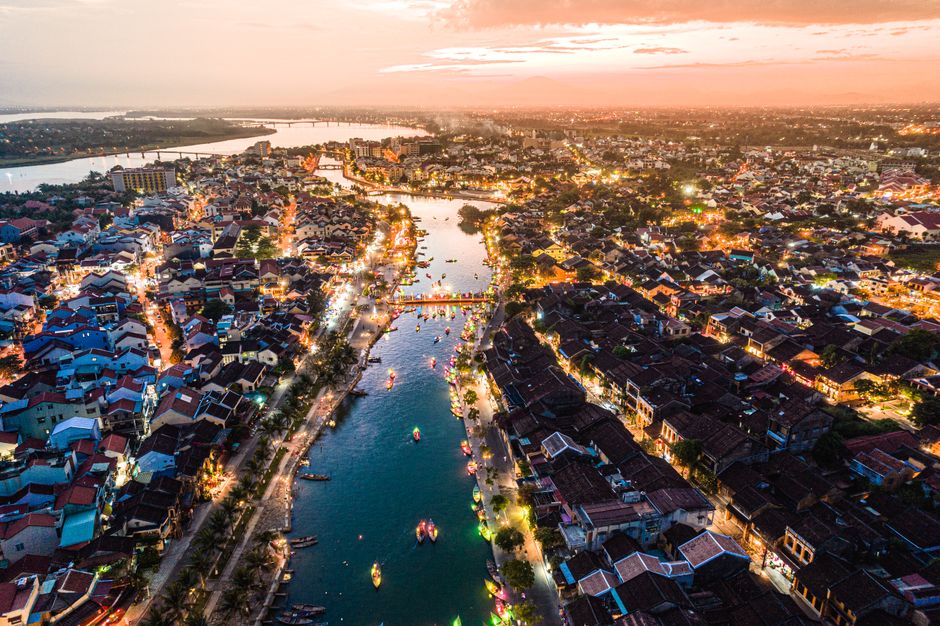
Hoi An is the most beautiful old town in Vietnam: a small riverside trading port of mustard-yellow merchant houses, Chinese assembly halls, family chapels and a famous covered bridge, lit at night by hundreds of silk lanterns reflected in the Thu Bon River. From the 15th to the 19th century, ships from China, Japan, the Netherlands and Portugal called here, and the town that grew up around the trade survived almost intact after the river silted up and commerce moved to Da Nang. UNESCO inscribed the Hoi An Ancient Town as a World Heritage Site on December 4, 1999, and the town is also a UNESCO Creative City for its crafts and folk art. Around the old town are rice fields, vegetable villages, coconut-palm waterways and the beaches of An Bang and Cua Dai, with the Cham Islands offshore and the temple ruins of My Son inland. Since July 2025, Hoi An has been part of Da Nang city. The best weather is from February to August; October and November are wet, and the old town’s riverside streets flood most years.
Right now in Hoi An
- Wed 23–26°C 74–80°F 49 mm Heavy rain
- Thu 24–26°C 76–79°F 56 mm Heavy rain
- Fri 24–28°C 75–83°F 23 mm Rain
Weather: MET Norway (CC BY 4.0) · Sea temperature: NOAA CoastWatch
Top tours in Hoi An
See all tours for Hoi An →
From local operators, with prices and reviews; you check availability and book on Viator, our partner. We may earn a commission at no extra cost to you. How we earn money
Hoi An at a glance
- Best for: historic architecture, lanterns and evening strolls, food, tailors and crafts, cycling through rice fields, and beach days.
- How long: 2 to 3 days; 4 or 5 with My Son, the Cham Islands and the beach.
- Best time: February to April, when it is warm, dry and not yet too hot; May to August is hot but good for the beach.
- Getting there: Da Nang International Airport is about 30 km (19 miles) north, 40 to 50 minutes by road.
- Getting around: on foot or by bicycle in town; Grab, taxis and electric buggies for the beaches.
- Good to know: you need an old-town ticket to enter the historic center; on the evening of each full moon, the town holds its lantern night.
- Before you go: the e-visa, visa-free stays, money and general safety are in our Vietnam travel guide.
Hoi An’s areas and where to stay
Hoi An is small: the old town covers a few blocks along the north bank of the Thu Bon River, and the beaches are 4 to 5 km (2.5 to 3 miles) away. Since the 2025 reform, the former city has been divided into the wards of Hoi An, Hoi An Dong and Hoi An Tay and the island commune of Tan Hiep, which takes in the Cham Islands.
The Ancient Town
The historic center, roughly between Phan Chu Trinh Street and the river, is closed to cars and, for most of the day, to motorbikes, under the town’s pedestrian and non-motorized-vehicle rules. Staying inside or right on its edge means you can walk out early, before the tour groups, and back again for the lanterns at night. Hotels here are mostly small boutique places and old houses.
An Hoi and Cam Nam islands
Across small bridges from the old town, An Hoi has the night market and riverside bars and restaurants facing the lanterns; Cam Nam is quieter and more residential, with homestays and street-food stalls.
The rice-field villages
Between the town and the sea, villages such as Tra Que and Cam Thanh are surrounded by rice paddies, vegetable gardens and water-coconut palms. Pool villas and homestays here offer peace and space a 10-minute bicycle ride from the old town.
An Bang and Cua Dai beaches
An Bang, 4 km (2.5 miles) north of the old town, has a relaxed beach lined with seafood restaurants and beach clubs. Cua Dai, to the east, has large resorts; parts of it have suffered serious erosion over the years, so check the state of the beach in front of any resort before booking. The coast toward Da Nang has more big resorts.
Top things to see in Hoi An
The old-town ticket
According to the Hoi An Center for Cultural Heritage Management and Conservation, visitors should buy a ticket before entering the Ancient Town, and each ticket helps fund conservation. Two tickets are sold: one for 80,000 VND, covering the old town, either the Japanese Covered Bridge or the Quan Cong Temple and two other sites of your choice, and one for 120,000 VND (about US$4.60), covering the old town, the Covered Bridge or the Quan Cong Temple, the museums and three other sites; the 120,000 VND ticket is the one usually sold to foreign visitors. Keep the stub to re-enter the old town. Groups buying eight or more tickets get a free guide. Tickets are sold at booths at the entrances to the old town.
Japanese Covered Bridge
The small bridge with a pagoda on it, Chua Cau, was built by the Japanese community at the end of the 16th century or the beginning of the 17th to link their quarter with the Chinese one, and is the symbol of Hoi An. It reopened in 2024 after a long restoration.
Assembly halls and temples
The Chinese communities from Fujian, Guangdong, Chaozhou and Hainan each built an assembly hall where traders met and worshipped. The Phuc Kien (Fujian) Assembly Hall, with its ornate gate, courtyard and dragon fountain, is the grandest. The Quan Cong Temple, opposite the market, is dedicated to a deified Chinese general.
Old merchant houses
Several centuries-old wooden houses, still lived in by the same families, can be visited on the ticket, including the Tan Ky House, the Phung Hung House and the Duc An House. They are long, narrow buildings with a shop at the front on the street, living quarters around a courtyard and a back door on the river, with flood marks on the walls.
Lanterns, the river and the night market
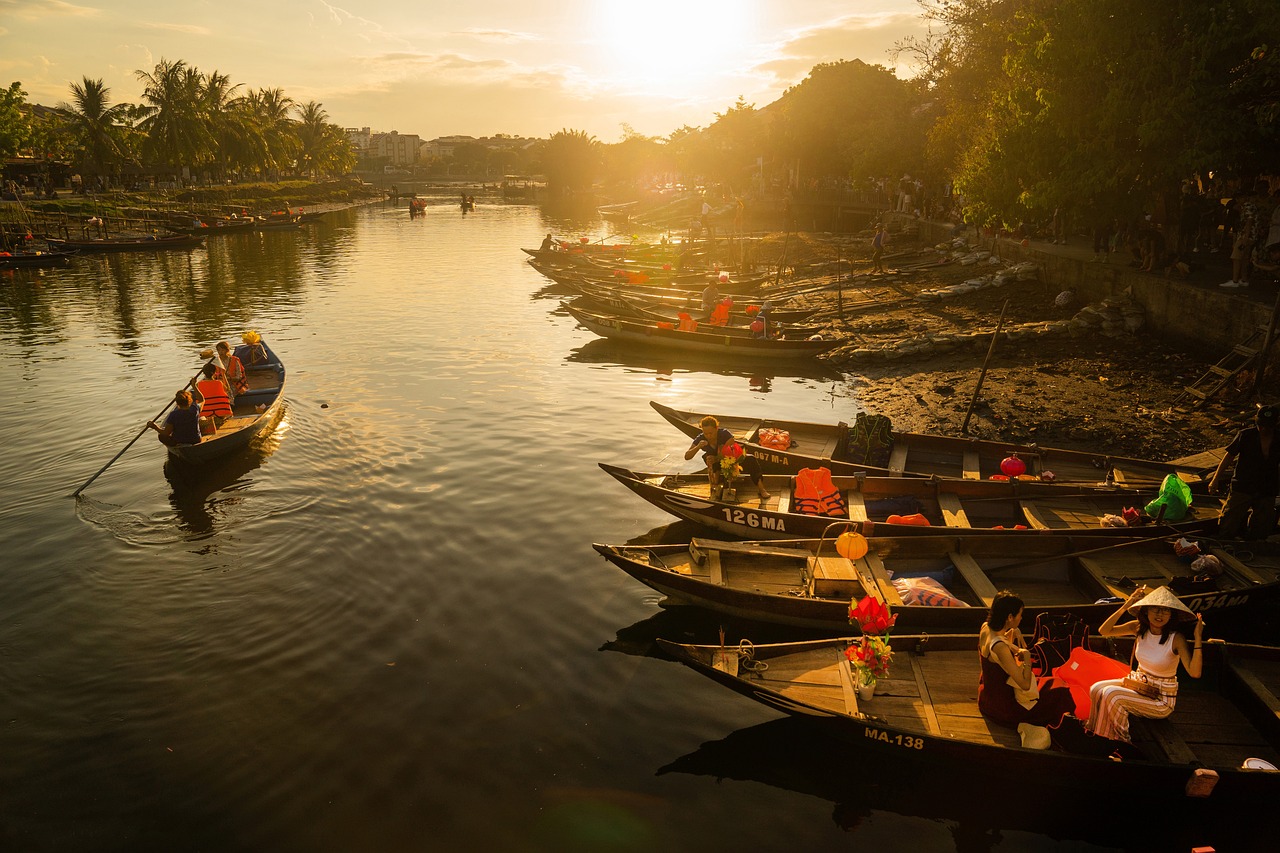
At dusk, the lanterns come on across the old town, and boat women sell rides on the Thu Bon River and paper lanterns to float on the water. The night market on Nguyen Hoang Street in An Hoi sells lanterns, souvenirs and street food. On the 14th day of each lunar month, the town holds its full-moon “old-town night,” when shops and houses are lit by lanterns and traditional games and music fill the streets. According to the management center, the old-town ticket also gives access to a Japanese tea ceremony at the Japanese culture exhibition house at 9:30 a.m. and 4:30 p.m., and to evening performances of bai choi singing games and folk music.
More classic sights
- Hoi An Museum of History and Culture and the Museum of Trade Ceramics: small museums on the town’s past and the shipwrecks and ceramics of the trade.
- Central Market: a busy riverside market for produce, fish and inexpensive food stalls.
- Thanh Ha Pottery Village and Kim Bong Carpentry Village: traditional craft villages a short bicycle or boat ride from town.
- Tra Que Vegetable Village: organic herb and vegetable gardens, named one of the Best Tourism Villages by UN Tourism in 2024.
Other things to do in Hoi An
Food and drink
Hoi An has a few dishes found nowhere else. Cao lau is chewy, smoky noodles with pork, greens and crispy croutons in a little broth, said to require water from one of the town’s old wells; white rose dumplings (banh bao vac) are delicate shrimp dumplings; com ga Hoi An is turmeric chicken rice; and the town’s banh mi sandwiches are among the most famous in the country. Mi Quang, the central noodle dish, is everywhere. Eat at the Central Market, the street stalls of An Hoi and Cam Nam, and the restaurants in old houses; cooking classes often begin with a market visit and a basket-boat ride.
Tailors and crafts
Hoi An is known for its tailors, who can make a suit, dress or shirt in 24 to 48 hours. Quality varies widely: bring a garment to copy, ask for at least two fittings and allow time for changes. Leather goods, lanterns and shoes are also made to order.
Cycling and the countryside
The flat roads around Hoi An are ideal for cycling: through the rice fields to An Bang beach, to Tra Que village or to the water-coconut forest at Cam Thanh, where you can ride in a round bamboo basket boat. See our cycling guide.
Festivals and events
The Mid-Autumn Festival and Tet (February 6, 2027) bring lanterns, folk games and markets; the management center lists events each month, including the Hoi An Creative Week in 2026. The Lantern Festival on the 15th day of the first lunar month, after Tet, is one of the most beautiful nights of the year.
Day trips from Hoi An
- My Son Sanctuary: the ruins of Cham temples set in a jungle valley, about 40 km (25 miles) west, about 1 hour by road; the ticket for foreign visitors is 150,000 VND, according to the My Son management board. Go at opening time to avoid heat and crowds.
- Cham Islands (Cu Lao Cham): a protected marine area about 20 km (12 miles) offshore, reached by speedboat from Cua Dai in 20 to 30 minutes, for snorkeling, beaches and a fishing village; boats run mainly from March to September. See our snorkeling guide.
- Da Nang: the Marble Mountains, the Lady Buddha on Son Tra and the beaches, 40 to 50 minutes north. See our Da Nang guide.
- Ba Na Hills: the hilltop resort and Golden Bridge, about 1.5 hours away.
- Hue: possible as a long day trip, 3 to 3.5 hours each way, but better with a night. See our Hue guide.
Nearby destinations
- Da Nang25 km
- Hue103 km
- Sanya292 km
- Phong Nha-Ke Bang National Park297 km
Getting there and getting around
By air
The nearest airport is Da Nang International Airport (DAD), about 30 km (19 miles) north, with frequent domestic flights from Hanoi and Ho Chi Minh City and international flights from across Asia. A Grab or taxi to Hoi An takes 40 to 50 minutes; many hotels arrange transfers.
By train and bus
The nearest railway station is in Da Nang, on the Reunification Express line. Sleeper buses and limousine vans run to Hoi An from Hue, Nha Trang and other cities, usually dropping passengers on the edge of town or at hotels.
Around Hoi An
Walk in the old town, and rent a bicycle (often free at hotels) for the beaches and villages. Grab cars and motorbikes, taxis and electric buggies cover longer distances. Motorbikes are not allowed in the central streets of the old town for most of the day.
When to go and how long to stay
Hoi An shares Da Nang’s central-coast climate. From February to April, the weather is warm and mostly dry, ideal for walking and cycling. May to August is hot and sunny, good for the beach. The rainy season, from September to December, brings heavy rain and the risk of tropical storms; the Thu Bon River often floods the riverside streets of the old town in October and November, sometimes to the first floor of the old houses. January is mild and drizzly. There is no long-term official climate station in Hoi An, so the table uses the 1991–2020 climate normals for Da Nang, 30 km (19 miles) north, from Vietnam’s National Center for Hydro-Meteorological Forecasting (NCHMF), as published by the World Meteorological Organization (WMO).
| Month | Average high / low | Rain (rainy days) | What to expect |
|---|---|---|---|
| January | 25 °C (77 °F) / 20 °C (67 °F) | 83 mm (3.3 in), 14 days | Mild and drizzly; quiet before Tet |
| February | 26 °C (79 °F) / 20 °C (69 °F) | 22 mm (0.9 in), 7 days | Drier; Tet on February 6 in 2027 and lantern festivals |
| March | 28 °C (83 °F) / 22 °C (72 °F) | 36 mm (1.4 in), 7 days | Warm and dry; a great month to visit |
| April | 31 °C (88 °F) / 24 °C (75 °F) | 50 mm (2.0 in), 7 days | Warm, dry and sunny; ideal for cycling |
| May | 33 °C (92 °F) / 25 °C (78 °F) | 71 mm (2.8 in), 10 days | Hot; best beach weather begins |
| June | 35 °C (95 °F) / 26 °C (79 °F) | 68 mm (2.7 in), 9 days | Hot and sunny; beach season |
| July | 34 °C (94 °F) / 26 °C (79 °F) | 92 mm (3.6 in), 12 days | Hot; occasional storms |
| August | 34 °C (93 °F) / 26 °C (78 °F) | 167 mm (6.6 in), 14 days | Hot; storms increasing |
| September | 32 °C (90 °F) / 25 °C (77 °F) | 394 mm (15.5 in), 17 days | Rains start; storm risk rises |
| October | 30 °C (85 °F) / 24 °C (75 °F) | 658 mm (25.9 in), 21 days | The wettest month; old-town flooding likely |
| November | 28 °C (82 °F) / 23 °C (73 °F) | 486 mm (19.1 in), 21 days | Very wet; floods and storms possible |
| December | 25 °C (78 °F) / 21 °C (69 °F) | 272 mm (10.7 in), 21 days | Wet and cooler; few crowds |
The region gets about 2,400 mm (94 in) of rain a year, more than half of it between September and November. In late October 2025, prolonged heavy rain caused two rounds of serious flooding across central Vietnam, according to the government.
2 days in Hoi An
Day one, the old town early, with the Covered Bridge, the Fujian Assembly Hall and two old houses, a cao lau lunch, a tailor fitting, then sunset on the river and the night market. Day two, cycle through the rice fields to Tra Que and a basket-boat ride at Cam Thanh, an afternoon at An Bang beach, and dinner in Cam Nam.
4 days with day trips
Add an early morning at My Son, a day snorkeling around the Cham Islands, and a cooking class.
Where to stay in Hoi An
- Ancient Town and its edge: boutique hotels and heritage houses within walking distance of everything.
- An Hoi and Cam Nam: riverside hotels and homestays across the bridges, close to the night market.
- Rice-field villages: pool villas and homestays in green surroundings, a short bicycle ride from town.
- An Bang and Cua Dai: beach hotels and resorts, 10 to 15 minutes from the old town by shuttle or taxi.
Rooms are busiest from February to April and in July and August.
What a trip to Hoi An costs
Prices are approximate, for October 2026, converted at about 26,000 dong (VND) to the US dollar.
| Item | Typical cost |
|---|---|
| Old-town ticket (Ancient Town, museums and three sites) | 120,000 VND (about US$4.60) |
| Bowl of cao lau or mi Quang | 35,000–60,000 VND (about US$1.35–2.30) |
| Banh mi | 25,000–40,000 VND (about US$1–1.55) |
| Boat ride on the river at night | 100,000–200,000 VND per boat (about US$3.85–7.70) |
| Bicycle rental, per day | 30,000–50,000 VND (about US$1.15–1.90) |
| Tailor-made cotton shirt | 400,000–700,000 VND (about US$15–27) |
| My Son Sanctuary, foreign visitor | 150,000 VND (about US$5.80) |
| Grab car from Da Nang airport | 300,000–450,000 VND (about US$12–17) |
| Mid-range hotel double, per night | 800,000–1,800,000 VND (about US$31–69) |
Practical tips for Hoi An
- Go early or late: the old town is quiet before 8 a.m. and at its prettiest after dusk.
- Keep your ticket stub: inspectors may ask for it at old-town entrances.
- Respect the houses: many heritage houses are homes; ask before taking photos inside.
- Give tailors time: order on your first day so there is time for fittings.
- Check flood forecasts: in October and November, riverside streets can be under water.
Safety
Hoi An is calm and safe, and crime against visitors is rare, though bag snatching occasionally happens on the darker roads to the beaches. The main hazards are floods and storms: from September to December, tropical storms can bring heavy rain and strong winds to the central coast, and the Thu Bon River regularly floods the old town’s lower streets in October and November; follow forecasts from the National Center for Hydro-Meteorological Forecasting and local instructions. At An Bang and Cua Dai, rip currents can be strong in the wet season, so swim near lifeguards. On the Cham Islands boats, wear the life jacket provided. Cycling is pleasant, but watch for motorbikes and cars on the main roads to the beaches and to Da Nang. Helmets are compulsory on motorbikes, and riding one requires a license valid in Vietnam, such as an international driving permit issued under the 1968 Convention with your home license. In an emergency, call 113 for police, 114 for fire and 115 for an ambulance.
What to pack for Hoi An
Light clothes, a hat and sunscreen, swimwear, comfortable sandals for walking and cycling, a rain jacket from September to December, and something covering shoulders and knees for temples and assembly halls. Vietnam uses 220 V, with sockets for flat (type A) and round (type C) two-pin plugs. See our rain jackets and travel adapters guides.
Hoi An travel FAQ
Do I need a ticket to enter Hoi An’s old town?
Yes. The heritage management center asks visitors to buy a ticket before entering. The 120,000 VND ticket covers the old town, the Covered Bridge or Quan Cong Temple, the museums and three other sites.
How many days do I need in Hoi An?
Two to three days for the old town, the countryside and the beach; four or five with My Son and the Cham Islands.
When is the Hoi An lantern festival?
The full-moon “old-town night” is held on the 14th day of each lunar month, and lanterns are lit every evening. The Lantern Festival after Tet and the Mid-Autumn Festival are the biggest.
What is the best time to visit Hoi An?
February to April for pleasant, dry weather; May to August for the beach. October and November are the wettest months, and the old town often floods.
Is Hoi An part of Da Nang now?
Yes. Since July 2025, the former Quang Nam province, including Hoi An, has been part of Da Nang city.
How do I get from Da Nang airport to Hoi An?
By Grab, taxi or hotel transfer in 40 to 50 minutes; expect to pay 300,000–450,000 VND for a car.
What food is Hoi An famous for?
Cao lau noodles, white rose dumplings, com ga turmeric chicken rice, banh mi and mi Quang.
Are Hoi An tailors worth it?
They can be, if you allow two or three days for fittings and check fabric and stitching carefully; quality varies a lot between shops.
Which is the best beach near Hoi An?
An Bang, 4 km (2.5 miles) north of the old town, has the nicest sand and a relaxed scene; Cua Dai has suffered erosion.
Can I visit the Cham Islands from Hoi An?
Yes. Speedboats leave from Cua Dai and take 20 to 30 minutes; trips run mainly from March to September, when the sea is calm.
Sources and last review
Researched and last reviewed on 4 October 2026. Old-town ticket options, the tea ceremony and evening programs, the UNESCO inscription date, the Creative City title, the 2026 Creative Week, Tra Que’s UN Tourism award and the new wards: the Hoi An Center for Cultural Heritage Management and Conservation (hoianworldheritage.org.vn); the 2025 merger with Da Nang and the October 2025 floods: the Government of Vietnam’s news portal; My Son ticket price: the My Son Relics and Tourism Management Board; climate normals for Da Nang: Vietnam’s National Center for Hydro-Meteorological Forecasting (NCHMF), via the World Meteorological Organization’s World Weather Information Service; exchange rate: Vietcombank. Which ticket foreign visitors are sold, the Covered Bridge’s dates and restoration, motorbike restrictions in the old town, the Cham Islands boat season, the beach erosion, distances and typical prices are general references or estimates, flagged for checking; driving-license and helmet rules are from the UK government’s factual safety pages. Prices and hours change, so check the official sites before you go. For entry rules, money and general safety, see our Vietnam travel guide.
Plan your trip
Partner links: TravelerCenter may earn a commission if you book, at no extra cost to you.
🇻🇳 Useful Vietnamese phrases for Hoi An
All 38 Vietnamese phrases: restaurant, hotel, emergencies, romance (printable) →