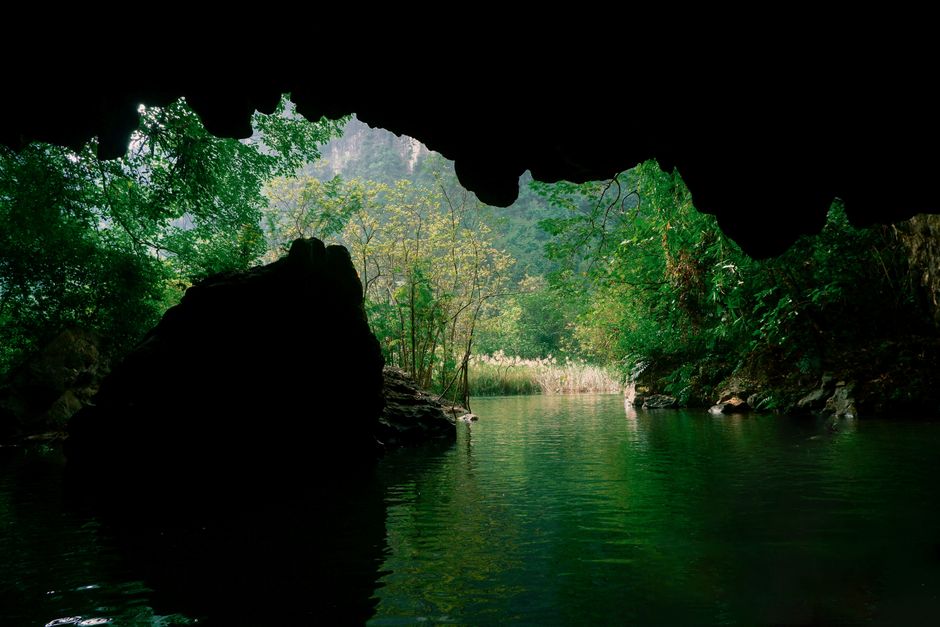
Phong Nha–Ke Bang National Park, in north-central Vietnam near the border with Laos, protects one of the oldest and largest karst landscapes in Asia: about 123,000 ha (475 sq miles) of jungle-covered limestone mountains, hollowed out by underground rivers into hundreds of caves. Among them is Son Doong, the largest known cave passage in the world, explored only in 2009, and others, such as Phong Nha Cave, entered by boat along an underground river, and Paradise Cave, with its cathedral-like halls of stalactites, that are easy to visit in a day. UNESCO inscribed the park as a World Heritage Site in 2003 for its geology and again in 2015 for its biodiversity, and in July 2025 extended it across the border to include Hin Nam No National Park in Laos, creating Vietnam’s first transboundary World Heritage Site. The village of Phong Nha, on the Son River at the park’s edge, is the base for caving tours, jungle treks, cycling and kayaking. Since July 2025, the park has been in Quang Tri province (formerly Quang Binh). The best months are February to August; from September to November, heavy rain and floods close caves and roads.
Right now in Phong Nha-Ke Bang National Park (Phong Nha)
- Thu23–26°C73–79°F3 mm rain
- Fri22–24°C72–75°F57 mm rain
- Sat22–26°C72–79°F19 mm rain
Top tours in Phong Nha-Ke Bang National Park
See all tours for Phong Nha-Ke Bang National Park →
From local operators, with prices and reviews; you check availability and book on Viator, our partner. We may earn a commission at no extra cost to you. How we earn money
Phong Nha at a glance
- Best for: caves of every scale, from easy show caves to multi-day expeditions, jungle trekking, river trips, cycling and war history.
- How long: 2 days for Phong Nha Cave, Paradise Cave and the Dark Cave; 3–5 days with an overnight adventure cave tour.
- Best time: February to August, when it is dry enough for caving; June to August is hot, with highs around 34 °C (93 °F).
- Getting there: Dong Hoi, the provincial gateway, about 45 km (28 miles) east, has an airport and a station on the North–South railway; buses and the Hue–Dong Hoi heritage train connect with Hue.
- Fees: each cave charges its own entry ticket; multi-day expeditions, including Son Doong, are sold as all-inclusive tours by licensed operators.
- Rules to know: go into wild caves only with licensed operators and guides, stay on paths and boardwalks in show caves, and do not touch formations.
- Before you go: the e-visa, visa-free stays, money and general safety are in our Vietnam travel guide.
Caves, permits and tickets (as of October 2026)
The park is managed by the Phong Nha–Ke Bang National Park Management Board, under the provincial government of Quang Tri. Show caves near Phong Nha village are open daily, and tickets are sold at the tourism center in Phong Nha and at each site. The Son Doong, Hang En, Tu Lan, Hang Va and other wild caves can only be visited on organized tours by licensed operators.
Show cave tickets
Ticket prices for the main show caves, as reported by local tour operators for 2026, are about 150,000 VND (about US$5.80) for Phong Nha Cave, plus a boat of about 700,000 VND shared by up to 12 people; about 250,000 VND (about US$9.60) for Paradise Cave; and around 450,000 VND for the Dark Cave package with zip-line and kayaking. Children under a set height enter free or at reduced prices. Prices are set by the provincial authorities and operators and change from time to time, so check at the tourism center before you go.
Son Doong: the world’s largest cave
Son Doong, discovered by a local man, Ho Khanh, in 1990 and surveyed by the British–Vietnamese caving team led by Howard Limbert in 2009, has a volume of about 38.5 million cubic meters and passages more than 200 m (650 ft) high, with jungle growing inside two collapsed dolines. Only one company, Oxalis Adventure, is licensed to take visitors into Son Doong: according to Vietnamese media, the Quang Binh provincial authorities granted Oxalis exclusive rights in 2019 for ten years, with an annual cap on visitors. According to Oxalis, the expedition costs VND 80,000,000 (US$3,000) per person, including VAT, the park entrance and environmental fee, the park’s management fee, porters, cave experts and safety staff, with groups of up to 10 guests; it runs only from January to the end of August, for safety reasons, and was already fully booked for 2027 at the time of writing, with limited places left for 2028. Participants must pass fitness and experience requirements, including a recent overnight trek, as the trip involves about 28 km (17 miles) of jungle trekking, river crossings, two nights camping inside the cave and a 90 m (295 ft) climb up the cave’s “Great Wall of Vietnam.”
The park’s key rules
Stay on boardwalks in show caves, do not touch or break formations, take all trash out, and do not swim in rivers or caves without a guide. The forest outside marked trails is a protected area, with unexploded ordnance from the war in some places; go into the jungle only with licensed guides. Drones need permission.
Top caves to see in Phong Nha
Phong Nha Cave
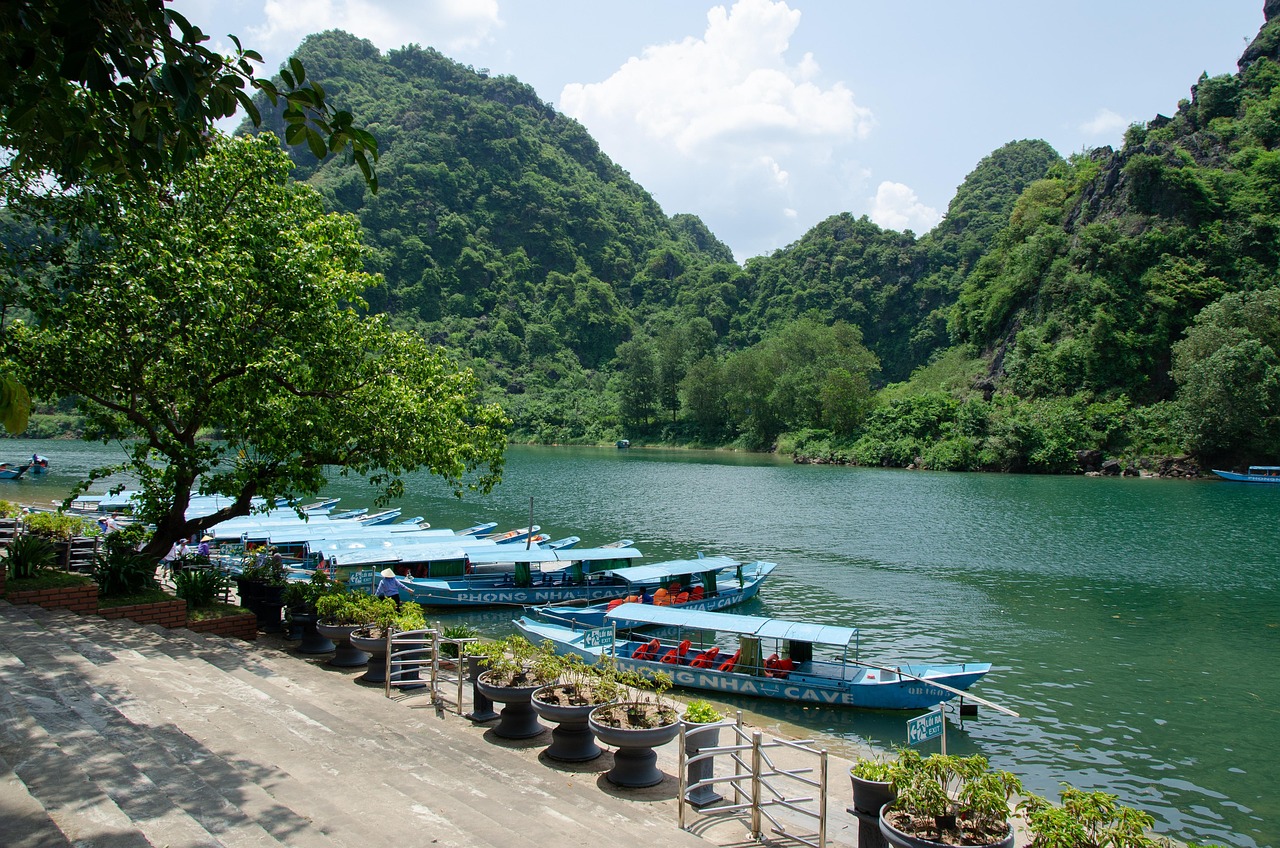
The park’s namesake, and its most visited cave, is entered by boat: wooden dragon boats leave the village pier and travel about 45 minutes up the Son River, then glide into the cave mouth and along an underground river past stalactites and stalagmites, before passengers walk back through dry chambers. Above it, Tien Son Cave is a dry cave reached by steps.
Paradise Cave (Thien Duong)
About 30 km (19 miles) from the village, Paradise Cave is about 31 km (19 miles) long; visitors walk about 1 km (0.6 miles) along a wooden boardwalk through enormous, beautifully lit chambers of white stalactites and stalagmites, among the most spectacular show caves in Asia. Guided tours of up to 7 km (4.3 miles) further into the cave are offered by operators. Electric carts run from the parking area to the foot of the stairs.
The Dark Cave (Hang Toi)
An adventure cave reached by zip-line over the Chay River, followed by a swim into the cave, a walk through mud to a natural mud bath, and kayaking back; good fun for active visitors, with helmets and headlamps provided.
Hang En and Tu Lan
Hang En, the world’s third-largest cave passage, with a sandy beach and swiftlet colonies inside, is visited on overnight treks with camping in the cave. The Tu Lan cave system, northwest of the park, combines jungle trekking with swimming through river caves; tours range from one day to four days. Both are run by licensed operators.
More caves and nature sites
- Botanic Garden: a short forest trail with waterfalls and a small rescue center for animals, near the park’s core.
- Nuoc Mooc Eco-trail: a boardwalk and swimming spot where a stream emerges from the limestone.
- Hang Va and Nuoc Nut: remote caves with rare cave formations, on multi-day expeditions.
- The Phong Nha Caves Exploration Museum: run by Oxalis in Phong Nha, with maps and equipment from 35 years of cave surveys.
Wildlife, trails and the jungle
The park’s forests are home to rare primates, including the Hatinh langur and red-shanked douc langur, as well as gibbons, Asian black bears, more than 300 bird species and many endemic plants; most animals are shy and rarely seen. Jungle treks with licensed operators follow old hunting and smuggling paths through the limestone, crossing streams and visiting ethnic minority villages such as those of the Bru-Van Kieu people. See our hiking guide.
Other things to do around Phong Nha
Cycling and the countryside
The flat valley around Phong Nha village, with rice fields, karst peaks and riverside villages such as Bong Lai, is perfect for cycling or a motorbike loop; farm stays offer lunch, swimming and kayaking on the Chay and Son rivers. See our cycling guide.
War history
Phong Nha lies on the route of the Ho Chi Minh Trail, the network of roads and paths that carried soldiers and supplies south during the American War, and its caves sheltered hospitals, depots and offices. The Eight Ladies Cave (Hang Tam Co) commemorates eight young volunteers killed in a bombing raid in 1972. The western branch of the Ho Chi Minh Highway, which crosses the park, is a scenic drive through the karst.
Food and drink
Local restaurants and farm stays serve grilled river fish, wild boar raised on farms, chao canh (thick noodle soup), fresh spring rolls and banh loc. Phong Nha village has a few cafés and bars popular with travelers. Try the local rice wine sparingly.
Around Phong Nha
- Dong Hoi: the coastal city that has been the administrative center of the enlarged Quang Tri province since 2025, with the ruins of Tam Toa Church, a beach and the airport.
- The Vinh Moc Tunnels and the DMZ: about 2 hours south by road. See our Hue guide.
- Hue: about 4 hours by road or by the heritage train from Dong Hoi.
- Ninh Binh and Hanoi: north by overnight train or bus. See our Ninh Binh guide.
Getting there
By air
Dong Hoi Airport (VDH), about 45 km (28 miles) east of Phong Nha, has flights from Hanoi and Ho Chi Minh City and a few other routes. Taxis and Grab cars take about 1 hour to Phong Nha, and many hotels arrange pickups.
By train
Dong Hoi Station is on the North–South railway, with overnight sleeper trains from Hanoi (about 10 to 11 hours) and day trains from Hue and Da Nang. Since August 28, 2026, Vietnam Railways has run a tourist train, HQ1/HQ2, between Hue and Dong Hoi, with stops near war sites on the way, according to Hue’s tourism department. Book on dsvn.vn.
By bus
Sleeper buses and limousine vans run directly to Phong Nha village from Hanoi, Ninh Binh, Hue and Hoi An, and local buses connect Dong Hoi with Phong Nha.
Getting around
Phong Nha village is small and walkable. Bicycles and motorbikes can be rented; the caves are spread out, so a car with driver, a tour or a motorbike is the easiest way to reach Paradise Cave and the Dark Cave. Boats to Phong Nha Cave leave from the village pier.
When to go and how long to stay
Phong Nha has a hot, monsoon climate with a long wet season in autumn. February to April is warm and mostly dry, ideal for trekking and caving. May to August is the hot season, often above 35 °C (95 °F), with the dry westerly “Lao wind,” but the caves stay cool and river trips are pleasant; Son Doong and other expeditions run until the end of August. September to November, sometimes into December, is the flood season: heavy rain and tropical storms raise the rivers, close Phong Nha Cave and many adventure caves, and can cut roads. December and January are cool, damp and often gray. Neither the WMO nor Vietnam’s National Center for Hydro-Meteorological Forecasting (NCHMF) publishes 1991–2020 normals for Dong Hoi on the WMO’s public lists, so the temperatures below come from Vietnam’s national technical regulation on natural conditions for construction, QCVN 02:2022/BXD, issued by the Ministry of Construction, for the Dong Hoi station on the coast, about 45 km (28 miles) east; rainfall is described from general sources, and the park’s forested interior is cooler and wetter.
| Month | Average high / low (Dong Hoi) | Typical rain | What to expect in the park |
|---|---|---|---|
| January | 22 °C (71 °F) / 17 °C (62 °F) | Drizzly | Cool and gray; Son Doong season starts |
| February | 22 °C (72 °F) / 18 °C (64 °F) | Light rain | Mild; Tet on February 6 in 2027 |
| March | 25 °C (77 °F) / 20 °C (67 °F) | Mostly dry | Good for trekking and caving |
| April | 29 °C (84 °F) / 22 °C (72 °F) | Dry | Warm and dry; caves at their best |
| May | 32 °C (90 °F) / 25 °C (77 °F) | Dry, with storms | Hot; river trips |
| June | 34 °C (93 °F) / 27 °C (80 °F) | Mostly dry | Very hot; Lao wind |
| July | 34 °C (93 °F) / 27 °C (80 °F) | Mostly dry | Very hot; swim in rivers and caves |
| August | 33 °C (92 °F) / 26 °C (79 °F) | Storms increase | Hot; last month of the Son Doong season |
| September | 31 °C (88 °F) / 24 °C (76 °F) | Wet | Flood season begins; tours reduced |
| October | 28 °C (83 °F) / 22 °C (72 °F) | Very wet | Floods likely; many caves closed |
| November | 26 °C (78 °F) / 20 °C (69 °F) | Very wet | Floods and storms |
| December | 23 °C (73 °F) / 18 °C (64 °F) | Wet, easing | Cool; some caves reopen |
2 days in Phong Nha
Day one, the boat to Phong Nha Cave and Tien Son Cave in the morning, and a bike ride through the countryside in the afternoon. Day two, Paradise Cave in the morning and the Dark Cave in the afternoon.
4 days with an adventure cave
Add an overnight trip to Hang En or a one- or two-day Tu Lan tour, booked well ahead, and the Botanic Garden or Nuoc Mooc.
Where to stay
- Phong Nha village: guesthouses, hostels and small hotels on the main street and the riverfront, close to the boat pier and tour offices.
- Bong Lai valley and the countryside: farm stays and homestays among rice fields and karst hills.
- Dong Hoi: city and beach hotels near the airport and station, about an hour from the caves.
Rooms fill on Vietnamese holidays and in summer; book adventure tours months ahead.
What a trip to Phong Nha costs
Prices are approximate, for October 2026, converted at about 26,000 dong (VND) to the US dollar. Cave ticket prices are those reported for 2026 by local operators, and the Son Doong price is Oxalis Adventure’s.
| Item | Typical cost |
|---|---|
| Phong Nha Cave ticket | 150,000 VND (about US$5.80) |
| Boat to Phong Nha Cave, shared by up to 12 | 700,000 VND per boat (about US$27) |
| Paradise Cave ticket | 250,000 VND (about US$9.60) |
| Dark Cave package with zip-line and kayak | about 450,000 VND (about US$17) |
| Overnight Hang En or Tu Lan adventure tour | 7,000,000–10,000,000 VND (about US$270–385) |
| Son Doong expedition | 80,000,000 VND (US$3,000) |
| Taxi or Grab from Dong Hoi airport | 400,000–600,000 VND (about US$15–23) |
| Mid-range hotel or farm stay double, per night | 500,000–1,500,000 VND (about US$19–58) |
Practical tips for Phong Nha
- Book adventure caves early: small-group tours fill months ahead, and Son Doong years ahead.
- Check river levels: in the flood season, the Phong Nha Cave boat and many tours are suspended.
- Bring shoes that grip: for wet, muddy caves, and sandals for river trips.
- Start early in summer: to beat the heat and the crowds at Paradise Cave.
- Use licensed operators: for any jungle trek or wild cave.
Safety
The park is safe for visitors who follow the rules. Floods are the main natural hazard: from September to November, heavy rain and storms raise the rivers rapidly, close caves and roads, and have cut off villages; follow forecasts from Vietnam’s National Center for Hydro-Meteorological Forecasting and local instructions. In wild caves, water levels can rise quickly after rain, which is why expeditions such as Son Doong operate only from January to August. Go into the jungle and wild caves only with licensed operators and guides. Unexploded ordnance from the war remains a hazard in central Vietnam: according to Vietnam’s National Mine Action Center, about 18.71% of the country is contaminated or suspected to be contaminated, with central provinces the worst affected, so stay on paths and never touch metal objects. In summer, heat above 35 °C (95 °F) can be dangerous on treks; drink plenty of water. Helmets are compulsory on motorbikes, and a license valid in Vietnam is required. In an emergency, call 113 for police, 114 for fire and 115 for an ambulance.
What to pack for Phong Nha
Light, quick-drying clothes, closed shoes with good grip for caves and treks, sandals or water shoes for river trips, a swimsuit, a headlamp, insect repellent, a hat and sunscreen, and a rain jacket from September to January. Vietnam uses 220 V, with sockets for flat (type A) and round (type C) two-pin plugs. See our water shoes, hiking shoes and rain jackets guides.
Phong Nha–Ke Bang travel FAQ
How do I visit Son Doong Cave?
Only on a multi-day expedition with Oxalis Adventure, the sole licensed operator, which costs VND 80,000,000 (US$3,000) per person, runs from January to August, and requires a good level of fitness and recent trekking experience.
How much are tickets to Phong Nha Cave and Paradise Cave?
About 150,000 VND for Phong Nha Cave, plus a shared boat of about 700,000 VND, and about 250,000 VND for Paradise Cave, according to prices reported for 2026; check at the tourism center.
What is the best time to visit Phong Nha?
February to August. From September to November, floods close many caves and roads.
How do I get to Phong Nha from Hue?
By bus or car in about 4 hours, or by train or the Hue–Dong Hoi heritage train to Dong Hoi and a taxi to Phong Nha.
How many days do I need in Phong Nha?
Two days for the main show caves; three to five with an overnight adventure cave.
Which province is Phong Nha in?
Quang Tri, since the July 2025 merger of Quang Binh into Quang Tri province.
Is Phong Nha a UNESCO site?
Yes. It was inscribed in 2003 and 2015, and in 2025 extended to include Hin Nam No National Park in Laos as a transboundary World Heritage Site.
Can I visit Phong Nha without a tour?
Yes, for the show caves: you can buy tickets and take the boat to Phong Nha Cave, and reach Paradise Cave and the Dark Cave by taxi or motorbike. Wild caves require tours.
Is Paradise Cave suitable for children and older visitors?
Yes. A wooden boardwalk with steps leads through the first kilometer, though the climb to the entrance is steep; electric carts cover part of the approach.
Are there unexploded bombs in Phong Nha?
The region was heavily bombed during the war, and unexploded ordnance remains in some areas; stay on marked paths and go into the jungle only with licensed guides.
Plan your trip
Partner links: TravelerCenter may earn a commission if you book, at no extra cost to you.
🇻🇳 Useful Vietnamese phrases for Phong Nha-Ke Bang National Park
All 38 Vietnamese phrases: restaurant, hotel, emergencies, romance (printable) →
Sources · last reviewed 4 October 2026
Researched and last reviewed on 4 October 2026. The park’s location, UNESCO status and transboundary extension and its place in Quang Tri province: the Phong Nha–Ke Bang National Park Management Board (phongnhakebang.vn); the Son Doong price, inclusions, group size, operating season (January to August), 2027 availability, fitness requirements and route details, and the July 13, 2025 UNESCO extension: Oxalis Adventure; Oxalis’s exclusive license (2019): VnExpress International ( secondary ); the 2025 provincial merger: the Government of Vietnam’s news portal; the Hue–Dong Hoi heritage train: the Hue Department of Tourism; monthly temperatures for Dong Hoi: Vietnam’s Ministry of Construction, QCVN 02:2022/BXD (read via luatvietnam.vn); unexploded ordnance: Vietnam National Mine Action Center (VNMAC); exchange rate: Vietcombank. Show cave ticket prices (reported by local operators for 2026), park area, cave dimensions, wildlife, war history, travel times, rainfall seasons and all other typical prices are general references or estimates, flagged for checking. Prices change, so check at the Phong Nha tourism center before you go. For entry rules, money and general safety, see our Vietnam travel guide.
Data: Weather: MET Norway (CC BY 4.0) · Rates: ECB · Costs: World Bank ICP and price levels · Wikidata (CC0)