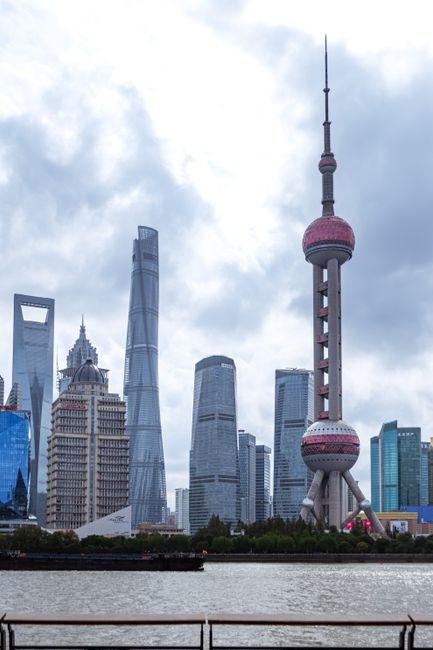
Short answer: Shanghai Pudong International (PVG) is Shanghai’s main international airport, about 30 km (19 miles) east of downtown. The fastest way in is the maglev train: about 8 minutes at up to 300 km/h to Longyang Road, where you change to the metro, for 50 yuan one way. The cheapest is Metro Line 2, about 7 yuan and roughly an hour to People’s Square. A metered taxi to People’s Square costs around 180 yuan and takes about 50 minutes, and night buses cover the hours when trains stop (all as of November 2026).
- IATA code
- PVG
- ICAO code
- ZSPD
- Serves
- Shanghai
Find flights to Shanghai (PVG)
Results open on our flights page, comparing airlines and agencies; Kiwi.com opens in a new tab. Leave Return empty for a one-way trip. TravelerCenter may earn a commission when you book, at no extra cost to you.
Travel guides for places this airport serves
Pudong has two large terminals, Terminal 1 and Terminal 2, side by side, each with a satellite hall (S1 and S2) for extra gates. Airports Council International (ACI World) counted almost 85 million passengers at Pudong in 2025, the fifth-busiest airport in the world, so check your terminal before you set off. Shanghai’s second airport, Hongqiao, is about 40 km away on the other side of the city and mainly handles domestic and regional flights.
Getting from Pudong Airport to central Shanghai
Five options cover almost everyone. Fares below come from Shanghai Airport Authority, the airport operator, and the Shanghai municipal government as of November 2026.
Shanghai Maglev (to Longyang Road)
- Route: Pudong Airport to Longyang Road station in Pudong, about 8 minutes, with a top speed of 300 km/h. At Longyang Road change to Metro Line 2 for Lujiazui, People’s Square and Nanjing Road.
- Hours: from the airport 7:02 a.m. to 9:42 p.m.; from Longyang Road 6:45 a.m. to 9:40 p.m.
- Fare: regular ticket 50 yuan one way or 80 yuan round trip; VIP ticket 100 yuan one way or 160 yuan round trip. Show a same-day air ticket for 20% off a single regular ticket.
- Worth it? The maglev is a memorable ride, but you still change to the metro at Longyang Road, so compare the total time to your hotel with Line 2 or a taxi. It does not run late at night.
Metro Line 2
- Station: Pudong Airport Terminal 1&2, between the two terminals; both terminals use it.
- Route: Line 2 crosses the whole city, through Longyang Road, Lujiazui, People’s Square and Jing’an Temple, and ends at Hongqiao Airport Terminal 2.
- Journey time and fare: about one hour to People’s Square, for about 7 yuan, the cheapest way into the city.
- Tip: check the last train times on Shanghai Metro’s website (shmetro.com) or at the station if you land late; the metro information line is 021-64370000.
Airport Link Line (to Hongqiao)
The Airport Link Line runs from the same Pudong Airport Terminal 1&2 station to Hongqiao Airport Terminal 2 in about 40 minutes, handy if you are connecting to a domestic flight at Hongqiao. Trains run from 6:00 a.m. to 10:00 p.m., about every 12–15 minutes.
Airport buses
- Airport Line 4: to Shanghai Railway Station (North Square) via Wujiaochang and Hongkou Football Stadium; leaves the terminals from about 7:00 a.m. to 11:00 p.m., every 20–70 minutes, 2–28 yuan by distance.
- Airport Line 7: to Shanghai South Railway Station; from about 7:30 a.m. to 11:00 p.m., every 25–45 minutes, 4–20 yuan.
- Late Night Bus: from 11:00 p.m. to 5:30 a.m., via Longyang Road, Century Avenue, East Yan’an Road and Yan’an Road to the Hongqiao transport hub; 18–34 yuan. It leaves when full at busy times, and at least every 30 minutes.
- Long-distance coaches: buses to cities in Jiangsu and Zhejiang, including Suzhou and Hangzhou, leave from the coach station near Terminal 2, with its ticket office at Wuzhou North Road and Africa Street.
Taxis
- Where: official taxi stands, open 24 hours, outside Arrivals Gate 12 at Terminal 1 (from Gates 4 or 8, walk south) and outside Arrivals Gate 25 at Terminal 2. Join the queue at the stand and ignore anyone offering rides inside the terminal.
- Fare: all city taxis are metered. The fare starts at 14 yuan for the first 3 km (16 yuan in some newer models), then 2.7 yuan per km, plus 50% per km after the first 15 km. Between 11:00 p.m. and 5:00 a.m. both rates rise by 30%.
- What to expect: around 180 yuan and about 50 minutes to People’s Square, more in heavy traffic. Have your hotel’s name and address written in Chinese to show the driver.
Ride-hailing apps and pre-booked transfers are an easy option for families, groups with lots of luggage or very late arrivals; you can book a transfer from the box near the top of this page.
Terminals
Both terminals handle international and domestic flights, and each has a satellite hall: S1 for Terminal 1 and S2 for Terminal 2. Your booking shows your terminal; the examples below come from Shanghai Airport Authority’s airline directory as of November 2026.
- Terminal 1: China Eastern Airlines, Shanghai Airlines and China United Airlines, with SkyTeam partners such as Air France, KLM, Delta, Korean Air and Vietnam Airlines, plus Japan Airlines, Asiana and China Airlines.
- Terminal 2: Air China, China Southern, Juneyao and Spring Airlines and most other foreign airlines, including Cathay Pacific, Singapore Airlines, Emirates, Qatar Airways, Etihad, Turkish Airlines, Lufthansa, Swiss, Finnair, British Airways, United, American Airlines, Air Canada and All Nippon Airways.
- Satellite halls S1 and S2: some flights board from these extra gate buildings. Give yourself extra time if your gate number starts with G.
Moving between terminals
- Free shuttle bus: runs between Terminal 1 and Terminal 2 24 hours a day, every 10–15 minutes.
- Connecting flights: if you change between an international and a domestic flight, follow the transfer signs and allow time for border control, customs and a new security check.
Arriving: arrival card, border control, payments and SIM/eSIM
- Arrival card: since November 2025 you can fill in China’s arrival card online before you fly, for free, on the National Immigration Administration (NIA) website or its “NIA 12367” app, or through the WeChat and Alipay mini-programs; kiosks and paper cards are also available at the border. Some travelers are exempt.
- Visa-free entry and transit: many nationalities can visit China without a visa for up to 30 days, and Pudong is a port for China’s 240-hour visa-free transit for travelers heading on to a third country or region. Who qualifies and the conditions are on our China travel guide.
- Border control and customs: for questions, the NIA hotline is 12367 and China Customs is 12360. Keep your passport with you after arrival; hotels register foreign guests with it.
- Mobile payments: China runs on Alipay and WeChat Pay. A service desk in International Arrivals (opposite Gate 10 at Terminal 1, near Exit 2A at Terminal 2), open 8:00 a.m. to 8:00 p.m., helps foreign visitors link an overseas bank card to Alipay.
- Money: currency exchange counters are in the arrivals and departures areas of both terminals, several of them open 24 hours, and there are ATMs.
- Phone and data: counters in International Arrivals sell Chinese SIM cards and rent portable Wi-Fi devices, some of them 24 hours. An eSIM bought before you fly usually works the moment you land. Free airport Wi-Fi (below) covers you until then.
Departing: check-in deadlines, security and tax refunds
- Check-in deadlines: for international flights (and flights to Hong Kong, Macao and Taiwan), check-in closes 60 minutes before departure (90 minutes for Ethiopian Airlines, 50 for Air China). For domestic flights it closes 40 minutes before departure with China Eastern, Shanghai Airlines, China Southern, China United and Air China, and 45 minutes with other airlines. Airlines can set their own rules, so check your ticket, and arrive well before the deadline.
- Self-service: self check-in kiosks are in both terminals, and your airline’s app usually lets you check in online.
- Power banks: China’s civil aviation authority bans power banks without a 3C certification mark, with an unclear mark, or from recalled models or batches on domestic flights. Take your power bank out of your bag at security.
- Border control: after check-in, international departures pass customs, exit border control and security, so allow extra time at busy hours.
- Tax refund: if you bought goods with a departure tax refund form, have them checked at the customs counter in the Departures hall (opposite Gate 11 at Terminal 1, Gate 25 at Terminal 2) before you check those bags in, then collect your refund at the bank counter after border control (near Gates 19–20 at Terminal 1 and Gate D83 at Terminal 2). There are also refund points in the satellite halls.
Facilities
- Wi-Fi: free across both terminals. Join “#AirportPVG-Free-WiFi” and log in with a code sent to your phone by text message, with a code from a Wi-Fi kiosk after scanning your passport, or by choosing “Passport Login” and taking a photo of your passport.
- Luggage storage: staffed left-luggage offices, open 6:00 a.m. to midnight, store bags for up to two months. Terminal 1: between Gates 4 and 5 in the 3rd-floor Departures hall and opposite Gate 7 in the 1st-floor Arrivals hall. Terminal 2: near check-in Island A on the 3rd floor and next to Exit 2A in International Arrivals. Bring your passport; bags are X-rayed.
- Lounges and VIP services: airline lounges serve premium passengers and members, and the airport sells VIP services; see the airport’s website.
- Accessibility: free self-service wheelchairs before and after security, an assistance call button at the Departures entrance (outside Gate 6 at Terminal 1, Gate 28 at Terminal 2), plus accessible elevators, restrooms and priority lanes. Ask your airline for full assistance when you book.
- Food and shops: both terminals have Chinese and international restaurants, cafés, shops and duty-free.
- Help: the airport service hotline is 021-96990.
Car rental and parking
Car rental: driving in mainland China requires a Chinese driving license, so most visitors use the metro, taxis, ride-hailing or a car with a driver. If you do have a Chinese license, you can compare rental prices from the box near the top of this page.
Parking: Shanghai Airport Authority runs three car parks:
- P1 and P2 (about 2,500 and 2,400 spaces) by the terminals: 10 yuan per hour for the first 2 hours, then 5 yuan per hour, up to 130 yuan per 24 hours. The first 20 minutes are free. P1 has a 1.8 m height limit.
- P4 long-term garage (about 4,850 spaces): 5 yuan per hour, up to 60 yuan per 24 hours; 2 m height limit.
- Accessible parking spaces are available, and prices are for cars (large vehicles pay double). Parking information line: 021-68340385.
Hotels near the airport
There is a transit hotel inside Terminal 2, on floors 6–7 (entrance on the 4th floor, up the escalator behind check-in row G on the 3rd floor), a three-minute walk from the security checkpoints, and hotels next to the terminals run shuttle buses that take about 5–10 minutes. They suit a dawn departure, a late arrival or a long layover. For most trips it is better to stay in the city: the maglev and Line 2 put Lujiazui and People’s Square within an hour, so hotels near Line 2 are a good middle ground. You can search hotels near PVG from the box near the top of this page.
Plan your trip: once you land, our Shanghai travel guide covers the Bund, Yu Garden, the French Concession, where to stay and day trips to the water towns, and the China travel guide has entry rules, payments and getting around the country. Shanghai is also the gateway to the canal city of Suzhou and the West Lake in Hangzhou.
Frequently asked questions
How do I get from Pudong airport to the city center?
Take the maglev to Longyang Road (about 8 minutes, 50 yuan) and change to Metro Line 2; take Line 2 all the way from the airport (about an hour to People’s Square, about 7 yuan); ride an airport bus to Shanghai Railway Station or Shanghai South Railway Station; or take a metered taxi, around 180 yuan to People’s Square (as of November 2026).
How much is the Shanghai maglev?
A regular one-way ticket is 50 yuan and a round trip 80 yuan; VIP tickets are 100 and 160 yuan. With a same-day air ticket you get 20% off a single regular ticket. Trains run from about 7:00 a.m. to 9:40 p.m. from the airport.
Which terminal does my airline use at Pudong?
China Eastern, Shanghai Airlines and their SkyTeam partners such as Air France, KLM, Delta and Korean Air use Terminal 1. Air China, China Southern, Juneyao, Spring Airlines and most other foreign airlines, including Cathay Pacific, Singapore Airlines, Emirates, Lufthansa, British Airways and United, use Terminal 2. Always check your booking.
How do I get from Pudong to Hongqiao airport?
Take the Airport Link Line from Pudong Airport Terminal 1&2 station to Hongqiao Airport Terminal 2, about 40 minutes, from 6:00 a.m. to 10:00 p.m. Metro Line 2 also links the two airports, with many more stops. At night, the Late Night Bus runs to the Hongqiao transport hub.
Is there free Wi-Fi at Shanghai Pudong airport?
Yes. Join “#AirportPVG-Free-WiFi” and log in with a text-message code, a code from a Wi-Fi kiosk that scans your passport, or the “Passport Login” option, which takes a photo of your passport.
Can I store luggage at Pudong airport?
Yes. Left-luggage offices in both terminals’ Departures and Arrivals halls are open from 6:00 a.m. to midnight and keep bags for up to two months. Bring your passport.
Researched and last reviewed on 10 November 2026. Sources: Shanghai Airport Authority (transport, maglev, Airport Link Line, buses, taxis, parking, airlines, check-in deadlines and services), the Shanghai municipal government (journey times, fares and the terminal shuttle), the Shanghai Maglev Transportation Development Co. (maglev discount), Airports Council International (passenger numbers) and China’s National Immigration Administration (arrival card and transit). Fares, hours and terminal assignments change, so check the official links before you travel.
Before you go: guidebooks and travel gear
Affiliate links: we may earn a commission at no extra cost to you. As an Amazon Associate we earn from qualifying purchases. We pick items for the place, not for the commission. How we earn money