Suzhou, in the south of Jiangsu province, about 100 km (60 miles) west of Shanghai, is the city of classical gardens and canals, the “Venice of the East” in the old travelers’ phrase. Founded around 514 BC as the capital of the kingdom of Wu, it grew rich on the Grand Canal, rice and silk, and its scholars, officials and merchants built private gardens behind high white walls: miniature worlds of rockeries, ponds, pavilions, latticed windows and carefully framed views. Nine of them, including the Humble Administrator’s Garden, the Lingering Garden, the Master of the Nets Garden and the Lion Grove, form the UNESCO World Heritage Site of the Classical Gardens of Suzhou, inscribed in 1997 and extended in 2000. Around them, the old city still keeps its canals, arched stone bridges and whitewashed houses, best seen along Pingjiang Road and Shantang Street, and I. M. Pei’s modern Suzhou Museum reinterprets the garden tradition. Suzhou is now a city of more than 12 million people, with a modern district around Jinji Lake, but the old town remains walkable. It is under half an hour from Shanghai by high-speed train, and the water towns of Tongli and Zhouzhuang and the shores of Lake Tai are close by. The big gardens need real-name tickets booked with your passport and fill up on weekends. The best months are April, May, October and November.
Right now in Suzhou
- Wed 14–25°C 56–76°F Clear
- Thu 15–24°C 59–75°F Clear
- Fri 17–24°C 63–76°F Partly cloudy
Weather: MET Norway (CC BY 4.0)
Top tours in Suzhou
See all tours for Suzhou →
From local operators, with prices and reviews; you check availability and book on Viator, our partner. We may earn a commission at no extra cost to you. How we earn money
Suzhou at a glance
- Best for: classical gardens, canals and old streets, silk, museums, water towns, Kunqu opera and tea.
- How long: 1–2 days for the gardens and old town; 3 with a water town or Lake Tai.
- Best time: April to May and October to November; June brings the plum rains, July and August are hot, and winters are cold and damp.
- Getting there: by high-speed train from Shanghai (about 25–30 minutes), Nanjing, Hangzhou and Beijing; the nearest big airports are in Shanghai.
- Getting around: on foot and by bike in the old town, by metro, taxi or DiDi further out, and by boat on the canals.
- Good to know: book the major gardens and the Suzhou Museum in advance, and visit on weekdays if you can.
- Before you go: visa-free entry, the 240-hour transit, the arrival card, payments and general safety are in our China travel guide.
Suzhou’s areas and where to stay
The old city, the Gusu district, is a rectangle of about 14 km² (5.4 sq miles) surrounded by a moat, with canals and lanes inside, and most of the gardens. East of it, Suzhou Industrial Park (SIP) around Jinji Lake is the modern city.
Pingjiang Road and the northeast old town
The most atmospheric base: guesthouses and boutique hotels in restored courtyard houses along the canal of Pingjiang Road, a short walk from the Humble Administrator’s Garden, the Lion Grove, the Suzhou Museum and the Couple’s Retreat.
Guanqian Street and the center
Around the old Guanqian Street pedestrian shopping area and the Taoist Xuanmiao Temple, mid-range and international hotels are central, with metro access and restaurants.
Shantang Street and the northwest
Near Shantang Street, the canal street that leads to Tiger Hill, and close to the Lingering Garden and Suzhou railway station, hotels are convenient for arrivals by train.
Jinji Lake and Suzhou Industrial Park
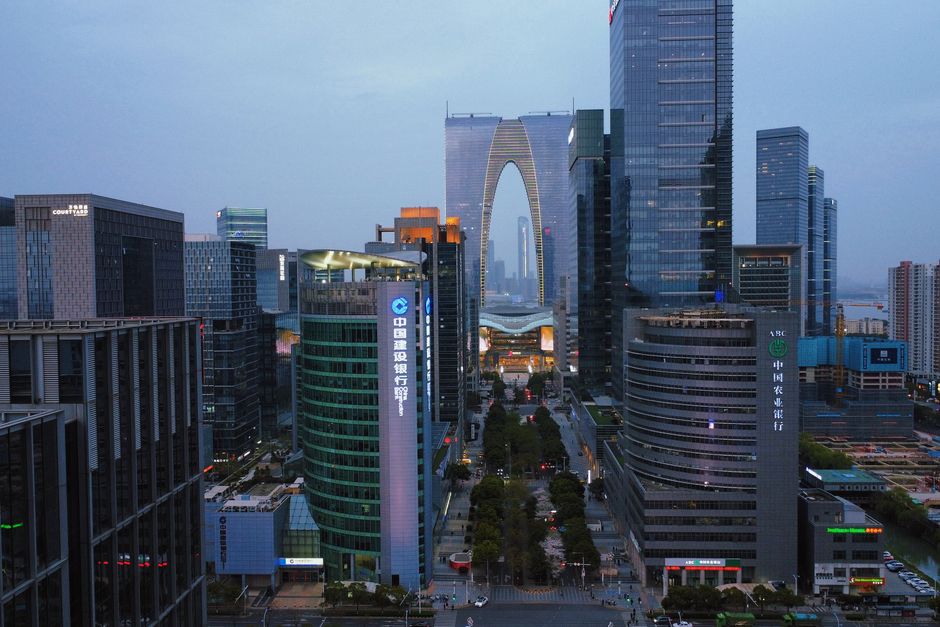
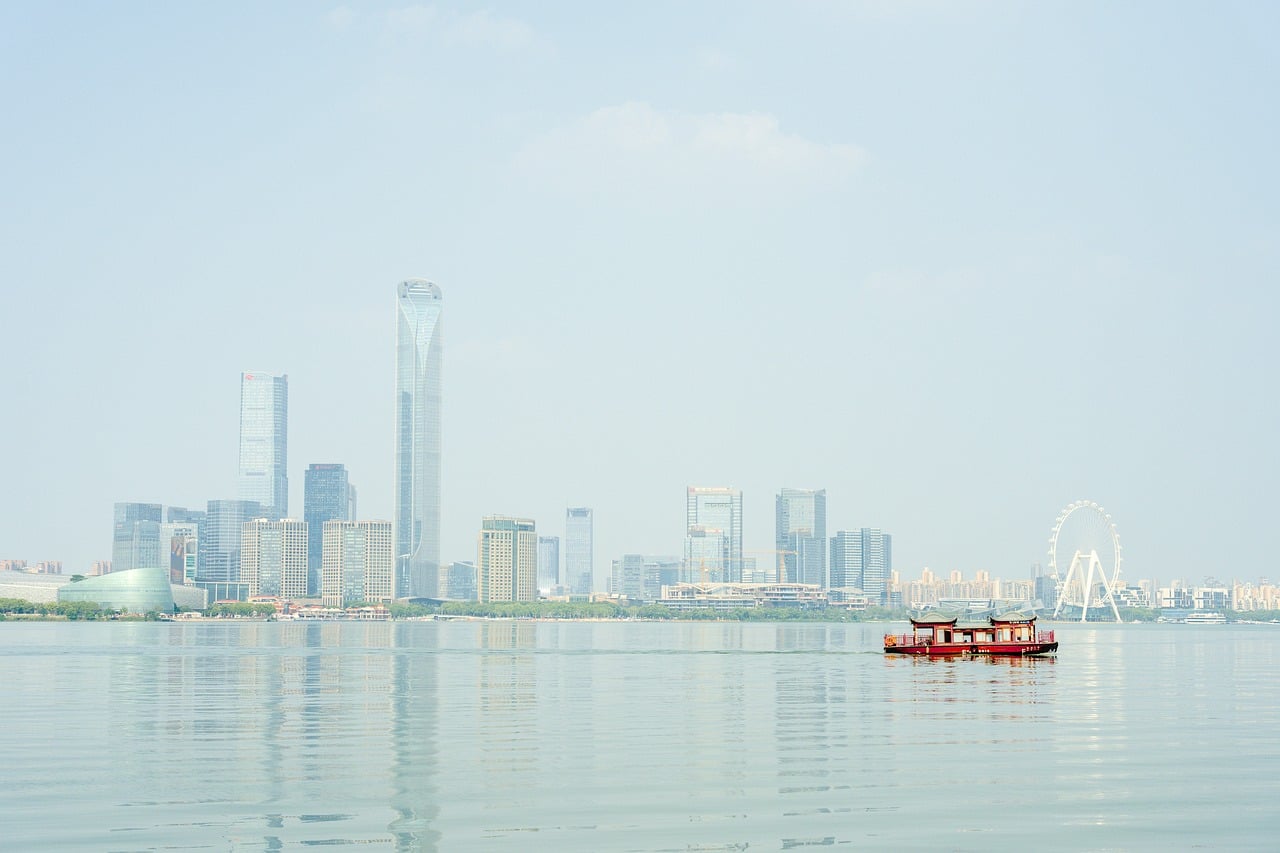
East of the old city, Jinji Lake is ringed by skyscrapers, including the arch-shaped Gate of the Orient, with international hotels, malls, a lakeside promenade and a musical fountain; it is about 20 minutes by metro from the old town.
Where to stay in Suzhou
- Pingjiang Road: courtyard guesthouses and boutique hotels by the canals.
- Guanqian Street: central mid-range and international hotels.
- Shantang Street and the station: convenient for trains and Tiger Hill.
- Jinji Lake: modern international hotels with lake views.
- Water towns: canal-side guesthouses in Tongli or Zhouzhuang for quiet evenings.
Rooms fill at weekends and holidays, when many visitors come from Shanghai.
Top things to see in Suzhou
The Humble Administrator’s Garden
The largest of Suzhou’s gardens, the Humble Administrator’s Garden (Zhuozheng Yuan), covers about 5 hectares (12 acres). According to the city’s gardens bureau, it was begun in 1509 by the imperial censor Wang Xianchen on the site of a temple; it passed through many owners, was restored by the government from 1951, and was inscribed by UNESCO in 1997. The garden is divided into three parts around ponds: the eastern part of lawns and woods, the central part, its heart, with pavilions, bridges and islands, and the western part with the Mandarin Duck Hall. Its name refers to a line about a retired official tending his garden as the “administration” of the humble. It is the most visited garden, so book a real-name ticket in advance with your passport and go at opening time.
The Lingering Garden
The Lingering Garden (Liu Yuan), just west of the old city, is famous for its architecture: a sequence of corridors, courtyards and halls, with more than 700 latticed windows framing views, and the Guanyun Peak, a 6.5-meter (21-foot) lake-eroded Taihu rock, one of the most celebrated stones in China.
The Master of the Nets Garden
The small Master of the Nets Garden (Wangshi Yuan), in the south of the old city, is considered the most perfect of the gardens: a residence and garden around a central pond, with every view carefully composed. On some evenings in the warmer months, a night garden tour stages short performances of Kunqu opera, pingtan storytelling and music in the halls.
The Lion Grove
The Lion Grove (Shizi Lin), founded by a Buddhist monk in 1342, is known for its maze of Taihu rocks, said to resemble lions, with tunnels and caves that children love to scramble through. It is near the Humble Administrator’s Garden and the Suzhou Museum.
The Suzhou Museum
Designed by I. M. Pei, whose family came from Suzhou, and opened in 2006, the Suzhou Museum is a geometric reinterpretation of the garden tradition in white walls, gray stone and glass, with a rock garden “painted” with sliced stone against a white wall. It holds paintings, calligraphy, ceramics, jade and the treasures of a Song-dynasty pagoda. Entry is free with an advance booking; it is usually closed on Mondays, and slots sell out at weekends. A large western branch opened in 2021.
Pingjiang Road and Shantang Street
Pingjiang Road runs along a canal in the northeast of the old city, lined with whitewashed houses, teahouses, Kunqu and pingtan performances and small museums; branch lanes lead to quiet neighborhoods. Shantang Street, laid out by the Tang poet Bai Juyi in the 9th century, runs about 3.5 km (2 miles) from the Changmen Gate to Tiger Hill; its restored eastern end is busy with snack stalls and canal boats, which are lit up at night.
More classic sights
- Tiger Hill: a wooded hill with a 10th-century brick pagoda that leans visibly, and the legendary tomb of the King of Wu.
- The Couple’s Retreat Garden: a quiet garden surrounded by canals on three sides, near Pingjiang Road.
- Canglang Pavilion: the oldest of the surviving gardens, from the Song dynasty, with a famous double corridor.
- Panmen Gate: the only surviving combined land and water gate of the city wall, with the Ruiguang Pagoda.
- Hanshan Temple and the Maple Bridge: a Buddhist temple made famous by a Tang poem about its midnight bell.
- Suzhou Silk Museum and the Kunqu Opera Museum: the city’s two great crafts.
Other things to do in Suzhou
Food and drink
Suzhou cuisine is refined and slightly sweet. Try squirrel-shaped mandarin fish (songshu guiyu), a whole fish scored, fried and glazed with sweet-and-sour sauce; Suzhou noodles in a rich, dark broth with toppings such as braised duck or fried fish, a breakfast tradition; Biluochun green tea from the hills of Lake Tai; seasonal dishes such as hairy crab from Yangcheng Lake in autumn; and Suzhou’s famous pastries and sweets, such as osmanthus cakes and fresh meat mooncakes. Old restaurants such as Songhelou on Guanqian Street and noodle shops in the old town serve the classics.
Canal boats and night views
Boats run along the outer moat and on the canals of Shantang Street and Pingjiang Road, best at dusk when the lanterns are lit. The musical fountain on Jinji Lake plays in the evening on many days.
Silk and crafts
Visit a silk workshop to see cocoons unwound and silk duvets made; Suzhou is also known for double-sided embroidery, where the image is the same on both sides, and for fans, carved wood and Taihu-stone bonsai. See our city sightseeing and boat trips guides.
Day trips from Suzhou
- Tongli: a water town of canals and bridges, with the elegant Retreat and Reflection Garden, part of the UNESCO gardens site, about 30–40 minutes by road.
- Zhouzhuang: the best-known water town, with the Double Bridge and Ming-era houses, about 1 hour by road; busy with tour groups, so stay for the evening.
- Luzhi and Mudu: smaller canal towns closer to the city, easy by bus or metro.
- Lake Tai: one of China’s largest freshwater lakes, with the Dongshan and Xishan peninsulas and islands, tea plantations and orchards, about 1 hour by road.
- Shanghai: about 25–30 minutes by high-speed train.
- Hangzhou and Nanjing: about 1–1.5 hours by high-speed train.
Nearby destinations
- Shanghai81 km
- Hangzhou124 km
- Nanjing194 km
- Huangshan (Yellow Mountain)268 km
Getting there and getting around
By train
Suzhou is on the main Beijing–Shanghai and Shanghai–Nanjing lines, with three main stations: Suzhou Station, just north of the old city, the most convenient, with trains to Shanghai, Nanjing and Wuxi; Suzhou North, on the Beijing–Shanghai high-speed line, for Beijing (about 4.5–5.5 hours); and Suzhou Industrial Park station in the east. Trains to Shanghai take about 25–30 minutes, and to Hangzhou about 1.5 hours. Book on the 12306 website or app with your passport; trains to and from Shanghai are frequent but fill at weekends.
By air
Suzhou has no major airport of its own; most travelers fly to Shanghai Hongqiao (about 85 km/53 miles away, next to Hongqiao station, from which trains reach Suzhou in about 25 minutes) or Shanghai Pudong. Sunan Shuofang airport in Wuxi, about 40 km (25 miles) away, is a designated port for the 240-hour visa-free transit, with all of Jiangsu province as the permitted area; you can also enter through Shanghai’s airports and travel on to Jiangsu within the 240 hours.
Around town
The old city is compact: walk, or rent a shared bike to ride along the canals. The metro links the stations, the old city and Jinji Lake; pay with Alipay or WeChat Pay QR codes. Taxis and DiDi are easy; buses run to Tiger Hill, Hanshan Temple and the water towns.
When to go and how long to stay
Suzhou has a humid subtropical climate, much like Shanghai’s. Spring (March–May) brings blossom in the gardens and mild weather, the classic season. June and early July are the plum rains, gray and showery, when the gardens are green and misty. Summer (July–August) is hot and humid, with highs around 32 °C (90 °F) and lotus flowers on the ponds. Autumn (October–November) is mild and sunny, with osmanthus, chrysanthemum shows and hairy-crab season. Winter (December–February) is cold and damp, with occasional snow on the gardens. There is no CMA station for Suzhou in the WMO normals, so the table uses the 1991–2020 normals for the Baoshan station in Shanghai, about 85 km (53 miles) to the east, as submitted by the China Meteorological Administration (CMA) to the World Meteorological Organization (WMO): average daily highs and lows, total precipitation, and days with at least 1 mm of rain or snow. Suzhou’s figures are very similar.
| Month | Average high / low | Rain (days with 1 mm or more) | What to expect |
|---|---|---|---|
| January | 8 °C (47 °F) / 2 °C (36 °F) | 70 mm (2.7 in), 8 days | Cold and damp; quiet gardens |
| February | 10 °C (50 °F) / 4 °C (38 °F) | 64 mm (2.5 in), 7 days | Cold; plum blossom; Chinese New Year |
| March | 14 °C (58 °F) / 7 °C (44 °F) | 86 mm (3.4 in), 10 days | Cool; spring blossom begins |
| April | 20 °C (68 °F) / 12 °C (54 °F) | 77 mm (3.0 in), 8 days | Mild; gardens in bloom; excellent |
| May | 25 °C (77 °F) / 18 °C (64 °F) | 90 mm (3.6 in), 8 days | Warm and pleasant; very good |
| June | 28 °C (82 °F) / 22 °C (71 °F) | 197 mm (7.7 in), 10 days | Plum rains; green and misty |
| July | 32 °C (90 °F) / 26 °C (79 °F) | 147 mm (5.8 in), 8 days | Hot and humid; lotus season |
| August | 32 °C (89 °F) / 26 °C (79 °F) | 210 mm (8.3 in), 10 days | Hot; wet; typhoon risk |
| September | 28 °C (82 °F) / 22 °C (72 °F) | 116 mm (4.6 in), 7 days | Warm; humid early in the month |
| October | 23 °C (73 °F) / 17 °C (62 °F) | 71 mm (2.8 in), 5 days | Mild and sunny; ideal; Golden Week crowds |
| November | 18 °C (64 °F) / 11 °C (51 °F) | 58 mm (2.3 in), 7 days | Cool and clear; autumn colors |
| December | 11 °C (52 °F) / 4 °C (40 °F) | 49 mm (1.9 in), 6 days | Cold and quiet |
The area receives about 1,240 mm (49 in) of precipitation a year, with peaks in June and August.
One day in Suzhou
Arrive early from Shanghai: the Humble Administrator’s Garden at opening, the Suzhou Museum and the Lion Grove, lunch of Suzhou noodles, Pingjiang Road in the afternoon, and Shantang Street at dusk.
Two to three days
Add the Lingering Garden, the Master of the Nets Garden with its night tour, Tiger Hill and Panmen, a canal boat on the moat, and a day in Tongli or at Lake Tai; then continue to Hangzhou or Shanghai.
What a trip to Suzhou costs
Prices are approximate, for October 2026, converted at about 6.74 yuan to the US dollar.
| Item | Typical cost |
|---|---|
| Humble Administrator’s Garden ticket | about 70–90 CNY by season (about US$10–13) |
| Lingering Garden ticket | about 45–55 CNY (about US$6.70–8.20) |
| Master of the Nets Garden or Lion Grove ticket | about 30–40 CNY (about US$4.50–5.90) |
| Suzhou Museum | free with booking |
| High-speed train to Shanghai, second class | about 25–45 CNY (about US$3.70–6.70) |
| Bowl of Suzhou noodles | 20–45 CNY (about US$3–6.70) |
| Canal boat ride | about 60–150 CNY (about US$8.90–22) |
| Mid-range hotel double, per night | 350–800 CNY (about US$52–119) |
Practical tips for Suzhou
- Book the big gardens: the Humble Administrator’s Garden and the Lingering Garden sell timed, real-name tickets; book with your passport, especially for weekends.
- Book the Suzhou Museum: free slots go fast; remember the usual Monday closure.
- Go early: the gardens are calmest at opening, before tour groups arrive.
- Visit on weekdays: weekends bring crowds from Shanghai.
- Combine gardens wisely: the Humble Administrator’s Garden, the Lion Grove and the museum are next to each other.
- Look for quieter gardens: the Couple’s Retreat, the Garden of Cultivation and Canglang Pavilion are peaceful.
Safety
Suzhou is very safe, with little crime. Watch for pickpockets in the crowded gardens, on Pingjiang Road and Shantang Street on weekends and holidays, and avoid touts selling garden tickets, canal boats or water-town tours; buy from official channels. Traffic in the old town is mostly scooters and bikes on narrow streets, but they move fast and silently: look both ways, even on lanes. Canal edges often have no railings, so watch children. In summer, heat and humidity are intense, and the plum rains and occasional typhoons can bring heavy rain; follow local alerts. Air quality is usually moderate. Carry your passport for tickets, trains and police checks. In an emergency, call 110 for police, 120 for an ambulance and 119 for fire.
What to pack for Suzhou
Comfortable walking shoes for stone paths and steps, an umbrella in spring and June, light, breathable clothes in summer, layers in spring and autumn, and a warm coat for the damp winter; a camera with a wide lens helps in the gardens. China uses 220 V, with flat two-pin, round two-pin and angled three-pin sockets. See our rain jackets and travel adapters guides.
Suzhou travel FAQ
Which Suzhou garden is the best?
The Humble Administrator’s Garden is the largest and most famous; the Lingering Garden has the finest architecture; and the small Master of the Nets Garden is often called the most perfect.
Do I need to book Suzhou gardens in advance?
For the big gardens, yes, especially on weekends: tickets are real-name and timed, booked online with your passport through the official channels.
How much is the Humble Administrator’s Garden ticket?
About 70–90 yuan, depending on the season; check the current price when you book.
How do I get from Shanghai to Suzhou?
By high-speed train from Shanghai, Shanghai Hongqiao or Shanghai West to Suzhou or Suzhou North in about 25–30 minutes.
Can I visit Suzhou as a day trip from Shanghai?
Yes. A long day covers the Humble Administrator’s Garden, the Suzhou Museum, the Lion Grove and Pingjiang Road; stay overnight to see the canals at night.
Is the Suzhou Museum free?
Yes, with an advance booking. It is usually closed on Mondays.
What is the best time to visit Suzhou?
April to May and October to November. June brings the plum rains, July and August are hot, and winters are cold and damp.
Which water town is best near Suzhou?
Tongli for its garden and quieter canals, Zhouzhuang for the classic scenes, or Luzhi for a smaller, local feel.
Can I use the 240-hour visa-free transit to visit Suzhou?
Yes. Enter through a designated port such as Shanghai Pudong, Shanghai Hongqiao or Sunan Shuofang airport, and you can travel in Jiangsu and the other permitted areas.
How many days do I need in Suzhou?
One to two days for the main gardens and old town; three to add a water town or Lake Tai.
Sources and last review
Researched and last reviewed on 4 October 2026. The history of the Humble Administrator’s Garden (1509, restoration from 1951, UNESCO 1997): the Suzhou Municipal Bureau of Landscape and Forestry; visa-free transit ports and the Jiangsu permitted area: the National Immigration Administration; train booking with a passport: China Railway’s official 12306 site; climate normals: the China Meteorological Administration via the World Meteorological Organization’s 1991–2020 normals (Shanghai Baoshan station, used as the nearest station); the exchange rate: the CFETS central parity rate; the gardens inscription and extension: the UNESCO World Heritage List. Garden ticket prices and booking channels, the Suzhou Museum’s hours and branch, night garden tour dates, distances, train times, population and typical prices are general references or estimates, flagged for checking; the gardens’ own ticketing sites could not be read. Prices and rules change, so check locally before you go. For entry rules, money and general safety, see our China travel guide.
Plan your trip
Partner links: TravelerCenter may earn a commission if you book, at no extra cost to you.
🇨🇳 Useful Mandarin Chinese phrases for Suzhou
All 38 Mandarin Chinese phrases: restaurant, hotel, emergencies, romance (printable) →