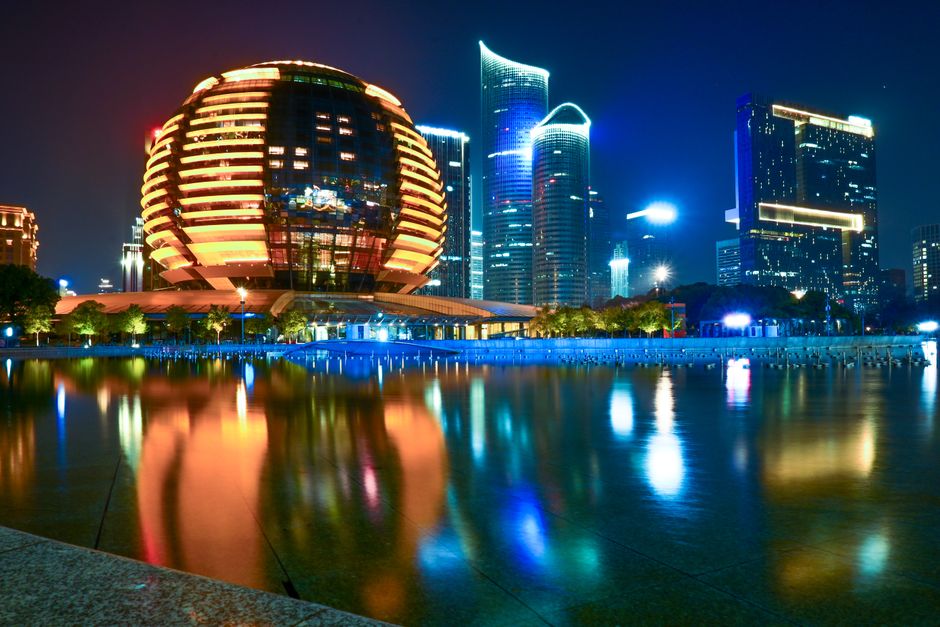
“Above there is heaven, below there are Suzhou and Hangzhou,” goes the old Chinese saying, and West Lake is the reason. Hangzhou, the capital of Zhejiang province, about an hour southwest of Shanghai by high-speed train, wraps around a lake of causeways, willows, arched bridges, pagodas and lotus ponds that has inspired poets and painters for over a thousand years; the West Lake Cultural Landscape became a UNESCO World Heritage Site in 2011. Hangzhou was the capital of the Southern Song dynasty in the 12th and 13th centuries, when it was one of the largest and richest cities in the world, and the southern end of the Grand Canal. Today it is also a booming tech city, home to Alibaba, that hosted the Asian Games in 2023. Walk or cycle the Su and Bai causeways, take a boat to the islands, climb the Leifeng Pagoda, visit the carved grottoes and halls of Lingyin Temple, sip Longjing (Dragon Well) green tea in the hillside villages where it is grown, and stroll the canal-side lanes of Qiaoxi and the old Hefang Street. The lakeshore itself is free and open day and night. The best times are April to May, for spring blossom and new tea, and September to November, for osmanthus and autumn color.
Right now in Hangzhou
- Wed 12–24°C 53–76°F Clear
- Thu 14–25°C 56–77°F Clear
- Fri 17–25°C 62–78°F Partly cloudy
Weather: MET Norway (CC BY 4.0)
Top tours in Hangzhou
See all tours for Hangzhou →
From local operators, with prices and reviews; you check availability and book on Viator, our partner. We may earn a commission at no extra cost to you. How we earn money
Hangzhou at a glance
- Best for: West Lake, gardens and pagodas, Buddhist temples, tea plantations, the Grand Canal, cycling and food.
- How long: 2–3 days; 4 with Wuzhen or the Qiandao Lake.
- Best time: March to May and September to November; June brings the plum rains, July and August are very hot, and winters are cold and damp.
- Getting there: by high-speed train from Shanghai (about an hour), Suzhou, Nanjing, Beijing and Huangshan, or by air to Hangzhou Xiaoshan (HGH).
- Getting around: on foot, by bike or by boat around the lake, and by metro, bus and taxi across the city.
- Good to know: avoid the lake on public holidays and summer weekends, when the causeways are packed.
- Before you go: visa-free entry, the 240-hour transit, the arrival card, payments and general safety are in our China travel guide.
Hangzhou’s areas and where to stay
The historic city lies on the east shore of West Lake, with the hills of the scenic area to the west and south, the Qiantang River to the south and the Grand Canal to the north. The new business district of Qianjiang New City stands on the river, and the city stretches across the river to Xiaoshan and Binjiang.
The east shore of West Lake (Hubin)
The best base for first-time visitors: hotels around Hubin and Nanshan Road are a short walk from the lake, the Broken Bridge, the shopping streets and metro Line 1, with plenty of restaurants and cafés.
The scenic area west of the lake
Boutique hotels and resorts are tucked into the hills and tea villages around Longjing, Maojiabu and the Lingyin Temple, quiet at night and surrounded by green, though you need a taxi or bike to reach the city.
Hefang Street and the old town
Around Hefang Street and Wushan Square, south of the center, mid-range hotels sit near the restored late-imperial streets, the Southern Song Imperial Street and the Drum Tower, a 10-minute walk from the lake.
Qiaoxi and the Grand Canal
In the north, the historic canal quarter of Qiaoxi around the Gongchen Bridge has guesthouses and boutique hotels in old buildings, canal-side cafés and museums.
Where to stay in Hangzhou
- East shore and Hubin: walking distance to the lake and the metro.
- West Lake hills and tea villages: boutique resorts and guesthouses among the tea fields.
- Hefang Street: mid-range hotels near the old streets.
- Qiaoxi: canal-side character.
- Qianjiang New City: international business hotels on the river.
Rooms fill and prices rise at weekends, during the May Day and National Day holidays and in osmanthus season in late September and October.
Top things to see in Hangzhou
West Lake
West Lake (Xi Hu) is about 6.4 km² (2.5 sq miles), with a shoreline of about 15 km (9 miles) and hills on three sides. Two causeways cross it: the Su Causeway (Su Di), built by the poet-governor Su Dongpo in the 11th century, runs 2.8 km (1.7 miles) north–south with six arched bridges and is lined with willows and peach trees; the shorter Bai Causeway (Bai Di), named after the Tang poet Bai Juyi, leads from the Broken Bridge to Gushan island, with the Zhejiang Provincial Museum and the Xiling Seal Engravers’ Society. The “Ten Scenes of West Lake,” named in the Southern Song, include Spring Dawn at Su Causeway, Lingering Snow on the Broken Bridge, Autumn Moon over the Calm Lake and Viewing Fish at Flower Harbor. The lakeshore, the causeways and the main parks are free and open all the time; some sights inside the scenic area, such as the Leifeng Pagoda and the island of Three Pools Mirroring the Moon, charge for entry. Walk or cycle at dawn to see it at its most peaceful.
Boats and the islands
Boats leave from piers around the lake to Xiaoyingzhou island, the “island within a lake,” with its zigzag bridges and the three stone pagodas of Three Pools Mirroring the Moon, pictured on the one-yuan note. Choose between large motorboats, small hand-rowed boats for a few people, and electric self-drive boats; agree the price and duration of hand-rowed boats first.
Leifeng Pagoda
On the south shore, the Leifeng Pagoda, rebuilt in 2002 over the ruins of a 10th-century pagoda that collapsed in 1924, is linked with the legend of the White Snake; escalators lead up to a viewing gallery with the best panorama of the lake, especially at sunset.
Lingyin Temple and Feilai Feng
In a wooded valley west of the lake, the Lingyin Temple (Temple of the Soul’s Retreat), founded in 328, is one of the largest and wealthiest Buddhist temples in China, with a huge seated Buddha carved from camphor wood. On the way in, the limestone hill of Feilai Feng (“the peak that flew from afar”) is carved with more than 300 Buddhist figures from the 10th to the 14th centuries, including a laughing Buddha. You pay one ticket for the scenic area and another for the temple. Come early on weekdays.
Longjing tea villages
The hills southwest of the lake grow Longjing (Dragon Well) tea, one of China’s most famous green teas. In villages such as Longjing, Meijiawu and Maojiabu, you can walk through terraced tea fields, watch leaves being pan-fired in spring and drink tea at a farmhouse; the first harvest, before Qingming in early April, is the most prized. The China National Tea Museum has free exhibitions on tea culture.
The Grand Canal and Qiaoxi
The Grand Canal, the longest canal in the world, begun in the 5th century BC and a UNESCO site since 2014, ends in Hangzhou. The 17th-century Gongchen Bridge crosses it in the Qiaoxi district, with museums of the canal, knives and scissors, fans and umbrellas in old factories; water buses run along the canal.
More classic sights
- Hefang Street and Qinghefang: a restored late-imperial street of old pharmacies, teahouses and snack stalls, with the Huqingyu Tang traditional medicine museum.
- Six Harmonies Pagoda: a 13-story wooden pagoda overlooking the Qiantang River.
- Xixi National Wetland Park: waterways, villages and persimmon trees west of the city, explored by boat.
- Liangzhu Archaeological Site: the remains of a 5,000-year-old walled city, a UNESCO site since 2019, with a fine museum north of the city.
- Zhejiang Provincial Museum: on Gushan island, with Liangzhu jades and celadon.
Other things to do in Hangzhou
Food and drink
Hangzhou cuisine is fresh, light and slightly sweet. Try West Lake vinegar fish, poached and glazed with a sweet-sour sauce; Dongpo pork, belly braised slowly in rice wine, named after Su Dongpo; Longjing shrimp, river shrimp stir-fried with tea leaves; beggar’s chicken, baked in lotus leaves and clay; pian’erchuan noodles with pickled greens and pork; and West Lake lotus root starch, a sweet hot drink. Old restaurants such as Louwailou on Gushan and Zhiweiguan are institutions, and teahouses around the lake serve Longjing with snacks.
Evening shows and lights
Impression West Lake, an outdoor show performed on the water, and The Romance of the Song Dynasty, a lavish theme-park show, are the best known; the musical fountain near Hubin plays on many evenings.
The Qiantang tide
The Qiantang River tidal bore, one of the largest in the world, surges up the estuary twice a day; it is most spectacular around the 18th day of the eighth lunar month (September or October), best watched from Yanguan in Haining, about an hour east. See our cycling, boat trips and hiking guides.
Day trips from Hangzhou
- Wuzhen and Xitang: beautifully preserved canal towns, about 1–1.5 hours by road; Wuzhen’s West Scenic Zone is best seen in the evening, with an overnight stay.
- Moganshan: a bamboo-forested hill resort with 1920s villas and boutique lodges, about 1 hour by road.
- Qiandao Lake (Thousand Island Lake): a reservoir dotted with forested islands, about 1 hour by high-speed train.
- Shaoxing: canals, the home of the writer Lu Xun and Shaoxing rice wine, about 20–30 minutes by high-speed train.
- Suzhou and Shanghai: about 1–1.5 hours by high-speed train.
- Huangshan: the granite Yellow Mountains, about 1.5–2 hours by high-speed train to Huangshan North; best for two days.
Nearby destinations
- Suzhou124 km
- Shanghai166 km
- Huangshan (Yellow Mountain)193 km
- Nanjing241 km
Getting there and getting around
By train
Hangzhou East is the main high-speed station, on metro Lines 1 and 4, with trains to Shanghai Hongqiao (about an hour), Suzhou, Nanjing, Beijing (about 4.5–6 hours), Huangshan North and the south; Hangzhou Station (City Station) near the lake and Hangzhou West also have high-speed trains. Book on the 12306 website or app with your passport.
By air
Hangzhou Xiaoshan International Airport (HGH), about 27 km (17 miles) east of the lake, has flights across China and to Asia and Europe, and is a designated port for the 240-hour visa-free transit, with all of Zhejiang province as the permitted area. Metro lines and airport buses link the airport with the city in about 45–60 minutes. Many international travelers fly into Shanghai and take the train.
Around town
West Lake is best explored on foot, by bike or by boat: the walk around the lake takes 3–4 hours, and shared bikes and the city’s public bikes are everywhere. The metro links the lakeshore, the stations, the airport and the canal; pay with Alipay or WeChat Pay QR codes. Tourist buses run through the scenic area to Lingyin and the tea villages; taxis and DiDi are easy, though cars are restricted on some lake roads on busy days.
When to go and how long to stay
Hangzhou has a humid subtropical climate. Spring (March–May) is the classic season: peach blossom on the Su Causeway, new tea in the hills and mild weather, though showers are frequent. June brings the plum rains, the wettest month. Summer (July–August) is very hot, with highs around 33–34 °C (92–93 °F), and lotus flowers on the lake. Autumn (September–November) is sunny and mild, with sweet osmanthus in bloom in late September and October and autumn colors in November. Winter (December–February) is cold and damp, with occasional snow, when the “Lingering Snow on the Broken Bridge” scene can be seen. The table uses the 1991–2020 climate normals for the Hangzhou station of the China Meteorological Administration (CMA), as submitted to the World Meteorological Organization (WMO): average daily highs and lows, total precipitation, and days with at least 1 mm of rain or snow.
| Month | Average high / low | Rain (days with 1 mm or more) | What to expect |
|---|---|---|---|
| January | 9 °C (47 °F) / 2 °C (36 °F) | 93 mm (3.7 in), 10 days | Cold and damp; rare snow on the lake |
| February | 11 °C (52 °F) / 4 °C (39 °F) | 90 mm (3.5 in), 9 days | Cold; plum blossom; Chinese New Year |
| March | 16 °C (61 °F) / 8 °C (46 °F) | 136 mm (5.3 in), 12 days | Cool; showers; peach blossom |
| April | 22 °C (72 °F) / 13 °C (55 °F) | 117 mm (4.6 in), 10 days | Mild; new Longjing tea; excellent |
| May | 27 °C (80 °F) / 18 °C (64 °F) | 127 mm (5.0 in), 10 days | Warm and pleasant; very good |
| June | 29 °C (85 °F) / 22 °C (71 °F) | 258 mm (10.2 in), 13 days | Plum rains; the wettest month |
| July | 34 °C (93 °F) / 26 °C (78 °F) | 168 mm (6.6 in), 9 days | Very hot; lotus on the lake |
| August | 33 °C (92 °F) / 25 °C (78 °F) | 177 mm (7.0 in), 11 days | Hot and humid; typhoon risk |
| September | 29 °C (84 °F) / 21 °C (71 °F) | 113 mm (4.5 in), 8 days | Warm; osmanthus begins |
| October | 24 °C (74 °F) / 16 °C (60 °F) | 74 mm (2.9 in), 6 days | Mild and sunny; ideal; Golden Week crowds |
| November | 18 °C (64 °F) / 10 °C (50 °F) | 75 mm (3.0 in), 8 days | Cool; autumn colors |
| December | 11 °C (52 °F) / 4 °C (40 °F) | 64 mm (2.5 in), 7 days | Cold and gray; quiet |
Hangzhou receives about 1,490 mm (59 in) of precipitation a year, with a peak in June.
Two days in Hangzhou
Day one, sunrise on the Su Causeway, a boat to the islands, the Leifeng Pagoda and dinner on the east shore, with the fountain or Impression West Lake in the evening. Day two, Lingyin Temple and Feilai Feng early, the Longjing tea villages and the Tea Museum, and Hefang Street at night.
Three to four days
Add the Grand Canal and Qiaoxi, the Xixi Wetland or the Liangzhu site, and an overnight in Wuzhen; then continue to Suzhou or Shanghai.
What a trip to Hangzhou costs
Prices are approximate, for October 2026, converted at about 6.74 yuan to the US dollar.
| Item | Typical cost |
|---|---|
| West Lake shore and causeways | Free |
| Leifeng Pagoda ticket | about 40 CNY (about US$5.90) |
| Feilai Feng scenic area plus Lingyin Temple | about 75 CNY in total (about US$11) |
| Boat to the islands, including island entry | about 55–70 CNY (about US$8.20–10) |
| Tea tasting in a Longjing village | 30–100 CNY (about US$4.50–15) |
| Dinner in a classic Hangzhou restaurant | 120–250 CNY (about US$18–37) per person |
| High-speed train to Shanghai Hongqiao | about 75–90 CNY (about US$11–13) |
| Mid-range hotel double, per night | 450–900 CNY (about US$67–134) |
Practical tips for Hangzhou
- Go early: the lake and Lingyin Temple are calmest before 8:00; weekends and holidays are packed.
- Rent a bike: cycling is the best way around the lake and up to the tea villages.
- Agree boat prices: for hand-rowed boats, fix the price and duration first.
- Buy tea carefully: real West Lake Longjing is expensive; buy from reputable shops or farms.
- Plan for summer heat: sightsee early and late from June to August.
- Check event closures: some lake roads restrict traffic on busy days.
Safety
Hangzhou is very safe, and violent crime is rare. Watch for pickpockets in the crowds on the Broken Bridge, the causeways and Hefang Street on holidays, and agree prices before rides in pedicabs or hand-rowed boats. Some tea sellers in the villages press visitors into expensive purchases or sell lower-grade tea as West Lake Longjing; you are under no obligation to buy. Traffic and electric scooters move fast on the roads around the lake, so cross carefully, and watch for cyclists on the causeways. In summer, the heat and humidity are intense, and the plum rains and occasional typhoons from July to September can bring heavy rain and flooding; follow local alerts. Air quality is usually good to moderate. Carry your passport for tickets and police checks. In an emergency, call 110 for police, 120 for an ambulance and 119 for fire.
What to pack for Hangzhou
Comfortable walking shoes, an umbrella in spring and June, light, breathable clothes, a hat and sunscreen in summer, layers in spring and autumn, a warm coat for the damp winter, and a reusable bottle for tea. China uses 220 V, with flat two-pin, round two-pin and angled three-pin sockets. See our rain jackets and travel adapters guides.
Hangzhou travel FAQ
Is West Lake free to visit?
Yes. The lakeshore, causeways and main parks are free and open all the time; some sights, such as the Leifeng Pagoda, the island boats and Lingyin Temple, charge for entry.
How do I get from Shanghai to Hangzhou?
By high-speed train from Shanghai Hongqiao to Hangzhou East in about an hour, with very frequent departures.
How long does it take to walk around West Lake?
About 3–4 hours at a steady pace for the full circuit of about 15 km, or 1–2 hours by bike.
How many days do I need in Hangzhou?
Two days for the lake, Lingyin Temple and the tea villages; three or four to add the Grand Canal, Xixi or Wuzhen.
What is the best time to visit Hangzhou?
March to May for blossom and new tea, and September to November for osmanthus and mild, sunny weather. Avoid public holidays.
Can I visit the Longjing tea plantations?
Yes. The villages of Longjing, Meijiawu and Maojiabu are in the hills southwest of the lake, reached by bus, bike or taxi; spring is harvest season.
Is Lingyin Temple worth visiting?
Yes. It is one of China’s most important Buddhist temples, and the Feilai Feng carvings on the way in are superb; go early on a weekday.
Can I use the 240-hour visa-free transit in Hangzhou?
Yes. Hangzhou Xiaoshan airport is a designated port, and you can travel throughout Zhejiang province, and on to other permitted areas such as Shanghai and Jiangsu.
When can I see the Qiantang tidal bore?
Twice a day, at its strongest around the 18th day of the eighth lunar month, in September or October, at Yanguan in Haining.
Where should I stay in Hangzhou?
On the east shore of West Lake for walking access, in the tea villages for peace, or around Hefang Street or Qiaoxi for old-town character.
Sources and last review
Researched and last reviewed on 4 October 2026. Visa-free transit ports and the Zhejiang permitted area: the National Immigration Administration; train booking with a passport: China Railway’s official 12306 site; climate normals: the China Meteorological Administration via the World Meteorological Organization’s 1991–2020 normals; the exchange rate: the CFETS central parity rate; UNESCO inscriptions: the UNESCO World Heritage List. Free lakeshore access, lake and causeway dimensions, ticket prices for the Leifeng Pagoda, Lingyin and boats, airport and train times, tidal bore timing, history and typical prices are general references or estimates, flagged for checking. Prices and rules change, so check locally before you go. For entry rules, money and general safety, see our China travel guide.
Plan your trip
Partner links: TravelerCenter may earn a commission if you book, at no extra cost to you.
🇨🇳 Useful Mandarin Chinese phrases for Hangzhou
All 38 Mandarin Chinese phrases: restaurant, hotel, emergencies, romance (printable) →