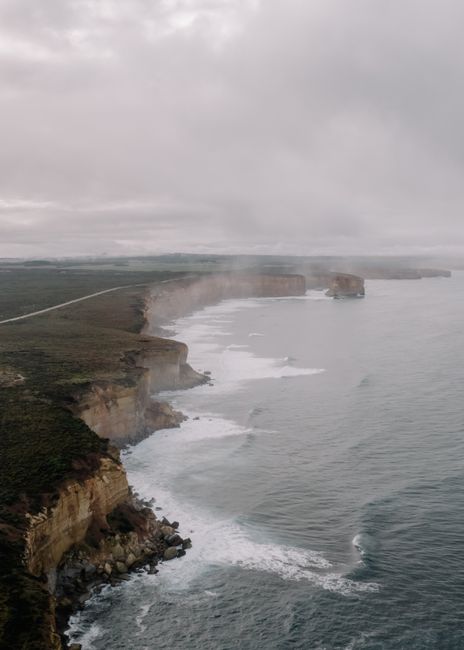
The Great Ocean Road is one of the world’s great coastal drives: about 240 km (150 miles) of road hugging the cliffs, surf beaches and rainforest of Victoria’s southwest coast, from Torquay, about 1.5 hours from Melbourne, to Allansford near Warrnambool. Returned soldiers built it between 1919 and 1932 as a memorial to those killed in World War I, and it remains the world’s largest war memorial. Along the way are the surf town of Torquay and Bells Beach, the holiday villages of Lorne and Apollo Bay, koalas in the treetops at Kennett River, the waterfalls and giant tree ferns of the Otway Ranges and, on the wildest stretch of coast, the limestone stacks of the Twelve Apostles in Port Campbell National Park. The coast is the country of the Wadawurrung, Eastern Maar and Gadubanud peoples. You can see the Twelve Apostles on a very long day trip from Melbourne, but the road rewards two to four days, with nights in Lorne, Apollo Bay or Port Campbell, time for short walks, and sunsets over the stacks. The Southern Ocean coast is cool, windy and dramatic, with the best weather from December to April and whale-watching in winter.
Right now in Great Ocean Road (Port Campbell)
- Wed8–15°C46–59°FMostly clear
- Thu7–21°C44–69°FMostly clear
- Fri13–20°C55–68°F4 mm rain
Top tours in Great Ocean Road
See all tours for Great Ocean Road →
From local operators, with prices and reviews; you check availability and book on Viator, our partner. We may earn a commission at no extra cost to you. How we earn money
Great Ocean Road at a glance
- Best months: December to April for the warmest, most settled weather and long evenings; June to September for southern right whales at Warrnambool and moody winter seas, with fewer crowds.
- Time needed: one very long day from Melbourne for the Twelve Apostles; two to four days to drive the whole road with stops.
- Getting there: drive from Melbourne to Torquay in about 1.5 hours via Geelong. Tours run daily from Melbourne; public transport is limited.
- Costs (as of October 2026): there is no fee to drive the road or to visit the Twelve Apostles lookouts.
- Current closure: the beach access steps at Loch Ard Gorge are closed because of geological instability; the lookouts remain open.
- Before you go: entry rules (ETA, eVisitor or visa), biosecurity and money are covered in our Australia travel guide.
Great Ocean Road sections and towns
Surf Coast: Torquay, Bells Beach and Anglesea
The eastern end is Australia’s surfing heartland. Torquay has surf museums and outlet shops, Bells Beach hosts a world-famous pro surfing contest at Easter, and Anglesea has a river and family beaches. Aireys Inlet’s red-and-white Split Point Lighthouse overlooks the road.
Lorne
The road’s most popular resort town, set on a curving bay below forested hills, with cafes, a pier and short drives to Erskine Falls and the Otways’ rainforest. It suits families and couples.
Kennett River, Wye River and Apollo Bay
Some of the most spectacular cliff-hugging driving is between Lorne and Apollo Bay. Kennett River is known for wild koalas and a glow-worm walk; Apollo Bay is a fishing town and a good base for the Otways.
The Otways and Cape Otway
West of Apollo Bay, the road turns inland through the Great Otway National Park’s forests. A side road leads to Cape Otway and its historic lightstation, one of the oldest on mainland Australia.
The Shipwreck Coast: Port Campbell to Warrnambool
The western section passes the Twelve Apostles, Loch Ard Gorge and London Bridge on a coast notorious for shipwrecks. Port Campbell is the closest village to the stacks; Warrnambool and Port Fairy are larger towns at the western end.
Top things to see on the Great Ocean Road
The Twelve Apostles
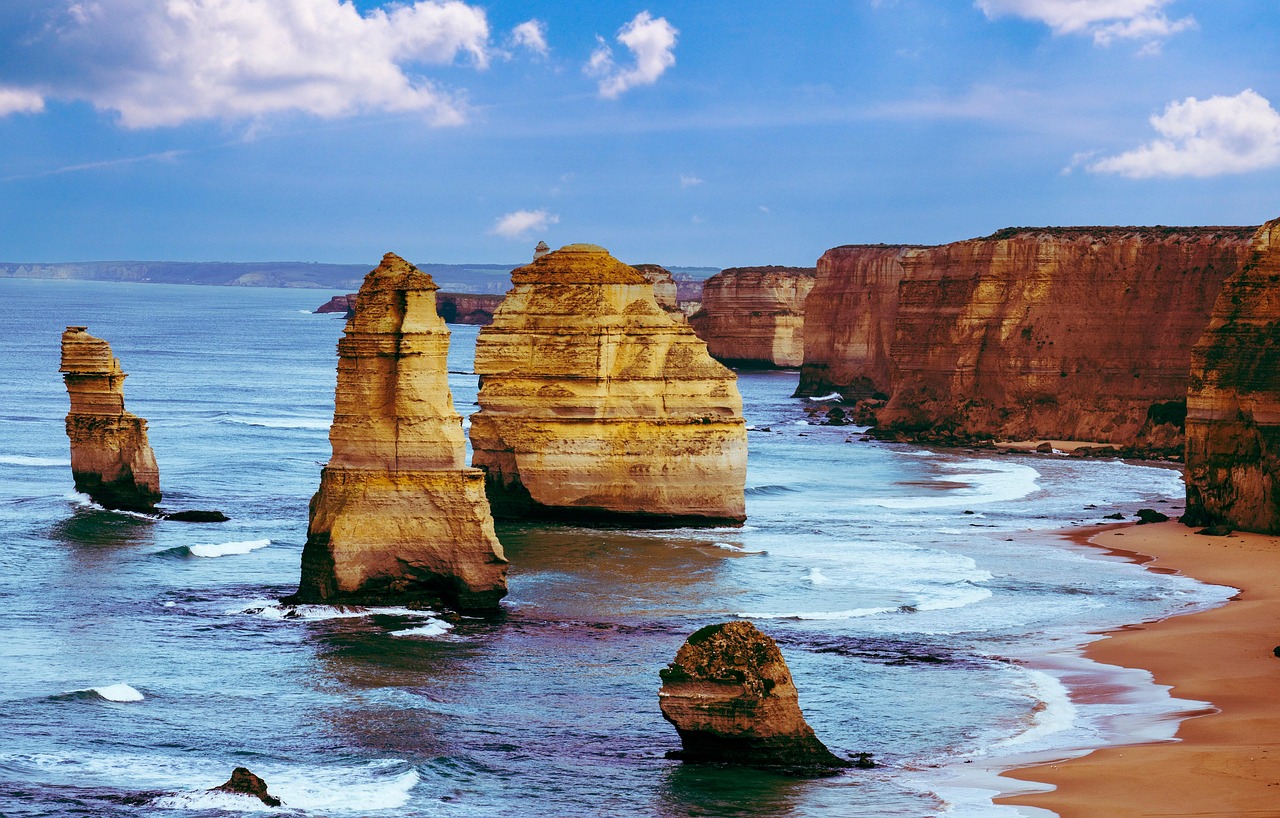
The Twelve Apostles are limestone stacks, one of Australia’s most iconic natural landmarks, rising from the Southern Ocean beside steep cliffs and changing color with the light. Despite the name, there were never twelve: the waves that carved them keep eroding them, and one collapsed in 2005, so only a handful stand today. The site, in Port Campbell National Park, is managed by the Great Ocean Road Coast and Parks Authority and has a large car park, lookouts, viewing platforms, toilets, shelters and accessible facilities; a walkway and tunnel lead under the road to the cliff-top boardwalk. A new Twelve Apostles visitor center is being developed. Entry is free. Sunrise and sunset are the best times for photos; come early to avoid tour buses, which peak in the middle of the day.
Gibson Steps
Just east of the Twelve Apostles, the Gibson Steps descend the cliff to the beach, giving views from the base of the towering limestone cliffs and of two stacks known as Gog and Magog. Don’t swim here: the surf is dangerous.
Loch Ard Gorge
A few minutes west, Loch Ard Gorge is a sheltered cove named after the clipper ship Loch Ard, wrecked here in 1878; only two of its 54 people survived. Lookouts and short walks explore the gorge, the Razorback and nearby blowholes. The steps down to the beach are currently closed because of geological instability.
London Bridge, The Grotto and The Arch
Just beyond Port Campbell, London Bridge was a double-arched rock bridge until the span joining it to the mainland collapsed in 1990, stranding two visitors (rescued by helicopter); it’s now called London Arch. The Grotto is a sinkhole with a pool framing the sea, and The Arch is a smaller rock arch.
The Otways: rainforest and waterfalls
In the Great Otway National Park, walks lead to Hopetoun Falls and Triplet Falls, through the tall forest of the Redwoods in the Aire Valley, and around Maits Rest’s giant tree ferns. Lake Elizabeth is a good place to look for platypus at dawn.
Wildlife: koalas and glow worms
At Kennett River, look for koalas in the eucalyptus trees along Grey River Road, and take the Kennett River Glow-Worm walk after dark. Kangaroos graze at Anglesea’s golf course, and Cape Otway’s forests are another koala hotspot.
Split Point and Cape Otway lighthouses
At Aireys Inlet, the 1891 Split Point Lighthouse, painted white with a red cap, stands above the road and offers tours to the top for views along the coast. At Cape Otway, about 30 minutes’ drive from the highway down a forest road, the lightstation built in 1848 marks the point where Bass Strait meets the Southern Ocean; the precinct has keepers’ cottages, a telegraph station and wartime radar bunker, with an entry fee. The drive in is one of the best places to spot koalas.
Bells Beach and the Surf Coast
Bells Beach, just west of Torquay, is a surfing pilgrimage site with a long right-hand break and a cliff-top lookout over the waves. Even if you don’t surf, stop to watch on a good swell day. Point Addis, a little further on, has a lookout and a Koorie cultural walk through the coastal bush.
Planning a visit to the Twelve Apostles
The stacks face southwest, so late afternoon and sunset light up the limestone in gold and orange; early morning is calmer and quieter. On many evenings, little penguins come ashore on the beach below after sunset, visible from the platforms with binoculars. The car park and boardwalk are busiest between about 11 a.m. and 3 p.m., when day tours arrive. Combine the Apostles with Gibson Steps, Loch Ard Gorge and London Arch in a two-to-three-hour loop, and allow extra time in summer for parking.
Other things to do on the Great Ocean Road
- Surfing lessons: surf schools run classes at Torquay, Anglesea and Lorne beaches.
- Great Ocean Walk: a multi-day hike of about 100 km (62 miles) from Apollo Bay to the Twelve Apostles, with walk-in campsites and guided options.
- Scenic helicopter flights: short flights from near the Twelve Apostles fly over the stacks, Loch Ard Gorge and London Arch.
- Whale watching: southern right whales calve off Warrnambool’s Logans Beach from about June to September.
- Tower Hill: an extinct volcano near Warrnambool with emus, koalas and walks.
Food and drink
Expect fish and chips on the foreshore, crayfish and abalone, Otway produce and cheese, and cellar doors and breweries around Geelong and the Bellarine Peninsula. Lorne, Apollo Bay and Port Fairy have the widest choice of restaurants and cafes. Tipping is optional.
Day trips and nearby
Geelong and the Bellarine Peninsula
Victoria’s second city, Geelong, has a revitalized waterfront. The Bellarine Peninsula, across the bay from the road’s eastern end, has wineries, Queenscliff’s historic fort and ferries to Sorrento on the Mornington Peninsula.
Port Fairy and Warrnambool
At the western end, Port Fairy is a well-preserved fishing village with cottages and a folk festival in March. Warrnambool has the Flagstaff Hill Maritime Village and whale watching.
The Grampians
The rugged sandstone ranges of Gariwerd (the Grampians National Park) are about two hours north of Warrnambool, a good extension for a longer road trip.
Nearby destinations
- Melbourne151 km
Getting there and getting around
Driving
Most visitors drive. From Melbourne, take the Princes Freeway (M1) to Geelong and on to Torquay, about 1.5 hours. Lorne is about 2 to 2.5 hours from Melbourne, Apollo Bay about 3 hours and the Twelve Apostles about 4 to 4.5 hours along the coast without stops. To save time, return to Melbourne via the faster inland route through Colac, about 3 hours from the Twelve Apostles. The road is narrow and winding with many bends and few overtaking places; use the pull-over bays, don’t stop on the road for photos, and remember to keep left.
Tours from Melbourne
Day tours from Melbourne cover the road to the Twelve Apostles and back in about 12 hours, with stops at Bells Beach, Lorne, Kennett River and Loch Ard Gorge. Multi-day tours and small-group trips allow more time.
Public transport
V/Line regional coaches link Geelong with Torquay, Lorne and Apollo Bay, and trains run from Melbourne to Geelong and Warrnambool. Services along the most scenic western section are infrequent, so a car or tour is more practical.
When to go and how long to stay
The coast has a mild, temperate oceanic climate, cooler and windier than Melbourne. Summer (December to February) is the peak season, with highs around 20–21 °C (67–70 °F) at Cape Otway and warmer days inland; beaches and towns are busy during school holidays. Autumn (March to May) often brings settled weather. Winter (June to August) is cold, wet and windy, with highs around 13–14 °C (55–57 °F), but the storms make the cliffs dramatic and whales arrive. Spring (September to November) is changeable and green.
| Month | Average high | Average low | Rain | Rain days (≥1 mm) |
|---|---|---|---|---|
| Jan | 21 °C (70 °F) | 14 °C (57 °F) | 45 mm (1.8 in) | 6 |
| Feb | 21 °C (70 °F) | 15 °C (59 °F) | 41 mm (1.6 in) | 5 |
| Mar | 20 °C (68 °F) | 14 °C (57 °F) | 54 mm (2.1 in) | 8 |
| Apr | 18 °C (64 °F) | 12 °C (54 °F) | 64 mm (2.5 in) | 10 |
| May | 16 °C (60 °F) | 11 °C (51 °F) | 85 mm (3.4 in) | 13 |
| Jun | 14 °C (56 °F) | 9 °C (48 °F) | 95 mm (3.8 in) | 14 |
| Jul | 13 °C (55 °F) | 8 °C (47 °F) | 112 mm (4.4 in) | 16 |
| Aug | 14 °C (56 °F) | 8 °C (47 °F) | 119 mm (4.7 in) | 16 |
| Sep | 15 °C (59 °F) | 9 °C (49 °F) | 94 mm (3.7 in) | 14 |
| Oct | 17 °C (62 °F) | 10 °C (50 °F) | 73 mm (2.9 in) | 11 |
| Nov | 18 °C (65 °F) | 11 °C (53 °F) | 61 mm (2.4 in) | 9 |
| Dec | 20 °C (67 °F) | 13 °C (55 °F) | 53 mm (2.1 in) | 8 |
| Year | 17 °C (63 °F) | 11 °C (52 °F) | 901 mm (35 in) | 130 |
Figures are the Bureau of Meteorology’s 1991–2020 statistics for Cape Otway Lighthouse, roughly midway along the road. Towns in sheltered bays, such as Lorne, can be warmer on summer days.
Events worth planning around
- Rip Curl Pro at Bells Beach (Easter): a world championship surfing contest.
- Lorne Pier to Pub swim (January): a large open-water swim.
- Port Fairy Folk Festival (March).
- Whale season at Warrnambool (about June to September).
Dates vary; check the organizers’ websites.
How long to stay: 1, 2 and 4 days
- One day: a tour or early start from Melbourne to the Twelve Apostles and Loch Ard Gorge, returning inland.
- Two days: Torquay, Lorne and Kennett River on day one, with a night in Apollo Bay; the Otways, Twelve Apostles and Loch Ard Gorge on day two.
- Four days: add Cape Otway, rainforest walks, a sunset at the Apostles, Port Fairy and Warrnambool.
Where to stay on the Great Ocean Road
- Lorne and Apollo Bay: hotels, motels, apartments and holiday parks, with the most restaurants.
- Port Campbell: motels, cabins and a holiday park closest to the Twelve Apostles.
- The Otways: rainforest retreats, cottages and eco-lodges.
- Warrnambool and Port Fairy: larger choice of hotels and heritage B&Bs at the western end.
Book well ahead for summer school holidays (late December to January) and Easter.
Typical costs
| Item (as of October 2026) | Australian dollars | About US dollars |
|---|---|---|
| — | — | — |
| Driving the road, Twelve Apostles lookouts | Free | Free |
| Day tour from Melbourne | about $120–200 | about $85–140 |
| Helicopter flight over the Apostles (short) | about $150–250 | about $105–175 |
| Surf lesson (2 hours) | about $70–100 | about $50–70 |
| Rental car, per day | about $70–120 | about $50–85 |
| Mid-range motel or apartment, per night | about $180–350 | about $125–240 |
Free access to the road and lookouts reflects the land manager’s information; other prices are typical ranges, not official prices. Conversions use about US$0.69 to A$1.
Safety on the Great Ocean Road
- Driving: the road is narrow and winding, with sharp bends, cliffs and slow vehicles. Keep left, take breaks, use pull-over areas, never stop on the road, and watch for wildlife at dusk.
- Unstable cliffs: the coast is eroding constantly. Stay behind fences and on marked paths; some access points, such as the Loch Ard Gorge beach steps, are closed because of instability.
- Rips and cold water: many beaches are unpatrolled, with strong rips and cold water. Swim only at patrolled beaches between the red and yellow flags in summer, and never swim at the Twelve Apostles, Gibson Steps or Loch Ard Gorge.
- Bushfire season: roughly November to March. The Otways’ forests and coastal towns are high-risk areas; check VicEmergency and fire danger ratings, obey total fire bans and leave early on high-risk days.
- Bird flu: don’t touch sick or dead wildlife; report it to the Emergency Animal Disease Hotline on 1800 675 888.
- Emergencies: call 000 (112 also works from mobile phones).
Practical tips for the Great Ocean Road
- Time zone: Australian Eastern Time, the same as Melbourne; daylight saving runs from 4 October 2026 to 4 April 2027.
- Direction: driving east to west from Melbourne keeps you on the ocean side of the road for the best views.
- Fuel and phone coverage: fuel up in larger towns; coverage is patchy in the Otways.
- Dogs: dogs are not permitted in Port Campbell National Park.
What to pack for the Great Ocean Road
Pack a windproof and waterproof jacket in every season, warm layers, comfortable walking shoes, a hat and sunscreen, and swimwear for patrolled beaches. Bring binoculars for whales and koalas.
Great Ocean Road travel FAQ
How long does it take to drive the Great Ocean Road?
About 4 to 4.5 hours from Melbourne to the Twelve Apostles along the coast without stops, but allow at least two days to enjoy it.
Is it free to see the Twelve Apostles?
Yes. There’s no charge for the car park, lookouts or boardwalk.
How many of the Twelve Apostles are left?
Only a handful of stacks stand, and there were never twelve. Erosion continues; one collapsed in 2005.
Can you go down to the beach at Loch Ard Gorge?
Not at the moment. The beach access steps are closed because of geological instability, but the lookouts are open.
Can you do the Great Ocean Road as a day trip from Melbourne?
Yes, on a long tour or with an early start, returning via the faster inland road, but it’s a 12-hour day.
Where can I see koalas on the Great Ocean Road?
At Kennett River, especially along Grey River Road, and in the forests near Cape Otway.
What is the best time to drive the Great Ocean Road?
December to April for the best weather; avoid peak holiday weekends if you can.
Which direction should I drive?
From east to west (Torquay to Warrnambool), so you’re on the ocean side of the road.
Where should I stay on the Great Ocean Road?
Lorne or Apollo Bay for the eastern section and Port Campbell for the Twelve Apostles.
Can I swim at the Twelve Apostles?
No. The surf and currents are dangerous; swim only at patrolled beaches between the flags.
Plan your trip
Partner links: TravelerCenter may earn a commission if you book, at no extra cost to you.
Sources · last reviewed 5 October 2026
Researched and last reviewed on 5 October 2026. Twelve Apostles facilities, the Loch Ard Gorge steps closure, the Gibson Steps and London Bridge descriptions, the visitor center project, the dog rule and the bird flu hotline come from the Great Ocean Road Coast and Parks Authority; Great Otway National Park walks from Parks Victoria; daylight saving dates from the NSW Government (Victoria changes on the same dates); climate from the Bureau of Meteorology’s 1991–2020 statistics for Cape Otway Lighthouse; the road’s coordinates and completion year from Wikidata. The road’s length and history, the 2005 collapse, the Loch Ard wreck, drive times, V/Line services, festivals, whale season, the Great Ocean Walk and typical prices are general references and flagged for checking. For entry rules, biosecurity and money, see our Australia travel guide.
Data: Weather: MET Norway (CC BY 4.0) · Sea temperature: NOAA CoastWatch · Rates: ECB · Costs: World Bank ICP and price levels · Wikidata (CC0)