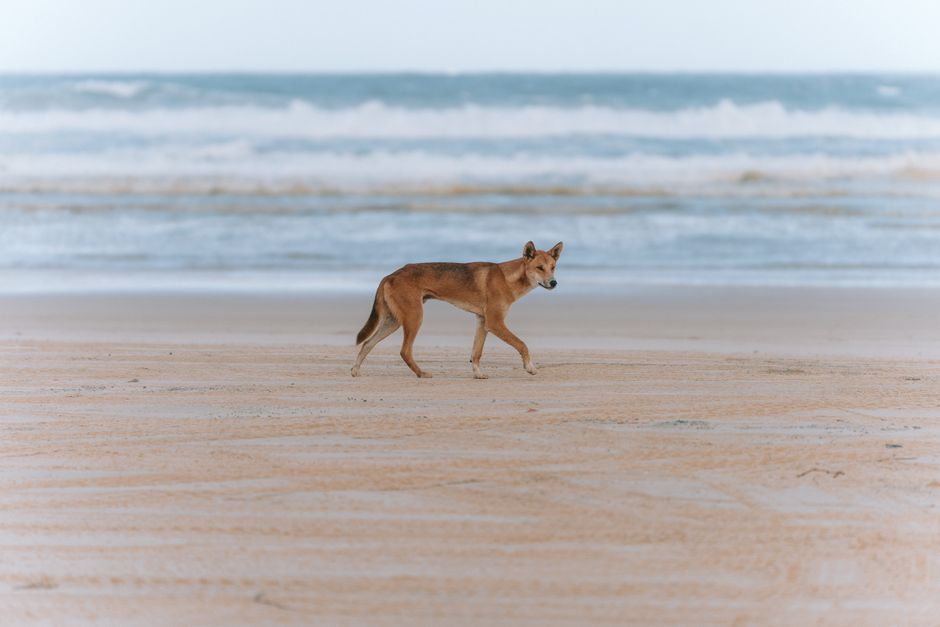
K’gari, formerly known as Fraser Island, is the largest sand island in the world: about 1,840 square kilometers (710 square miles) of dunes, rainforest growing on sand, more than 100 freshwater lakes and a 120-kilometer (75-mile) surf beach, off the coast of Queensland about 3.5 to 4 hours’ drive north of Brisbane. It is the country of the Butchulla people, whose name for the island, K’gari, means “paradise”; the Queensland Government formally restored the name in 2023. The island is listed by UNESCO as a World Heritage site and almost all of it is protected in K’gari (Great Sandy) National Park and recreation area. There are no sealed roads. Visitors arrive by vehicle barge and explore in four-wheel-drive vehicles, driving along the beach at low tide and on soft sand tracks through the forest, or join a 4WD tour. Highlights include the clear blue water of Lake McKenzie (Boorangoora), the rusting wreck of the Maheno, Eli Creek, the colored sands of the Pinnacles and the views from Indian Head. K’gari is also home to wild dingoes (wongari), among the purest in eastern Australia, and visitors must follow strict dingo-safe rules.
Right now in K'gari (Fraser Island) (Eurong)
- Wed 20–25°C 68–77°F 20 mm Heavy rain
- Thu 19–21°C 66–70°F 1 mm Mostly clear
- Fri 19–22°C 66–71°F Cloudy
Weather: MET Norway (CC BY 4.0) · Sea temperature: NOAA CoastWatch
Top tours in K'gari (Fraser Island)
See all tours for K'gari (Fraser Island) →
From local operators, with prices and reviews; you check availability and book on Viator, our partner. We may earn a commission at no extra cost to you. How we earn money
K’gari at a glance
- Best months: April to October for mild, drier weather and calmer seas; July to October for humpback whales in Hervey Bay. Summer (December to February) is hot, humid and busy during school holidays.
- Time needed: a full-day tour from Hervey Bay or Rainbow Beach at minimum; two or three days to explore the lakes, beach and rainforest properly.
- Getting there: vehicle barges cross from River Heads near Hervey Bay and from Inskip Point near Rainbow Beach; passenger ferries serve the island’s resort. There are no bridges.
- Permits: you need a vehicle access permit to drive on the island and a camping permit to camp, both bought before you arrive.
- Before you go: entry rules (ETA, eVisitor or visa), biosecurity and money are covered in our Australia travel guide.
Getting to the island and permits
Barges and ferries
There are two main crossings. From Inskip Point, near Rainbow Beach at the southern tip, vehicle barges make a short crossing of about 10 minutes to Hook Point, from where you drive north along the beach. From River Heads, south of Hervey Bay, vehicle barges cross to Wanggoolba Creek or Kingfisher Bay on the island’s western side, a trip of about 30 to 50 minutes. A passenger ferry also links River Heads and the Kingfisher Bay resort. Book barges ahead in school holidays.
Vehicle access permits
K’gari is a Recreation Area Management park, and Queensland law requires a vehicle access permit for any vehicle driven there, including rental 4WDs. Buy it online from Queensland Parks and Wildlife Service (QPWS) before you arrive and display it on the vehicle. Permits are sold for periods from about a month to a year; fees change each financial year. Tour passengers don’t need their own permit.
Camping permits
You must book and pay for a camping permit before camping anywhere in the national park, including the beach camping zones. QPWS campgrounds range from fenced, serviced campgrounds such as Central Station, Dundubara and Waddy Point to open beach zones with no facilities. Families with young children should use fenced campgrounds because of dingoes. Campfires are generally not allowed except in communal fire rings where provided; check current rules.
4WD-only access
Every road and track on K’gari is sand, so you need a high-clearance 4WD vehicle; 2WD cars and AWD SUVs will get stuck. The eastern beach is a gazetted road: normal Queensland road rules apply, including speed limits, seatbelts and alcohol limits, and police patrol it. Lower your tire pressure for sand, drive on the firm sand about two hours either side of low tide, and avoid the soft sand at high tide. Watch for washouts at creek crossings, pedestrians, planes landing on the beach and wildlife. Many rental companies in Hervey Bay and Rainbow Beach rent island-ready 4WDs and include permit and barge packages.
Self-drive or tour?
Self-driving gives you freedom to linger at lakes, camp and reach the quieter north, but it means mastering sand driving, reading tides, buying permits and booking barges, and rental 4WDs carry high insurance excesses for sand and saltwater damage. Guided tours use large 4WD buses or smaller tag-along convoys, include permits, barges and lunch, and leave the driving to people who do it daily. For a first visit of one or two days, especially if you have never driven on sand, a tour is the simpler and safer choice. Experienced 4WD drivers with three or more days will get the most from a self-drive trip.
A classic self-drive route
From Inskip Point, cross on the barge to Hook Point and drive north along the beach at low tide to Eurong, then turn inland on the sand tracks to Central Station, Wanggoolba Creek and Lake McKenzie. Return to the beach and continue north past Happy Valley to Eli Creek, the Maheno and the Pinnacles, then on to Indian Head and the Champagne Pools. Spend a night at Eurong, Happy Valley or a fenced campground, and leave via the western barge from Wanggoolba Creek or Kingfisher Bay to River Heads, or retrace your route south.
Top things to see on K’gari
Lake McKenzie (Boorangoora)
A “perched” lake, sitting on a bed of impermeable organic matter high in the dunes, with pure white silica sand and water shading from clear to deep blue. It’s the island’s most popular swimming spot; arrive early or late to avoid tour groups, and don’t use sunscreen or soap in the water, to protect it. A fenced day-use area keeps dingoes out of the picnic grounds.
Seventy-Five Mile Beach, Eli Creek and the Maheno
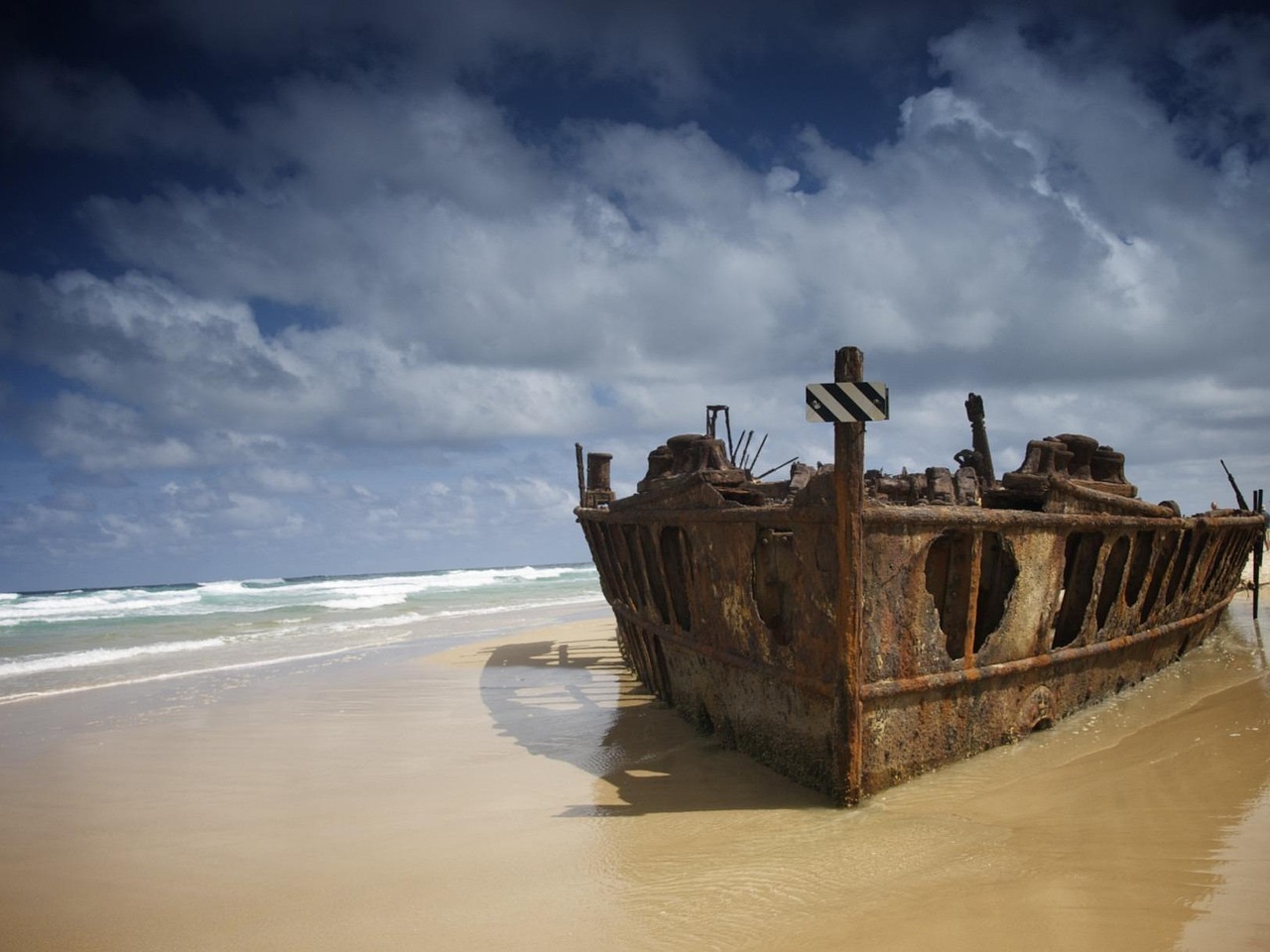
The eastern ocean beach is the island’s highway. Eli Creek pours clear fresh water across the sand; walk the boardwalk upstream and float back down. Further north, the wreck of the SS Maheno, a former ocean liner and World War I hospital ship, has lain rusting on the beach since a cyclone drove it ashore in 1935.
The Pinnacles and Rainbow Gorge
North of the Maheno, the Pinnacles are eroded sand cliffs streaked in reds, oranges and yellows, sacred to Butchulla women. Further south, a walk leads into Rainbow Gorge’s colored sand formations.
Indian Head and the Champagne Pools
At the north of the beach, Indian Head (Takky Wulai) is a rocky headland with a lookout where you can often see sharks, rays, turtles and, in season, whales in the water below. Just beyond, the Champagne Pools are rock pools filled by breaking waves, the safest place for a saltwater dip on the east coast.
Central Station and Wanggoolba Creek
In the center of the island, Central Station is a former forestry camp surrounded by tall rainforest growing in pure sand. The boardwalk along Wanggoolba Creek follows water so clear it is almost invisible, past giant king ferns. Nearby Pile Valley has towering satinay trees.
Lake Wabby and other lakes
Lake Wabby, the island’s deepest lake, is slowly being swallowed by a moving sand dune, the Hammerstone Sandblow; reach it on a walk from the beach or from the inland car park. Lake Birrabeen and Lake Boomanjin are quieter alternatives to Lake McKenzie.
Other things to do on K’gari
- Scenic flights: small planes take off from the beach for short flights over the lakes, sandblows and shipwreck.
- Walking: the K’gari Great Walk links lakes and rainforest over several days, and many short walks start at Central Station and Lake McKenzie.
- Fishing: the beach is famous for tailor, whiting and dart; check fishing rules and seasonal closures.
- Whale watching: from about July to October, humpback whales rest in Hervey Bay on the island’s west side; cruises leave from Hervey Bay’s marina.
- Butchulla culture: learn about the Butchulla people’s history and the island’s sacred sites on Aboriginal-guided tours.
Food and drink
Food options are limited to the island’s resort restaurants, the bakery and stores at Eurong and Happy Valley, and a few kiosks. Supplies are expensive, so bring food and water from Hervey Bay or Rainbow Beach if you are self-driving, and store it securely from dingoes.
Nearby
Hervey Bay
The main gateway town, with a long, calm beach, the Urangan Pier and whale-watching cruises from July to October. It has the most accommodation and 4WD rental companies.
Rainbow Beach and the Cooloola Coast
Rainbow Beach, near the southern barge, is known for its colored sand cliffs and the Carlo Sandblow. The beach drive south through Cooloola, part of Great Sandy National Park, leads to Double Island Point and Noosa on the Sunshine Coast, also 4WD only.
Lady Elliot Island
The southern Great Barrier Reef’s coral cays can be reached by flights from Hervey Bay; see our Great Barrier Reef guide.
Nearby destinations
- Sunshine Coast157 km
- Brisbane248 km
When to go and how long to stay
K’gari has a subtropical climate with warm to hot summers and mild winters. Summer (December to February) is hot and humid, with highs around 29–30 °C (84–86 °F), afternoon storms and the most rain. Autumn (March to May) is warm and settling. Winter (June to August) is dry and mild, with highs around 22–23 °C (71–73 °F) and cool nights, ideal for driving and walking. Spring (September to November) is warm and dry, and whales are still in Hervey Bay until October.
| Month | Average high | Average low | Rain | Rain days (≥1 mm) |
|---|---|---|---|---|
| Jan | 30 °C (86 °F) | 23 °C (73 °F) | 150 mm (5.9 in) | 10 |
| Feb | 30 °C (86 °F) | 23 °C (73 °F) | 163 mm (6.4 in) | 10 |
| Mar | 29 °C (84 °F) | 22 °C (72 °F) | 142 mm (5.6 in) | 11 |
| Apr | 27 °C (81 °F) | 20 °C (69 °F) | 111 mm (4.4 in) | 11 |
| May | 24 °C (76 °F) | 18 °C (64 °F) | 128 mm (5.0 in) | 11 |
| Jun | 22 °C (72 °F) | 16 °C (60 °F) | 102 mm (4.0 in) | 10 |
| Jul | 22 °C (71 °F) | 15 °C (58 °F) | 68 mm (2.7 in) | 8 |
| Aug | 23 °C (73 °F) | 16 °C (60 °F) | 54 mm (2.1 in) | 6 |
| Sep | 25 °C (77 °F) | 18 °C (64 °F) | 42 mm (1.7 in) | 5 |
| Oct | 26 °C (79 °F) | 19 °C (66 °F) | 91 mm (3.6 in) | 6 |
| Nov | 28 °C (82 °F) | 21 °C (69 °F) | 60 mm (2.4 in) | 6 |
| Dec | 29 °C (84 °F) | 22 °C (71 °F) | 100 mm (3.9 in) | 7 |
| Year | 26 °C (79 °F) | 19 °C (67 °F) | 1,208 mm (48 in) | 101 |
Figures are the Bureau of Meteorology’s 1991–2020 statistics for Sandy Cape Lighthouse, at the northern tip of K’gari. The center and south of the island are similar, with slightly more rain.
Wildlife on K’gari
Beyond dingoes, the island has more than 350 recorded bird species, including brahminy kites, sea eagles and migratory shorebirds, along with wallabies, echidnas, sand monitors (goannas) and, in the lakes, turtles. Offshore, dolphins, rays and sharks patrol the beach gutters, loggerhead and green turtles feed around the headlands, and humpback whales pass along the coast from about June to November. Keep a respectful distance from all wildlife, and never feed birds or goannas.
How long to stay: 1, 2 and 3 days
- One day: a 4WD tour from Hervey Bay or Rainbow Beach covering Lake McKenzie, Central Station, Eli Creek and the Maheno.
- Two days: add Lake Wabby, the Pinnacles and Indian Head, with a night at Eurong, Happy Valley or Kingfisher Bay.
- Three days: add the Champagne Pools, a scenic flight and a quieter lake, or camp in a fenced campground.
Where to stay on K’gari
- Kingfisher Bay: an eco-resort on the western side with restaurants, a ferry link and ranger-guided activities.
- Eurong and Happy Valley: beachside hotels, units and holiday houses on the eastern beach.
- QPWS campgrounds: fenced, serviced campgrounds and open beach camping zones; a camping permit is required.
- Hervey Bay and Rainbow Beach: a wide range of hotels and holiday parks if you visit on day tours.
Book well ahead for school holidays and Easter, when barges and campgrounds fill.
Typical costs
| Item (as of October 2026) | Australian dollars | About US dollars |
|---|---|---|
| — | — | — |
| Vehicle access permit, up to 1 month | about $60–70 | about $41–48 |
| Camping permit, per person per night | about $8 | about $6 |
| Vehicle barge, return | about $150–250 | about $105–175 |
| 4WD rental, per day | about $250–400 | about $170–275 |
| Day tour from Hervey Bay or Rainbow Beach | about $200–300 | about $140–205 |
| Resort or hotel room, per night | about $200–400 | about $140–275 |
Permit fees are set by QPWS and change each financial year; all figures here are typical ranges to check before booking, not official prices. Conversions use about US$0.69 to A$1.
Safety on K’gari
- Dingoes (wongari): K’gari’s dingoes are wild animals, and some have bitten or attacked people, especially children. Always stay within arm’s reach of children, and keep young people close; walk in groups and carry a stick for protection; never feed dingoes or leave food, bait or rubbish where they can get it; and camp in fenced areas if you have children. If a dingo approaches, stand tall, face it, fold your arms, and back away calmly to a vehicle or building; don’t run. Report negative encounters to rangers. Feeding or disturbing dingoes is illegal, with heavy on-the-spot fines.
- 4WD driving: most serious incidents on K’gari are vehicle rollovers. Drive slowly, keep to speed limits, avoid sharp turns on sand, watch for washouts and never drive at high tide or at night.
- Ocean swimming: the eastern surf beach has strong rips and currents, and sharks are present; swimming in the ocean is not recommended. Swim in freshwater lakes, creeks or the Champagne Pools instead.
- Lakes and creeks: don’t dive into lakes; water depth is hard to judge.
- Bushfire season: roughly August to December in southeast Queensland; in 2020 a large fire burned about half the island. Obey fire bans and closures.
- Heat and sun: carry plenty of water and use sun protection; there’s little shade on the beach.
- Emergencies: call 000 (112 also works from mobile phones). Mobile coverage is patchy.
Practical tips for K’gari
- Time zone: Australian Eastern Standard Time (UTC+10), with no daylight saving in Queensland.
- Tides: check tide times before planning beach drives; plan crossings of the southern beach around low tide.
- Rubbish: take all rubbish off the island or use dingo-proof bins.
- Fuel: fuel is sold on the island, but it’s expensive; fill up before the barge.
What to pack for K’gari
Pack swimwear, a hat, high-factor sunscreen (but not for use in the lakes), insect repellent, sandals and closed shoes, a light rain jacket, a torch and water bottles. Self-drivers need a tire pressure gauge, recovery gear, a first aid kit and secure food storage.
K’gari travel FAQ
Do I need a permit to drive on K’gari?
Yes. A vehicle access permit from Queensland Parks and Wildlife Service is required for every vehicle, bought before you arrive.
Do I need a 4WD on K’gari?
Yes. All roads and tracks are sand, so you need a high-clearance 4WD. Otherwise, join a 4WD tour.
Do I need a camping permit?
Yes. Book and pay for a camping permit before you camp anywhere on the island.
How do I get to K’gari?
By vehicle barge from Inskip Point near Rainbow Beach or from River Heads near Hervey Bay, or by passenger ferry to Kingfisher Bay.
Are dingoes dangerous on K’gari?
They can be. Keep children within arm’s reach, walk in groups, never feed dingoes and store food securely.
Can you swim in the ocean on K’gari?
It’s not recommended because of rips and sharks. Swim in Lake McKenzie, Eli Creek or the Champagne Pools.
Why was Fraser Island renamed K’gari?
K’gari is the Butchulla name for the island, meaning “paradise.” The Queensland Government formally restored it in 2023.
Can you do K’gari as a day trip?
Yes, on a 4WD tour from Hervey Bay or Rainbow Beach, but two or three days is better.
When is the best time to visit K’gari?
April to October for mild, drier weather; July to October to add whale watching in Hervey Bay.
Is there accommodation on K’gari?
Yes: a resort at Kingfisher Bay, hotels and holiday houses at Eurong and Happy Valley, and QPWS campgrounds.
Sources and last review
Researched and last reviewed on 5 October 2026. The requirement for a vehicle access permit in Recreation Area Management parks and for a camping permit before camping comes from the Queensland Government’s permits page; the dingo (wongari) program, Be Dingo-Safe guidance and dingo history from the Queensland Government’s dingo pages; climate from the Bureau of Meteorology’s 1991–2020 statistics for Sandy Cape Lighthouse; area, name and coordinates from Wikidata. Queensland Parks and Wildlife Service, barge operators and Fraser Coast tourism websites could not be read from this environment, so permit and camping fees, barge routes and times, driving rules, campground names, detailed dingo-safe steps and fines, the 2020 fire, attraction details and typical prices are general references and flagged for checking. For entry rules, biosecurity and money, see our Australia travel guide.
Plan your trip
Partner links: TravelerCenter may earn a commission if you book, at no extra cost to you.