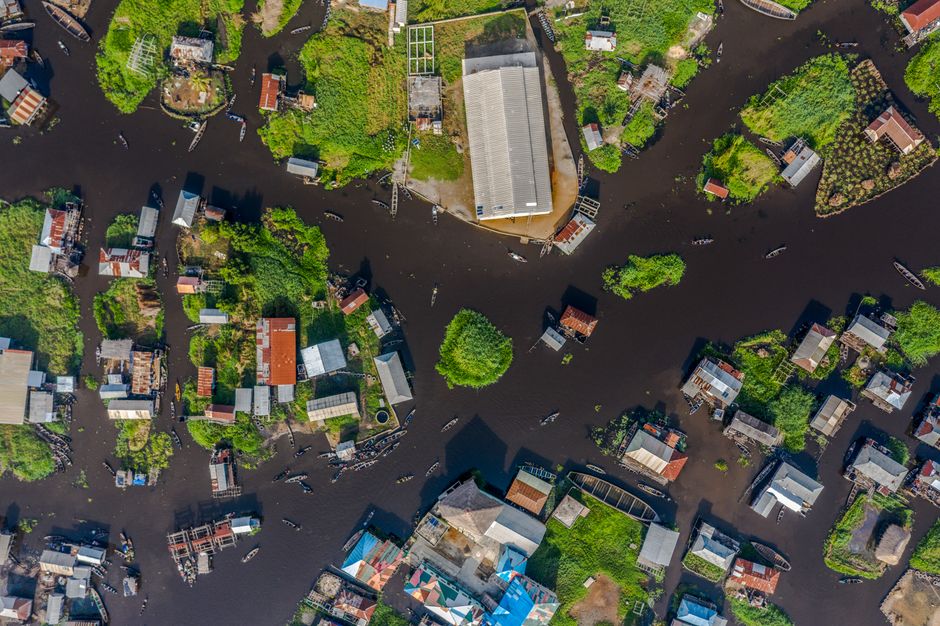
Cotonou is Benin’s economic capital and largest city, a busy, creative metropolis strung along the Atlantic between the ocean and Lake Nokoué. Almost everyone who visits Benin passes through it, because the international airport, the port and most government offices are here, but Benin’s official tourism site makes the case for staying a while, and it is right. At dusk, the city gathers on the Esplanade de l’Amazone, beneath a giant bronze statue of a woman warrior of the Kingdom of Dahomey; by day, you can walk the murals of the port’s graffiti wall, browse the new Ganhi market or plunge into the vast Dantokpa market, and in the evening eat grilled fish with your feet in the sand at Fidjrossè. Cotonou is also the base for day trips to Ouidah and the Door of No Return, the stilt town of Ganvié and Porto-Novo, each about an hour away, and to the royal palaces of Abomey. The airport is inside the city. Most non-African visitors need a Benin e-visa obtained online. Cotonou can be visited all year; November to March is the driest time.
Right now in Cotonou
- Sat28–29°C83–84°F2 mm rain
- Sun27–29°C80–85°F4 mm rain
- Mon28–29°C82–84°F2 mm rain

Cotonou: quick answers
- Things to do in Cotonou
- The Esplanade de l’Amazone, The port’s graffiti wall, The Ganhi market, Dantokpa market. More
- Best time to visit Cotonou
- Any time of year; November to March is the driest, and January adds the Vodun Days in nearby Ouidah. June is the wettest month. More
- How many days in Cotonou
- Two to three days for the city itself, or about a week as a base for Ganvié, Ouidah, Porto-Novo and Abomey. More
- Where to stay in Cotonou
- Ganhi and the center, The Marina and the seafront, Haie Vive and Cadjehoun, Fidjrossè, Akpakpa. More
Cotonou at a glance
- Best for: monuments and street art, markets, seaside dining, contemporary art, and day trips to Ouidah, Ganvié, Porto-Novo and Abomey.
- How long: 2 to 3 days for the city, or up to a week as a base for the south.
- Best time: all year; driest from November to March, wettest in June.
- Getting there: Bernardin Gantin International Airport (COO), inside the city near the coast.
- Getting around: by zémidjan (moto-taxi), taxi, ride-hailing app or car with driver.
- Money: the West African CFA franc (XOF); carry cash in small notes.
- Before you go: visas, health rules, money and general practical advice are in our Benin travel guide.
Explore Cotonou in videos
Hand-picked travel videos from YouTube creators to help you picture the trip. They play from YouTube; the facts in this guide come from our own research.
Cotonou’s neighborhoods and where to stay
Cotonou stretches from west to east along the coast, cut in two by the lagoon channel that links Lake Nokoué to the sea. In twenty minutes you can go from the busy commercial center to the beach.
Ganhi and the center
The commercial heart of the city, around the Ganhi market and Notre-Dame Cathedral, with banks, shops, older hotels and the busy streets leading to Dantokpa market and the lagoon bridges.
The Marina and the seafront
Boulevard de la Marina runs along the ocean past the Esplanade de l’Amazone, government buildings and the city’s best-known luxury hotel, the Sofitel Cotonou Marina, the hub of business and conference life.
Haie Vive and Cadjehoun
Leafy districts near the airport, with many restaurants, bars, cafés, guesthouses and mid-range hotels, popular with visitors and expatriates.
Fidjrossè
West of the airport, the beach road is lined with thatched beach restaurants, seaside hotels and bars, and it is the center of weekend life, best at sunset.
Akpakpa
East of the lagoon channel, a large residential and industrial district on the road to Porto-Novo and the Nigerian border.
Top things to see in Cotonou
The Esplanade de l’Amazone
Cotonou’s newest landmark is a wide oceanfront esplanade dominated by L’Amazone, a monumental bronze statue honoring the Agojie (Agodjié), the women soldiers of the Kingdom of Dahomey. Benin’s tourism site recommends coming at the end of the day, when the light softens, a sea breeze picks up and the whole city seems to be out walking, jogging and taking photos. Nearby, the Place des Martyrs and the Bio Guerra Monument, named after a northern leader who resisted colonial rule, continue the journey through Benin’s history.
The port’s graffiti wall
Along the wall of the port runs what is billed as Africa’s longest graffiti wall, hundreds of meters of murals by Beninese and international artists. It is free to see, best on foot or slowly from the back of a zémidjan, and a good introduction to the city’s thriving contemporary art scene of galleries, foundations and studios.
The Ganhi market
Opened in December 2024 near Notre-Dame Cathedral, the modern Ganhi market shelters a bright, airy two-story hall under a large umbrella-shaped metal roof. Several hundred stalls, most run by women, are organized by section: food, fruit and vegetables, fabrics, jewelry, cosmetics and leather goods, with shops and small restaurants. Go in the morning, when the fruit stalls are full, and leave with a length of cloth or a bag of spices.
Dantokpa market
On the banks of the lagoon, Dantokpa (Tokpa) is one of the largest open-air markets in West Africa, a vast, crowded maze where you can buy almost anything, from cloth, spices and household goods to the ingredients of traditional medicine. It is intense and fascinating; go with a guide or a clear plan, keep your bag close and expect to bargain.
More classic sights
- Notre-Dame Cathedral: the red-and-white striped cathedral beside the Ganhi market, one of the city’s best-known buildings.
- Contemporary art: galleries and art foundations around the city show Beninese and African artists; check current exhibitions.
- Craft center: stalls selling carvings, masks, appliqué hangings, bronzes and cloth near the center.
- Fidjrossè beach: for a sunset walk along the sand and a drink in a beach restaurant.
Other things to do in Cotonou
Eating in Cotonou
An evening at a Fidjrossè beach restaurant, under thatched roofs, fairy lights and Afrobeat, is Cotonou’s essential experience, and people dine late. The classic order is braised fish, sea bream, sea bass or captain fish, with moyo, a fresh tomato, onion and chili sauce, and fried plantain or sweet potato. Then try amiwo, a red maize paste cooked in tomato sauce and served with chicken; atassi, rice and beans; akassa, fermented maize paste in leaves with peanut, okra or vegetable sauce; and grilled wagasi, a Fulani cheese from the north. Ask for the chili on the side. Haie Vive and the center also have French, Lebanese, Italian and Asian restaurants.
Nightlife and music
Cotonou’s evenings center on the beach restaurants of Fidjrossè, the bars and maquis of Haie Vive and live-music venues playing Beninese styles, Afrobeat and highlife. Weekends are busiest.
Beaches
The ocean at Cotonou is beautiful but powerful, with a strong sandbar and currents, and Benin’s tourism site advises against swimming outside areas supervised by some hotels. Enjoy the beaches for walks, sunsets and seaside meals, and swim in hotel pools. See our beaches guide.
Cloth and tailoring
Buy wax-print cloth at the Ganhi or Dantokpa market and have it made into a shirt or dress by a local tailor, often within a couple of days.
Day trips from Cotonou
- Ouidah: about 40 km (25 miles) west, an hour by road; walk the 4 km Route des Captifs to the Door of No Return, visit the Temple of the Pythons and the Sacred Forest of Kpassè, ideally with an accredited guide. The Vodun Days fill the town from 2 to 9 January 2027.
- Ganvié: about an hour north, a pirogue trip from the Abomey-Calavi landing through the stilt town on Lake Nokoué and its floating market. See our boat trips guide.
- Porto-Novo: about 50 minutes east, Benin’s official capital, with museums, Afro-Brazilian houses and the Great Mosque.
- Abomey: a long day, about 2.5 to 3 hours each way, for the Royal Palaces of the Kingdom of Dahomey, a UNESCO World Heritage site.
- Grand-Popo: about 1.5 hours west, a laid-back beach town with a lagoon and river mouth; better as an overnight stop.
Getting there and getting around
From the airport
Bernardin Gantin International Airport (COO) sits inside the city, near the coast in the Cadjehoun district, usually 10 to 20 minutes by road from the center, Haie Vive and the Marina hotels. Taxis wait outside arrivals; agree the fare before you get in, or use a ride-hailing app or a hotel transfer. With luggage, a car is better than a zémidjan.
Getting around the city
There is no metro or tram. The zémidjan, a moto-taxi whose driver wears a numbered yellow shirt, is a Cotonou institution and by far the quickest way through rush-hour traffic: give your destination, agree the fare with a smile before getting on, wear a helmet and hold on. For trips with luggage, at night or for longer distances, use a taxi or a ride-hailing app, and hire a car with driver for day trips. Shared taxis and minibuses for Ouidah, Porto-Novo and the west coast leave from stations around the city.
When to go and how long to stay
Benin’s tourism site says Cotonou has no off-season: it is warm and lively all year, with highs of about 28 to 32 °C (83 to 90 °F). The dry season, from November to March, is the most comfortable for sightseeing and day trips, with harmattan haze some days between December and February; January brings the Vodun Days in Ouidah. The main rainy season runs from about April to July, peaking in June with heavy tropical downpours; August is the coolest and driest month of the middle of the year; and a second rainy season follows in September and October. The table shows averages for 1991–2020 at Cotonou, from the climate normals Benin’s meteorological service submitted to the World Meteorological Organization (WMO).
| Month | High / low | Rain | What to expect |
|---|---|---|---|
| January | 32 / 24 °C (89 / 76 °F) | 19 mm (0.8 in) | Dry; Vodun Days in Ouidah |
| February | 32 / 26 °C (90 / 79 °F) | 38 mm (1.5 in) | Hot and dry |
| March | 32 / 27 °C (90 / 80 °F) | 81 mm (3.2 in) | Hottest and most humid |
| April | 32 / 26 °C (90 / 79 °F) | 126 mm (5.0 in) | Rains begin |
| May | 31 / 25 °C (88 / 78 °F) | 213 mm (8.4 in) | Frequent heavy showers |
| June | 30 / 25 °C (85 / 76 °F) | 333 mm (13.1 in) | The wettest month |
| July | 29 / 24 °C (83 / 76 °F) | 135 mm (5.3 in) | Cooler; rain easing |
| August | 28 / 24 °C (83 / 75 °F) | 39 mm (1.5 in) | Coolest month; short dry spell |
| September | 29 / 24 °C (84 / 76 °F) | 135 mm (5.3 in) | Showers return |
| October | 30 / 25 °C (86 / 76 °F) | 165 mm (6.5 in) | Second rainy peak |
| November | 32 / 25 °C (89 / 78 °F) | 44 mm (1.7 in) | Dry season returns |
| December | 32 / 25 °C (89 / 77 °F) | 12 mm (0.5 in) | Dry and festive |
2 days in Cotonou
Day one, the Ganhi market and Notre-Dame Cathedral in the morning, Dantokpa with a guide, then the port’s graffiti wall, and sunset on the Esplanade de l’Amazone. Day two, a morning pirogue trip to Ganvié, an afternoon of galleries and craft shopping, and dinner at a Fidjrossè beach restaurant.
4 to 5 days with day trips
Add a day in Ouidah, or stay the night to see the Door of No Return at dawn; a morning in Porto-Novo; and a long day to the Royal Palaces of Abomey, or a night at the beach in Grand-Popo.
Where to stay in Cotonou
- The Marina: the city’s top hotels, including the Sofitel Cotonou Marina, on the seafront boulevard near the Esplanade de l’Amazone.
- Haie Vive and Cadjehoun: mid-range hotels and guesthouses near the airport, with the best choice of restaurants and bars.
- Fidjrossè: beach hotels and guesthouses on the coast road west of the airport, for a relaxed stay.
- The center: simpler hotels near the Ganhi market, handy for markets and shared taxis.
What a trip to Cotonou costs
Prices are approximate, for November 2026, in West African CFA francs (XOF), with dollars at about XOF 585, based on the BCEAO’s rate on 10 November 2026.
| Item | Typical cost |
|---|---|
| Zémidjan ride across the center | XOF 300–1,000 (under US$2) |
| Taxi from the airport to Haie Vive or the Marina | XOF 3,000–5,000 (US$5–9) |
| Street snack or plate of atassi | XOF 500–2,000 (US$1–3) |
| Grilled fish with moyo in a Fidjrossè beach restaurant | XOF 4,000–8,000 (US$7–14) |
| Meal in a mid-range restaurant | XOF 8,000–15,000 (US$14–26) |
| Local beer | XOF 500–1,000 (US$1–2) |
| Pirogue tour of Ganvié | XOF 10,000–20,000 (US$17–34) per boat |
| Mid-range hotel double, per night | XOF 40,000–80,000 (US$68–137) |
| Car with driver for a day trip | XOF 35,000–60,000 (US$60–100) plus fuel |
Practical tips for Cotonou
- Agree fares first: for zémidjans, taxis and pirogues, before you set off.
- Carry small notes: drivers and market traders rarely have change.
- Go to markets early: cooler, calmer and with the freshest produce.
- Respect sacred places: on trips to Ouidah and Ganvié, follow your guide and ask before photographing people or shrines.
- Book ahead for January: hotels fill up during the Vodun Days.
Safety
Practical risks in Cotonou are mostly everyday city ones. Traffic is the biggest: motorbikes are everywhere, so cross roads carefully and wear a helmet on a zémidjan. Keep your phone and bag close in Dantokpa and other crowded places. Do not swim in the open sea, where the sandbar and currents are strong; use supervised hotel areas or pools. Protect yourself against mosquitoes, drink bottled water and stay out of the midday sun. Cotonou has the country’s best hospitals and private clinics. For emergencies, call 117 for the police and 118 for the fire brigade, which also handles ambulance calls.
What to pack for Cotonou
Light, loose cotton or linen clothing, a long-sleeved layer for evenings and mosquitoes, modest clothes for churches, mosques and Vodun sites, sandals that slip off easily for temples, comfortable walking shoes, a hat, sunscreen, insect repellent, a light rain jacket from April to October, your yellow fever certificate if you are traveling on to Togo, and an adapter for the European two-pin sockets at 220 V. See our rain jackets and travel adapters guides.
Cotonou travel FAQ
How do I get from Cotonou airport to the city?
By taxi from outside arrivals, agreeing the fare first, by ride-hailing app or by hotel transfer. The airport is inside the city, usually 10 to 20 minutes from the center and the main hotel areas.
How many days do I need in Cotonou?
Two to three days for the city itself, or about a week as a base for Ganvié, Ouidah, Porto-Novo and Abomey.
Is Cotonou the capital of Benin?
Cotonou is the economic capital and largest city, with the airport and most government offices; Porto-Novo, about 50 minutes east, is the official capital.
Can you swim in Cotonou?
The ocean is powerful and the sandbar dangerous, so swimming is not recommended outside areas supervised by hotels. The beaches are best for walks, sunsets and seaside restaurants.
How far is Ouidah from Cotonou?
About 40 km (25 miles) west, roughly an hour by car, taxi or shared taxi on a paved road.
What is the best area to stay in Cotonou?
The Marina for top hotels by the sea, Haie Vive and Cadjehoun for restaurants and mid-range hotels near the airport, and Fidjrossè for a beach stay.
Can I travel from Cotonou to Lomé or Lagos?
Yes, by bus, shared taxi or car along the coastal highway: Lomé in Togo is about 150 km west, and Lagos in Nigeria lies to the east. Check each country’s visa and health rules first. See our Lagos travel guide.
What is the best time to visit Cotonou?
Any time of year; November to March is the driest, and January adds the Vodun Days in nearby Ouidah. June is the wettest month.
Plan your trip
Partner links: TravelerCenter may earn a commission if you book, at no extra cost to you.
🇫🇷 Useful French phrases for Cotonou
All 38 French phrases: restaurant, hotel, emergencies, romance (printable) →
Before you go: guidebooks and travel gear
Affiliate links: we may earn a commission at no extra cost to you. As an Amazon Associate we earn from qualifying purchases. We pick items for the place, not for the commission. How we earn money
Sources · last reviewed 10 November 2026
Researched and last reviewed on 10 November 2026. The Esplanade de l’Amazone and its statue, Place des Martyrs and the Bio Guerra Monument, the port’s graffiti wall, the Ganhi market and its December 2024 opening, Fidjrossè, swimming advice, zémidjans, food, the Sofitel Cotonou Marina, length of stay and travel times to Ganvié, Ouidah and Porto-Novo, and Ouidah’s sights: Bénin Tourisme, the official tourism site (benin.bj); Vodun Days dates: the official festival site (vodundays.bj); airport name: Bernardin Gantin International Airport (aeroport-cotonou.com); visas: Benin’s official e-visa platform (evisa.bj); temperatures and rainfall, 1991–2020: Benin’s meteorological service via the World Meteorological Organization’s climate normals; emergency numbers: the UK government’s Benin page; exchange rate: the BCEAO; coordinates: Wikidata. Neighborhood descriptions, Dantokpa, the cathedral and other landmarks, Ganvié boat details, Abomey and Grand-Popo travel times, airport travel times and fares, nightlife, prices and tips are general references or estimates, flagged for checking. Hours and fees change, so check the official sites before you go. For visas, money and general practical advice, see our Benin travel guide.
Data: Weather: MET Norway (CC BY 4.0) · Sea temperature: NOAA CoastWatch · Rates: ECB · Wikidata (CC0)