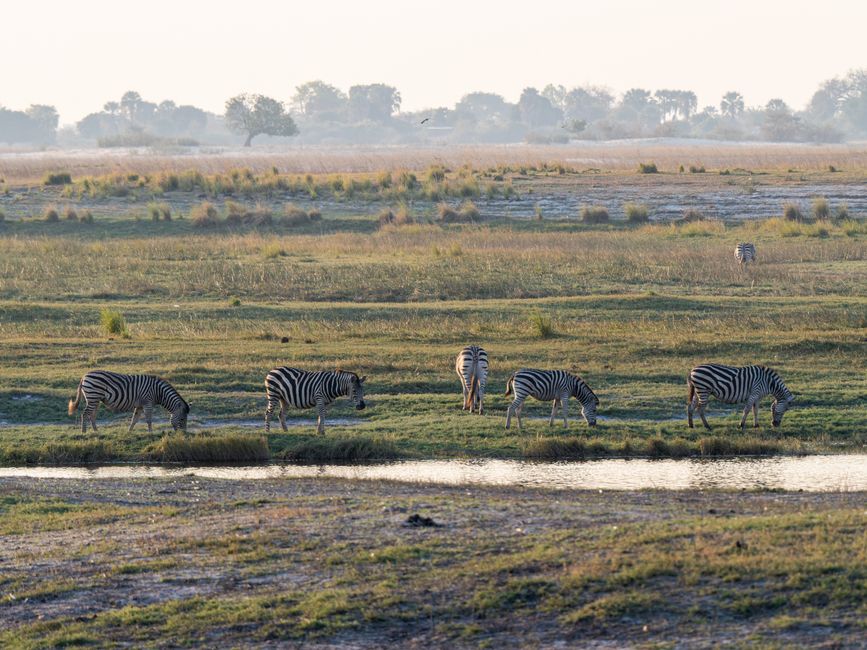
The Okavango Delta is one of the most extraordinary wild places on Earth: a vast inland delta where a river from the Angolan highlands spreads out into the Kalahari and simply disappears, feeding a mosaic of clear channels, papyrus swamps, lagoons, floodplains and palm-fringed islands. Elephants wade between islands, lions and leopards hunt on the floodplains, and red lechwe splash through the shallows, while more than 400 kinds of birds nest in the reeds. The delta was added to the UNESCO World Heritage List in 2014. Its eastern side is protected as Moremi Game Reserve, open to self-drive visitors with a 4×4, while most of the rest is divided into private and community concessions, where small, often luxurious camps are reached by light aircraft from Maun. Here you can explore by mokoro, the traditional canoe poled by a local guide, as well as by motorboat, on foot and in open safari vehicles. The magic of the Okavango is its timing: the flood arrives in the dry winter, so the delta is fullest from about June to August, just when wildlife from the surrounding dry country is drawn to the water.
Right now in Okavango Delta (Maun)
- Wed 19–34°C 66–94°F Partly cloudy
- Thu 21–35°C 69–94°F Mostly clear
- Fri 23–34°C 73–94°F Partly cloudy
Weather: MET Norway (CC BY 4.0)
Top tours in Okavango Delta
See all tours for Okavango Delta →
From local operators, with prices and reviews; you check availability and book on Viator, our partner. We may earn a commission at no extra cost to you. How we earn money
Okavango Delta at a glance
- Best months: June to October for game viewing and high water; July and August for the deepest flood. November to March is the green season, with lower rates, newborn animals and superb birding.
- Time needed: at least three nights in one camp; five to eight nights split between a water camp and a land camp, or combined with Moremi or Chobe.
- Getting there: fly to Maun (MUB), usually via Johannesburg, then by light aircraft to a camp; or drive about 100 km (60 miles) from Maun to Moremi’s South Gate in a 4×4.
- Costs (as of October 2026): Moremi charges non-residents P270 (about US$20) per adult per day under the DWNP schedule in force since 2022; fly-in camps cost from roughly US$800 to over US$2,500 per person per night, all-inclusive.
- Before you go: visas, money and park fees across the country are covered in our Botswana travel guide.
Park fees, concessions and rules
Moremi Game Reserve fees
Moremi is run by the Department of Wildlife and National Parks (DWNP), which charges a daily entry fee per person and per vehicle, plus camping fees. Rates under the schedule introduced in April 2022, as reported at the time:
| Visitor category | Park entry, adult, per day |
|---|---|
| — | — |
| Non-residents (international visitors) | P270 (about US$20) |
| SADC residents | P205 (about US$15) |
| Botswana citizens | P30 (about US$2) |
Campsites in Moremi, such as South Gate, Xakanaxa, Third Bridge and Khwai (North Gate), are run by private operators who charge a separate camping fee, often in US dollars; they must be booked and paid in advance, and the DWNP permit is best arranged at its office in Maun. Guests at fly-in camps in the private concessions don’t pay these fees directly: concession and park fees are included in the camp rate.
Concessions and community areas
Outside Moremi, the delta is divided into large concessions leased to safari companies or community trusts, each with only a few camps. This limits visitor numbers, funds conservation and village projects, and allows activities that aren’t permitted in Moremi itself, including off-road driving to follow animals, night drives and walking safaris. Some concessions are mainly “water” areas, where mokoro and boat trips are the main activity, others mainly “land” areas with game drives, and many offer both depending on the water level.
Rules for self-drivers in Moremi
- Book first: every campsite must be reserved before you enter; visitors without bookings may be turned away.
- Gate times: drive only in daylight, entering and leaving by the gate times posted at South Gate and North Gate; driving at night is not permitted.
- Stay on the roads: off-road driving is prohibited inside the reserve, and you must stay in your vehicle except at campsites and designated spots.
- Water crossings: check depth on foot only where it is safe and never where hippos or crocodiles may be; ask rangers about crossings, which change with the flood.
- Leave no trace: take all rubbish out, use the campsite ablutions and never feed animals.
Delta areas and who each one suits
Moremi Game Reserve
Moremi covers the eastern delta and Chief’s Island, combining permanent water at Xakanaxa and Third Bridge with the dry woodland and floodplains around South Gate and the Khwai River. It has some of Africa’s best game viewing in a public reserve, with lions, leopards, wild dogs, elephants and big herds of buffalo and lechwe, and is the main destination for self-drive and mobile safaris. Boat trips run from Xakanaxa and Mboma when water levels allow.
The private concessions of the central and western delta
The heart of the delta, west and north of Chief’s Island, is only reachable by air. Camps here range from intimate tented camps to lodges with plunge pools, all with guides, game drives and water activities. Choose a “water camp” for mokoro trips, island walks and birding, or a mixed camp for both game drives and water activities. These areas suit travelers who want exclusivity and are prepared to pay for it.
Khwai
The Khwai community concession, along the Khwai River at Moremi’s northeastern edge, is famous for elephants, wild dogs, leopards and hippo pools. Unlike in Moremi, night drives and off-road driving are permitted with registered operators, and there are community campsites as well as lodges. It is on the self-drive route between Moremi and Savuti.
The Okavango Panhandle
In the northwest, the Okavango flows through a narrow valley, the Panhandle, before fanning out. Around Shakawe and Seronga, riverside lodges offer fishing for tigerfish and bream, birding, boat trips and access to community mokoro trips at much lower prices than the central delta. The Tsodilo Hills are nearby.
Maun
Maun, on the Thamalakane River at the southeastern edge of the delta, is the safari hub, with the airport, supermarkets, 4×4 rental, banks and riverside lodges. Day and overnight mokoro trips into the delta’s southern fringe and scenic flights leave from here, making Maun a good base for budget travelers.
Top things to see and do in the Okavango Delta
Mokoro trips
Gliding through narrow channels lined with papyrus, water lilies and reeds in a mokoro is the quintessential delta experience. Your poler stands at the back and pushes with a long pole, and you sit low in the water, eye to eye with painted reed frogs, malachite kingfishers and jacanas walking on the lily pads. Trips last from a couple of hours to multi-day expeditions, camping on islands. Traditional wooden mekoro have largely been replaced by fiberglass versions to protect trees. Mokoro trips depend on water levels and are usually possible from about May to October in most areas, and longer in permanently flooded parts of the delta.
Game drives
Morning and afternoon drives in open vehicles explore floodplains and woodland in search of lions, leopards, cheetahs, wild dogs, elephants, buffalo, giraffes, zebras and many antelope, including the water-loving red lechwe and the shy sitatunga. In private concessions, guides can follow animals off-road and run night drives with a spotlight to look for leopards, hyenas, genets and bushbabies.
Walking safaris
On foot, with an experienced guide, you learn to read tracks, dung and the smaller creatures of the bush. Island walks, often combined with mokoro trips, are offered in concessions and from Maun-based community trips. Walking is not permitted in Moremi without a licensed guide.
Boat trips and fishing
Motorboats are used in the deeper channels and lagoons, especially in the northern and Panhandle areas, for birding, sunset cruises and visits to heronries. Catch-and-release fishing for tigerfish and bream is popular in the Panhandle and some northern camps; there is a closed fishing season in parts of the delta during the breeding period.
Scenic flights
A helicopter or light-aircraft flight over the delta is unforgettable: from above, you see the network of channels, the round islands, elephant herds wading across floodplains and hippos in the lagoons. Flights leave from Maun, and helicopters with doors off allow photography. Your inter-camp flights are mini scenic flights in themselves.
Birding
The delta is one of Africa’s best birding areas, with Pel’s fishing owl, African skimmers, slaty egrets, wattled cranes, African fish eagles and colorful bee-eaters. Birding peaks in the green season, when migrants arrive.
Other things to do in and around the delta
Food and drink
Meals in delta camps are usually included and served communally or at private tables: breakfast before the morning activity, brunch or lunch, afternoon tea, and dinner after the evening drive, often with a boma fire. Many camps use local flavors such as seswaa (pounded slow-cooked beef), pap, butternut, and sorghum. In Maun, riverside restaurants, cafés and supermarkets serve self-drivers; try a Botswana beef steak. Most camps include house wines, beer and soft drinks.
Culture and rock art
Visit villages on the western side of the delta to see the Okavango’s famous baskets woven from mokola palm, or take a cultural walk with a community guide. The Tsodilo Hills, a UNESCO site in the far northwest, hold more than 4,000 rock paintings and are sacred to the local San and Hambukushu people.
Day trips and nearby
The Makgadikgadi and Nxai Pans
About two to three hours’ drive east of Maun, the salt pans of the Makgadikgadi and Nxai Pan national parks offer meerkat encounters, quad-biking and sleep-outs on the pans in the dry season, and a zebra migration in the rainy season. Baines’ Baobabs in Nxai Pan are a famous photo stop.
Central Kalahari Game Reserve
To the south, the Central Kalahari is one of Africa’s largest reserves, with black-maned lions and gemsbok on the fossil river valleys of Deception Valley. It is for self-sufficient 4×4 travelers or fly-in camps.
Savuti and Chobe
North of Moremi, the sand road through Khwai continues to Savuti in Chobe National Park, known for lions and elephants, and then to the Chobe Riverfront at Kasane. See our Chobe National Park guide.
Nearby destinations
- Chobe National Park178 km
Getting there and getting around
By air
International travelers usually connect in Johannesburg for flights to Maun (MUB); some flights also come from Cape Town, Kasane and Gaborone. From Maun, light aircraft fly to the camps’ airstrips in 20 to 60 minutes. Luggage on these flights is limited, typically to about 20 kg (44 lb) per person, including hand luggage, in soft bags without wheels or frames. Most camps arrange the flights as part of the package.
By road
Maun is about 970 km (600 miles) by paved road from Gaborone, via Rakops or Nata, and about 600 km (370 miles) from Kasane via Nata. From Maun, a paved road runs to Shorobe, then sand and gravel lead about 100 km (60 miles) to Moremi’s South Gate. Inside the reserve, roads are deep sand and seasonal water crossings, so a high-clearance 4×4 is essential. The western Panhandle is reached by a paved road from Maun to Shakawe.
Getting around inside the delta
In concessions, you move with the camp’s guides by vehicle, mokoro or boat, and between camps by light aircraft. In Moremi, self-drivers use the network of sand tracks; carry a GPS with offline maps, as signs are few and tracks change with the flood.
When to go and how long to stay
The delta’s seasons follow two cycles. The local rains fall from about November to March, when it is hot and humid with afternoon storms. The flood from Angola arrives months later: water starts to spread into the delta around April and May, reaches its peak in the central delta in about June to August, and recedes from September, while the distant edges such as Maun often see the highest water around July and August. June to October is the peak season, with dry weather, high water and concentrated game; July and August mornings are cold, and October is very hot. Rates fall sharply in the green season, when the landscapes are lush and birdlife is at its best.
| Month | Average high | Average low | Rain | Days with 10 mm or more |
|---|---|---|---|---|
| Jan | 32 °C (90 °F) | 20 °C (68 °F) | 109 mm (4.3 in) | 4 |
| Feb | 32 °C (90 °F) | 20 °C (67 °F) | 97 mm (3.8 in) | 3 |
| Mar | 32 °C (89 °F) | 19 °C (66 °F) | 67 mm (2.6 in) | 2 |
| Apr | 31 °C (87 °F) | 16 °C (61 °F) | 24 mm (1.0 in) | 1 |
| May | 28 °C (83 °F) | 11 °C (52 °F) | 5 mm (0.2 in) | 0 |
| Jun | 26 °C (78 °F) | 8 °C (46 °F) | 1 mm (0 in) | 0 |
| Jul | 26 °C (78 °F) | 8 °C (46 °F) | 0 mm (0 in) | 0 |
| Aug | 29 °C (84 °F) | 10 °C (51 °F) | 0 mm (0 in) | 0 |
| Sep | 33 °C (91 °F) | 15 °C (60 °F) | 3 mm (0.1 in) | 0 |
| Oct | 34 °C (94 °F) | 19 °C (66 °F) | 16 mm (0.6 in) | 1 |
| Nov | 34 °C (93 °F) | 20 °C (68 °F) | 47 mm (1.9 in) | 1 |
| Dec | 33 °C (91 °F) | 20 °C (68 °F) | 79 mm (3.1 in) | 2 |
| Year | 31 °C (87 °F) | 15 °C (60 °F) | 449 mm (18 in) | 14 |
Figures are Botswana Meteorological Services’ 1971–2000 averages for Maun, at the southeastern edge of the delta, as published by the World Meteorological Organization; the last column counts days with at least 10 mm (0.4 in) of rain. Conditions in the delta are similar, with slightly cooler nights near water.
How long to stay: 3, 5 and 8 nights
- Three nights: one camp with both land and water activities, or a mokoro overnight from Maun plus a scenic flight.
- Five nights: two camps, one water camp for mokoro and boating and one land camp for game drives.
- Eight nights: three camps in different parts of the delta, or a self-drive through Moremi, Khwai and Savuti on the way to Chobe.
Where to stay in the Okavango Delta
- Fly-in camps in private concessions: small tented camps and lodges, often with 6 to 12 tents, with all meals, drinks, activities and park fees included. The most exclusive cost over US$2,000 per person per night in high season.
- Lodges in and around Moremi: a few lodges operate inside or on the edge of the reserve, with game drives and boat trips.
- Public campsites in Moremi: South Gate, Xakanaxa, Third Bridge and Khwai, with basic ablutions; unfenced and very popular in the dry season.
- Khwai community campsites and lodges: a little cheaper, with night drives allowed.
- Maun: riverside lodges, guesthouses and backpacker camps, a base for mokoro trips and flights.
- The Panhandle: fishing and birding lodges around Shakawe and Sepupa.
Typical costs in the Okavango Delta
| Item (as of October 2026) | Pula | About US dollars |
|---|---|---|
| — | — | — |
| Moremi entry, non-resident adult, per day (DWNP schedule since 2022) | P270 | $20 |
| Moremi entry, SADC resident adult, per day | P205 | $15 |
| Mokoro day trip from Maun, per person | about P900–1,600 | about $67–120 |
| Scenic helicopter flight, per person, 30–60 minutes | about P2,500–6,000 | about $185–445 |
| Light aircraft transfer, Maun to a delta camp | about P3,000–6,000 | about $220–445 |
| Riverside lodge in Maun, double, per night | about P1,500–3,500 | about $110–260 |
| Fly-in camp, per person per night, all-inclusive | about P10,000–40,000+ | about $740–3,000+ |
The Moremi fees follow the DWNP schedule introduced in April 2022, as reported at the time, and are flagged for checking; everything else is a typical range. Conversions use about P13.50 to US$1.
Safety in the Okavango Delta
- Unfenced camps: elephants, hippos, buffalo, lions and hyenas walk freely through camps and campsites. Never walk around after dark without an escort, keep tents zipped, don’t keep food or fruit in your tent, and give elephants and hippos a very wide berth.
- Water safety: hippos and crocodiles live in the channels and lagoons; don’t swim or wade except where your guide says it is safe, sit still in the mokoro, and keep hands out of the water.
- Walking: only walk with a qualified guide, follow instructions exactly, stay in single file and never run from an animal.
- Malaria: the delta is a malaria area, with the highest risk from about November to April. Take preventive medicine as advised by a travel-health professional, use repellent and long sleeves from dusk, and sleep under a net.
- Sand driving: deep sand causes overheating and rollovers; drive slowly, lower tire pressure as your rental company advises, and avoid crossing deep water without local knowledge. Carry extra water, fuel and recovery gear.
- Heat and sun: October often tops 35 °C (95 °F); drink plenty of water, wear a hat, and rest in the middle of the day.
- Emergencies: camps have radio contact with Maun and evacuation plans; carry insurance that covers air evacuation. National emergency numbers are 999 (police) and 997 (ambulance).
Practical tips for the Okavango Delta
- Book early: fly-in camps and Moremi campsites for July to October often sell out a year ahead.
- Pack soft: light aircraft only take soft bags; leave extra luggage at your Maun hotel or the air operator’s office.
- Cash: bring US dollars or pula in small notes for tips; there are no ATMs in the delta.
- Signal: there is no mobile coverage in most of the delta; tell family you’ll be offline.
- Children: many camps set minimum ages for mokoro and walking activities; check before booking.
What to pack for the Okavango Delta
Pack neutral clothes (khaki, olive, tan), a fleece, warm jacket, hat and gloves for June to August mornings, a light rain jacket in the green season, sun hat, sunglasses and SPF 50 sunscreen, long sleeves and trousers for the evenings, insect repellent, binoculars, a camera with a long lens, a dry bag for boat and mokoro trips, a headlamp and a power bank. See our rain jackets and water shoes guides.
Okavango Delta travel FAQ
When is the best time to visit the Okavango Delta?
From June to October, when it is dry, the flood is high and wildlife gathers near water. The flood is usually deepest from about June to August. November to March is the green season, with lower rates and excellent birding.
How much does it cost to visit the Okavango Delta?
A day mokoro trip from Maun costs roughly US$70–120. Fly-in camps cost from about US$800 to over US$2,500 per person per night, all-inclusive. Self-drivers pay Moremi’s P270 (about US$20) daily entry plus camping fees.
What is a mokoro?
A traditional canoe, once carved from a tree trunk and now usually made of fiberglass, poled by a standing guide through the delta’s shallow channels. It’s a quiet way to see birds, frogs, lilies and sometimes elephants.
Can you self-drive in the Okavango Delta?
Only in Moremi Game Reserve and the Khwai area, on its eastern side, in a high-clearance 4×4 with all campsites pre-booked. The rest of the delta is in private concessions reached by air.
How do you get to the Okavango Delta?
Fly to Maun, usually via Johannesburg, then by light aircraft to your camp. Self-drivers go by road from Maun to Moremi’s South Gate, about 100 km (60 miles) away.
Is the Okavango Delta safe?
Yes, with sensible precautions. Camps are unfenced, so follow your guides’ rules about walking after dark, keep tents closed and never swim in the channels, where hippos and crocodiles live.
Is there malaria in the Okavango Delta?
Yes. The risk is highest from about November to April. Consult a travel-health professional about preventive tablets and use repellent and nets.
Why does the Okavango flood in the dry season?
The water falls as rain in Angola’s highlands in summer and takes several months to flow down the Okavango River, so it reaches the delta in Botswana’s dry winter, usually peaking from about June to August.
What animals can you see in the Okavango Delta?
Elephants, lions, leopards, cheetahs, wild dogs, buffalo, hippos, crocodiles, giraffes, zebras, red lechwe, sitatunga and hundreds of bird species, including Pel’s fishing owl.
How many days do you need in the Okavango Delta?
At least three nights; five to eight nights let you combine a water camp and a land camp, or add Moremi, Khwai and Chobe.
Sources and last review
Researched and last reviewed on 5 October 2026. Climate: Botswana Meteorological Services’ 1971–2000 averages for Maun via the World Meteorological Organization; the exchange rate: the Bank of Botswana. Moremi fees follow the Department of Wildlife and National Parks schedule introduced in April 2022, as reported at the time; we could not confirm them on a government page, so they are flagged for checking. UNESCO status, distances, flood timing, campsite and camp details, flight rules, malaria seasons and typical prices are general references or estimates, flagged for checking. For entry rules and money, see our Botswana travel guide.
Plan your trip
Partner links: TravelerCenter may earn a commission if you book, at no extra cost to you.