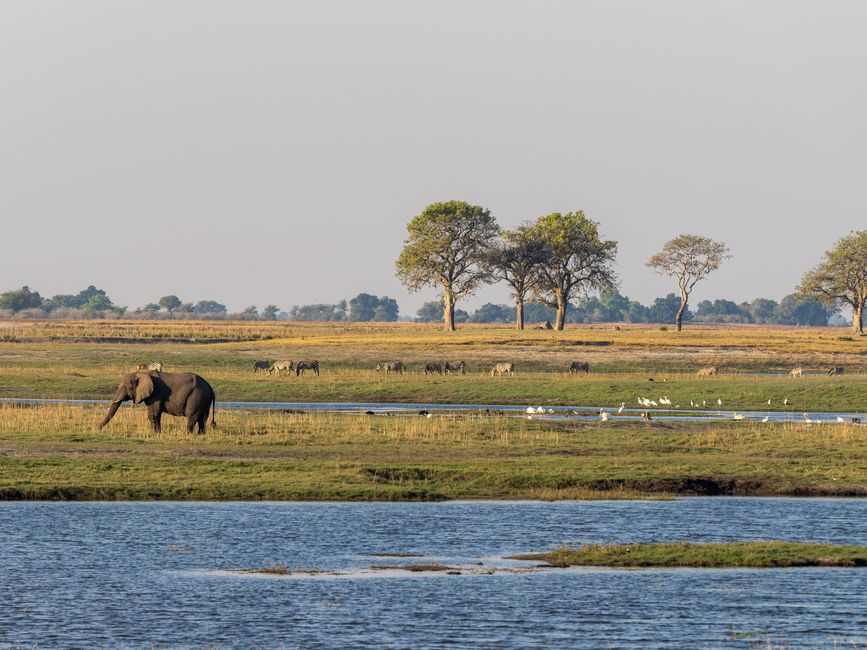
Chobe National Park, in Botswana’s far north, is famous for elephants. In the dry season, thousands of them come down to the Chobe River to drink, bathe and cross to the floodplains, often in family herds that fill the riverbanks as far as you can see, and Botswana as a whole has one of the largest elephant populations in Africa. The park also holds lions, leopards, buffalo, hippos, crocodiles, giraffes, sable and puku, and more than 450 bird species. Covering roughly 11,700 km² (4,500 square miles), Chobe has several very different areas: the Chobe Riverfront next to the small town of Kasane, the most visited and easiest to reach; the open marsh and channel of Savuti, renowned for lions and elephants; and the remote Linyanti wetlands in the northwest. What makes Chobe so popular is its location: Kasane is about 80 km (50 miles) from Victoria Falls and sits where four countries nearly meet, so a few days of game drives and river cruises fit easily into a trip to the falls, the Okavango Delta or Namibia’s Zambezi Region. The best months are the dry ones, from about June to October, when animals concentrate along the river.
Right now in Chobe National Park (Kasane)
- Wed 20–33°C 67–92°F Mostly clear
- Thu 21–33°C 70–92°F Partly cloudy
- Fri 22–33°C 72–92°F Mostly clear
Weather: MET Norway (CC BY 4.0)
Top tours in Chobe National Park
See all tours for Chobe National Park →
From local operators, with prices and reviews; you check availability and book on Viator, our partner. We may earn a commission at no extra cost to you. How we earn money
Chobe at a glance
- Best months: June to October for elephants and game viewing along the river; September and October are hottest and busiest at the water. November to March is the green season, with lush scenery and migrant birds.
- Time needed: two or three nights in Kasane for the Riverfront; five or more nights to add Savuti or Linyanti.
- Getting there: fly to Kasane (BBK) via Johannesburg or Maun, or drive about 80 km (50 miles) from Victoria Falls through the Kazungula border.
- Costs (as of October 2026): under the DWNP schedule in force since 2022, non-residents pay P270 (about US$20) per adult per day to enter the park, plus vehicle and camping fees.
- Before you go: visas, money and park fees across the country are covered in our Botswana travel guide.
Park fees, gates and rules
Entry fees
Chobe is run by the Department of Wildlife and National Parks (DWNP). Rates under the schedule introduced in April 2022, as reported at the time:
| Visitor category | Park entry, adult, per day |
|---|---|
| — | — |
| Non-residents (international visitors) | P270 (about US$20) |
| SADC residents | P205 (about US$15) |
| Botswana citizens | P30 (about US$2) |
Vehicles pay a separate daily fee, and campsites inside the park, such as Ihaha on the Riverfront and Savuti, are run by private operators who charge their own camping fees and require advance booking. If you join a game drive or boat cruise from a Kasane lodge, the operator normally adds the park fee to your bill. Pay DWNP fees at the Sedudu gate or in advance at the DWNP office in Kasane; carry cash in pula as a backup.
Gates and opening times
The main entrance for the Riverfront is Sedudu Gate, a few minutes west of Kasane. Ngoma Gate, at the western end of the Riverfront transit road near the Ngoma bridge to Namibia, and the Mababe Gate, south of Savuti, serve travelers crossing the park. Gates open around sunrise and close around sunset; the exact times are posted at each gate and change with the season. You must leave the park or be at your campsite before the gate closes, as driving after dark is not allowed.
Rules for visitors
- Stay in your vehicle except at designated spots and campsites, and keep to the roads.
- No night driving in the national park; night drives are only offered in private concessions outside it.
- Give elephants space: don’t drive between members of a herd, wait for them to cross, and back away if one flaps its ears or shakes its head.
- Boats on the river must keep a respectful distance from animals on the banks and in the water.
- Book campsites before you arrive; they are unfenced and in high demand from June to October.
Chobe areas and who each one suits
The Chobe Riverfront and Kasane
The Riverfront, a strip of floodplain, riverine woodland and sandy roads along the Chobe River west of Kasane, has the park’s highest concentration of animals in the dry season: elephants, buffalo, hippos, giraffes, sable, puku, lions and leopards, with crocodiles and water birds on the river. It is the easiest part of Chobe to visit, with morning and afternoon game drives and boat cruises from Kasane, and suits first-time visitors and short stays. Expect more vehicles and boats than elsewhere in Botswana, especially in the afternoons.
Savuti
In the southwest of the park, Savuti is an area of grassy plains, rocky outcrops and the Savuti Channel, which has flowed and dried up in unpredictable cycles over the past century. It is known for lions, spotted hyenas, elephants in the dry season and, in the rainy season, zebra on the move. Savuti is about 170 km (105 miles) from Kasane by deep sand roads, so you need a 4×4 or a fly-in camp; it is on the classic self-drive route between Moremi and Kasane.
Linyanti and the private concessions
West of Savuti, the Linyanti River and swamps form the border with Namibia. The concessions of the Linyanti, Selinda and Kwando areas, outside the national park, are home to luxury fly-in camps with excellent elephant, wild dog, lion and leopard sightings, night drives and walking. They are quieter and more expensive than the Riverfront.
Nogatsaa and the interior
The dry woodland interior around Nogatsaa and Tchinga, with seasonal pans, is rarely visited and suits experienced self-drivers. In the rainy season, elephants disperse here away from the river.
Top things to see and do in Chobe
River cruises
A three-hour boat cruise on the Chobe River is the highlight for most visitors: you drift close to elephants drinking and swimming, hippos, Nile crocodiles basking on the banks, and herds of buffalo on the floodplains, with African fish eagles, skimmers and kingfishers overhead. Sunset cruises are the most popular; morning cruises are quieter. Small photographic boats with swivel seats are offered by several operators in Kasane.
Game drives on the Riverfront
Shared morning and afternoon drives in open vehicles leave from Kasane lodges, entering at Sedudu Gate. Morning drives start before sunrise, when predators are most active; afternoon drives catch elephants coming to drink. Self-drivers can explore the Riverfront’s sand roads in a 4×4.
Elephant crossings
From about August to October, elephants cross the Chobe River between Botswana and the Namibian floodplains, swimming with only their trunks above water. Watching a herd cross from a boat is one of Africa’s great wildlife spectacles.
Savuti predators
Savuti’s open plains and marsh are good for lions, cheetahs and hyenas. The rocky hills near the Savuti campsite have San rock paintings.
Birding
With river, floodplain and woodland habitats, Chobe is excellent for birds: African skimmers nest on sandbanks in the dry season, carmine bee-eaters arrive around September, and the green season brings migrants from Europe and Asia.
Kasane Forest Reserve and town
Kasane has a small riverside town center, craft shops, and lodges with lawns along the river. The nearby Kasane Forest Reserve offers quieter game viewing outside the park.
Other things to do in Chobe
Food and drink
Kasane’s lodges have restaurants and riverside decks, ideal for a sundowner. Expect grilled Botswana beef, fish such as bream, and international dishes; supermarkets in town stock supplies for self-drivers. Fly-in camps in Linyanti and Savuti include all meals. Try seswaa, Botswana’s pounded slow-cooked beef, if you see it on a menu.
Fishing
Tigerfish and bream fishing on the Chobe and Zambezi rivers is popular from Kasane and from lodges on Impalila Island in Namibia. Catch-and-release is encouraged; licenses are usually arranged by the operator.
Day trips and nearby
Victoria Falls and Livingstone
Kasane is about 80 km (50 miles), or a little over an hour plus border formalities, from Victoria Falls in Zimbabwe. Many operators run day trips both ways, and Livingstone in Zambia is reached over the Kazungula bridge. See our Victoria Falls and Livingstone guides.
The Okavango Delta and Moremi
From Savuti, sand roads continue south through Khwai to Moremi Game Reserve, or you can fly from Kasane to Maun and the delta camps. See our Okavango Delta guide.
Namibia’s Zambezi Region
Across the Ngoma bridge, Namibia’s Zambezi Region (formerly the Caprivi Strip) has the wetlands of Nkasa Rupara and Bwabwata national parks. See our Namibia travel guide.
Hwange National Park
Zimbabwe’s largest park lies about two to three hours from Victoria Falls. See our Hwange National Park guide.
Nearby destinations
- Victoria Falls171 km
- Okavango Delta178 km
- Livingstone179 km
- Hwange National Park269 km
Getting there and getting around
By air
Kasane Airport (BBK) has scheduled flights from Johannesburg, Maun and Gaborone. Many visitors fly into Victoria Falls International Airport (VFA) in Zimbabwe, which has more international flights, and transfer to Kasane by road. Light aircraft link Kasane with Savuti, Linyanti and the Okavango Delta camps; luggage limits on these flights are usually about 20 kg (44 lb) per person in soft bags.
By road
Kasane is on a paved road from Nata (about 300 km, 185 miles) and, beyond, Francistown and Maun. The Kazungula border with Zimbabwe is a few kilometers east of town, on the road to Victoria Falls; the Kazungula bridge crosses the Zambezi to Zambia; and the Ngoma bridge leads into Namibia. Transit traffic between Kasane and Ngoma can use the paved road through the park interior; keep to the speed limit and watch for elephants on the road. Border posts close at night, so check opening hours before you set off.
Getting around the park
The Riverfront has sand roads suitable only for 4x4s; most visitors join drives from Kasane lodges. Savuti and Linyanti need a high-clearance 4×4 with experience in deep sand, or a fly-in package. There is no fuel inside the park; fill up in Kasane.
When to go and how long to stay
Chobe has a summer-rainfall climate. The dry season (May to October) is the best time for wildlife on the Riverfront, as pans in the interior dry up and animals move to the river; elephant numbers peak from about August to October. Days are warm and nights cool in June and July, then temperatures climb, often above 35 °C (95 °F) in October. The rainy season (November to March) brings afternoon storms, green landscapes and newborn animals; elephants disperse into the interior, and some Savuti roads become difficult.
| Month | Average high | Average low | Rain | Days with 10 mm or more |
|---|---|---|---|---|
| Jan | 31 °C (87 °F) | 20 °C (67 °F) | 134 mm (5.3 in) | 4 |
| Feb | 31 °C (87 °F) | 19 °C (67 °F) | 134 mm (5.3 in) | 4 |
| Mar | 31 °C (88 °F) | 19 °C (66 °F) | 70 mm (2.8 in) | 2 |
| Apr | 30 °C (87 °F) | 16 °C (61 °F) | 23 mm (0.9 in) | 1 |
| May | 29 °C (83 °F) | 12 °C (54 °F) | 2 mm (0.1 in) | 0 |
| Jun | 26 °C (79 °F) | 10 °C (50 °F) | 0 mm (0 in) | 0 |
| Jul | 26 °C (79 °F) | 10 °C (49 °F) | 0 mm (0 in) | 0 |
| Aug | 29 °C (85 °F) | 12 °C (54 °F) | 0 mm (0 in) | 0 |
| Sep | 33 °C (91 °F) | 16 °C (61 °F) | 2 mm (0.1 in) | 0 |
| Oct | 34 °C (94 °F) | 19 °C (67 °F) | 20 mm (0.8 in) | 1 |
| Nov | 33 °C (92 °F) | 20 °C (69 °F) | 63 mm (2.5 in) | 2 |
| Dec | 31 °C (89 °F) | 20 °C (67 °F) | 127 mm (5.0 in) | 4 |
| Year | 30 °C (87 °F) | 16 °C (61 °F) | 575 mm (23 in) | 18 |
Figures are Botswana Meteorological Services’ 1971–2000 averages for Kasane, at the park’s northeastern edge, as published by the World Meteorological Organization; the last column counts days with at least 10 mm (0.4 in) of rain. Savuti, inland and further south, is a little hotter by day and cooler at night.
How long to stay: 2, 4 and 7 nights
- Two nights: stay in Kasane for a sunset river cruise, a morning game drive and an afternoon drive or boat trip.
- Four nights: two nights in Kasane and two at Savuti, or add a day trip to Victoria Falls.
- Seven nights: Kasane (2 nights), Savuti (2) and Linyanti or Khwai (3), or self-drive from Kasane through Savuti to Moremi.
Where to stay in Chobe
- Kasane riverside lodges and hotels: the widest choice, from mid-range hotels to luxury lodges, with river cruises and game drives.
- Lodges inside the park: a small number of lodges on the Riverfront itself allow early access to the river.
- Houseboats: several houseboats moor on the Chobe River, usually on the Namibian side, with tender boats for game viewing.
- Savuti and Linyanti camps: tented fly-in camps, all-inclusive, with game drives and, in the concessions, night drives.
- Public campsites: Ihaha on the Riverfront and Savuti, unfenced, with basic ablutions; book well ahead.
- Kazungula and the outskirts: budget lodges and campsites with shuttle access to activities.
Typical costs in Chobe
| Item (as of October 2026) | Pula | About US dollars |
|---|---|---|
| — | — | — |
| Chobe entry, non-resident adult, per day (DWNP schedule since 2022) | P270 | $20 |
| Shared river cruise, 3 hours, per person (plus park fee) | about P500–900 | about $37–67 |
| Shared game drive, 3 hours, per person (plus park fee) | about P500–900 | about $37–67 |
| Photographic boat safari, per person | about P1,000–1,800 | about $75–135 |
| Mid-range Kasane lodge, double, per night | about P1,500–3,500 | about $110–260 |
| Fly-in camp in Savuti or Linyanti, per person per night | about P10,000–30,000+ | about $740–2,200+ |
| Day trip from Kasane to Victoria Falls, per person | about P1,800–3,000 | about $135–220 |
The park fee follows the DWNP schedule introduced in April 2022, as reported at the time, and is flagged for checking; everything else is a typical range. Conversions use about P13.50 to US$1.
Safety in Chobe
- Wildlife: Chobe and its campsites are unfenced. Elephants and hippos walk through Kasane town and lodge grounds, especially at night; don’t walk after dark, and never approach elephants or get between a hippo and the water.
- River safety: the Chobe River has hippos and large crocodiles. Never swim or wade, keep hands and feet inside boats, and wear life jackets when provided.
- Malaria: Chobe is a malaria area, with the highest risk from about November to April. Take preventive medicine as advised by a travel-health professional and use repellent from dusk to dawn.
- Roads: watch for elephants and other animals on the Kasane–Nata and Kasane–Ngoma roads, especially at dawn, dusk and night; avoid driving after dark. In Savuti, deep sand demands low tire pressure and slow speeds to prevent rollovers.
- Heat: October temperatures often top 35 °C (95 °F); carry water on drives.
- Emergencies: call 999 (police) or 997 (ambulance); Kasane has a hospital and private clinics, and serious cases are evacuated, so carry insurance with evacuation cover.
Practical tips for Chobe
- Book early: Kasane lodges, Ihaha and Savuti campsites, and Linyanti camps fill up for July to October.
- Morning is quieter: the Riverfront is busiest in the afternoon, when most cruises and drives run.
- Visas: if you plan to cross to Victoria Falls or Zambia, check each country’s entry rules first; Zimbabwe’s KAZA UNIVISA covers Zimbabwe and Zambia and day trips into Botswana through Kazungula.
- Cash: Kasane has ATMs and card-friendly shops; bring small notes for tips.
What to pack for Chobe
Pack neutral clothes, a warm fleece and jacket for June and July mornings, a sun hat, sunglasses, SPF 50 sunscreen, long sleeves for the evenings, insect repellent, binoculars, a camera with a long zoom lens and a beanbag for boat photography, a headlamp, and a light rain jacket in the green season. See our rain jackets and travel adapters guides.
Chobe National Park travel FAQ
How much is the Chobe National Park entry fee?
Under the DWNP schedule in force since April 2022, non-residents pay P270 (about US$20) per adult per day, SADC residents P205 and Botswana citizens P30, plus vehicle and camping fees. Tour operators in Kasane usually add the fee to your activity price.
When is the best time to visit Chobe?
From June to October, especially August to October, when elephants gather along the Chobe River. The green season from November to March is quieter, cheaper and good for birds.
Can you do a day trip to Chobe from Victoria Falls?
Yes. Kasane is about 80 km (50 miles) from Victoria Falls, and day trips usually include a morning boat cruise, lunch and an afternoon game drive. Allow time for the Kazungula border and check visa rules.
What is the difference between the Chobe Riverfront and Savuti?
The Riverfront, next to Kasane, is easy to reach and has dense dry-season wildlife but more vehicles. Savuti, about 170 km (105 miles) away by sand road, is remote, known for lions and requires a 4×4 or fly-in camp.
Can I self-drive in Chobe National Park?
Yes, in a high-clearance 4×4. The Riverfront’s sand roads are manageable for most drivers; Savuti and Linyanti need experience in deep sand. Book campsites in advance and leave or reach camp before sunset.
Is there malaria in Chobe?
Yes. The risk is highest from about November to April. Consult a travel-health professional about preventive tablets and use repellent and nets.
Is a Chobe river cruise worth it?
Yes; for many visitors it is the highlight. You see elephants drinking and swimming at close range, along with hippos, crocodiles and water birds. Sunset cruises are the most popular.
How do I get to Kasane?
Fly to Kasane Airport, usually via Johannesburg or Maun, or fly into Victoria Falls in Zimbabwe and transfer about an hour by road through the Kazungula border.
Are there night drives in Chobe?
Not inside the national park, where driving after dark is prohibited. Night drives are offered in private concessions such as Linyanti and Selinda, outside the park.
How many days do you need in Chobe?
Two or three nights in Kasane cover the Riverfront by road and boat; five to seven nights let you add Savuti or Linyanti, or continue to the Okavango Delta.
Sources and last review
Researched and last reviewed on 5 October 2026. Climate: Botswana Meteorological Services’ 1971–2000 averages for Kasane via the World Meteorological Organization; the exchange rate: the Bank of Botswana; KAZA UNIVISA coverage: the Zambia Department of Immigration. Park fees follow the Department of Wildlife and National Parks schedule introduced in April 2022, as reported at the time; we could not confirm them on a government page, so they are flagged for checking. The park’s size, gate names and times, distances, campsites, flight rules, elephant seasons, malaria seasons and typical prices are general references or estimates, flagged for checking. For entry rules and money, see our Botswana travel guide.
Plan your trip
Partner links: TravelerCenter may earn a commission if you book, at no extra cost to you.