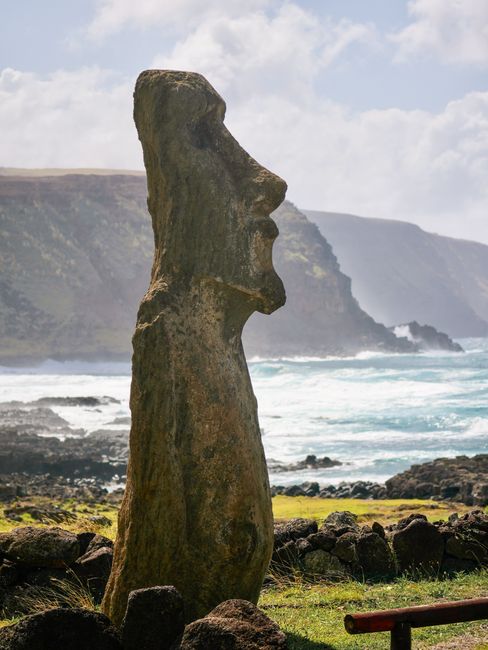
Easter Island, called Rapa Nui by its people, is a small volcanic triangle in the South Pacific, about 3,700 km (2,300 miles) west of mainland Chile and one of the most remote inhabited places on Earth. It is famous for its moai, the giant stone figures carved centuries ago by the Rapa Nui and raised on ceremonial platforms (ahu) around the coast to watch over their villages. Most of the island is Rapa Nui National Park, a UNESCO World Heritage Site since 1995, managed since 2017 by the Ma’u Henua indigenous community. To visit you need a park ticket and an accredited guide for the archaeological sites, and every visitor must complete an entry form and keep within a 30-day stay limit. Beyond the moai, there are volcanic craters, a white-sand beach with palm trees, clear water for diving, and a living Polynesian culture. It’s warm and humid all year, with showers in every season.
Right now in Easter Island (Hanga Roa)
- Tue 18–20°C 65–67°F 8 mm Rain
- Wed 20–21°C 68–70°F 7 mm Light rain
- Thu 19–21°C 67–70°F 6 mm Clear
- Mon 12 Oct Columbus Day (Día del Descubrimiento de Dos Mundos)
Weather: MET Norway (CC BY 4.0) · Sea temperature: NOAA CoastWatch · Holidays: Nager.Date
Top tours in Easter Island
See all tours for Easter Island →
From local operators, with prices and reviews; you check availability and book on Viator, our partner. We may earn a commission at no extra cost to you. How we earn money
Easter Island at a glance
- Best for: the moai and archaeological sites, Polynesian culture, volcanic landscapes, diving and snorkeling, and a once-in-a-lifetime remote island trip.
- How long: 4–5 nights is ideal; 3 nights is the minimum to see the main sites at a reasonable pace.
- Best time: all year; January to March is warmest, with highs of 27 °C (80–82 °F), and the Tapati festival in early February is the busiest time.
- Getting there: flights from Santiago to Mataveri airport, about 5.5 hours; LATAM is the only airline on the route.
- Entry rules: the free Single Entry Form (FUI), a return ticket for a stay of no more than 30 days, and accommodation registered with Sernatur.
- Park rules: a Rapa Nui National Park ticket, valid 10 days from your first visit, and an accredited guide or Rapa Nui host for the sites.
- Before you go: entry rules for Chile, money and general safety are in our Chile travel guide.
Before you fly: the entry form and the 30-day limit
Flights to Easter Island are domestic, so there is no passport control on arrival, but Law 21.070 sets special rules for visitors. According to Chile’s official tourism board and ChileAtiende:
- Single Entry Form (Formulario Único de Ingreso, FUI): fill it in online on the Ministry of the Interior’s site, within 48 hours before your flight. It’s free. The PDI checks it at the departure airport, and you can’t board without it.
- Maximum stay: you need a return ticket for a stay of no more than 30 days, counting the days of arrival and departure. The limit can’t be extended.
- Accommodation: a booking at accommodation registered with Sernatur, with its address, or an invitation from a Rapa Nui resident or other authorized person, processed with a folio number from the island’s Provincial Government.
- Food rules: products made from honey can’t be brought to the island, and all animal and plant products must be declared to the SAG.
Chilean residents and Rapa Nui people follow different rules. Foreign visitors also need to meet Chile’s normal entry rules when they arrive on the mainland.
Rapa Nui National Park: tickets, guides and rules (as of October 2026)
The park covers most of the island and all the major archaeological sites. Since November 23, 2017, it has been run by the Ma’u Henua indigenous community under a 50-year concession. According to Ma’u Henua:
- A ticket is compulsory for every visitor. Buy it online through the official site, rapanuinationalpark.com, at the ticket machines (tótems) in the airport, or at the ticket office in Hanga Roa, open Monday to Saturday from 9 a.m. to 5:30 p.m. Foreign visitors must choose the ticket for foreigners; the wrong ticket can stop you entering.
- Price: the official sales page lists park tickets from CLP 20,000 to CLP 95,000; the foreign adult ticket is the higher price, about US$96 at October 2026 exchange rates. Check the current price when you buy.
- Validity: 10 days from your first entry to the park, not from the purchase date. Rano Raraku and Orongo can be visited only once per ticket, so plan those days carefully.
- An accredited guide or Rapa Nui host is compulsory to enter the park’s sites. Hire one through your hotel, a licensed agency or the list of guides accredited by Ma’u Henua.
- Hours: sites open from 9 a.m., once the park rangers (Muto’i Henua) have checked them. Sites can be open, open with caution or temporarily closed because of wind, rain, mud, bees or maintenance; Orongo, on the rim of the Rano Kau crater, often closes in strong wind. Ma’u Henua posts daily site status on its official WhatsApp channel.
- Respect the heritage: never touch, climb, sit or lean on moai, ahu, petroglyphs or other structures, and don’t take stones or anything else from the sites. Damage is punished under the National Monuments Law with fines of 5 to 100 UTM (a Chilean indexed unit) and possible criminal charges.
- Other rules: no drones without written authorization, no alcohol or smoking in the park, no fires, no pets, no camping in the park (camping is allowed only in Hanga Roa at authorized sites), and bicycles only on permitted roads.
Toilets are available only at Orongo, Rano Raraku, Hanga Rau and Ahu Akivi.
Top things to see on Easter Island
Rano Raraku: the moai quarry
The volcanic crater where almost all the moai were carved from compressed volcanic ash is the most remarkable site on the island: hundreds of statues stand half-buried on the grassy slopes, and others lie unfinished in the rock, showing every stage of carving. Inside the crater is a reed-fringed lake. Allow two hours, remember that you can enter only once per ticket, and go with your guide early or late for the best light.
Ahu Tongariki
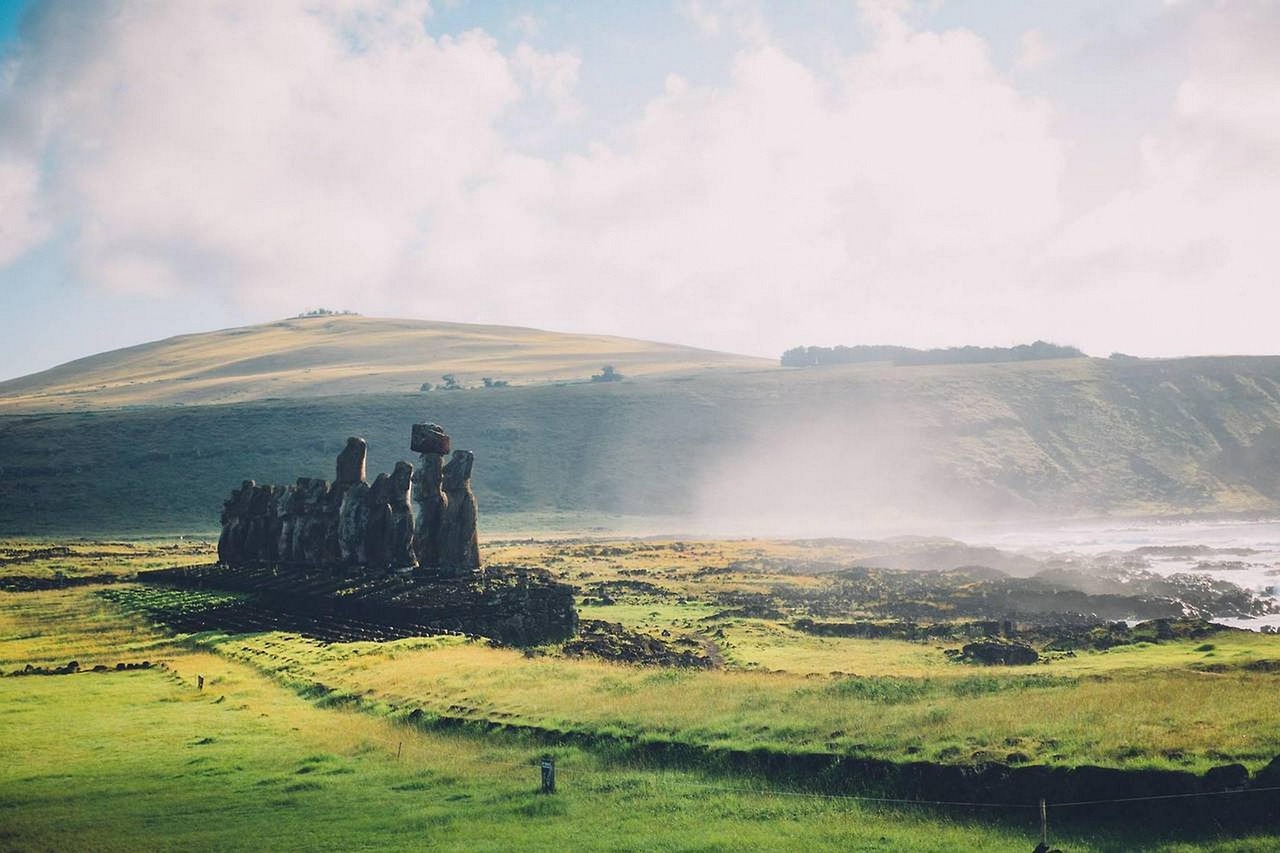
Below Rano Raraku on the south-east coast, the largest ceremonial platform on the island carries 15 moai in a row, restored in the 1990s after a tsunami had scattered them. Sunrise behind the statues is the island’s classic photograph.
Anakena
The island’s main white-sand beach, fringed with coconut palms on the north coast, is where legend says the first king, Hotu Matu’a, landed. Ahu Nau Nau, with moai still wearing their red stone topknots (pukao) and with finely carved backs, stands just behind the beach. It’s the best place to swim and has snack stalls.
Orongo and Rano Kau
At the south-western tip, the huge crater of Rano Kau holds a freshwater lake with floating reed islands, and on its rim the ceremonial village of Orongo, with stone houses and petroglyphs, was the center of the Birdman (Tangata Manu) cult, a yearly race to bring back the first sooty tern egg from the islets offshore. Remember the one-visit rule and that the site closes in strong wind.
Ahu Akivi
Inland, the seven moai of Ahu Akivi are the only ones that face the sea, said to look toward the homeland of the first settlers. They are aligned with the equinox sunset.
Ahu Tahai and Hanga Roa
At the edge of Hanga Roa, the Tahai complex has three ahu, including one moai with restored eyes, and is the island’s favorite sunset spot. Nearby, the Padre Sebastián Englert Anthropological Museum explains Rapa Nui history and culture.
More to see
- Puna Pau: the small red-stone quarry where the pukao topknots were carved.
- Ana Te Pahu and other caves: lava tubes once used as shelters and gardens.
- Te Pito Kura: the site of the largest moai ever raised on an ahu, now fallen, and a smooth round stone said to hold mana (spiritual power).
- Ahu Vinapu: famous for its tightly fitted stonework.
Other things to do on Easter Island
Diving, snorkeling and the sea
The water around Rapa Nui is famously clear, with visibility that can exceed 30 m (100 ft), underwater lava formations and a submerged moai replica off Hanga Roa used by divers. Dive centers in Hanga Roa run trips for beginners and certified divers. Sea turtles visit Hanga Roa’s small harbor; don’t touch or feed them. See our guides to diving and snorkeling.
Beaches and surfing
Anakena and the small Ovahe beach on the north coast are the only sandy beaches; Pikinini and the pools by Hanga Roa’s harbor are popular for a dip. The island has powerful reef breaks for experienced surfers, and lessons for beginners in Hanga Roa. See our guide to beaches.
Culture, dance and the Tapati festival
Evening shows of Rapa Nui music and dance in Hanga Roa are lively and colorful. The Tapati Rapa Nui festival, held each year in early February, fills two weeks with traditional competitions, including the haka pei, sliding down a hill on banana trunks, canoe races and body painting. It’s the busiest and most expensive time to visit.
Hiking, cycling and horseback riding
Hike to the summit of Terevaka, the island’s highest point at about 507 m (1,660 ft), for a 360-degree view of the ocean, or ride horses or bikes along the coast. Remember that entering park sites requires your ticket and a guide.
Food and drink
Seafood is the specialty: fresh tuna and mahi-mahi ceviche, tuna empanadas, and the traditional umu, a feast of meat, fish, sweet potato and taro cooked in an earth oven, often served at cultural events. Po’e, a sweet banana or pumpkin cake, is a local dessert. Almost everything else is flown or shipped in from the mainland, so restaurant and supermarket prices are well above Santiago’s. Many restaurants line Atamu Tekena street and the waterfront in Hanga Roa.
Getting there and getting around
Flights
Mataveri International Airport (IPC) is on the edge of Hanga Roa, a few minutes from most hotels, and hotels usually meet guests with a flower necklace. LATAM flies from Santiago in about 5.5 hours, with more flights in high season; flights have also operated to Papeete in Tahiti. Book early for January, February and Easter, and remember that you need the FUI before you can check in.
Getting around
Hanga Roa is walkable. To see the island, most visitors combine guided tours, which solve the guide requirement, with a rental car, scooter or bike for days at the beach and in town. The island’s road around the coast and to Anakena is paved in many sections, but others are rough; drive slowly and watch for horses and cattle on the roads. Taxis are available in Hanga Roa. There’s no public bus.
When to go and how long to stay
Easter Island has a mild subtropical climate, warm and humid all year, with showers in every month, usually short. The table uses the Meteorological Directorate’s 1991–2020 normals for Mataveri airport, as published by the World Meteorological Organization.
| Season | Average high / low | Rainy days per month | What it’s like |
|---|---|---|---|
| Summer (Dec–Feb) | 26–28 °C (78–82 °F) / 19–21 °C (66–69 °F) | 9–10 | Warmest and sunniest; Tapati festival in February; busiest season |
| Fall (Mar–May) | 27 °C falling to 23 °C (80 to 74 °F) / 20 °C falling to 18 °C (68 to 64 °F) | 11–12 | Warm, with more showers; quieter after Easter |
| Winter (Jun–Aug) | 21–22 °C (70–71 °F) / 16–17 °C (60–62 °F) | 11–12 | Mild, breezy and wetter; good walking weather, fewest visitors |
| Spring (Sep–Nov) | 22 °C rising to 24 °C (71 to 75 °F) / 16 °C rising to 18 °C (60 to 64 °F) | 9–10 | Pleasant and increasingly sunny |
Mataveri receives about 1,130 mm (44 in) of rain a year, spread through all seasons, with April to July the wettest months. Sea temperatures range from about 20 °C (68 °F) in winter to about 25 °C (77 °F) in late summer.
Easter Island month by month
| Month | High / low | Rain | What to expect |
|---|---|---|---|
| January | 27 °C (80 °F) / 20 °C (68 °F) | 81 mm (3.2 in) | Hot and sunny; summer holidays; book ahead |
| February | 28 °C (82 °F) / 21 °C (69 °F) | 69 mm (2.7 in) | Tapati festival; the busiest and most expensive weeks |
| March | 27 °C (80 °F) / 20 °C (68 °F) | 87 mm (3.4 in) | Still warm; good diving |
| April | 26 °C (78 °F) / 19 °C (67 °F) | 123 mm (4.8 in) | Wettest months begin; Easter week is busy |
| May | 23 °C (74 °F) / 18 °C (64 °F) | 117 mm (4.6 in) | Mild with showers; quiet |
| June | 22 °C (71 °F) / 17 °C (62 °F) | 109 mm (4.3 in) | Cooler and breezy; low season |
| July | 21 °C (70 °F) / 16 °C (61 °F) | 113 mm (4.5 in) | Coolest month; Chilean winter school holidays |
| August | 21 °C (70 °F) / 16 °C (60 °F) | 97 mm (3.8 in) | Mild; fewer visitors |
| September | 22 °C (71 °F) / 16 °C (60 °F) | 97 mm (3.8 in) | Spring; drier days return |
| October | 22 °C (72 °F) / 16 °C (61 °F) | 91 mm (3.6 in) | Pleasant and quieter; good value |
| November | 24 °C (75 °F) / 18 °C (64 °F) | 75 mm (3.0 in) | Warm and increasingly sunny |
| December | 26 °C (78 °F) / 19 °C (66 °F) | 70 mm (2.7 in) | Summer begins; busy at Christmas and New Year |
Crowds and prices: February (Tapati), January, Easter and the Chilean winter holidays in July are the busiest periods; flights and hotels can sell out. Easter Island runs two hours behind mainland Chile: UTC−6 in the southern winter and UTC−5 in summer.
Three days on Easter Island
Day one, Hanga Roa, the museum and sunset at Ahu Tahai. Day two, a full guided day along the south coast to Ahu Vinapu, Ahu Tongariki and Rano Raraku, ending at Anakena for a swim. Day three, Orongo and the Rano Kau crater in the morning, then Ahu Akivi and Puna Pau.
Five days
Add sunrise at Tongariki, a dive or snorkel, the north coast and Te Pito Kura, a hike up Terevaka, a cultural dance show and a slow beach day at Anakena. Remember that Rano Raraku and Orongo can be entered only once on a 10-day ticket.
Where to stay
All accommodation is in or near Hanga Roa, the island’s only town, and must be registered with Sernatur for the FUI. Options range from campsites and family-run guesthouses (residenciales) to cabins, boutique hotels and a few upscale lodges with all-inclusive excursions. Book early for February and Easter. Foreign tourists who pay a hotel registered with Chile’s tax service in US dollars or with a card issued abroad don’t pay the 19% VAT (IVA) on the room.
What a trip to Easter Island costs
Easter Island is expensive. These are our estimates for October 2026 at about CLP 985 per US dollar, except the park ticket range, which comes from the official sales page.
| Item | Typical price |
|---|---|
| Rapa Nui National Park ticket | CLP 20,000–95,000 (US$20–96), official range; foreigners pay the top price |
| Return flight Santiago–Easter Island | CLP 350,000–900,000 (US$355–915), depending on season |
| Full-day guided tour of the sites | CLP 60,000–110,000 (US$60–110) |
| Rental car, per day | CLP 50,000–80,000 (US$50–80) |
| Two-tank dive | CLP 80,000–120,000 (US$80–120) |
| Campsite or hostel bed | CLP 15,000–35,000 (US$15–35) |
| Mid-range double room | CLP 120,000–220,000 (US$120–225) |
| Lunch in Hanga Roa | CLP 15,000–25,000 (US$15–25) |
Hanga Roa has a few ATMs and most hotels and restaurants take cards; many businesses also accept US dollars.
Practical tips for Easter Island
- Fill in the FUI within 48 hours before your flight and keep the confirmation.
- Plan the once-only sites: Rano Raraku and Orongo can be entered only once per ticket.
- Hire your guide early in high season, and confirm that the guide is accredited by Ma’u Henua.
- Sun and rain: the sun is strong even on cloudy days, and showers come and go quickly; carry both sunscreen and a rain jacket.
- Fire risk: strong winds and dry grass make the island very vulnerable to wildfires, according to Ma’u Henua; never light fires and don’t smoke in the park.
- Health: there’s a hospital in Hanga Roa, but serious cases are flown to Santiago; travel insurance with evacuation is important. Dengue has occurred on the island in some years, so use insect repellent.
- Emergencies: 133 for the police, 131 for an ambulance, 137 for maritime emergencies; inside the park, go to the nearest Muto’i Henua ranger.
What to pack for Easter Island
Light summer clothes, a long-sleeved layer and a light sweater for breezy evenings, a rain jacket (see our guide to rain jackets), a sun hat, sunglasses and high-factor sunscreen, swimwear, water shoes for rocky entries (see our guide to water shoes), comfortable walking shoes, insect repellent, and a type C/L plug adapter for Chile’s 220 V sockets. Leave honey products at home.
Easter Island travel FAQ
Do I need a permit to visit Easter Island?
Yes. Complete the free Single Entry Form (FUI) online within 48 hours before your flight, with a return ticket for a stay of up to 30 days and a booking at Sernatur-registered accommodation.
How long can I stay on Easter Island?
A maximum of 30 days, including the days of arrival and departure, under Law 21.070. The limit can’t be extended.
How much is the Rapa Nui National Park ticket?
As of October 2026, the official sales page lists tickets from CLP 20,000 to CLP 95,000, with foreigners paying the top price, about US$96. The ticket is valid 10 days from your first entry.
Do I need a guide on Easter Island?
Yes. According to Ma’u Henua, an accredited guide or Rapa Nui host is compulsory to enter the national park’s sites.
Can I visit Rano Raraku and Orongo more than once?
No. Each can be entered only once per park ticket, so plan your visits carefully.
How do I get to Easter Island?
Fly from Santiago to Mataveri airport with LATAM, about 5.5 hours. Book early for January, February and Easter.
How many days do I need on Easter Island?
Four or five nights is ideal; three nights is the minimum for the main sites.
When is the best time to visit Easter Island?
Any time of year. January to March is warmest, and the Tapati festival in early February is the most colorful but busiest time; winter is mild and quiet.
Can I swim on Easter Island?
Yes, at Anakena and Ovahe beaches and in the pools by Hanga Roa’s harbor. The water is clear and between about 20 and 25 °C (68–77 °F).
What currency is used on Easter Island?
The Chilean peso. Many businesses also accept US dollars, and cards are widely taken in Hanga Roa.
Sources and last review
Researched and last reviewed on 4 October 2026. Entry form, stay limit, accommodation and food rules: Chile’s official tourism site, chile.travel, and ChileAtiende (PDI); park tickets, guides, validity, once-only sites, sales points, hours, site status, toilets, rules and penalties: the Ma’u Henua community’s official park sites; ticket price range: the park’s official sales page; exchange rate: the Central Bank of Chile; hotel VAT exemption: Decree-Law 825; climate: the Meteorological Directorate’s 1991–2020 normals for Mataveri airport, as published by the World Meteorological Organization. Which ticket price applies to foreign adults, the island’s distance and history, the moai and site descriptions, flight times and routes, diving visibility, sea temperatures, Tapati, dengue, the hospital and typical costs come from general references and are flagged for checking; costs are our estimates. Rules and prices change, so check the official sites before you go. For entry rules and money, see our Chile travel guide.
Plan your trip
Partner links: TravelerCenter may earn a commission if you book, at no extra cost to you.
🇪🇸 Useful Spanish phrases for Easter Island
All 38 Spanish phrases: restaurant, hotel, emergencies, romance (printable) →