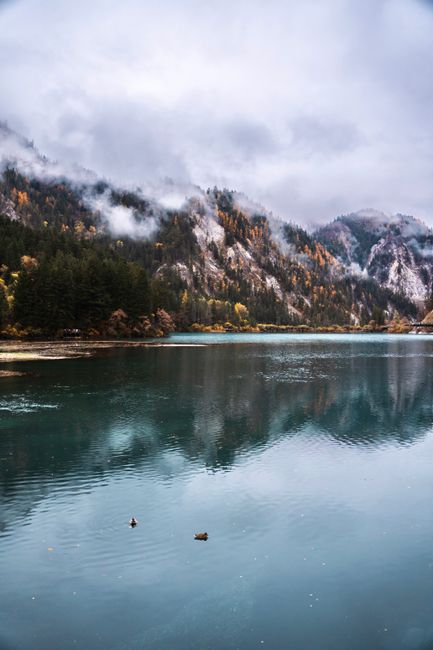
Jiuzhaigou, the “Valley of Nine Villages,” in the Min Mountains of northern Sichuan province in southwest China, is famous for water of almost unreal colors. In a Y-shaped system of forested valleys, more than a hundred lakes, filled by springs and dammed by natural travertine barriers, glow turquoise, sapphire, jade and emerald, linked by cascades, braided streams and wide waterfalls such as Nuorilang and Pearl Shoal, beneath snow peaks rising above 4,000 m (13,100 ft). The valleys take their name from nine Tibetan villages, three of which are still lived in, with prayer flags and stupas along the roads. Jiuzhaigou is a UNESCO World Heritage Site, a national nature reserve and part of the habitat of the giant panda, and it is protected strictly: visitors explore on park buses and wooden boardwalks, and nobody may stay overnight inside. The park was damaged by an earthquake in 2017 and reopened in stages; today all three valleys are open, with daily visitor caps and real-name booking. Autumn, from late September to early November, is the most beautiful and busiest season, with forests in red and gold around the lakes. A high-speed railway from Chengdu now cuts the journey to a few hours.
Right now in Jiuzhaigou (Jiuzhaigou Valley)
- Wed 2–21°C 35–69°F Partly cloudy
- Thu 3–18°C 38–64°F 1 mm Light showers
- Fri 8–15°C 46–60°F 4 mm Rain
Weather: MET Norway (CC BY 4.0)
Top tours in Jiuzhaigou
See all tours for Jiuzhaigou →
From local operators, with prices and reviews; you check availability and book on Viator, our partner. We may earn a commission at no extra cost to you. How we earn money
Jiuzhaigou at a glance
- Best for: colored lakes and waterfalls, autumn foliage, boardwalk walks, Tibetan villages and mountain scenery.
- How long: 1 full day in the park, plus travel days; 2–3 days with Huanglong.
- Best time: late September to early November for autumn colors; June to August for green forests and full waterfalls; winter for frozen falls and few visitors.
- Getting there: by high-speed train from Chengdu East to Huanglong Jiuzhai station, then about 2 hours by road; by air to Jiuzhai Huanglong Airport; or by road from Chengdu (about 440 km/275 miles).
- Good to know: book tickets in advance with your passport; tickets sell out on holidays; all hotels are outside the park; the valleys lie at about 2,000–3,100 m (6,560–10,170 ft).
- Before you go: visa-free entry, the arrival card, payments and general safety are in our China travel guide.
The park and the valleys: where things are
The scenic area stretches south from the entrance at Zhangzha town, at about 2,000 m (6,560 ft). Park buses run up the main valley, Shuzheng, to the hub at Nuorilang, where it splits into two branches: Rize to the southwest and Zechawa to the southeast. In all, the valleys add up to more than 60 km (37 miles) of road and boardwalks.
Shuzheng Valley
The lower valley, Shuzheng, runs about 14 km (9 miles) from the entrance to Nuorilang. Its highlights include the reedy Reed Lake, Bonsai Shoal, with shrubs growing out of the water, the chain of Shuzheng Lakes with their water mills and the village of Shuzheng, the Tiger Lake and Rhinoceros Lake, and the Shuzheng Waterfall. A long boardwalk follows the lakes, ideal for walking downhill at the end of the day.
Rize Valley
Rize, the most famous branch, climbs to the Primeval Forest at its head. Going down, you pass Swan Lake, Arrow Bamboo Lake, Panda Lake and its waterfall, Five Flower Lake, with its peacock-blue water and sunken trees, Pearl Shoal and its waterfall, and Mirror Lake, where the mountains are reflected on calm mornings.
Zechawa Valley
Zechawa climbs to Long Lake, the largest and highest lake in the park, at about 3,060 m (10,040 ft), surrounded by snow peaks, and the small Five-Color Pond, among the most vivid in Jiuzhaigou. The Seasonal Lakes lower down fill and drain with the seasons; buses do not stop there.
Zhangzha town and Jiuzhaigou county
Zhangzha, just outside the entrance, is a strip of hotels, restaurants and shows along the road and the river. Jiuzhaigou county town (Yongle), about 40 km (25 miles) further east, is cheaper and quieter but means a longer daily ride.
Tickets, booking and visitor limits
According to the Jiuzhaigou Administration, the park’s management authority, the peak-season ticket (1 April to 15 November) costs 190 yuan, and the compulsory park bus (sightseeing bus) ticket costs 90 yuan. In the off-season (16 November to 31 March), the entrance ticket is 80 yuan and the bus 80 yuan. Insurance of 10 yuan is optional. Visitors entitled to discounts or free entry must book the matching ticket type in advance and show the original documents.
Every visitor must make a real-name booking in advance, through the “Jiuzhaigou Lüyou Guanfang Pingtai” (Jiuzhaigou Tourism official platform) WeChat mini program or the official “Jiuzhaigou” WeChat account, and enter with the same identity document, for foreign visitors your passport. The daily maximum is 41,000 visitors in peak season and 23,000 in the off-season. Tickets for popular days, such as the National Day holiday in early October, sell out days ahead. When a date is full, the mini program offers a waitlist, and returned tickets are released at 8:00 and 17:00 each day. The administration warns against unofficial sellers offering cheap or “fast-entry” tickets.
In peak season, entry is from 8:00 to 14:00 (from 7:30 on holidays) and the park closes at 18:00; in the off-season, entry runs from 8:30 to 14:00. During the off-season, some sights and boardwalks close in rotation to let the ecosystem rest. Your ticket is valid for one day; there is no overnight stay in the park, a rule summed up as “visit in the valley, sleep outside.”
After the 2017 earthquake
The magnitude 7.0 earthquake of 8 August 2017 damaged roads, boardwalks and some lakes and waterfalls, and the park closed. It reopened in stages from 2018, with some areas closed for years while repairs and safety work continued. As of October 2026, the administration’s notices describe the scenic area as fully open: the whole area reopened for the 2026 peak season on 1 April, and again on 30 July 2026, after a debris flow on 26 July briefly closed the upper parts of Rize and all of Zechawa. We found no current official notice listing areas still closed because of the 2017 earthquake; some features changed permanently, such as the breached lip of Sparkling Lake in Shuzheng, and individual boardwalks may close after heavy rain. Check the latest notices on the official website before you go.
Top things to see in Jiuzhaigou
Five Flower Lake
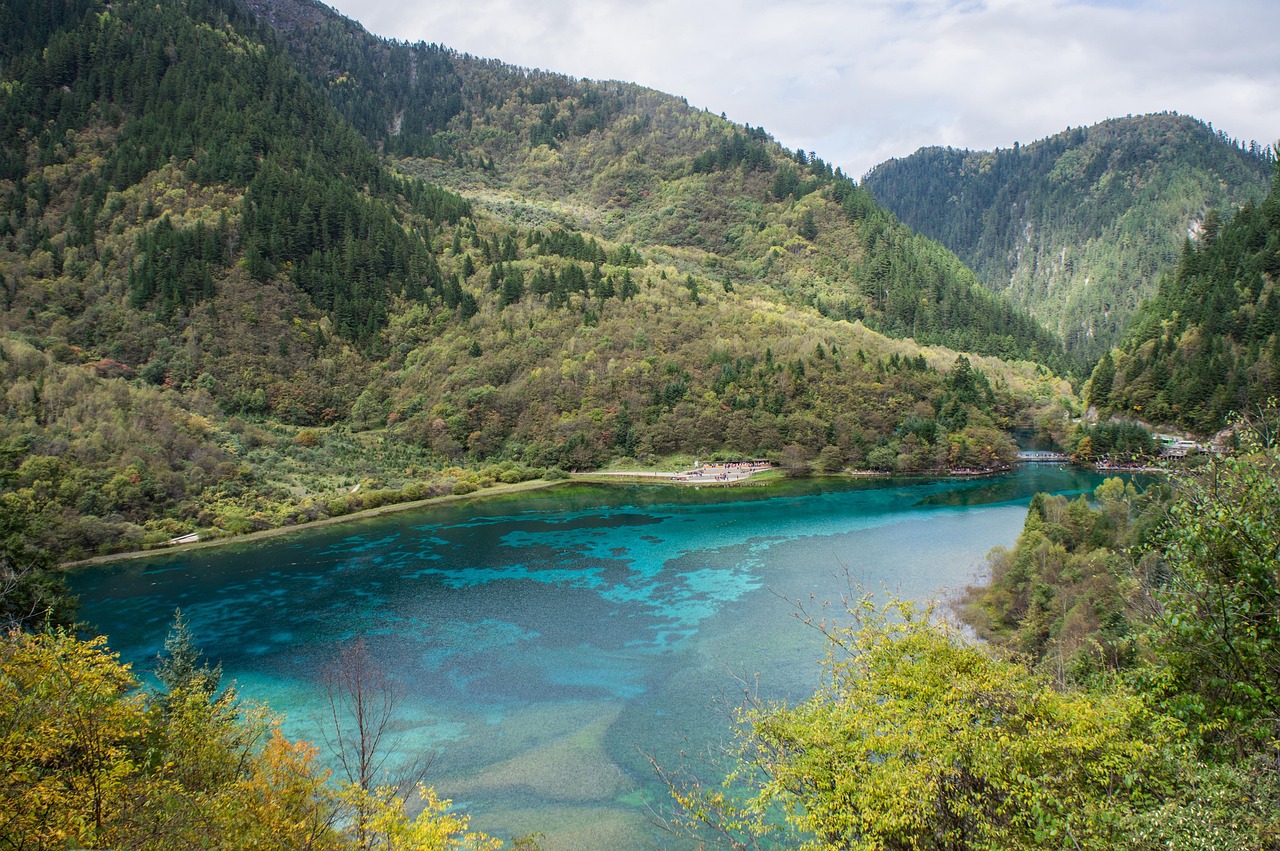
Five Flower Lake (Wuhua Hai), in the Rize valley, is the park’s signature view: a shallow lake where calcareous deposits, algae and sunken tree trunks create patches of blue, green and yellow. Look down on it from the road above, then walk the boardwalk along its shore.
Nuorilang Waterfall
Nuorilang Waterfall, one of the widest travertine waterfalls in China, pours in a broad white curtain over a forested ledge next to the Nuorilang hub. It is at its fullest in summer and freezes into blue curtains in winter.
Pearl Shoal
At Pearl Shoal, water rushes over a broad, gently sloping travertine bed, breaking into bright beads, before plunging over the Pearl Shoal Waterfall. A boardwalk crosses the shoal, and a staircase leads down the side of the fall.
Long Lake and the Five-Color Pond
Long Lake, about 7 km (4 miles) long, fills the head of the Zechawa valley beneath snow peaks; it never drains, fed by snowmelt. A short walk downhill leads to the Five-Color Pond, small, clear and astonishingly colorful.
Arrow Bamboo Lake and Panda Lake
Arrow Bamboo Lake, named for the bamboo that pandas eat, and Panda Lake, below it, with a long, multi-level waterfall, are among the most photographed scenes in Rize.
More classic sights
- Mirror Lake: mirror-still water at dawn.
- Shuzheng Lakes: some 19 terraced lakes, with water mills and prayer flags.
- Primeval Forest: old-growth fir and spruce at the head of Rize, with a boardwalk loop.
- Shuzheng village: a Tibetan village with a white stupa and prayer flags.
Other things to do in Jiuzhaigou
Walking the boardwalks
Most visitors combine the park buses with walks along the boardwalks, which link almost every lake. A classic plan is to ride first to the top of Rize, walk down through the Primeval Forest, Arrow Bamboo Lake and Five Flower Lake to Pearl Shoal, take the bus to Long Lake, and finish by walking the Shuzheng lakes. The official site suggests buses at about 7:00–8:00 and a full day to 17:30. Walking downhill saves effort at this altitude. See our hiking guide.
Tibetan culture and shows
In Zhangzha and the surrounding villages, evening shows present Tibetan and Qiang song and dance, such as the long-running Tibetan Mystery (Zangmi) performance, and some family restaurants offer bonfire dances. The villages of Shuzheng, Heye and Zechawa inside the park still have Tibetan homes, stupas and prayer wheels.
Food and drink
Restaurants in Zhangzha serve Sichuan dishes and Tibetan food: yak meat hotpot and stews, tsampa (roasted barley flour), butter tea, yogurt, barley wine and Tibetan bread. Inside the park, the Nuorilang service center has a large restaurant and shops, and it has the park’s only smoking area; many visitors bring snacks and water.
Day trips from Jiuzhaigou
- Huanglong: a UNESCO World Heritage Site of terraced, mineral-colored travertine pools climbing a valley to about 3,550 m (11,650 ft), about 100 km (62 miles) south near Huanglong Jiuzhai station; often visited on the way in or out.
- Shenxianchi (Fairy Pool): a smaller, quieter area of travertine pools and forests in Jiuzhaigou county.
- Jiawuhai and the panda park: a lake and giant-panda center in Jiuzhaigou county, suggested by the administration as an alternative on sold-out days.
- Songpan: a historic walled town on the old trade route, with horse-trekking outfitters, about 2 hours south.
Nearby destinations
- Chengdu283 km
Getting there and getting around
By train
Since its section to Huangshengguan opened on 30 August 2024, the Chengdu–Xining railway has run high-speed trains from Chengdu East to Huanglong Jiuzhai station, at about 2,977 m (9,767 ft), in as little as 1 hour 39 minutes; up to 30 trains a day serve Huanglong Jiuzhai, Huangshengguan and Songpan. From Huanglong Jiuzhai station it is about 93 km (58 miles), around 2 hours by road, to the Jiuzhaigou entrance, with direct shuttle buses timed to the trains. Book on the 12306 website or app with your passport.
By air
Jiuzhai Huanglong Airport (JZH), near Chuanzhusi in Songpan county, is a high-altitude airport about 88 km (55 miles), or 1.5 hours, from the park entrance, with flights from Chengdu, Chongqing, Beijing, Shanghai, Guangzhou, Xi’an and other cities, and buses to Jiuzhaigou and Huanglong. Winter snow can disrupt flights, so allow a buffer for your return.
By road
Long-distance buses run from Chengdu (about 9–10 hours), Mianyang and Lanzhou. By car, the western route from Chengdu via Wenchuan, Maoxian and Songpan is about 440 km (275 miles); roads through the mountains can close after heavy rain or snow.
Getting around
Inside the park, the bus included with your bus ticket stops at all the main sights; hop on and off as often as you like. Outside, taxis and hotel shuttles connect Zhangzha’s hotels with the entrance.
Visa-free transit
Jiuzhaigou, in the Aba prefecture, is not among the 11 Sichuan cities in the permitted area of the 240-hour visa-free transit, so transit travelers arriving in Chengdu cannot include it; you need a visa or visa-free entry.
When to go and how long to stay
Jiuzhaigou has a cool mountain climate, with big differences between day and night and between the valley floor and the upper lakes. Spring (April–May) brings fresh green leaves and blossoms, with melting snow on the peaks. Summer (June–August) is mild, around 20–23 °C (68–73 °F) by day, with frequent showers and the fullest waterfalls; landslides and debris flows are possible after heavy rain. Autumn (late September–early November) is the classic season, with red, orange and gold forests; colors usually peak in mid- to late October. Winter (December–March) is cold but often sunny, with frozen waterfalls, snow and very few visitors. The table uses the 1991–2020 climate normals for the Songpan station of the China Meteorological Administration (CMA), as submitted to the World Meteorological Organization (WMO), at about 2,880 m (9,450 ft), about 65 km (40 miles) to the south: average daily highs and lows, total precipitation, and days with at least 1 mm of rain or snow. The entrance at Zhangzha is lower and a few degrees milder; Long Lake is similar or colder.
| Month | Average high / low | Rain (days with 1 mm or more) | What to expect |
|---|---|---|---|
| January | 7 °C (44 °F) / −10 °C (14 °F) | 7 mm (0.3 in), 2 days | Cold, sunny and quiet; frozen falls |
| February | 9 °C (49 °F) / −7 °C (20 °F) | 13 mm (0.5 in), 4 days | Cold; Chinese New Year; snow possible |
| March | 12 °C (54 °F) / −3 °C (27 °F) | 34 mm (1.4 in), 9 days | Thaw begins; off-season rotation ends on the 31st |
| April | 15 °C (60 °F) / 1 °C (34 °F) | 68 mm (2.7 in), 12 days | Peak season opens; fresh green |
| May | 18 °C (65 °F) / 5 °C (41 °F) | 119 mm (4.7 in), 17 days | Spring flowers; rain increases |
| June | 20 °C (68 °F) / 8 °C (47 °F) | 119 mm (4.7 in), 16 days | Green and showery |
| July | 23 °C (73 °F) / 10 °C (50 °F) | 99 mm (3.9 in), 13 days | Warm days; summer crowds |
| August | 23 °C (73 °F) / 10 °C (49 °F) | 84 mm (3.3 in), 11 days | Showers; full waterfalls |
| September | 20 °C (67 °F) / 7 °C (45 °F) | 105 mm (4.1 in), 13 days | Clearing; colors begin late |
| October | 15 °C (58 °F) / 3 °C (37 °F) | 78 mm (3.1 in), 13 days | Peak autumn colors; National Day crowds |
| November | 11 °C (52 °F) / −4 °C (25 °F) | 14 mm (0.6 in), 4 days | Last colors; off-season from the 16th |
| December | 8 °C (47 °F) / −9 °C (16 °F) | 4 mm (0.2 in), 1 day | Cold and dry; winter scenery |
Songpan receives about 740 mm (29 in) of precipitation a year, most of it from April to October.
One day in Jiuzhaigou
Take one of the first buses to the Primeval Forest, walk down Rize past Arrow Bamboo, Panda and Five Flower lakes to Pearl Shoal and Mirror Lake, have lunch at Nuorilang, take the bus to Long Lake and the Five-Color Pond, then finish with the Shuzheng lakes on the way out.
Three days with Huanglong
Arrive by train at Huanglong Jiuzhai and visit Huanglong on the way; spend a full day in Jiuzhaigou; on day three, visit Shenxianchi or Songpan, or return to Chengdu by train.
Where to stay near Jiuzhaigou
Hotels cluster in Zhangzha, by the entrance: from guesthouses and Tibetan-style inns to large resort hotels along the road; this is the most convenient base for an early start. Jiuzhaigou county town, about 40 km (25 miles) away, has cheaper rooms. Near the railway, hotels at Chuanzhusi and Songpan suit visits to Huanglong. Book early for autumn and the national holidays, when prices rise sharply. Choose licensed accommodation: the authorities have penalized unlicensed homestays near the park.
What a trip to Jiuzhaigou costs
Prices are approximate, for October 2026, converted at about 6.74 yuan to the US dollar.
| Item | Typical cost |
|---|---|
| Entrance ticket, peak season (1 April–15 November) | 190 CNY (about US$28) |
| Park bus, peak season | 90 CNY (about US$13) |
| Entrance and park bus, off-season | 80 + 80 CNY (about US$12 + 12) |
| Optional insurance | 10 CNY (about US$1.50) |
| High-speed train, Chengdu East–Huanglong Jiuzhai | about 150–250 CNY (about US$22–37) second class |
| Lunch at Nuorilang or in Zhangzha | 50–100 CNY (about US$7–15) |
| Mid-range hotel double in Zhangzha, per night | 300–800 CNY (about US$45–119), more in October |
Practical tips for Jiuzhaigou
- Book early: reserve your date on the official mini program with your passport as soon as your plans are fixed; holiday dates sell out.
- Start early: take one of the first buses to beat the tour groups; entry closes at 14:00.
- Stay on the boardwalks: leaving the boardwalks, wading, swimming, feeding fish, smoking (outside Nuorilang’s smoking area) and drones are banned.
- Avoid national holidays: early October and May Day bring the daily maximum of 41,000 visitors.
- Dress in layers: mornings and the upper valleys are cold even in summer.
- Check official notices: heavy rain can close sections at short notice.
Safety
Jiuzhaigou lies at about 2,000–3,100 m (6,560–10,170 ft), so mild altitude symptoms such as headaches and breathlessness are common, especially for visitors arriving fast by plane or train; the administration advises getting enough sleep before the trip, walking slowly, avoiding strenuous exercise and not drinking large amounts of water at once, and going down or seeing a doctor if you feel unwell. The region is seismically active: the 2017 earthquake struck the park directly, and landslides and debris flows follow heavy rain in summer, as in July 2026. Stay away from cliffs, unstable slopes and low-lying areas, do not linger on hazardous stretches, follow staff instructions and evacuation signs, and check notices on rainy days. Boardwalks are slippery when wet or icy; mind your step and hold children’s hands near water. Weather changes quickly in the mountains, with strong sun at altitude and cold mornings. Crowds at bus stops are heavy at peak times; queue patiently. Medical help is available through the park’s rescue line and in Zhangzha. In an emergency, call 110 for police, 120 for an ambulance and 119 for fire.
What to pack for Jiuzhaigou
Layers (a fleece and a warm jacket even in summer, a down jacket in autumn and winter), a waterproof jacket, comfortable non-slip walking shoes, sunglasses, a hat and sunscreen, a refillable water bottle, snacks and your passport for booking and entry. China uses 220 V, with flat two-pin, round two-pin and angled three-pin sockets. See our hiking shoes, rain jackets and travel adapters guides.
Jiuzhaigou travel FAQ
How much is the Jiuzhaigou ticket in 2026?
In peak season (1 April to 15 November) the entrance ticket is 190 yuan plus 90 yuan for the compulsory park bus; in the off-season, 80 yuan plus 80 yuan.
Do I need to book Jiuzhaigou in advance?
Yes. All visitors must make a real-name booking on the official mini program or WeChat account and enter with the same passport or ID.
How many visitors are allowed in Jiuzhaigou each day?
Up to 41,000 a day in peak season and 23,000 in the off-season; holiday dates sell out.
Is Jiuzhaigou fully open after the 2017 earthquake?
According to the administration, the whole scenic area is open as of October 2026, after a full reopening on 30 July 2026 following a short closure caused by a debris flow. Some features changed permanently after 2017.
Can I stay overnight inside Jiuzhaigou?
No. Overnight stays inside the park are not allowed; hotels are in Zhangzha and the county town.
How do I get from Chengdu to Jiuzhaigou?
By high-speed train from Chengdu East to Huanglong Jiuzhai station in as little as 1 hour 39 minutes, then about 2 hours by shuttle bus; by air to Jiuzhai Huanglong Airport; or by bus in about 9–10 hours.
What is the best time to visit Jiuzhaigou?
Late September to early November for autumn colors; summer for full waterfalls; winter for snow and few visitors.
Is one day enough for Jiuzhaigou?
One full day covers the main lakes in all three valleys if you start early; add a day for Huanglong.
Is altitude a problem in Jiuzhaigou?
The park lies at about 2,000–3,100 m (6,560–10,170 ft); most people feel fine, but take it slowly and avoid strenuous exercise.
Can I use the 240-hour visa-free transit for Jiuzhaigou?
No. Jiuzhaigou is not in the permitted area for Sichuan, which covers Chengdu and ten other cities.
Sources and last review
Researched and last reviewed on 5 October 2026. The peak and off-season entrance and bus prices, optional insurance, daily maximums of 41,000 and 23,000 visitors, real-name booking channels, waitlist and ticket releases, entry and closing times, seasonal rotation, the no-overnight rule, the ban on drones and wading, the full reopening on 1 April 2026, the debris flow of 26 July 2026 and reopening on 30 July 2026, the altitude range of the scenic area and safety notices, the valley layout and the suggested routes: the Jiuzhaigou Administration’s official website (jiuzhai.com), including its notices of November 2025, March, July, September and October 2026; the Chengdu–Xining railway, Huanglong Jiuzhai station, train times and distances to the park, the airport, bus routes and road distances: the same site’s transport page; visa-free transit and the Sichuan permitted area: the National Immigration Administration; train booking with a passport: China Railway’s official 12306 site; climate normals: the China Meteorological Administration via the World Meteorological Organization’s 1991–2020 normals (Songpan station, the nearest in the series); the exchange rate: the CFETS central parity rate; the inscription: the UNESCO World Heritage List. Details of earthquake damage and staged reopenings, lake and waterfall dimensions, Huanglong’s altitude, autumn timing and typical prices are general references or estimates, flagged for checking. Prices and rules change, so check locally before you go. For entry rules, money and general safety, see our China travel guide.
Plan your trip
Partner links: TravelerCenter may earn a commission if you book, at no extra cost to you.
🇨🇳 Useful Mandarin Chinese phrases for Jiuzhaigou
All 38 Mandarin Chinese phrases: restaurant, hotel, emergencies, romance (printable) →