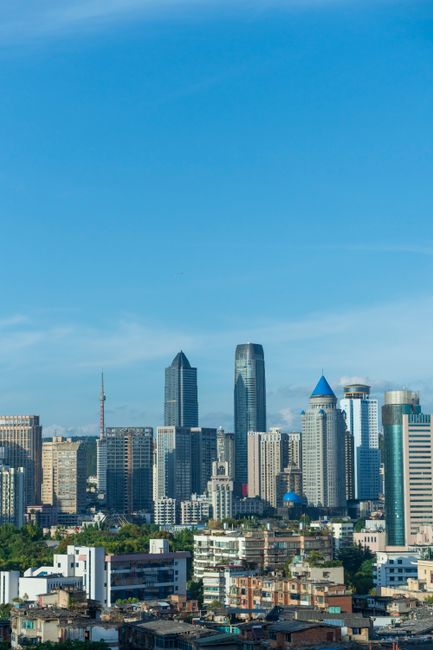
Chengdu, the capital of Sichuan province in the fertile basin of southwest China, is famous for two things above all: giant pandas and fiery food. On its northern edge, the Chengdu Research Base of Giant Panda Breeding lets you watch dozens of pandas munching bamboo, climbing and sleeping in leafy enclosures, best at breakfast time. In the city, life moves at a famously relaxed pace: locals spend afternoons in bamboo chairs at the teahouses of People’s Park, play mahjong on the sidewalks and gather in hotpot restaurants late into the night. Chengdu was named a UNESCO City of Gastronomy in 2010, and Sichuan cooking, with its numbing Sichuan pepper and chili, is reason enough to come: mapo tofu, dandan noodles, kung pao chicken and bubbling hotpot. Add the Buddhist Wenshu Monastery, the restored lanes of Kuanzhai Xiangzi and Jinli, the poet Du Fu’s thatched cottage, the gold mask of the Jinsha site, Sichuan opera with its “face-changing,” and day trips to the Leshan Giant Buddha, Mount Emei and the ancient Dujiangyan irrigation system. The panda base sells tickets by real-name online booking, up to 14 days ahead. The best months are March to June and September to November.
Right now in Chengdu
- Wed 16–25°C 60–77°F Mostly clear
- Thu 17–25°C 63–77°F 1 mm Partly cloudy
- Fri 19–23°C 66–73°F 2 mm Partly cloudy
Weather: MET Norway (CC BY 4.0)
Top tours in Chengdu
See all tours for Chengdu →
From local operators, with prices and reviews; you check availability and book on Viator, our partner. We may earn a commission at no extra cost to you. How we earn money
Chengdu at a glance
- Best for: giant pandas, Sichuan food and hotpot, teahouses, temples, Sichuan opera and trips to Leshan and Mount Emei.
- How long: 3 days for the city and pandas; 5–6 with Leshan, Mount Emei or Dujiangyan.
- Best time: March to June and September to November; July and August are hot, humid and wet, and winters cool and gray.
- Getting there: by air to Chengdu Tianfu (TFU) or Shuangliu (CTU), or by high-speed train from Chongqing, Xi’an, Beijing and Guangzhou.
- Getting around: by metro, which covers both airports and most sights, and by taxi or DiDi.
- Good to know: arrive at the panda base at opening time, when the pandas are most active.
- Before you go: visa-free entry, the 240-hour transit, the arrival card, payments and general safety are in our China travel guide.
Chengdu’s areas and where to stay
Chengdu is laid out in rings around Tianfu Square, with the Funan and Jin rivers curving through the center. Most sights are within the Second Ring Road, and the metro reaches the rest.
Chunxi Road and Taikoo Li
The modern heart of the city, east of Tianfu Square: the shopping streets of Chunxi Road, the open-air Sino-Ocean Taikoo Li district around the old Daci Temple, the IFS mall with its giant panda climbing the wall, and international and boutique hotels. It is the most convenient base for food and nightlife.
Kuanzhai Xiangzi and People’s Park
West of the center, around the restored Qing-dynasty lanes of Kuanzhai Xiangzi (the Wide and Narrow Alleys) and People’s Park, hotels and courtyard guesthouses sit in leafy streets close to teahouses and the Qingyang Palace.
Wenshu Monastery area
North of Tianfu Square, the streets around Wenshu Monastery have traditional-style buildings, vegetarian restaurants, teahouses and hostels, and are the closest central area to the panda base.
Jinli and Wuhou
South of the center, around the Wuhou Shrine and Jinli Ancient Street, the area has mid-range hotels, Tibetan shops and restaurants, and easy access to the Jiuyan Bridge bar area on the river.
Where to stay in Chengdu
- Chunxi Road and Taikoo Li: international and boutique hotels, food and shopping.
- Kuanzhai Xiangzi and People’s Park: courtyard hotels and teahouse atmosphere.
- Wenshu Monastery: traditional streets and budget hotels, closest to the pandas.
- Jinli and Wuhou: mid-range hotels near the shrine and the river bars.
- Near Chengdu East station: business hotels for early trains.
Rooms fill during the May Day and National Day holidays and at big events.
Top things to see in Chengdu
The giant panda base
The Chengdu Research Base of Giant Panda Breeding, about 10 km (6 miles) north of the center on Panda Avenue, combines a breeding center with a large landscaped park of bamboo groves, lakes and enclosures for giant pandas, red pandas and other animals; the nurseries, where cubs are cared for after the summer breeding season, are the star attraction in autumn. According to the base, all visitors must make an online real-name reservation and show the same original ID, such as a passport, at the gate; tickets can be reserved up to 14 days in advance through the base’s official WeChat account or mini-program, or authorized platforms such as Trip.com, and sell out on busy days. Adult tickets cost 55 yuan, with student tickets at 27 yuan, and visitors aged 60 and over enter free without booking. Tickets are for a morning or afternoon slot: from March to October, morning entry runs from 7:30 to 12:00 and afternoon entry from 12:00 to 17:00, and from November to February from 8:00 and until 16:30. The pandas are most active at feeding time in the early morning, and they sleep through the afternoon heat, so book a morning slot and arrive at opening. Electric sightseeing carts run around the park, and the daily capacity is 85,000. The base also runs Panda Valley near Dujiangyan, where pandas are prepared for life in the wild.
People’s Park and the teahouses
People’s Park is where Chengdu relaxes: the Heming Teahouse by the lake serves jasmine and green tea in lidded cups, while ear cleaners, masseurs and shoe shiners make their rounds; in the mornings, locals dance, sing and practice calligraphy with water on the paving. The park also has a “marriage market,” where parents post details of their unmarried children.
Wenshu Monastery
The Wenshu Monastery, Chengdu’s best-preserved Buddhist temple, dates from the Tang dynasty and was rebuilt in the Qing; its incense-filled halls, a thousand-Buddha peace pagoda and gardens are active with worshippers, and its vegetarian restaurant and teahouse are popular. Entry is free; dress modestly.
Kuanzhai Xiangzi and Jinli
The Wide and Narrow Alleys (Kuanzhai Xiangzi) are three parallel lanes of restored Qing courtyard houses, now teahouses, snack shops, bars and boutiques, busy in the evening. Jinli Ancient Street, next to the Wuhou Shrine, is a lantern-lit lane of food stalls, crafts and teahouses.
Wuhou Shrine and Du Fu Thatched Cottage
The Wuhou Shrine honors Zhuge Liang, the strategist of the Three Kingdoms era, and Liu Bei, ruler of the kingdom of Shu, with statues of heroes from the classic novel. The Du Fu Thatched Cottage, a park of bamboo, ponds and halls on the site where the Tang poet lived in the 8th century, is one of the city’s most peaceful places.
Jinsha Site Museum
The Jinsha Site Museum preserves the excavation of a capital of the ancient Shu kingdom, about 3,000 years old, with ivory, jade and gold, including the Golden Sun Bird disc that became the symbol of Chinese cultural heritage. It complements the Sanxingdui Museum north of the city.
More classic sights
- Qingyang Palace: the city’s largest Taoist temple, next to the Culture Park.
- Chengdu Museum and Tianfu Square: the city’s history and puppetry collections on the central square.
- Sichuan Museum: bronzes, Buddhist sculpture and Han-dynasty tomb figures near Du Fu’s cottage.
- Anshun Bridge and the Jiuyan Bridge: the river by night, with bars and lights.
- Tibetan quarter: shops and restaurants around the Wuhou Shrine.
Other things to do in Chengdu
Food and drink
Sichuan cooking is about málà, the numbing tingle of Sichuan pepper with the heat of chili, but also sweet, sour and smoky flavors. Try hotpot, a bubbling pot of chili and tallow broth (ask for a split yuanyang pot with a mild side) in which you cook meat, tofu and vegetables; chuanchuan, skewers cooked in a communal pot; mapo tofu; dandan noodles; kung pao chicken; twice-cooked pork; zhong dumplings in sweet chili oil; longchaoshou wontons; spicy rabbit heads for the adventurous; and sweet rice cakes. Jasmine tea in a teahouse cools you down, and the city has a lively craft beer and cocktail scene. Cooking classes teach Sichuan basics.
Sichuan opera
Sichuan opera is known for bian lian (face-changing), where performers switch masks in a split second, along with fire-spitting, puppetry and comic sketches; short shows for visitors run nightly at teahouses such as Shufeng Yayun in the Culture Park.
Festivals
The Chengdu Lantern Festival around Chinese New Year fills parks with giant illuminated figures, and temple fairs are held at Wuhou Shrine and Qingyang Palace. See our city sightseeing and hiking guides.
Day trips from Chengdu
- Leshan Giant Buddha: the largest stone Buddha in the world, 71 m (233 ft) tall, carved into a cliff at the meeting of three rivers in the 8th century; about 1 hour by high-speed train to Leshan, then a bus. See it on foot down the cliff stairway or from a boat on the river. A UNESCO site with Mount Emei.
- Mount Emei: one of China’s four sacred Buddhist mountains, 3,099 m (10,167 ft) high, with temples, monkeys, forest trails and the Golden Summit, reached by bus and cable car; about 1.5 hours by train to Emeishan. Best overnight.
- Dujiangyan and Mount Qingcheng: a 2,200-year-old irrigation system still in use, and a forested Taoist mountain, about 1 hour by train; a UNESCO site.
- Sanxingdui Museum: the extraordinary bronze masks and figures of a Bronze Age culture, in Guanghan, about 1 hour north.
- Huanglongxi: an old riverside town of wooden houses, about 1 hour south.
- Chongqing: about 1–1.5 hours by high-speed train.
Leshan and Mount Emei lie within the Sichuan area permitted for 240-hour visa-free transit visitors; Jiuzhaigou and the Tibetan areas of western Sichuan do not.
Nearby destinations
- Chongqing265 km
- Jiuzhaigou283 km
Getting there and getting around
By air
Chengdu has two airports, both designated ports for the 240-hour visa-free transit, with a permitted area covering Chengdu and 10 other Sichuan cities. Chengdu Tianfu International Airport (TFU), opened in 2021 about 50 km (30 miles) southeast of the center, handles most international flights; metro Line 18 runs to the city in about 40–60 minutes. Chengdu Shuangliu International Airport (CTU), about 16 km (10 miles) southwest, handles mostly domestic flights and is on metro Line 10. A taxi from Tianfu takes about an hour.
By train
Chengdu East is the main high-speed station, with trains to Chongqing (about 1–1.5 hours), Xi’an (about 3–4 hours), Beijing, Shanghai and Guangzhou; Chengdu South serves Leshan and Emeishan, and Chengdu West and Xipu the trains to Dujiangyan and Qingcheng. Book on the 12306 website or app with your passport.
Around town
The metro is extensive and cheap, with English signs; pay with Alipay or WeChat Pay QR codes or a Tianfu Tong card. For the panda base, take metro Line 3 to Panda Avenue and a short shuttle bus, or a taxi or DiDi from the center in about 30 minutes. Taxis and shared bikes are plentiful, and the riverside paths are good for walking.
When to go and how long to stay
Chengdu has a humid subtropical climate, famous for its overcast skies: sunny days are relatively rare, and mist often hangs over the basin. Spring (March–May) is mild and green, with blossom and pleasant temperatures. Summer (June–August) is hot and very humid, with highs around 28–30 °C (83–86 °F) and heavy rain, mostly at night, in July and August. Autumn (September–November) is mild, with ginkgo trees turning gold in November. Winter (December–February) is cool and gray, rarely freezing, but damp, with limited indoor heating. The table uses the 1991–2020 climate normals for the Wenjiang station of the China Meteorological Administration (CMA), in Chengdu’s western suburbs, as submitted to the World Meteorological Organization (WMO): average daily highs and lows, total precipitation, and days with at least 1 mm of rain.
| Month | Average high / low | Rain (days with 1 mm or more) | What to expect |
|---|---|---|---|
| January | 9 °C (49 °F) / 3 °C (37 °F) | 8 mm (0.3 in), 3 days | Cool, gray and damp; lanterns |
| February | 12 °C (54 °F) / 5 °C (41 °F) | 11 mm (0.4 in), 4 days | Cool; Chinese New Year |
| March | 17 °C (62 °F) / 8 °C (47 °F) | 24 mm (0.9 in), 6 days | Mild; blossom; very pleasant |
| April | 23 °C (72 °F) / 13 °C (55 °F) | 45 mm (1.8 in), 8 days | Warm and green; excellent |
| May | 26 °C (79 °F) / 17 °C (63 °F) | 78 mm (3.1 in), 10 days | Warm; showers increase |
| June | 28 °C (83 °F) / 21 °C (69 °F) | 110 mm (4.3 in), 11 days | Hot and humid |
| July | 30 °C (86 °F) / 22 °C (72 °F) | 232 mm (9.1 in), 12 days | The wettest month; hot |
| August | 30 °C (86 °F) / 22 °C (71 °F) | 217 mm (8.5 in), 12 days | Hot, humid and rainy |
| September | 26 °C (78 °F) / 19 °C (66 °F) | 121 mm (4.8 in), 11 days | Mild; frequent drizzle |
| October | 21 °C (69 °F) / 15 °C (58 °F) | 43 mm (1.7 in), 8 days | Mild; Golden Week crowds |
| November | 16 °C (61 °F) / 10 °C (49 °F) | 15 mm (0.6 in), 4 days | Cool; golden ginkgo leaves |
| December | 11 °C (51 °F) / 4 °C (40 °F) | 6 mm (0.2 in), 2 days | Cool and gray; quiet |
Chengdu receives about 910 mm (36 in) of rain a year, half of it in July and August.
Three days in Chengdu
Day one, the panda base at opening, then Wenshu Monastery for a vegetarian lunch, People’s Park teahouse in the afternoon and hotpot for dinner. Day two, the Wuhou Shrine and Jinli, Du Fu Thatched Cottage and the Kuanzhai Xiangzi in the evening, with a Sichuan opera show. Day three, a day trip to the Leshan Giant Buddha.
Five days or more
Add Mount Emei with a night on the mountain, Dujiangyan and Mount Qingcheng, or the Sanxingdui Museum, then continue to Chongqing or Xi’an by high-speed train.
What a trip to Chengdu costs
Prices are approximate, for October 2026, converted at about 6.74 yuan to the US dollar.
| Item | Typical cost |
|---|---|
| Panda base ticket, adult | 55 CNY (about US$8.20) |
| Hotpot dinner | 80–150 CNY (about US$12–22) per person |
| Bowl of dandan noodles | 12–25 CNY (about US$1.80–3.70) |
| Tea in People’s Park | 15–40 CNY (about US$2.20–5.90) |
| Sichuan opera show | about 150–300 CNY (about US$22–45) |
| High-speed train to Leshan, second class | about 50–60 CNY (about US$7.40–8.90) |
| Leshan Giant Buddha ticket | about 80 CNY (about US$12) |
| Mid-range hotel double, per night | 350–700 CNY (about US$52–104) |
Practical tips for Chengdu
- Book the pandas early: reserve a morning slot up to 14 days ahead and arrive at opening; bring the passport you booked with.
- Pace the spice: ask for wēi là (mildly spicy) or a split hotpot, and keep soy milk or tea at hand.
- Expect gray skies: bring an umbrella from June to September.
- Use the metro to Tianfu airport: it is far from the center; allow time.
- Plan day trips by train: buy Leshan and Emei tickets early at weekends.
- Dress for temples: cover shoulders and knees at Wenshu and on Mount Emei.
Safety
Chengdu is a safe, easygoing city, and violent crime against visitors is rare. Watch for pickpockets in crowded places such as Chunxi Road, Kuanzhai Xiangzi and the metro, and ignore touts at the panda base and Leshan offering tickets, “fast-track entry” or tours; the panda base itself warns against unofficial sellers. Traffic is heavy, and electric scooters ride on sidewalks and against the flow, so look carefully when crossing. In summer, heavy rain can flood streets and cause landslides in the mountains west of the city, and the heat and humidity are tiring: follow local alerts and forecasts. Air quality can be poor on some winter days. Sichuan is an earthquake zone. On Mount Emei, the monkeys are aggressive: keep food out of sight and don’t feed them. Carry your passport for tickets, trains and police checks. In an emergency, call 110 for police, 120 for an ambulance and 119 for fire.
What to pack for Chengdu
Comfortable walking shoes, an umbrella or light rain jacket from May to September, breathable clothes for the humid summer, layers and a warm jacket for damp winters, modest clothes for temples, warm layers and good shoes for Mount Emei, where the summit is cold even in summer, and stomach remedies for the spice. China uses 220 V, with flat two-pin, round two-pin and angled three-pin sockets. See our rain jackets and travel adapters guides.
Chengdu travel FAQ
How do I book the Chengdu panda base?
Online with real names, up to 14 days ahead, through the base’s official WeChat account or mini-program or authorized platforms such as Trip.com. Show the same passport at the gate.
How much is the panda base ticket?
55 yuan for adults and 27 yuan for students; visitors aged 60 and over enter free without a reservation.
What is the best time to see pandas in Chengdu?
Early morning, at feeding time, when pandas are most active; book a morning slot and arrive at opening. In hot weather they rest in air-conditioned indoor enclosures.
How do I get to the panda base?
By metro Line 3 to Panda Avenue and a short shuttle bus, or by taxi or DiDi from the center in about 30 minutes.
How many days do I need in Chengdu?
Three days for the pandas, teahouses, temples and food; five or more to add Leshan, Mount Emei or Dujiangyan.
How do I get from Chengdu to the Leshan Giant Buddha?
By high-speed train from Chengdu East or Chengdu South to Leshan in about an hour, then by bus or taxi to the scenic area.
Is Sichuan food very spicy?
Often, yes, with chili and numbing Sichuan pepper, but many dishes are mild or sweet. Ask for mild (wēi là) or a split hotpot.
What is the best time to visit Chengdu?
March to June and September to November. Summers are hot, humid and wet, and winters cool and gray.
Can I use the 240-hour visa-free transit in Chengdu?
Yes. Tianfu and Shuangliu airports are designated ports, and you can travel in Chengdu and 10 other Sichuan cities, including Leshan, and other permitted areas.
How do I get from Chengdu to Chongqing?
By high-speed train from Chengdu East to Chongqing in about 1–1.5 hours, with frequent departures.
Sources and last review
Researched and last reviewed on 4 October 2026. Panda base ticket prices, real-name booking, the 14-day window, booking channels, morning and afternoon slots, hours, free entry for over-60s, the 85,000 daily cap and Panda Valley: the Chengdu Research Base of Giant Panda Breeding’s official pages; visa-free transit ports and the 11 permitted Sichuan cities: the National Immigration Administration; train booking with a passport: China Railway’s official 12306 site; climate normals: the China Meteorological Administration via the World Meteorological Organization’s 1991–2020 normals (Wenjiang station); the exchange rate: the CFETS central parity rate. Distances, metro access, airport links, train times, the UNESCO gastronomy title, Leshan and Emei details, temple history and typical prices are general references or estimates, flagged for checking. Prices and rules change, so check locally before you go. For entry rules, money and general safety, see our China travel guide.
Plan your trip
Partner links: TravelerCenter may earn a commission if you book, at no extra cost to you.
🇨🇳 Useful Mandarin Chinese phrases for Chengdu
All 38 Mandarin Chinese phrases: restaurant, hotel, emergencies, romance (printable) →