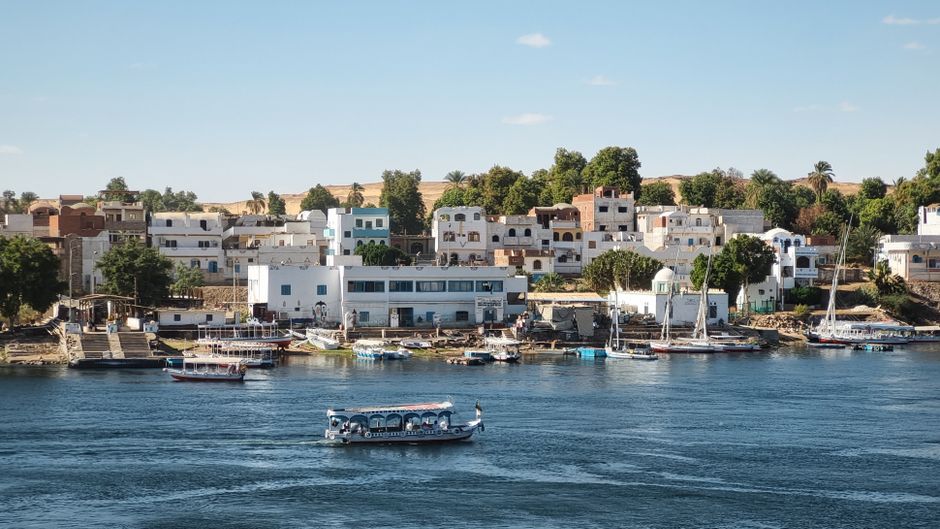
Aswan, Egypt’s southernmost city, sits where the Nile squeezes between granite boulders and golden dunes at the First Cataract, about 200 km (125 miles) south of Luxor. For thousands of years it was Egypt’s frontier with Nubia and a trading post for gold, ivory and the granite used for obelisks and colossal statues. Today it is the most relaxed and beautiful town on the Nile: white-sailed feluccas tack between Elephantine Island and the botanical gardens of Kitchener’s Island, colorful Nubian villages line the west bank under the dunes, and the domed tombs of nobles and the ruined Monastery of St Simeon look down from the desert. Just upstream, the island temple of Philae, dedicated to Isis and rescued from the rising waters by UNESCO, is one of Egypt’s loveliest sights, and beyond the High Dam stretches Lake Nasser. Aswan is also the base for the great temples of Abu Simbel, 280 km (174 miles) to the south, and the starting or finishing point of most Nile cruises to Luxor, with stops at Kom Ombo and Edfu. Plan two or three nights. The best months are October to April; summer is among the hottest anywhere in Egypt.
Right now in Aswan
- Wed 23–35°C 73–94°F Partly cloudy
- Thu 23–37°C 73–99°F Partly cloudy
- Fri 27–39°C 80–101°F Clear
- Today Armed Forces Day (عيد القوات المسلحة)
Weather: MET Norway (CC BY 4.0) · Holidays: Nager.Date
Top tours in Aswan
See all tours for Aswan →
From local operators, with prices and reviews; you check availability and book on Viator, our partner. We may earn a commission at no extra cost to you. How we earn money
Aswan at a glance
- Best for: felucca sails, Philae, Abu Simbel, Nubian culture, the Nile scenery and slow evenings.
- How long: 2 days, or 3 with Abu Simbel.
- Best time: October to April; from May to September, highs average about 39–42 °C (102–107 °F).
- Getting there: fly into Aswan (ASW), take the sleeper or day train from Cairo, Giza or Luxor, or a Nile cruise from Luxor.
- Getting around: on foot along the Corniche, by public ferry, felucca, motorboat and taxi.
- Good to know: Abu Simbel means a pre-dawn start; pay for site tickets by card.
- Before you go: visas, money and general safety are in our Egypt travel guide.
Aswan’s areas and where to stay
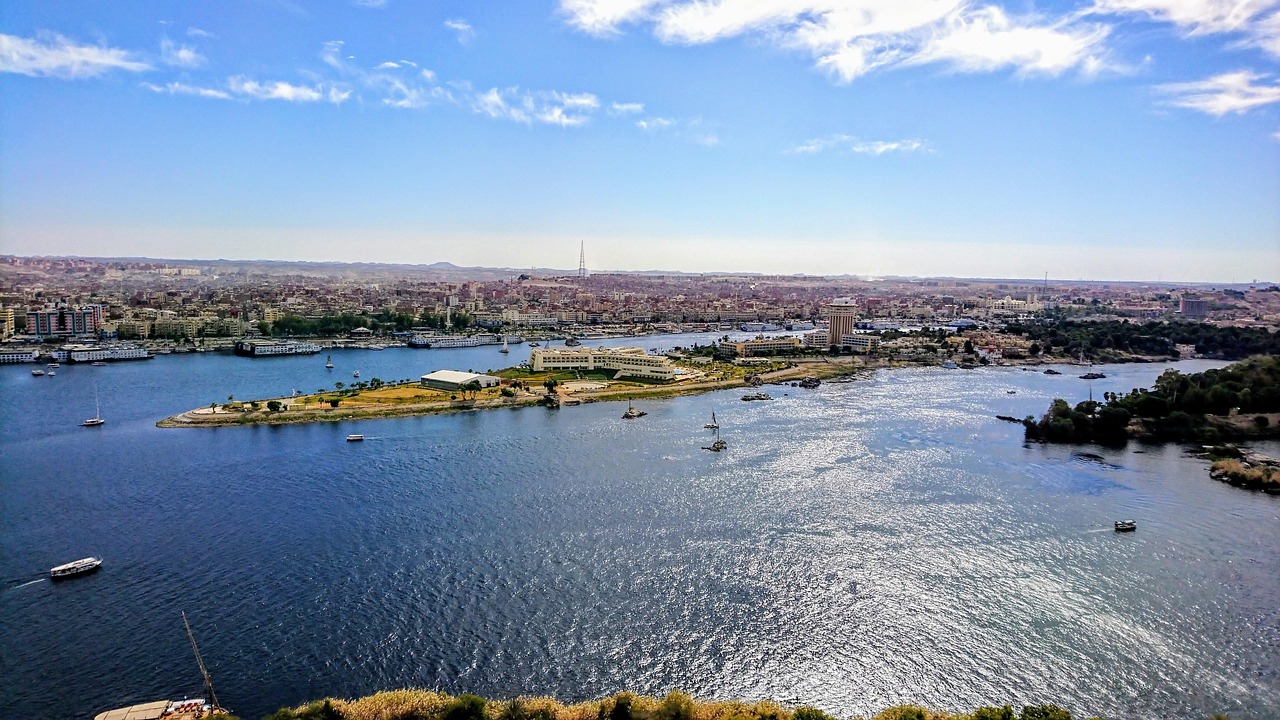
The town stretches along the east bank of the Nile, with the Corniche, the souk and the railway station. Opposite are Elephantine Island and the west bank, with Nubian villages and the desert hills.
The Corniche and the center
The Corniche has mid-range and budget hotels, felucca landings and the ferries, and the souk runs parallel behind it toward the station. Most cruise boats moor along the riverbank.
The south end: the Old Cataract
At the southern end of the Corniche, the historic Old Cataract hotel, where Agatha Christie wrote part of “Death on the Nile”, sits on a granite bluff above the river, near the Nubia Museum and the Fatimid cemetery.
Elephantine Island and the islands
Elephantine Island has two Nubian villages, guesthouses with river views, and a big resort hotel at its northern tip. Other islands have their own resorts reached by private boat.
The west bank: Nubian villages
Villages such as Gharb Soheil, upstream, have brightly painted guesthouses with domed rooms, rooftop terraces and home-cooked Nubian food; they are peaceful but a boat ride from town.
Where to stay in Aswan
- The Corniche: central and convenient for the station and the souk.
- Elephantine Island: quiet guesthouses a short ferry ride from town.
- Nubian villages: colorful guesthouses and a taste of village life.
- Luxury on the river: the Old Cataract and island resorts.
Top things to see in Aswan
Philae Temple
The Temple of Isis at Philae was one of the last places where the ancient Egyptian religion was practiced, into the 6th century AD. When the old Aswan Dam flooded the island for much of the year, and then the High Dam threatened to submerge it entirely, UNESCO and Egypt dismantled the complex block by block in the 1970s and rebuilt it on the higher island of Agilkia. The temple, with its graceful colonnades, pylons, the kiosk of Trajan and Christian crosses carved into the reliefs, is reached by a short motorboat ride from the Marina Philae landing at Shellal; the boat is paid separately. According to the Ministry of Tourism and Antiquities, the ticket costs EGP 550 (about US$10.50) for foreign adults and EGP 275 for students, and the site opens at 7 a.m. with last entry at 3 p.m. An evening sound and light show is held on the island.
Felucca sails and the islands
The best way to see Aswan is from a felucca. A one- to three-hour sail takes you around Elephantine Island, past the rocks of the cataract and the domed Mausoleum of the Aga Khan, to Kitchener’s Island, a botanical garden of tropical trees. Agree the price for the whole boat and the route before you board. See our boat trips guide.
Elephantine Island
On the southern tip of Elephantine (EGP 200 for the archaeological area), excavations of ancient Yebu include the reconstructed Temple of Khnum, the small Aswan Museum and an ancient nilometer, used to measure the river’s flood. The two Nubian villages are good for a stroll.
The Nubia Museum
The Nubia Museum (EGP 400), set in a garden on a hill south of the center, tells the story of Nubia from prehistory to the villages drowned by Lake Nasser, with statues, jewelry, a model of a Nubian house and the international campaign that saved Abu Simbel and Philae. The ministry lists it as open from 9 a.m. to 4 p.m., with extra evening hours on Thursdays and Fridays.
The Unfinished Obelisk
In an ancient granite quarry in town lies the Unfinished Obelisk (EGP 220): had it been completed, it would have been about 42 m (138 ft) tall, the largest ever cut, but it cracked and was abandoned still attached to the bedrock.
The west bank: tombs and monastery
On the hill of Qubbet el-Hawa, the rock-cut Tombs of the Nobles of the Old and Middle Kingdoms have views over the whole river. Farther south, the fortified Monastery of St Simeon (EGP 100), founded in the 7th century, stands alone in the desert; walk up from the river or ride a camel.
Nubian villages
A visit to a Nubian village such as Gharb Soheil, by boat, is a highlight for many visitors: painted houses, markets, henna, and Nubian tea and dinner in a family home. It is popular and quite commercial, but the colors and hospitality are real.
The High Dam and Kalabsha
The High Dam, completed in 1970, holds back Lake Nasser, one of the world’s largest artificial lakes, and ended the annual Nile flood. The viewpoint on top is mainly of engineering interest. Near it, on an island in the lake, the relocated Temple of Kalabsha (EGP 200) is quiet and rewarding, with the kiosk of Qertassi and the rock temple of Beit el-Wali.
Abu Simbel
The two rock-cut temples of Abu Simbel, carved by Ramesses II around 1260 BC near the Sudanese border, are among the most famous monuments in Egypt. Four 20 m (66 ft) seated statues of Ramesses guard the Great Temple, and inside, eight more colossi line the hall, leading to a sanctuary where the king sits with three gods. Next to it, the smaller temple honors his queen, Nefertari, and the goddess Hathor. Between 1964 and 1968, an international campaign led by UNESCO cut both temples into blocks and rebuilt them 65 m (213 ft) higher, away from the waters of Lake Nasser. Twice a year, on about October 22 and February 22, the rising sun shines along the full length of the Great Temple to light up the statues in the sanctuary, an event that draws big crowds.
According to the Ministry of Tourism and Antiquities’ ticket site, the standard ticket costs EGP 822 (about US$16) for foreign adults and EGP 445.50 for students, and EGP 1,272 on the two sun festival days; the site opens at 6 a.m. Abu Simbel is about 280 km (174 miles) south of Aswan, about 3.5 hours by road through the desert. Most visitors go on a minibus or private car that leaves Aswan at about 4 a.m., spend about two hours at the temples and are back by early afternoon. EgyptAir also flies to Abu Simbel’s small airport from Aswan and Cairo, with a bus to the temples. You can stay overnight in the village to see the temples quietly at dawn and the evening sound and light show, or arrive on a Lake Nasser cruise.
Other things to do in Aswan
Food and drink
Try Nubian dishes such as fatta, stews of okra or molokhia baked in clay pots, bread from the village ovens, grilled Nile fish and lentil soup, with hibiscus (karkadeh) and fresh mango or guava juice. Riverside restaurants and floating terraces on the Corniche are lovely at sunset, and a drink on the Old Cataract’s terrace is a classic, though it requires a reservation and a minimum spend. Alcohol is served in the larger hotels and some restaurants.
The souk
Aswan’s long souk street is more relaxed than Cairo’s or Luxor’s: spices, hibiscus, dates, Nubian baskets, scarves and galabiyas. Haggle gently.
Swimming and camel rides
Some boatmen take visitors to swim from sandy banks below the dunes on the west bank in the warm months; the current is strong, so swim only where locals swim. Camel rides from the west bank lead up to St Simeon’s monastery.
Day trips from Aswan
- Abu Simbel: a pre-dawn road trip or a flight; see above.
- Kom Ombo: the unusual double temple dedicated to the crocodile god Sobek and the falcon god Haroeris, with a small museum of mummified crocodiles, about 45 km (28 miles) north (EGP 450, open into the evening).
- Edfu: the Temple of Horus, the most complete temple in Egypt, about 110 km (68 miles) north (EGP 550); often combined with Kom Ombo on the road to Luxor.
- Luxor: about 3 hours by train or road, or 3–4 nights by Nile cruise; see our Luxor guide.
Nearby destinations
- Luxor181 km
- Marsa Alam230 km
Getting there and getting around
By air
Aswan International Airport (ASW), about 25 km (16 miles) southwest of the center beyond the High Dam, has flights to Cairo in about 1.5 hours and to Abu Simbel. Taxis to the Corniche take about 30 minutes.
By train
The station is at the north end of the Corniche. According to the Abela sleeper train timetable for October 2026, sleepers from Cairo and Giza arrive between about 08:15 and 12:00, and northbound sleepers leave between about 16:20 and 20:20. Day trains run to Luxor in about 3 hours.
Nile cruises
Most Nile cruises run between Aswan and Luxor in 3 or 4 nights, with stops at Kom Ombo and Edfu; boats sailing north from Aswan usually take 3 nights, those sailing south 4. Slower dahabiyas take 4–6 nights. A few cruise boats sail Lake Nasser between Aswan and Abu Simbel, stopping at remote temples such as Wadi el-Sebua and Amada.
Getting around
The Corniche is easy to walk. Public ferries cross to Elephantine Island and the west bank for a few pounds, motorboats and feluccas can be hired for any trip, and taxis or drivers are needed for Philae, the High Dam, the Unfinished Obelisk and the airport.
When to go and how long to stay
Aswan is extremely dry and sunny. Winter (November to February) has warm, clear days around 23–30 °C (74–86 °F) and cool nights, perfect for sightseeing and sailing. Spring heats up fast, and from May to September highs average about 39–42 °C (102–107 °F), with little relief at night; cruise prices drop, but sightseeing must happen at dawn. Abu Simbel is even hotter in summer, with average highs around 41 °C (106 °F) in July and August. The table uses the 1991–2020 climate normals for the Aswan station of the Egyptian Meteorological Authority (EMA), as published by the World Meteorological Organization (WMO): average daily highs and lows, total precipitation, and days with at least 1 mm of rain.
| Month | Average high / low | Rain (days with 1 mm or more) | What to expect |
|---|---|---|---|
| January | 23 °C (74 °F) / 10 °C (50 °F) | under 1 mm, 0 days | Warm days, cool nights; peak season |
| February | 26 °C (79 °F) / 12 °C (53 °F) | under 1 mm, 0 days | Sunny; Abu Simbel sun festival (Feb 22) |
| March | 30 °C (86 °F) / 15 °C (60 °F) | 1 mm (under 0.1 in), 0 days | Warm and pleasant |
| April | 35 °C (96 °F) / 20 °C (68 °F) | under 1 mm, 0 days | Hot afternoons |
| May | 39 °C (103 °F) / 25 °C (76 °F) | under 1 mm, 0 days | Very hot; go out at dawn |
| June | 42 °C (107 °F) / 27 °C (80 °F) | under 1 mm, 0 days | Extreme heat |
| July | 42 °C (107 °F) / 28 °C (82 °F) | under 1 mm, 0 days | Extreme heat; low season |
| August | 42 °C (107 °F) / 28 °C (82 °F) | under 1 mm, 0 days | Extreme heat |
| September | 40 °C (104 °F) / 25 °C (78 °F) | under 1 mm, 0 days | Very hot |
| October | 36 °C (98 °F) / 22 °C (72 °F) | 1 mm (under 0.1 in), 0 days | Hot early on; Abu Simbel sun festival (Oct 22) |
| November | 30 °C (86 °F) / 16 °C (61 °F) | under 1 mm, 0 days | Warm; excellent sailing weather |
| December | 24 °C (76 °F) / 11 °C (52 °F) | under 1 mm, 0 days | Mild days, cool nights; busy |
Aswan averages about 2 mm (0.1 in) of rain a year, one of the lowest totals of any city in the world.
Two days in Aswan
Day one, Philae in the morning, the Unfinished Obelisk and the Nubia Museum, then a long felucca sail around Elephantine and Kitchener’s Island at sunset. Day two, Abu Simbel by road or air, back by early afternoon, and dinner in a Nubian village.
Three days
Add the Tombs of the Nobles and St Simeon’s monastery on the west bank, Elephantine Island and Kalabsha, or Kom Ombo on the way to Luxor.
What a trip to Aswan costs
Prices are approximate, for October 2026, converted at about EGP 52.3 to the US dollar. Site tickets are the ministry’s foreign adult prices.
| Item | Typical cost |
|---|---|
| Philae Temple (boat extra) | EGP 550 (about US$10.50) |
| Abu Simbel | EGP 822 (about US$16) |
| Nubia Museum | EGP 400 (about US$7.65) |
| Unfinished Obelisk | EGP 220 (about US$4.20) |
| Felucca for 1–2 hours (whole boat) | EGP 400–1,000 (about US$7.65–19) |
| Shared minibus to Abu Simbel, per seat | EGP 1,000–2,000 (about US$19–38) |
| Nubian dinner | EGP 400–900 (about US$7.65–17) |
| Mid-range hotel double, per night | EGP 2,000–5,000 (about US$38–96) |
Practical tips for Aswan
- Book Abu Simbel ahead: arrange the 4 a.m. transport through your hotel or a licensed agency, and carry your passport for checkpoints.
- Carry a card: site ticket offices accept Visa and Mastercard; keep small notes for boats and tips.
- Agree boat prices: for feluccas and motorboats, agree the total price, the route and the time first.
- Sail at sunset: the wind usually picks up in the afternoon, and the light is best.
- Respect village life: ask before photographing people in Nubian villages.
- Plan for the sun festival: around October 22 and February 22, book transport and hotels early.
Safety
Aswan is one of the most relaxed towns in Egypt, but expect gentle touting from felucca captains, motorboat owners, caleche drivers and souk sellers; agree prices clearly and say no politely. At Philae, the boat fare is paid separately from the site ticket, and boatmen may ask for more at the end, so confirm the total before boarding. The heat is the main risk: from May to September, temperatures above 40 °C (104 °F) are normal, so drink plenty of water, wear a hat, and avoid sightseeing between late morning and late afternoon. On the Nile, use boats with life jackets and don’t swim where currents are strong or near the cataract rocks. The road to Abu Simbel crosses empty desert, with police checkpoints where passports are checked; travel with licensed transport, and don’t drive it yourself at night. In an emergency, call 122 for the police, 123 for an ambulance and 126 for the tourist police.
What to pack for Aswan
A sun hat, sunglasses and high-factor sunscreen, light long-sleeved clothes, a warm layer for winter nights, felucca evenings and the pre-dawn trip to Abu Simbel, comfortable sandals for boats and walking shoes for the sites, a scarf against wind and dust, and a refillable water bottle. See our water shoes and travel adapters guides.
Aswan travel FAQ
How much is the ticket to Philae Temple?
According to the Ministry of Tourism and Antiquities, EGP 550 (about US$10.50) for foreign adults and EGP 275 for students; the motorboat to the island is paid separately.
How much is the Abu Simbel ticket?
The ministry’s ticket site lists EGP 822 for foreign adults and EGP 445.50 for students, and EGP 1,272 on the sun festival days of February 22 and October 22.
How do I get from Aswan to Abu Simbel?
By road, about 3.5 hours each way, usually leaving Aswan at about 4 a.m. in a minibus or private car, or by a short EgyptAir flight.
When does the sun light up Abu Simbel?
On about February 22 and October 22, at sunrise, the sun’s rays reach the statues in the sanctuary of the Great Temple.
How many days do I need in Aswan?
Two days for Philae, a felucca sail, the Nubia Museum and Abu Simbel; three to add the west bank, Elephantine and Kalabsha.
What is the best time to visit Aswan?
October to April. From May to September, highs average around 40 °C (104 °F) or more.
How much does a felucca ride cost in Aswan?
Boats are rented whole; expect roughly EGP 400–1,000 for one to two hours, depending on the season and your bargaining.
Can I visit a Nubian village?
Yes. Boats take visitors to villages such as Gharb Soheil for markets, painted houses, tea and dinner with families.
Should I start a Nile cruise in Aswan or Luxor?
Either works. Northbound cruises from Aswan usually take 3 nights and southbound cruises from Luxor 4; start in Aswan if you want to add Abu Simbel before sailing.
How do I get from Luxor to Aswan?
By day train in about 3 hours, by road with stops at Edfu and Kom Ombo, or by a 3–4 night Nile cruise.
Sources and last review
Researched and last reviewed on 5 October 2026. Ticket prices and hours for Philae, Abu Simbel (including the sun festival days), the Nubia Museum, the Unfinished Obelisk, Elephantine Island, the Monastery of St Simeon, Kalabsha, Kom Ombo and Edfu, and card payment: the Ministry of Tourism and Antiquities (egymonuments.com and egymonuments.gov.eg); sleeper train times: Abela Trains; climate normals: the Egyptian Meteorological Authority via the World Meteorological Organization’s 1991–2020 normals (Aswan and Abu Simbel stations); the exchange rate: the Central Bank of Egypt. Abu Simbel transport times and flights, Philae boat arrangements, cruise lengths, history and dimensions, and typical prices are general references or estimates, flagged for checking. Prices and rules change, so check locally before you go. For visas, money and general safety, see our Egypt travel guide.
Plan your trip
Partner links: TravelerCenter may earn a commission if you book, at no extra cost to you.
🇪🇬 Useful Arabic phrases for Aswan
All 38 Arabic phrases: restaurant, hotel, emergencies, romance (printable) →