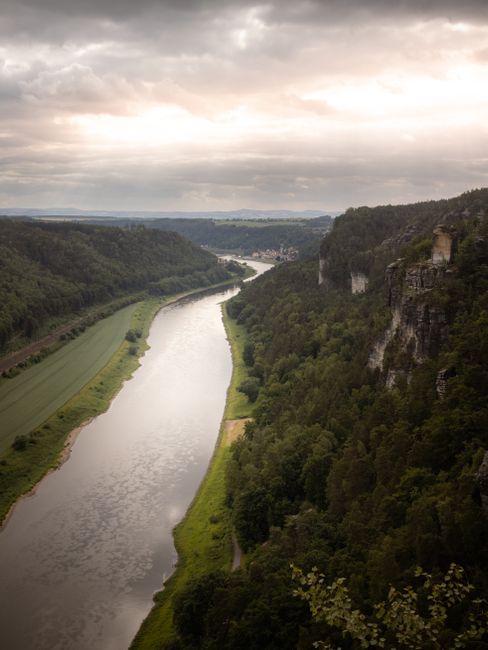
Saxon Switzerland (Sächsische Schweiz) is the German half of the Elbe Sandstone Mountains: a land of rock towers, table mountains, deep gorges and beech forest on both banks of the Elbe, between Dresden and the Czech border. Its heart is Saxon Switzerland National Park, which joins Bohemian Switzerland across the border. You come to cross the Bastei Bridge high above the river, look down from the walls of Königstein Fortress, climb ladders to the Schrammsteine viewpoints, ride an old tram up the Kirnitzsch valley and walk stages of the Malerweg, the Painters’ Way. The area has had a hard summer: a violent storm on 31 July 2026 flattened forest around Kurort Rathen, and some paths are still closed. Most of the region is open, though, including the Bastei. It is under an hour from Dresden by S-Bahn. Give it one long day for the Bastei and Königstein, three or four to hike properly.
Right now in Saxon Switzerland (Bad Schandau)
- Wed 8–19°C 46–66°F Clear
- Thu 10–19°C 49–66°F 4 mm Rain
- Fri 8–13°C 46–55°F Cloudy
Weather: MET Norway (CC BY 4.0) · Rates: ECB
Top tours in Saxon Switzerland
See all tours for Saxon Switzerland →
From local operators, with prices and reviews; you check availability and book on Viator, our partner. We may earn a commission at no extra cost to you. How we earn money
Saxon Switzerland at a glance
- Best for: hiking, rock viewpoints, climbing, castles and fortresses, river trips and photography.
- How long: 1 long day for the Bastei and Königstein Fortress; 3–4 days to add the Schrammsteine, the Kirnitzsch valley and Bohemian Switzerland; 8 days for the whole Malerweg.
- Best time: May, June, September and early October. Summer is busy and stormy; winter is quiet, with icy steps.
- Getting in: the S1 S-Bahn from Dresden runs about every 30 minutes along the Elbe to Kurort Rathen, Königstein and Bad Schandau.
- Key prices: as of October 2026, the Bastei Bridge was free, Königstein Fortress cost €17 for adults and a single trip on the Kirnitzschtal tram €7.
- Before you go: entry rules, money and general safety are in our Germany travel guide.
What’s open in 2026: the storm, closed trails and fire rules
Conditions change from week to week, so read this before planning a route. As of early October 2026:
- The July 2026 storm. Late in the afternoon of 31 July 2026, a short, very local storm hit the forest between the Bastei, Kurort Rathen and Hohnstein. About 25 hectares were damaged and the park expects some 12,000 fallen trees; one walker was killed and others were injured. The district office closed the affected forest from 1 August, and the clean-up, using helicopters since 26 August, will take a long time. The rest of the park, including the whole rear section around the Schrammsteine and the Kirnitzsch valley, and the table mountains on the left bank, were not affected.
- The Bastei is open. The Bastei viewpoint, the Bastei Bridge, the Ferdinand viewpoint and the Basteiweg path down to Kurort Rathen are open, and Rathen itself can be visited. The Schwedenlöcher gorge, the upper Amselgrund towards Rathewalde, the Gansweg and the whole Polenz valley have reopened too.
- Still closed. The Amselsee lake and the Amselgrund from Rathen up to the Schwedenlöcher junction, the Pionierweg, Knotenweg and Füllhölzelweg paths, and the side path from the Basteiweg to the Felsenbühne, Rathen’s open-air theatre, which was damaged. While the helicopters work, both Gamrig car parks and the Gamrig rock are closed; day visitors are asked to come by S-Bahn or park at the Elbe car park in Oberrathen, then take the ferry.
- Neurathen rock castle. The rock castle beside the Bastei Bridge, with its walkways between the towers, is closed until further notice because of safety problems. The path over the bridge is not affected.
- Malerweg diversions. On stage 2, walk from the Bastei on the blue-stripe trail to the Schwedenlöcher, down to the Amselgrund and on to Rathewalde; the Schindergraben up to Hohnstein is closed, so use the green-stripe trail from the Gasthaus Polenztal. On stage 3, the Kohlichtgraben is blocked by dead spruce; detour on the yellow-stripe trail and the road through Goßdorf (about 2 km longer). On stage 5, the lower Bergsteig is impassable; the detour by the Winterbergstraße and the Erlsgrund to Schmilka adds about 700 m.
- Dead trees everywhere. Bark beetles have killed large areas of spruce, and the park warns of falling trees and branches on many paths. Avoid the forest in strong wind, heavy rain or under snow, and never wait under broken branches. You enter at your own risk.
- Fire. Smoking and making fires are banned in the national park, and that includes camping stoves. There are nine official fire pits, but even these may not be used from forest-fire danger level 3. If you see smoke or flames anywhere else, call 112.
The national park’s trail service page has a live map of closures and diversions, and the regional tourist board posts news on its “Aktuelles” page. The NationalparkZentrum’s information line (+49 35022 50240) answers daily from 9:00 to 18:00, to 15:00 on Sundays and holidays.
Top things to see in Saxon Switzerland
Prices and hours below were checked on official sites in October 2026. They change, so check before you go.
The Bastei and the Bastei Bridge
The Bastei is a ridge of rock towers 194 m above the Elbe, with views down to the river bend at Kurort Rathen and across to the table mountains. The stone Bastei Bridge of 1851 links the towers; it is free and always open. From the S-Bahn station at Kurort Rathen, cross the river on the small rope ferry, then climb the Basteiweg through Rathen, a steep path with steps that takes about 30 to 45 minutes. Drivers can use the large Bastei car park on the plateau.
Königstein Fortress
Festung Königstein, on a table mountain 240 m above the Elbe, is one of the largest hilltop fortresses in Europe: a walled plateau of barracks, chapels, an arsenal and a well cut 152 m into the rock. A walk around the ramparts gives some of the best views in the region, and exhibitions tell its 800-year story.
Tickets and hours. From 28 March to 1 November 2026, the fortress opens daily 9:00–18:00, and tickets cost €17 for adults, €13 reduced and €42 for families. From 2 November 2026 to 19 March 2027, it opens 9:00–17:00, until 19:00 on Advent weekends for the Christmas market, and tickets cost €15, €11 and €36. It closes on 24 December. Last entry is an hour before closing, children under 6 go free, and the ticket includes the exhibitions and the lift up the rock. From Königstein station, walk up in about 40 minutes or take the little road train in season.
The Schrammsteine
East of Bad Schandau, the Schrammsteine are a long, jagged wall of sandstone towers. Marked trails with iron ladders, stairs and handrails, such as the Wildschützensteig, climb to the Schrammsteinaussicht viewpoint, one of the finest in the park, and a ridge path continues along the top. Allow half a day from Bad Schandau or from the Kirnitzsch valley, and do not go up in wet or icy weather.
The Kirnitzsch valley, its tram and the Lichtenhain waterfall
Since 1898, the Kirnitzschtalbahn, one of Germany’s smallest tram lines and the only one that runs into a national park, has carried walkers about 8 km from Bad Schandau up the wooded Kirnitzsch valley to the Lichtenhain waterfall (Lichtenhainer Wasserfall). Every stop is a trailhead: for the Schrammsteine, the Affensteine, the Kuhstall and the Großer Winterberg. As of October 2026, the summer timetable runs every 30 minutes until 1 November, and a reduced winter timetable starts on 2 November. A single trip costs €7 and a day ticket €10 (half price for children under 15), and a family day ticket €25. The Deutschlandticket is valid, but ordinary VVO single and day tickets are not.
The Kuhstall
A short climb from the Lichtenhain waterfall, the Kuhstall (“cow shed”) is a huge natural rock arch. A narrow staircase squeezed into a crack in the rock, the Himmelsleiter (Ladder to Heaven), climbs to a viewpoint above it.
Bad Schandau and its lift
The spa town of Bad Schandau, on the right bank of the Elbe, is the best base for the rear part of the park, with the NationalparkZentrum visitor centre, inns and a riverside promenade. Its oddest sight is the Personenaufzug, an Art Nouveau lift in a 50 m steel tower built in 1904, which lifts you from the town to a viewing platform and the plateau of Ostrau, a starting point for walks to the Schrammsteine. As of October 2026, it runs daily 9:00–18:00 in April and October, 9:00–20:00 from May to September and 9:00–17:00 from November to March; a single ride costs €2.50 and a return €3.50 for adults.
The table mountains: Lilienstein and Pfaffenstein
On the left bank and around Königstein, flat-topped mountains rise straight out of the fields. The Lilienstein, opposite the fortress, has a steep path with ladders to its plateau, and the Pfaffenstein has rock passages and the Barbarine, a slender rock needle.
Things to do in Saxon Switzerland
Hiking and the Malerweg
The Malerweg (Painters’ Way) follows the routes of the Romantic painters who came here in the 18th and 19th centuries, Caspar David Friedrich among them. It runs about 116 km in eight stages, from Liebethal near Pirna through the national park to the Czech border, then back along the left bank past the table mountains to Pirna, with the Bastei, the Schrammsteine, Königstein and the Pfaffenstein on the way. Baggage transfer can be booked. Check the diversions above before you start. Shorter classics include the Bastei and the Schwedenlöcher, the Schrammsteine ridge and the Kuhstall loop. See our hiking guide.
Climbing
The Elbe Sandstone Mountains are known as the cradle of free climbing, and the local rules are strict. Climbing is allowed only on 1,135 recognised free-standing summits, some closed in spring and summer for nesting birds. Chalk is banned, protection in cracks must be made of textile slings only (no metal nuts or cams), and you must never climb on wet or damp rock, which breaks easily. Climbers finish on the summit and sign the summit book. If you are new to sandstone, hire a local guide.
River trips and cycling
Paddle steamers of the Sächsische Dampfschiffahrt sail from Dresden up the Elbe to Rathen, Königstein and Bad Schandau, and smaller boats link the villages. The river is shallow, though, and in dry spells low water stops sailings at short notice: as of 2 October 2026, the Saxon Switzerland lines and the regional hikers’ boat were cancelled because of low water. Check before you go. The Elbe Cycle Route follows the river through the whole region, with small ferries between the banks. See our boat trips guide and our cycling guide.
Bohemian Switzerland across the border
The sandstone landscape continues into the Czech Republic as Bohemian Switzerland National Park, with the Pravčická brána, Europe’s largest natural sandstone arch, and boat rides through the Kamenice gorges at Hřensko. From Schmilka, the last German village, a ferry crosses toward Hřensko, and trains from Bad Schandau reach Děčín in about 20 minutes. As of October 2026, the Gabriela Trail to the arch is closed, but the arch, Edmund’s Gorge and the Wild Gorge are open. Read more in our Bohemian Switzerland guide, and continue to Prague, under two hours from Bad Schandau by EuroCity train.
Nearby destinations
- Bohemian Switzerland9 km
- Dresden41 km
- Prague92 km
- Karlovy Vary125 km
- Leipzig141 km
- Berlin189 km
- Wrocław194 km
- Český Krumlov234 km
Getting to Saxon Switzerland
By S-Bahn from Dresden. The S1 runs from Meissen through Dresden main station along the left bank of the Elbe to Pirna, Kurort Rathen, Königstein, Bad Schandau and Schöna, about every 30 minutes. Kurort Rathen is about 40 minutes from Dresden, and Bad Schandau a little under an hour. Bad Schandau station is on the opposite bank from the town; a small ferry and buses link the two. Regional and EuroCity trains between Dresden and Prague also stop at Bad Schandau.
By car. Take the B172 from Dresden through Pirna along the Elbe. Car parks at the Bastei, Rathen and the trailheads fill early on fine weekends, and some near Rathen are closed during the storm clean-up; arrive before 9:00 or use the train.
Getting around. The VVO network covers the S-Bahn, the buses, the river ferries and the Kirnitzschtal tram (with its own fares). Hikers usually walk one way and return by train, bus, tram or ferry. Overnight guests in many villages receive a guest card that includes free local public transport; ask your host.
Rules in the national park
- Stay on the paths everywhere in the park; in the core zone, use only marked and signposted trails.
- Camping and sleeping outdoors are banned in the national park. The only exception is for climbers: from 16 June to 31 January, they may sleep at 58 signposted rock shelters (“Boofen”) outside the core zone, and only as part of a climbing trip. From 1 February to 15 June, no one may sleep outdoors.
- Fires, candles, camping stoves and smoking are banned, even at the Boofen; fires are allowed only at nine official fire pits, and not from forest-fire danger level 3.
- Outside the park, in the landscape protection area, bivouacking is generally allowed but tents only at official sites, and nature reserves such as the Pfaffenstein are off limits overnight. The Forststeig trekking route has its own trekking shelters and campsites.
- Take all your rubbish home, keep quiet at night, and respect closure signs (a black cross on white means a path is closed).
When to go and how long to stay
The hills are cooler and much wetter than Dresden, and the gorges stay damp even in summer. The table uses the Deutscher Wetterdienst (DWD) 1991–2020 averages for its Lichtenhain-Mittelndorf station, at 321 m on the edge of the park above the Kirnitzsch valley: average temperature over day and night, rainfall and hours of sunshine per month.
| Season | Average temperature | Rain per month | Sunshine per month | What it’s like |
|---|---|---|---|---|
| Winter (Dec–Feb) | −0.5 to 0.5 °C | 45–63 mm | 41–73 hours | Cold, often foggy; icy ladders and steps; Königstein Christmas market on Advent weekends |
| Spring (Mar–May) | 3.9 °C rising to 13.3 °C | 38–66 mm | 121–216 hours | Fresh beech leaves, fewer people; no sleeping out for climbers until mid-June |
| Summer (Jun–Aug) | 16.4–18.4 °C | 87–95 mm | 214–226 hours | Warm, busy and stormy; cool in the gorges; low water can stop the steamers |
| Autumn (Sep–Nov) | 13.8 °C falling to 4.2 °C | 59–61 mm | 156 falling to 47 hours | Golden forests and morning fog in the valleys; quieter trails |
Lichtenhain gets about 790 mm of rain a year, much of it in summer thunderstorms, and only about 1,650 hours of sunshine. After rain, sandstone steps are slippery and climbing is forbidden until the rock has dried.
Saxon Switzerland in 1 day
Take an early S1 from Dresden to Kurort Rathen, cross on the ferry and climb to the Bastei. Walk back down, ride the train two stops to Königstein and spend the afternoon on the fortress walls before returning to Dresden.
Saxon Switzerland in 3 days
Day 1 as above. Day 2: from Bad Schandau, ride the lift to Ostrau and hike the Schrammsteine, returning by the Kirnitzschtal tram. Day 3: the Kuhstall and the Lichtenhain waterfall, or cross the border at Schmilka for the Pravčická brána and the gorges of Bohemian Switzerland.
Where to stay in Saxon Switzerland
- Bad Schandau: the main base, with the widest choice of hotels, the tram, the lift and trains to Dresden and Děčín.
- Kurort Rathen: a car-free village right below the Bastei; quiet at night, but close to the storm-damaged area this year.
- Königstein: a small town below the fortress, handy for the Lilienstein and the Pfaffenstein.
- Pirna: a pretty old town at the gateway to the region, with more choice and fast trains to Dresden.
- Hinterhermsdorf and Schmilka: villages in the rear of the park, good for long hikes and early starts.
Practical tips for Saxon Switzerland
- Check closures the day before: the national park’s trail map and the tourist board’s news page change often, especially around Rathen.
- Go by train: car parks fill early, and the S-Bahn, ferries and buses connect almost every trailhead.
- Check the river: steamer sailings are often cancelled in dry spells.
- Avoid windy days: falling dead trees are a real risk across the park.
What to pack for Saxon Switzerland
Sturdy hiking shoes with a good grip for sandstone steps, iron ladders and narrow crevices; a rain jacket and a warm layer; water and snacks, as inns close early outside the season; and a map or offline map app showing current closures. In summer, bring insect repellent and check for ticks after walking.
Saxon Switzerland travel FAQ
Is the Bastei Bridge open after the 2026 storm?
Yes. As of October 2026, the Bastei viewpoint, the bridge and the Basteiweg path to Kurort Rathen are open, and the bridge is free. The Neurathen rock castle beside it is closed until further notice, and parts of the Amselgrund below remain closed after the storm.
What happened in Saxon Switzerland in July 2026?
A violent local storm on 31 July 2026 damaged about 25 hectares of forest between the Bastei, Rathen and Hohnstein, with some 12,000 trees down. One walker died. The area has been closed and cleared step by step since then; the rest of the park was not affected.
How do I get from Dresden to Saxon Switzerland?
Take the S1 S-Bahn from Dresden main station, about every 30 minutes, to Kurort Rathen (about 40 minutes) for the Bastei, Königstein for the fortress or Bad Schandau for the rear of the park.
How much does Königstein Fortress cost?
Until 1 November 2026, €17 for adults, €13 reduced and €42 for families, with daily opening 9:00–18:00. From 2 November, €15 for adults, with opening 9:00–17:00. Children under 6 go free.
Can you visit the Neurathen rock castle?
No. As of October 2026, the Felsenburg Neurathen next to the Bastei Bridge is closed until further notice for safety reasons. You can still cross the bridge and see the castle’s rocks from it.
How long is the Malerweg?
About 116 km in eight stages, from Liebethal near Pirna through the national park to the Czech border and back along the left bank to Pirna. Most walkers take eight days; some stages have storm or tree-fall diversions in 2026.
Can you camp in Saxon Switzerland National Park?
No. Camping and sleeping outdoors are banned in the national park. Climbers may sleep at 58 marked rock shelters from 16 June to 31 January, only as part of a climbing trip. Use campsites or the Forststeig trekking shelters instead.
Are the Elbe steamers running to Saxon Switzerland?
Not always. As of 2 October 2026, the steamer lines into Saxon Switzerland were cancelled because of low water. Sailings resume when the river rises; check the operator’s site on the day.
Can you do Saxon Switzerland as a day trip from Dresden?
Yes. With an early start, the Bastei and Königstein Fortress fit into one day by S-Bahn. To hike the Schrammsteine or the Malerweg, stay a few nights in Bad Schandau or Rathen.
Can I combine Saxon Switzerland with Bohemian Switzerland?
Yes. The two national parks adjoin. Trains from Bad Schandau reach Děčín in about 20 minutes, and a ferry from Schmilka crosses toward Hřensko and the gorges.
Sources and last review
Researched and last reviewed on 4 October 2026. The July 2026 storm, forest closures, the trail map, camping, fire and climbing rules: the Saxon Switzerland National Park and Forest Administration (Sachsenforst); open and closed paths, Malerweg diversions, Neurathen and low-water cancellations: the Saxon Switzerland tourist board (Tourismusverband Sächsische Schweiz); the Malerweg: malerweg.de; Königstein Fortress prices and hours: Festung Königstein; the Kirnitzschtal tram: Regionalverkehr Sächsische Schweiz-Osterzgebirge (RVSOE); the Bad Schandau lift: the town’s tourism company; climate: Deutscher Wetterdienst 1991–2020 averages for Lichtenhain-Mittelndorf. S-Bahn times, the walk to the Bastei, the fortress and park history and some sight descriptions come from general sources and are flagged for checking. Trails close and reopen at short notice, so check the official links before you go. For entry rules, money and general safety, see our Germany travel guide; for the nearest city, our Dresden guide; and for the Czech side, our Bohemian Switzerland guide.
Plan your trip
Partner links: TravelerCenter may earn a commission if you book, at no extra cost to you.
🇩🇪 Useful German phrases for Saxon Switzerland
All 38 German phrases: restaurant, hotel, emergencies, romance (printable) →