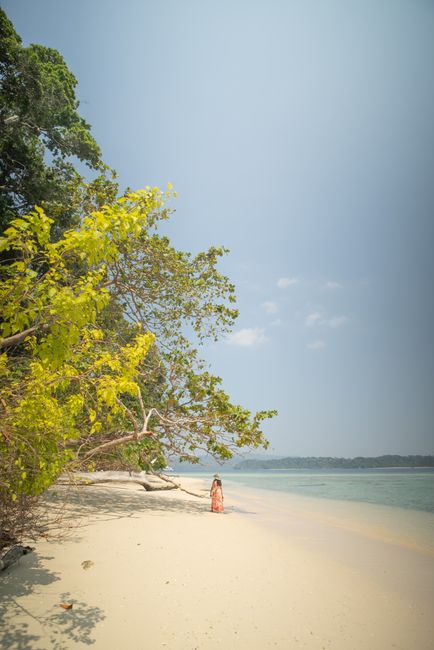
The Andaman Islands are India’s tropical archipelago in the Bay of Bengal, about 1,200 km (750 miles) east of the mainland: a chain of forested islands fringed by white sand, mangroves and coral reefs. Together with the Nicobar Islands farther south, they form the Union Territory of the Andaman and Nicobar Islands, which has nearly 300 islands in all; only a few dozen are inhabited and only a handful are open to tourists. Most visitors fly into Sri Vijaya Puram, the capital, known until 2024 as Port Blair, to see the Cellular Jail, a memorial to India’s freedom struggle, then take ferries to Swaraj Dweep (formerly Havelock Island), famous for Radhanagar Beach and diving, and Shaheed Dweep (formerly Neil Island), smaller and quieter. Foreign visitors face special entry rules, as the whole Union Territory is a restricted area; check the current permit position before you book. The best time to visit is November to April, when the sea is calm and the skies clear; from May to September, the southwest monsoon brings heavy rain and rough seas.
Right now in Andaman Islands (Sri Vijaya Puram)
- Wed24–31°C75–87°F4 mm rain
- Thu23–30°C74–86°F4 mm rain
- Fri24–31°C75–88°F3 mm rain
Top tours in Andaman Islands
See all tours for Andaman Islands →
From local operators, with prices and reviews; you check availability and book on Viator, our partner. We may earn a commission at no extra cost to you. How we earn money
Andaman Islands at a glance
- Best for: white-sand beaches, snorkeling and diving, coral reefs, freedom-struggle history, mangroves and limestone caves, and slow island days.
- How long: 5 to 7 days for Sri Vijaya Puram, Swaraj Dweep and Shaheed Dweep; 10 days or more with Baratang, Long Island or Diglipur.
- Best time: November to April, with calm seas and dry weather; January to March is ideal for diving.
- Getting there: flights from Chennai, Kolkata, Delhi, Bengaluru and other Indian cities to Sri Vijaya Puram (Port Blair), which is a designated e-Visa entry airport; ships from Chennai, Kolkata and Visakhapatnam take about three days.
- Getting around: government ferries and private catamarans between the islands; taxis, buses and rented scooters on land.
- Permits: the Bureau of Immigration lists the entire Union Territory as a restricted area for foreigners, needing a Restricted Area Permit (RAP); see the entry section below.
- Before you go: the e-Visa, the online e-Arrival card, money and general safety are in our India travel guide.
Entry for foreign visitors (as of October 2026)
The Restricted Area Permit
According to the Bureau of Immigration (BOI), the entire Union Territory of the Andaman and Nicobar Islands is a Restricted/Protected Area, and foreigners who intend to visit it need a Restricted Area Permit (RAP). The BOI says foreigners living outside India should apply through an Indian mission at least 30 days in advance, and those already in India through the jurisdictional Foreigners Regional Registration Office (FRRO) at least 15 days in advance. The e-Visa itself is not valid for protected or restricted areas without prior permission, and holding a RAP does not give access to places that need separate permission, such as tribal reserves or particular islands.
Exemptions and registration on arrival
For several years, foreign tourists were issued a permit, or registered with immigration, on arrival at Sri Vijaya Puram’s airport or harbor, and in 2018 the Ministry of Home Affairs removed the RAP requirement for 29 inhabited islands, including Swaraj Dweep and Shaheed Dweep, subject to registration on arrival. The official pages we could reach do not confirm whether that relaxation still applies in October 2026, and the Andaman and Nicobar Administration’s websites could not be reached, so confirm the current rules with your Indian mission or the FRRO before you book flights, and carry your passport and visa at all times, as permits and registrations are checked at ferry terminals and hotels.
Closed and protected areas
Many islands and areas remain completely closed to foreigners, and some to all visitors. The Nicobar Islands are closed to tourists. North Sentinel Island, home to the Sentinelese, is off-limits to everyone, and approaching it is a criminal offense. On South and Middle Andaman, the Jarawa Tribal Reserve protects the Jarawa people, who number a few hundred and avoid outside contact; Incredible India notes that any attempt to engage with them is illegal. The Andaman Trunk Road to Baratang passes through the reserve, where stopping, photographing, filming or offering anything to the Jarawa is strictly prohibited.
The Andaman Islands: which island to choose
Sri Vijaya Puram (Port Blair) and South Andaman
The capital, founded in 1789 and named Port Blair after Captain Archibald Blair of the East India Company, is the hub for flights, ferries and permits. It is a busy, hilly town with the Cellular Jail, museums, markets around Aberdeen Bazaar, and beaches such as Corbyn’s Cove a short drive away. Most visitors spend a night or two here at each end of a trip.
Swaraj Dweep (Havelock Island)
The largest and most popular of the tourist islands, about 2 hours by catamaran from Sri Vijaya Puram, Swaraj Dweep has the long sweep of Radhanagar Beach (Beach No. 7), with fine white sand and forested hills, and Elephant Beach, reached by boat or a forest trail, with shallow reefs. Most of the islands’ dive centers are here. Resorts and beach huts are spread along the east coast around Beaches No. 3 to 5 and near Radhanagar.
Shaheed Dweep (Neil Island)
Small, flat and rural, Shaheed Dweep is about an hour by ferry from Swaraj Dweep. Its beaches, Bharatpur, Laxmanpur and Sitapur, are good for swimming, sunrise and sunset, and the natural coral bridge at Laxmanpur appears at low tide. It is easy to explore by bicycle, and life moves slowly.
Baratang and Middle Andaman
About 100 km (62 miles) north of the capital by road, Baratang is known for its limestone caves, reached by boat through mangrove creeks, and its mud volcanoes, which bubble with gases from below. The road runs through the Jarawa Tribal Reserve, so trips follow strict rules. Farther north, Rangat, Long Island and Mayabunder see few visitors.
Diglipur and North Andaman
The northernmost tourist area, a long day’s journey away, has Ross and Smith Islands, joined by a sandbar, Saddle Peak, the archipelago’s highest point at about 730 m (2,400 ft), and turtle nesting beaches.
Top things to see in the Andaman Islands
Cellular Jail National Memorial
Built between 1896 and 1906, the Cellular Jail, known as Kala Pani (“Black Waters”), held Indian freedom fighters in solitary confinement. Its three-story wings, with 698 cells, radiated from a central tower like the arms of a starfish; three of the original seven wings survive. Today it is a national memorial with a museum, and an evening light and sound show tells its story.
Netaji Subhas Chandra Bose Dweep (Ross Island)
A short boat ride from the capital, the former British headquarters is now a peaceful island of ruined churches and bungalows overgrown by fig roots, with deer and peacocks. Boats leave from the capital’s Water Sports Complex jetty.
North Bay Island
North Bay is the capital’s main water-sports spot, with glass-bottom boats, snorkeling, sea walks and introductory dives over its reefs. It appears on the back of the ₹20 note.
Mahatma Gandhi Marine National Park
About 29 km (18 miles) west of the capital, at Wandoor, this marine park covers about 281.5 km² (109 sq miles) of 15 islands, open sea and creeks, with coral reefs and clear water. Boats from Wandoor go to Jolly Buoy or Red Skin Island, which open in alternate seasons; a park permit and a boat ticket are needed, and plastic is not allowed on the islands.
Chidiya Tapu and Mount Harriet
At the southern tip of South Andaman, Chidiya Tapu (“bird island”) is a forested headland for birdwatching and one of the islands’ best sunset spots. Mount Harriet, about 365 m (1,200 ft) and the highest point in South Andaman, has a national park with forest trails and views over the islands; it is about 55 km (34 miles) by road or 15 km (9 miles) via a short ferry from the capital.
More classic sights
- Anthropological Museum: displays on the islands’ Indigenous peoples, in Sri Vijaya Puram.
- Fisheries Museum: more than 350 marine species, in Sri Vijaya Puram.
- Barren Island: India’s only active volcano, about 135 km (84 miles) from the capital, visible from boats but not open for landing.
Beaches, snorkeling and diving
The Andamans have some of India’s best snorkeling and diving, with hard and soft corals, reef fish, turtles, rays and, in season, manta rays. Swaraj Dweep is the main diving center, with PADI and other certified schools offering introductory dives and courses; popular sites include the Wall, Johnny’s Gorge and Dixon’s Pinnacle. Shaheed Dweep, North Bay and the Mahatma Gandhi Marine National Park are good for snorkeling. The best visibility is usually from December to April. Do not stand on coral, touch marine life or collect shells and coral, which is also illegal to take out of the islands. Swim only where locals and lifeguards indicate it is safe; see the safety section below. See our snorkeling, diving and beaches guides.
Other things to do in the Andaman Islands
Food and drink
Seafood is the highlight: grilled fish, prawn curry in coconut gravy, lobster, crab and squid, often cooked in the Bengali or South Indian style of the islands’ settlers. Markets in the capital sell samosas, pakoras and fish fry. Local produce includes coconuts, honey, cinnamon and nutmeg. Alcohol is available in licensed bars and resorts, though not everywhere on the smaller islands. Drink bottled or filtered water, and carry a refillable bottle, as plastic is discouraged on many beaches.
Kayaking, mangroves and wildlife
Guided kayak trips paddle through mangrove creeks on Swaraj Dweep, sometimes at night to see bioluminescent plankton, and beaches in the north and on Rangat are turtle nesting sites, including for the giant leatherback.
History and culture
Beyond the Cellular Jail, the islands’ 20th-century history includes the Japanese occupation in 1942, and in 1943–44 the capital served as the headquarters of Subhas Chandra Bose’s Azad Hind government; the Netaji Flag Hoisting Memorial marks where he raised the Indian flag.
Day trips from Sri Vijaya Puram
- Ross Island and North Bay: a combined half-day or full-day boat trip from the capital’s jetty.
- Wandoor and Jolly Buoy or Red Skin Island: a full day of snorkeling in the Mahatma Gandhi Marine National Park.
- Baratang: a long day trip by road through the Jarawa Tribal Reserve to the limestone caves and mud volcanoes, leaving before dawn.
Getting there and getting around
By air
Veer Savarkar International Airport in Sri Vijaya Puram (code IXZ) has direct flights from Chennai (about 2 hours) and Kolkata, and from Delhi, Bengaluru, Hyderabad, Mumbai and other cities, some via Chennai or Kolkata. Port Blair is on the BOI’s list of designated e-Visa entry airports and seaports, but nearly all foreign visitors fly in from the mainland. See our Chennai and Kolkata travel guides.
By sea from the mainland
Passenger ships run from Chennai, Kolkata and Visakhapatnam to Sri Vijaya Puram, taking about three days, with cabins and bunk classes. Schedules are irregular; it is an adventure, not a time-saver.
Ferries between the islands
Two kinds of ferries link the capital with Swaraj Dweep and Shaheed Dweep: government ferries run by the Andaman and Nicobar Administration’s Directorate of Shipping Services, which are cheap but book up fast, and private air-conditioned catamarans, which take about 1½ to 2½ hours to Swaraj Dweep and about an hour between Swaraj and Shaheed. Book private ferries online in advance, especially from December to May, carry your passport and permit details, and arrive early for security and permit checks. Sailings are canceled when the sea is rough, so leave a buffer day before your flight home.
On the islands
In the capital, taxis, autos and buses cover the town and the south. On Swaraj and Shaheed, rent a scooter or bicycle, or use autos and taxis. Buses run north along the Andaman Trunk Road to Baratang, Rangat, Mayabunder and Diglipur, a long journey that crosses creeks by vehicle ferry.
When to go and how long to stay
The Andamans are hot and humid all year, with highs of 29 to 33 °C (85 to 91 °F) and sea temperatures around 28 to 30 °C (82 to 86 °F). November to April is the dry season and the best time to visit, with calm seas and good visibility; January to March is the driest. The southwest monsoon arrives in May and lasts until September, with more than 400 mm (16 in) of rain a month, rough seas, ferry cancellations and closed dive sites. October and November bring the northeast monsoon and the peak cyclone season in the Bay of Bengal, with more showers. The table shows 1991–2020 normals for the Port Blair station from the India Meteorological Department (IMD), as published by the World Meteorological Organization (WMO); rainy days are days with at least 2.5 mm of rain.
| Month | Average high / low | Rain (rainy days) | What to expect |
|---|---|---|---|
| January | 30 °C (86 °F) / 23 °C (73 °F) | 49 mm (1.9 in), 2 days | Dry, calm sea; peak season |
| February | 31 °C (87 °F) / 23 °C (73 °F) | 14 mm (0.6 in), under 1 day | Driest month; excellent diving |
| March | 32 °C (89 °F) / 23 °C (74 °F) | 33 mm (1.3 in), 2 days | Hot, clear water |
| April | 33 °C (91 °F) / 25 °C (76 °F) | 78 mm (3.1 in), 4 days | Hottest; calm sea, busy |
| May | 32 °C (89 °F) / 25 °C (77 °F) | 407 mm (16.0 in), 16 days | Monsoon arrives; seas rough |
| June | 30 °C (86 °F) / 25 °C (76 °F) | 484 mm (19.1 in), 19 days | Heavy rain; ferry cancellations |
| July | 30 °C (85 °F) / 24 °C (76 °F) | 448 mm (17.7 in), 19 days | Wet and windy |
| August | 30 °C (85 °F) / 24 °C (76 °F) | 460 mm (18.1 in), 19 days | Wet and windy |
| September | 30 °C (85 °F) / 24 °C (75 °F) | 505 mm (19.9 in), 20 days | Wettest month |
| October | 30 °C (86 °F) / 24 °C (75 °F) | 301 mm (11.8 in), 15 days | Showers; cyclone risk |
| November | 30 °C (87 °F) / 24 °C (76 °F) | 222 mm (8.7 in), 10 days | Improving; cyclone risk |
| December | 30 °C (86 °F) / 24 °C (75 °F) | 111 mm (4.4 in), 5 days | Season begins; busy at holidays |
The capital gets about 3,110 mm (122 in) of rain a year, most of it from May to November.
Five days in the Andamans
Day one: the Cellular Jail and its light and sound show. Day two: Ross Island and North Bay, then ferry to Swaraj Dweep. Day three: diving or snorkeling at Elephant Beach, and sunset at Radhanagar. Day four: Shaheed Dweep’s natural bridge and Sitapur. Day five: back to the capital, with a buffer for weather.
Ten days on the islands
Add a dive course on Swaraj Dweep, a day in the marine national park, and a trip north to Baratang or Diglipur.
Where to stay in the Andaman Islands
- Sri Vijaya Puram: hotels of every level around Aberdeen Bazaar and on the hills, plus beach hotels at Corbyn’s Cove; good for the first and last nights.
- Swaraj Dweep: the widest choice of beach resorts, cottages and dive lodges, from simple huts to luxury resorts near Radhanagar.
- Shaheed Dweep: small resorts and guesthouses near Bharatpur and Sitapur beaches; quieter and simpler.
- Long Island and Diglipur: a few eco-lodges and government guesthouses for off-the-beaten-track trips.
Rooms and ferries sell out at Christmas and New Year; book ahead, and check that your hotel registers foreign guests.
What a trip to the Andaman Islands costs
Prices are approximate, for October 2026, converted at about 96 rupees (₹) to the US dollar. They are estimates, as official fee schedules could not be checked.
| Item | Typical cost |
|---|---|
| Private catamaran, Sri Vijaya Puram to Swaraj Dweep | ₹1,500–3,500 (about US$16–36) |
| Government ferry, one way | ₹400–1,000 (about US$4.20–10) |
| Introductory “discover scuba” dive | ₹4,500–8,000 (about US$47–83) |
| Snorkeling trip with boat | ₹1,000–3,000 (about US$10–31) |
| Seafood dinner | ₹600–2,000 (about US$6.30–21) |
| Beach cottage double, per night | ₹2,500–7,000 (about US$26–73) |
| Beach resort double, per night | ₹8,000–25,000 (about US$83–260) |
Practical tips for the Andaman Islands
- Sort out permits first: confirm the RAP and registration rules with your Indian mission before booking, and keep your passport with you.
- Book ferries early: private catamarans sell out in season; keep printed or downloaded tickets.
- Leave a buffer day: bad weather can cancel ferries, so do not plan the last ferry on the day of your flight.
- Bring cash: ATMs are in the capital and the main villages, but can run out, and card payments are not universal.
- Leave no plastic: many beaches and the marine park ban single-use plastic.
Safety
The Andaman Islands are peaceful and crime is low, but nature calls for care. Sea conditions: currents can be strong off some beaches, including Radhanagar at times, and few beaches have lifeguards; swim only where others swim, never alone or after drinking, and stay out of the sea when flags or staff say it is unsafe. From May to September, and during storms, seas are rough, swimming is unsafe and ferries are canceled. Saltwater crocodiles live in creeks and mangroves and have occasionally been seen near beaches, including on Swaraj Dweep; heed warning signs and avoid swimming near creek mouths, at dusk or at night. Cyclones and the monsoon: the Bay of Bengal’s cyclone seasons are April to May and October to December; follow IMD warnings and instructions from the administration, and keep flexible plans. The islands also lie in an active earthquake zone; if you feel a strong earthquake on the coast, move to high ground, as the 2004 tsunami showed. Diving: dive only with certified operators, and do not fly within 18 to 24 hours of diving. Protected areas: entering tribal reserves or closed islands is illegal and dangerous. Heat and sun: use reef-safe sunscreen and drink plenty of water. In an emergency, call 112.
What to pack for the Andaman Islands
Light, quick-drying clothes, swimwear and a rash guard, reef-safe sunscreen, a hat and sunglasses, water shoes for coral beaches, your own mask and snorkel if you have them, a dry bag for ferries, insect repellent, a light rain jacket for showers, a flashlight, and copies of your passport, visa and permit. India uses 230 V, with round-pin plugs of types C, D and M. See our water shoes and travel adapters guides.
Andaman Islands travel FAQ
Do foreigners need a permit for the Andaman Islands?
The Bureau of Immigration lists the whole Union Territory as a restricted area requiring a Restricted Area Permit, applied for through an Indian mission or the FRRO. Earlier exemptions with registration on arrival could not be confirmed for October 2026, so check before booking.
Can I fly to the Andamans on an e-Visa?
Port Blair is a designated e-Visa entry airport, but the e-Visa is not valid for restricted areas without the required permission, so sort out the permit as well.
Is Port Blair the same as Sri Vijaya Puram?
Yes. The capital was renamed Sri Vijaya Puram in 2024. Havelock Island is now Swaraj Dweep, Neil Island is Shaheed Dweep and Ross Island is Netaji Subhas Chandra Bose Dweep.
How do I get from Sri Vijaya Puram to Swaraj Dweep?
By private catamaran in about 1½ to 2½ hours, or by government ferry. Book ahead in season.
What is the best time to visit the Andaman Islands?
November to April, when the sea is calm and it is mostly dry. May to September brings the monsoon and rough seas.
Can I visit Baratang’s limestone caves?
Yes, on a long day trip by road from the capital through the Jarawa Tribal Reserve, where stopping and photography are prohibited, then by boat through the mangroves.
Can I visit the Nicobar Islands?
No. The Nicobar Islands are closed to tourists, as are the tribal reserves and North Sentinel Island.
Is it safe to swim at Radhanagar Beach?
Usually, in calm conditions where others are swimming, but currents can be strong. Heed warnings and lifeguards.
Is diving good in the Andaman Islands?
Yes. Swaraj Dweep has certified dive centers and good reefs, with the best visibility from December to April.
Is the Andaman Islands safe for tourists?
Yes, crime is low. The main risks are the sea, crocodiles in creeks, cyclones and the monsoon, and limited medical care on the smaller islands.
Plan your trip
Partner links: TravelerCenter may earn a commission if you book, at no extra cost to you.
🇮🇳 Useful Hindi phrases for Andaman Islands
All 38 Hindi phrases: restaurant, hotel, emergencies, romance (printable) →
Sources · last reviewed 5 October 2026
Researched and last reviewed on 5 October 2026. Restricted Area Permit rules for the Union Territory, application deadlines and the e-Visa’s validity in restricted areas: the Bureau of Immigration (Ministry of Home Affairs) and its e-Visa site, which also lists Port Blair as a designated e-Visa airport and seaport; the islands’ names (Sri Vijaya Puram, Swaraj Dweep, Shaheed Dweep, Netaji Subhas Chandra Bose Dweep), the Cellular Jail, beaches, the marine national park, Mount Harriet, Chidiya Tapu, Baratang, Barren Island, Little Andaman, the Jarawa, the Fisheries and Anthropological museums, history and festivals: Incredible India (Ministry of Tourism); climate normals for the Port Blair station: the India Meteorological Department, via the World Meteorological Organization (1991–2020 normals archived by NOAA’s National Centers for Environmental Information); the exchange rate: the Reserve Bank of India (FBIL reference rate). The Andaman and Nicobar Administration’s websites (tourism, shipping, forests and police) could not be reached, so the 2018 island exemptions and registration on arrival, ferry operators, times and prices, park permits, crocodile and beach conditions, distances and all costs are general references or estimates, flagged for checking. Rules change, so confirm before you go. For the e-Visa and money, see our India travel guide.
Data: Weather: MET Norway (CC BY 4.0) · Sea temperature: NOAA CoastWatch · Rates: ECB · Costs: World Bank ICP and price levels · Wikidata (CC0)