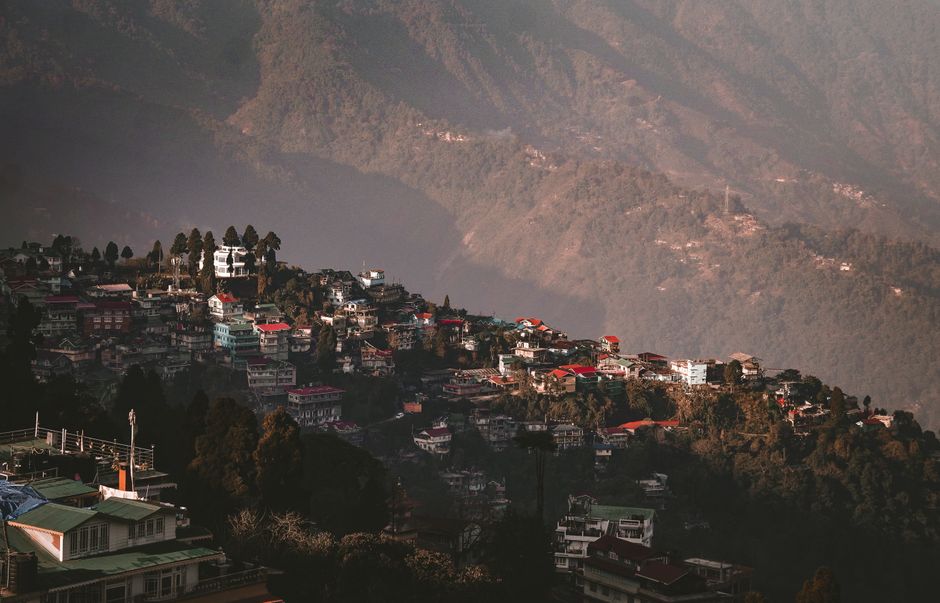
Darjeeling clings to a ridge at about 2,040 m (6,700 ft) in the hills of northern West Bengal, facing Kangchenjunga, at 8,586 m (28,169 ft) the world’s third-highest mountain, across a sea of valleys and tea gardens. The town began as a British sanatorium after the Raja of Sikkim granted the hill to the East India Company in 1835, and grew into the summer capital of the Bengal Presidency. It is still a place of colonial churches and cottages, steep lanes and stairways, Buddhist monasteries and Hindu temples, and a mix of Gorkha, Lepcha, Bhutia, Tibetan and Bengali cultures. Darjeeling is famous for three things above all: its tea, grown on steep estates since the mid-19th century and prized around the world; the sunrise over Kangchenjunga, and on clear days Everest, from Tiger Hill; and the Darjeeling Himalayan Railway, the “Toy Train,” a narrow-gauge line climbing from the plains since 1881 and a UNESCO World Heritage Site. The best times to visit are March to May and October to December, when skies are clearest; the monsoon, from June to September, is very wet, with frequent landslides on hill roads.
Right now in Darjeeling
- Wed11–21°C51–69°FMostly clear
- Thu9–19°C49–67°FPartly cloudy
- Fri10–18°C51–64°F1 mm rain
Top tours in Darjeeling
See all tours for Darjeeling →
From local operators, with prices and reviews; you check availability and book on Viator, our partner. We may earn a commission at no extra cost to you. How we earn money
Darjeeling at a glance
- Best for: Himalayan views, tea gardens and tastings, the Toy Train, monasteries, colonial hill-station charm, and treks along the Singalila Ridge.
- How long: 3 days for the town, Tiger Hill, a tea estate and a Toy Train ride; 4 or 5 with Kalimpong, Mirik or a short trek.
- Best time: March to May and October to December; mountain views are clearest from October to December.
- Getting there: Bagdogra airport, about 90 km (56 miles) away, and New Jalpaiguri railway station, followed by 3 to 4 hours by road; or the Toy Train from New Jalpaiguri.
- Getting around: on foot in town (steep lanes and steps); shared jeeps and hired cars outside.
- Good to know: Bagdogra is one of the airports designated for arrival on an e-Visa.
- Before you go: the e-Visa, the online e-Arrival card, money, trains and general safety are in our India travel guide.
Darjeeling’s ridge: where things are
Darjeeling is built on a narrow, Y-shaped ridge, with roads and lanes stacked one above the other. The higher you stay, the better the views, and the more steps you climb.
Chowrasta and the Mall
At the top of town, Chowrasta (“where four roads meet”) is a sunny public square with benches, pony rides and views of Kangchenjunga on clear days, joined to the Mall, a pedestrian loop around Observatory Hill. Hotels, cafés, bookshops and tea shops cluster around here; it is the most pleasant place to stay, though cars cannot reach every hotel.
Gandhi Road and Laden La Road
Below Chowrasta, the main roads through town have the market, the bus and shared-jeep stands, banks, restaurants and many mid-range hotels. They are busy and noisy but convenient.
The station and Hill Cart Road
At the lowest level, Hill Cart Road runs past the Toy Train station and the motor stand. Budget hotels are here, but traffic is heavy.
Ghoom and the outskirts
About 8 km (5 miles) south, Ghoom is a separate small town on the saddle of the ridge, with India’s highest railway station and an old monastery. Tea estate bungalows and homestays in the surrounding gardens offer a quieter, more rural stay.
Top things to do in Darjeeling
The Darjeeling Himalayan Railway (Toy Train)
According to the Darjeeling district administration, the Darjeeling Himalayan Railway (DHR) is a 2 ft (610 mm) gauge railway built between 1879 and 1881, about 88 km (55 miles) long, climbing from about 100 m (330 ft) at New Jalpaiguri in the plains to about 2,200 m (7,220 ft) at Darjeeling with six zigzags and five loops. UNESCO declared it a World Heritage Site on 2 December 1999, and it is now part of the Mountain Railways of India, together with the Kalka–Shimla and Nilgiri lines. Today, the district says, six diesel locomotives handle most scheduled services, and daily tourist trains, the joy rides, run from Darjeeling to Ghum, India’s highest railway station, and back, passing round the Batasia Loop. A steam-hauled Red Panda service runs from Darjeeling to Kurseong, the railway’s headquarters, and vintage British-built B-class steam engines pull special trains for enthusiasts. The joy ride takes about two hours, with stops at Batasia and Ghum, and is the most popular way to ride. Tickets are sold by Indian Railways, including online, and sell out in the high season; the full journey from New Jalpaiguri takes most of a day and can be suspended after monsoon landslides, so check before planning on it.
Tiger Hill sunrise
Tiger Hill, at about 2,590 m (8,480 ft) and 11 km (7 miles) south of town, is the classic sunrise viewpoint. As the sun rises, the peaks of Kangchenjunga light up pink and gold before the valleys below, and on clear days Everest, about 172 km (107 miles) away, is just visible. Jeeps leave town around 4 a.m.; in peak season, traffic jams on the road up are common, so start early. A viewing building charges small entry fees. Views are most reliable from October to December.
Tea gardens and tea tasting
Darjeeling tea is grown on about 87 estates in the hills, and the first flush in spring and the second flush in early summer are especially prized. The Happy Valley Tea Estate, just below town, dating back to 1854, offers factory tours and tastings, and shops on the Mall and in Chowrasta sell the different flushes. Tea estate stays outside town let you walk through the gardens and watch plucking, which runs from about March to November.
Batasia Loop and the Gorkha War Memorial
Near Ghoom, the railway spirals around a landscaped garden at the Batasia Loop, where a memorial honors Gorkha soldiers. On clear mornings, the views of Kangchenjunga from the garden are superb, and the joy ride stops here.
Monasteries
Ghoom Monastery (Yiga Choeling), founded in the 19th century, houses a large statue of the future Buddha, Maitreya. In town, Bhutia Busty Monastery belongs to the Kagyu school, and the Japanese Temple, built in 1972 by the Nipponzan Myohoji order, sits beside the white Peace Pagoda, with views across the hills.
Himalayan Mountaineering Institute and the zoo
Founded on 4 November 1954, after the first ascent of Everest, the Himalayan Mountaineering Institute has a museum of climbing history and equipment, and Tenzing Norgay, who lived in Darjeeling, is buried nearby. It shares a site with the Padmaja Naidu Himalayan Zoological Park, established in 1958, which breeds red pandas and snow leopards and also keeps Tibetan wolves and Himalayan birds.
More classic sights
- Observatory Hill and Mahakal Temple: a hilltop shrine sacred to both Hindus and Buddhists, above Chowrasta, draped in prayer flags.
- Tibetan Refugee Self Help Centre: at Lebong, founded after 1959, with carpet, weaving and craft workshops open to visitors.
- Lloyd Botanical Garden: established in 1878 on 40 acres below the town, with orchids and Himalayan plants.
- St. Andrew’s Church: a colonial church near the Mall.
- Darjeeling Ropeway: a cable car down into the Rangeet Valley over tea gardens, when operating.
- Rock Garden and Ganga Maya Park: landscaped gardens around waterfalls below town.
Other things to do in Darjeeling
Walks and treks
Short walks lead around the Mall, along Tenzing Norgay Road, and down to the tea gardens. For a real trek, the Singalila Ridge along the Nepal border, through Singalila National Park, leads to Tonglu and Sandakphu, at about 3,640 m (11,940 ft), with views of four of the world’s five highest mountains: Everest, Kangchenjunga, Lhotse and Makalu. The trek usually starts at Manebhanjan and takes four to six days; guides are required in the national park. Day hikes to Kamala Falls and village homestays at Gorkhey are gentler options. See our hiking guide.
Food and drink
Darjeeling’s food reflects its mix of cultures: Tibetan momos, thukpa noodle soup and sha phaley (fried pastries filled with meat), Nepali sel roti (a ring-shaped rice bread) and aloo dum, and Bengali sweets. The old bakeries and tea rooms around Chowrasta and the Mall serve cakes, sandwiches and pots of local tea. In the cold, try thongba, a warm millet brew served in a bamboo mug, or butter tea.
Shopping
Look for Darjeeling tea (check the estate and flush), Tibetan carpets and crafts from the refugee center, thangka paintings, woolen shawls, and the curved khukuri knife of the Gorkhas, sold in markets around town (check airline and customs rules before buying one).
Festivals
Tibetan New Year, Losar, is celebrated in February or March, and Buddha Jayanti in May. Hindu festivals such as Dashain (Durga Puja) and Tihar (Diwali) light up the town in autumn. The Darjeeling Carnival is usually held in November, and tea and tourism festivals take place in winter.
Day trips from Darjeeling
- Kalimpong: a market town with monasteries, nurseries and views of Kangchenjunga, about 50 km (31 miles) and 2½ hours away. It became a separate district in 2017.
- Mirik: a lake town surrounded by tea gardens and pine forests, about 45 km (28 miles) west.
- Kurseong: the “land of white orchids,” a quieter hill town about 30 km (19 miles) down the ridge, reached by road or the Red Panda steam train.
- Senchal Lake and Wildlife Sanctuary: forests and lakes near Tiger Hill, about 10 to 15 km (6 to 9 miles) from town.
- Sikkim: Gangtok is about 4 to 5 hours away by road. Indian citizens do not need a permit for most of Sikkim, but foreign visitors need a permit to enter, according to the Bureau of Immigration; it is usually issued at the border checkpoint at Rangpo or arranged in advance.
Nearby destinations
- Paro122 km
- Thimphu144 km
- Sagarmatha National Park (Everest Region)182 km
Getting there and getting around
By air
Bagdogra Airport (IXB), near Siliguri and about 90 km (56 miles) from Darjeeling according to the district administration, has flights from Kolkata, Delhi, Guwahati and other cities. It is a designated e-Visa entry airport. Pre-paid taxis to Darjeeling take about 3 to 4 hours.
By train
New Jalpaiguri (NJP) station in Siliguri is the main railhead, with direct trains from Kolkata, Delhi, Guwahati and other cities, including overnight trains from Kolkata. From NJP, take a taxi or shared jeep up the hill, or, if it is running its full route, the Toy Train, a long, slow and memorable journey.
By road
According to the district administration, Darjeeling is about 77 km (48 miles) from Siliguri by road, and there are four routes up: via Tindharia and Kurseong (the main road, following the railway), via Dudhia and Mirik, via Rohini, and via Pankhabari. Shared jeeps run from Siliguri’s Tenzing Norgay bus stand and the motor stands at NJP and Bagdogra; private taxis are also available from pre-paid stands.
Around town
Darjeeling is best explored on foot, but the lanes and stairways are steep. Shared jeeps and taxis link the town with Ghoom, Tiger Hill and the outlying sights; for sunrise at Tiger Hill and longer day trips, hire a car through your hotel. Traffic in town is heavy in the high season.
When to go and how long to stay
Darjeeling has a cool subtropical highland climate. March to May is spring, with highs of 16 to 19 °C (61 to 67 °F), rhododendrons and magnolias in bloom and the first-flush tea harvest, though haze can hide the mountains. The monsoon, from June to September, is very wet, with more than 600 mm (25 in) of rain in July alone, thick mist, leeches on trails and frequent landslides on hill roads and the railway. October to December brings the clearest skies and the best views of Kangchenjunga, with crisp days of 14 to 19 °C (57 to 67 °F). January and February are cold, with lows near 2 °C (35 °F) and occasional snow. The table shows 1991–2020 normals for the Darjeeling station from the India Meteorological Department (IMD), as published by the World Meteorological Organization (WMO); rainy days are days with at least 2.5 mm of rain.
| Month | Average high / low | Rain (rainy days) | What to expect |
|---|---|---|---|
| January | 11 °C (52 °F) / 2 °C (35 °F) | 11 mm (0.4 in), under 1 day | Coldest month; clear but cold |
| February | 12 °C (54 °F) / 3 °C (38 °F) | 11 mm (0.4 in), 1 day | Cold; occasional snow; Losar in some years |
| March | 16 °C (61 °F) / 6 °C (43 °F) | 26 mm (1.0 in), 3 days | Spring; first-flush tea |
| April | 19 °C (65 °F) / 9 °C (48 °F) | 89 mm (3.5 in), 7 days | Rhododendrons; warmer, some haze |
| May | 19 °C (67 °F) / 11 °C (51 °F) | 160 mm (6.3 in), 10 days | Busy; pre-monsoon showers |
| June | 20 °C (68 °F) / 13 °C (55 °F) | 419 mm (16.5 in), 18 days | Monsoon arrives; heavy rain |
| July | 20 °C (67 °F) / 13 °C (56 °F) | 648 mm (25.5 in), 23 days | Wettest month; landslide risk |
| August | 20 °C (68 °F) / 14 °C (56 °F) | 530 mm (20.9 in), 22 days | Very wet and misty |
| September | 20 °C (67 °F) / 13 °C (55 °F) | 385 mm (15.2 in), 16 days | Rains easing late in the month |
| October | 19 °C (67 °F) / 10 °C (50 °F) | 79 mm (3.1 in), 4 days | Clear skies return; festivals |
| November | 17 °C (63 °F) / 6 °C (43 °F) | 11 mm (0.4 in), under 1 day | Best views of Kangchenjunga |
| December | 14 °C (57 °F) / 4 °C (38 °F) | 3 mm (0.1 in), under 1 day | Crisp and clear; cold nights |
The station gets about 2,370 mm (93 in) of rain a year, more than 80% of it from June to September.
Three days in Darjeeling
Day one: Chowrasta and the Mall, Observatory Hill, the Himalayan Mountaineering Institute and the zoo, and tea at a Mall tea room. Day two: sunrise at Tiger Hill, Ghoom Monastery and Batasia Loop on the way back, then the Toy Train joy ride in the afternoon. Day three: Happy Valley Tea Estate, the Tibetan Refugee Self Help Centre and the Japanese Temple and Peace Pagoda.
Five days or more
Add Kalimpong or Mirik, a night on a tea estate, a ride on the Red Panda steam train to Kurseong, or the trek to Sandakphu.
Where to stay in Darjeeling
- Chowrasta and the Mall: heritage hotels and guesthouses with views, the best area.
- Gandhi Road and Laden La Road: mid-range hotels close to transport and the market.
- Hill Cart Road: budget hotels near the station, busy and noisy.
- Ghoom: quieter guesthouses near Tiger Hill and the railway.
- Tea estates: colonial planters’ bungalows and homestays in the gardens outside town.
Rooms are often unheated, so in winter ask about heaters and hot water. Book early for April to June and October to December, when Indian holiday seasons fill the town.
What a trip to Darjeeling costs
Prices are approximate, for October 2026, converted at about 96 rupees (₹) to the US dollar. They are estimates, as Indian Railways’ fare pages could not be checked.
| Item | Typical cost |
|---|---|
| Toy Train joy ride, diesel / steam | ₹1,000–1,800 (about US$10.40–19) |
| Shared jeep to Tiger Hill for sunrise | ₹300–600 per person (about US$3–6) |
| Himalayan Mountaineering Institute and zoo, foreigners | ₹100–300 (about US$1–3) |
| Tea tasting at an estate | ₹200–1,000 (about US$2–10.40) |
| Momos and thukpa at a local restaurant | ₹150–350 (about US$1.60–3.60) |
| Taxi from Bagdogra or NJP | ₹3,000–4,500 (about US$31–47) |
| Mid-range hotel double, per night (high season) | ₹3,000–8,000 (about US$31–83) |
Practical tips for Darjeeling
- Book the Toy Train early: joy rides sell out in spring and autumn; book on Indian Railways’ system in advance.
- Check the weather for Tiger Hill: if the forecast is cloudy, the early start may not be worth it.
- Travel light: many hotels are reached by steps, not roads.
- Buy tea carefully: look for named estates and flushes, and buy from estates or established tea shops.
- Carry cash: ATMs are in town, but shared jeeps and small shops prefer cash.
Safety
Darjeeling is a friendly, safe town. Landslides are the main risk: during the monsoon, from June to September, heavy rain often causes landslides that block roads and the railway, sometimes for days; travel by day, allow extra time, and check road conditions before driving up or down. Mountain roads are steep and narrow, and shared jeeps can be crowded; use registered taxis and avoid night driving. Cold: winter nights drop close to freezing and rooms are often unheated, so bring warm clothes. Treks on the Singalila Ridge reach about 3,600 m (11,800 ft); ascend gradually and go with a licensed guide. Steps and lanes are slippery when wet. Local strikes, known as bandhs, occasionally close shops and transport; ask your hotel about the latest news. In an emergency, call 112.
What to pack for Darjeeling
Warm layers year-round: a fleece and jacket for evenings, and a heavy coat, hat and gloves from November to February; a rain jacket, umbrella and waterproof shoes for the monsoon; comfortable shoes with good grip for steep lanes; and binoculars for mountain views. India uses 230 V, with round-pin plugs of types C, D and M. See our rain jackets, hiking shoes and travel adapters guides.
Darjeeling travel FAQ
How long is the Darjeeling Toy Train ride?
The joy ride from Darjeeling to Ghum and back via the Batasia Loop takes about two hours. The full line from New Jalpaiguri is about 88 km (55 miles) and takes most of a day.
Is the Darjeeling Himalayan Railway a UNESCO site?
Yes. UNESCO declared it a World Heritage Site on 2 December 1999; it is now part of the Mountain Railways of India.
Can I see Everest from Darjeeling?
On clear days, Everest is just visible from Tiger Hill, about 172 km (107 miles) away. Kangchenjunga dominates the view from the town itself.
What is the best time to visit Darjeeling?
March to May and October to December. October to December has the clearest mountain views.
Can I fly into Bagdogra on an e-Visa?
Yes. Bagdogra is one of the designated e-Visa entry airports, about 90 km (56 miles) from Darjeeling.
How do I get from Bagdogra or New Jalpaiguri to Darjeeling?
By taxi or shared jeep in about 3 to 4 hours, or by the Toy Train from New Jalpaiguri when the full line is running.
How many days do I need in Darjeeling?
Three days covers Tiger Hill, the Toy Train, a tea estate and the main sights. Add days for Kalimpong, Mirik or a trek.
Do I need a permit to visit Sikkim from Darjeeling?
Foreign visitors need a permit to enter Sikkim, usually issued at the Rangpo checkpoint or arranged in advance. Indian citizens do not need one for most of the state.
When is the best time to buy Darjeeling tea?
Fresh first-flush teas appear from about April, and second-flush teas in early summer. Estates and shops sell tea year-round.
Is Darjeeling safe for tourists?
Yes. The main risks are landslides and road closures in the monsoon and cold in winter.
Plan your trip
Partner links: TravelerCenter may earn a commission if you book, at no extra cost to you.
🇮🇳 Useful Hindi phrases for Darjeeling
All 38 Hindi phrases: restaurant, hotel, emergencies, romance (printable) →
Sources · last reviewed 4 October 2026
Researched and last reviewed on 4 October 2026. The Darjeeling Himalayan Railway’s gauge, construction dates, length, altitudes, zigzags and loops, locomotives, joy rides, the Red Panda service and UNESCO listing date; Darjeeling’s altitude, Kangchenjunga’s height, Tiger Hill, access by air, rail and road, Kalimpong district, HMI, the zoo, the Japanese Temple, the Lloyd Botanical Garden and Senchal: the Darjeeling district administration; the town’s history, Happy Valley Tea Estate, the Tibetan Refugee Self Help Centre, Tiger Hill’s altitude, food, crafts, festivals and treks: Incredible India (Ministry of Tourism); Bagdogra as a designated e-Visa airport, and permits for Sikkim: the Bureau of Immigration; climate normals for the Darjeeling station: the India Meteorological Department, via the World Meteorological Organization (1991–2020 normals archived by NOAA’s National Centers for Environmental Information); the exchange rate: the Reserve Bank of India (FBIL reference rate). Indian Railways’ DHR pages and West Bengal Tourism could not be reached, so Toy Train fares, schedules and line status, the number of tea estates, Sikkim permit procedures, trekking rules, distances and typical prices are general references or estimates, flagged for checking. Prices and hours change, so check locally before you go. For the e-Visa, money and trains, see our India travel guide.
Data: Weather: MET Norway (CC BY 4.0) · Rates: ECB · Costs: World Bank ICP and price levels · Wikidata (CC0)