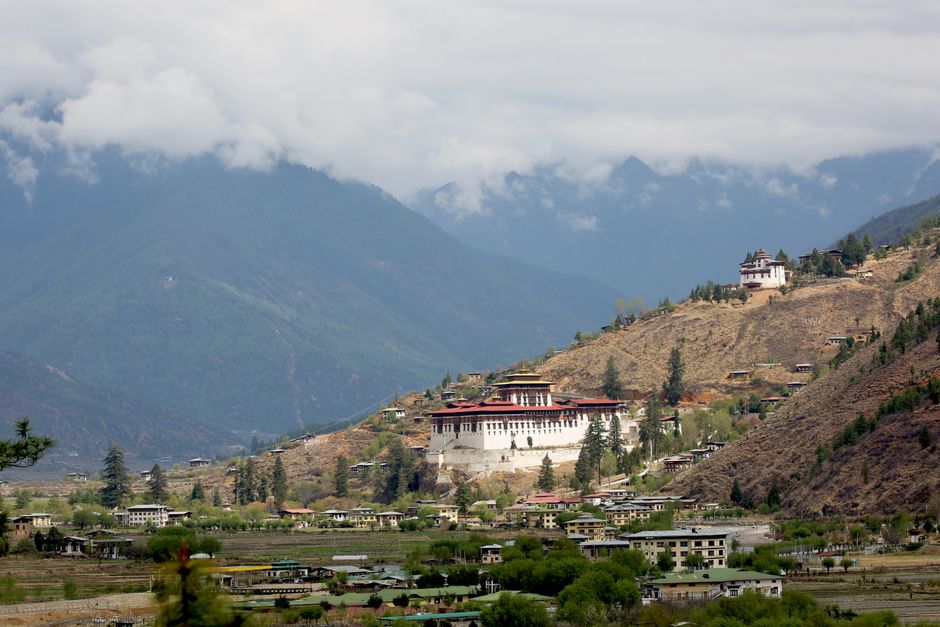
Paro is where almost every visitor to Bhutan begins and ends: a broad, fertile valley in the west of the kingdom, at about 2,200 m (7,300 ft), where the country’s only major international airport lies beside the Paro Chhu river among red-rice paddies, apple orchards and traditional three-story farmhouses with painted windows. Above the small town, the great fortress-monastery of Rinpung Dzong guards the valley, and the old watchtower behind it holds the National Museum. About 10 km (6 miles) north of town, the Taktsang Monastery, the Tiger’s Nest, clings to a cliff about 900 m (3,000 ft) above the valley floor, Bhutan’s most famous sight and one of the great walks of the Himalaya. Paro also has Kyichu Lhakhang, one of the oldest temples in the kingdom, the spring Paro Tshechu festival, the road over the Chele La pass to the Haa Valley, and the start of the Jomolhari and Druk Path treks. Like the rest of Bhutan, it is visited with a certified guide, and most visitors pay the US$100-per-night Sustainable Development Fee. The best months are October and November and March to May.
Right now in Paro
- Wed 9–20°C 48–68°F 3 mm Showers
- Thu 9–20°C 48–67°F 1 mm Partly cloudy
- Fri 9–15°C 49–59°F 5 mm Showers
Weather: MET Norway (CC BY 4.0)
Top tours in Paro
See all tours for Paro →
From local operators, with prices and reviews; you check availability and book on Viator, our partner. We may earn a commission at no extra cost to you. How we earn money
Paro at a glance
- Best for: the Tiger’s Nest hike, dzongs and temples, the Paro Tshechu, farmhouse stays and hot stone baths, and the start of treks.
- How long: 2 nights at the start or end of a trip, 3 with Chele La or Haa.
- Best time: October and November, for clear skies; March to May, for blossoms and the Paro Tshechu.
- Getting there: Paro International Airport (PBH) is just south of town; Thimphu is about an hour’s drive east.
- Getting around: by car with your driver and guide; the town center is walkable.
- Fees to know: the Tiger’s Nest costs Nu 1,000 to enter, according to the Department of Tourism, plus the daily Sustainable Development Fee for your stay in Bhutan.
- Before you go: the SDF, visa, guide rules, money and general safety are in our Bhutan travel guide.
Paro’s areas and where to stay
The Paro valley runs roughly northwest to southeast for about 25 km (15 miles), with the town, the airport and the dzong in the middle.
Paro town
A short main street of painted wooden shopfronts, handicraft shops, cafés and small hotels, with an archery ground and a weekend market by the river. It is convenient for evenings out and close to the dzong and museum.
The upper valley (toward Taktsang and Drukgyel)
North of town, the road passes Kyichu Lhakhang, farm villages and orchards toward the Tiger’s Nest trailhead and Drukgyel Dzong. Many of Paro’s best hotels and luxury lodges are here, in quiet locations with valley views, along with farmhouse homestays.
South of the airport and the Bondey area
Hotels on the hillsides south of the airport, near the Thimphu road, have views over the runway and the valley, handy for early flights.
Farmhouse homestays
Certified homestays in villages around the valley offer a night with a Bhutanese family, home cooking and often a hot stone bath.
Top things to see in Paro
Taktsang Monastery (the Tiger’s Nest)
According to legend, Guru Rinpoche flew here on the back of a tigress in the 8th century to subdue a local demon and meditated in a cave in the cliff; the temple complex built around the cave in 1692 clings to the rock face at about 3,100 m (10,200 ft), about 900 m (3,000 ft) above the valley. It was badly damaged by fire in 1998 and carefully rebuilt. The trail starts from a parking area at the end of the valley road and climbs about 500 m (1,640 ft) through pine forest hung with prayer flags, to a cafeteria and viewpoint roughly halfway and on to a lookout facing the monastery; a final section descends about 120 m (390 ft) of steps, past a waterfall, and climbs up again to the entrance. Allow 2 to 3 hours up and 1.5 to 2 hours down, plus time inside; start early to avoid the midday heat and the crowds. According to the Department of Tourism, the entry fee is Nu 1,000 (about US$10.40), and the monastery is open in the morning and afternoon with a break at midday. Bags, phones and cameras are left at a checkpoint before entering, and photography is not allowed inside. Horses can carry visitors part of the way up; since April 2023, the Paro district has required them to be booked in advance through the Taktsang services management group, and you must walk the final steps. Your guide must accompany you.
Rinpung Dzong
The “fortress on a heap of jewels,” built in 1646 by Zhabdrung Ngawang Namgyal, the founder of the Bhutanese state, houses Paro’s monastic body and district offices. Walk down to it over the covered cantilever bridge, Nyamai Zam, admire the carved woodwork and murals in its courtyards, and visit during the Paro Tshechu, when the courtyard and the ground below fill with dancers and crowds. Entry is free, according to the Department of Tourism’s fee list.
The National Museum (Ta Dzong)
The round watchtower above Rinpung Dzong became the National Museum in 1968; it and a new building beside it display thangka paintings, masks, textiles, weapons, stamps and natural history. Entry is Nu 300.
Kyichu Lhakhang
One of the oldest and most sacred temples in Bhutan, traditionally dated to the 7th century, when the Tibetan king Songtsen Gampo is said to have built 108 temples to pin down a demoness lying across the Himalaya. Its orange trees and prayer wheels make a peaceful stop on the way up the valley. Entry is Nu 500.
Drukgyel Dzong and the upper valley
At the head of the valley, the fortress of Drukgyel was built in the 17th century to commemorate a victory over Tibetan invaders and long stood in ruins after a fire in 1951; it has been rebuilt. On clear days, the snow peak of Jomolhari, about 7,300 m (24,000 ft), appears behind it.
More classic sights
- Dungtse Lhakhang: a temple shaped like a chorten, built in 1421 by the bridge-builder saint Thangtong Gyalpo.
- Tachogang Lhakhang: a temple beside the Paro Chhu on the road to Thimphu, reached by an iron-chain bridge in the style of Thangtong Gyalpo (Nu 500).
- Jangtsa Dumtseg Lhakhang: a small chorten-shaped temple near town (free).
- Dobji Dzong: a quiet former fortress on a hilltop south of Paro, on the old road to Haa (free).
- Paro town and the archery ground: watch Bhutan’s national sport, played over 145 m (476 ft) with traditional bamboo or modern bows, often accompanied by songs and dances.
Other things to do in Paro
The Paro Tshechu
Paro’s five-day festival in spring, usually in March or April, is one of the largest in Bhutan, with masked dances in the dzong courtyard and, before dawn on the last day, the unrolling of a giant thangka, the thongdrel, which is said to bless all who see it. Dates follow the lunar calendar; check the Department of Tourism’s festival calendar and book hotels early.
Chele La and the Haa Valley
The road over Chele La, at about 3,990 m (13,090 ft), one of the highest motorable passes in Bhutan, climbs through forest and prayer flags to views of Jomolhari and Jichu Drake on clear mornings, with short hikes along the ridge. Beyond it, the quiet Haa Valley has farmhouse stays, the White and Black Temples (Lhakhang Karpo and Lhakhang Nagpo) and a summer festival.
Hot stone baths and farmhouse dinners
A dotsho, a traditional bath in a wooden tub heated with river stones roasted in a fire and infused with medicinal herbs, is a Paro specialty, offered at farmhouses and hotels. Many farmhouses also serve home-cooked dinners of red rice, ema datshi and butter tea.
Food and drink
Paro’s restaurants serve Bhutanese dishes, usually milder for visitors unless you ask: try ema datshi (chilies and cheese), red rice, shakam paa (dried beef with chilies), momos and suja (butter tea). Cafés in town serve coffee and cakes, and a local distillery and breweries produce whisky and craft beer.
Hiking and cycling
Easy walks lead through the valley’s villages and orchards, and longer hikes climb to Zuri Dzong above town or to the Bumdra monastery above Taktsang, an overnight camp. Mountain bikers ride the valley roads and the descent from Chele La. See our hiking and cycling guides.
Day trips and treks from Paro
- Thimphu: the capital, about an hour east. See our Thimphu guide.
- Haa Valley: about 2.5 hours over the Chele La, best with a night.
- The Druk Path trek: a 5- to 6-day trek over the hills between Paro and Thimphu, past high lakes and with views of the Himalaya.
- The Jomolhari trek: 7 to 9 days from Drukgyel Dzong to the base camp of Jomolhari, crossing passes above 4,800 m (15,700 ft).
- Punakha: about 3.5 to 4 hours east via Thimphu and the Dochula pass.
Nearby destinations
- Thimphu22 km
- Darjeeling122 km
- Sagarmatha National Park (Everest Region)273 km
- Lhasa298 km
Getting there and getting around
By air
Paro International Airport (PBH), a few minutes from town, is Bhutan’s main international gateway, served by Drukair and Bhutan Airlines from cities including Bangkok, Delhi, Kolkata, Bagdogra, Bodh Gaya, Dhaka, Kathmandu, Guwahati, Dubai and Singapore, according to the Department of Tourism. The narrow, mountain-ringed approach is flown only in daylight by specially trained pilots, and flights are sometimes delayed by weather. The Department of Tourism has a visitor information center at the airport, where you can change money and buy a SIM card. Your guide and driver meet you outside arrivals.
By road
Paro is about 50 km (31 miles), roughly an hour, from Thimphu, and about 4 to 5 hours from the Indian border at Phuentsholing. There is no public transport for tourists; you travel with your driver and guide, or by taxi from the airport.
When to go and how long to stay
Paro has a temperate climate with four seasons. Autumn, from late September to November, brings dry, sunny days, cold nights and the best views of Jomolhari. Winter, from December to February, is dry and sunny, but nights fall below freezing. Spring, from March to May, is mild, with fruit blossom and the Paro Tshechu. Summer, from June to September, is the wettest season, though Paro gets far less rain than southern Bhutan. The table shows averages published by Bhutan’s National Center for Hydrology and Meteorology (NCHM) for the Paro station on the World Meteorological Organization’s (WMO) World Weather Information Service, based on 1996–2018; NCHM has not published 1991–2020 normals there.
| Month | Average high / low | Rain (rainy days) | What to expect |
|---|---|---|---|
| January | 13 °C (55 °F) / −1 °C (29 °F) | 8 mm (0.3 in), 1 day | Cold, sunny and dry; frosty mornings |
| February | 14 °C (58 °F) / 1 °C (33 °F) | 13 mm (0.5 in), 2 days | Cold; Losar; occasional snow on the hills |
| March | 17 °C (63 °F) / 4 °C (39 °F) | 21 mm (0.8 in), 4 days | Mild; blossom; Paro Tshechu in some years |
| April | 20 °C (68 °F) / 7 °C (45 °F) | 29 mm (1.2 in), 6 days | Pleasant; Paro Tshechu in some years; busy |
| May | 22 °C (72 °F) / 11 °C (51 °F) | 58 mm (2.3 in), 10 days | Warm; afternoon showers |
| June | 24 °C (76 °F) / 14 °C (57 °F) | 71 mm (2.8 in), 13 days | Monsoon begins; green fields |
| July | 24 °C (76 °F) / 15 °C (60 °F) | 120 mm (4.7 in), 18 days | Wettest month; cloud on the hills |
| August | 24 °C (76 °F) / 15 °C (59 °F) | 111 mm (4.4 in), 17 days | Wet; rice growing |
| September | 23 °C (74 °F) / 14 °C (57 °F) | 82 mm (3.2 in), 13 days | Rains easing late in the month |
| October | 21 °C (69 °F) / 9 °C (48 °F) | 47 mm (1.8 in), 4 days | Clear and mild; peak season |
| November | 17 °C (62 °F) / 4 °C (39 °F) | 1 mm (under 0.1 in), under 1 day | Crisp, dry and clear |
| December | 15 °C (58 °F) / 0 °C (33 °F) | 3 mm (0.1 in), under 1 day | Cold and sunny; quiet |
2 days in Paro
Day one, Rinpung Dzong, the National Museum and Kyichu Lhakhang, with an evening in town or a hot stone bath. Day two, the Tiger’s Nest hike, starting early, and a farmhouse dinner.
3 days with Chele La
Add a morning drive to Chele La for the mountain views and a ridge walk, continuing to the Haa Valley for the afternoon or overnight.
Where to stay in Paro
- Paro town: small hotels and guesthouses within walking distance of cafés, shops and the dzong.
- The upper valley: mid-range hotels and luxury lodges among fields and pine forest, close to the Tiger’s Nest trailhead.
- Hillsides south of the airport: hotels with valley views, convenient for flights and the Thimphu road.
- Farmhouse homestays: certified family homes for a night of village life.
All tourist accommodation must be certified by the Department of Tourism. Rooms are scarce during the Paro Tshechu; book months ahead.
What a trip to Paro costs
Prices are approximate, for October 2026, converted at about Nu 96 to the US dollar. Entry fees are those published by the Department of Tourism.
| Item | Typical cost |
|---|---|
| Sustainable Development Fee, adult, per night | US$100 |
| Taktsang (Tiger’s Nest) entry | Nu 1,000 (about US$10.40) |
| National Museum | Nu 300 (about US$3.10) |
| Kyichu Lhakhang | Nu 500 (about US$5.20) |
| Rinpung Dzong | Free |
| Horse to the Taktsang halfway point, booked in advance | Nu 1,000–2,000 (about US$10–21) |
| Hot stone bath at a farmhouse | Nu 1,500–3,000 (about US$16–31) |
| Lunch in a local restaurant | Nu 300–700 (about US$3.10–7.30) |
| Three-star hotel double, per night | Nu 5,000–12,000 (about US$52–125) |
Practical tips for Paro
- Do the Tiger’s Nest on your last full day: it helps to acclimatize to the altitude first.
- Start the hike by 8 a.m.: for cooler air, softer light and fewer people.
- Wear proper shoes: the trail is steep, dusty or muddy, and the steps near the monastery are uneven.
- Dress for the dzongs and temples: long sleeves and long trousers or skirts; your guide wears a ceremonial scarf.
- Book horses ahead: if you need one for the Tiger’s Nest, ask your operator to reserve it through the management group.
Safety
Paro is very safe, with little crime. The main things to watch are the altitude, as the valley is at about 2,200 m (7,300 ft) and the Tiger’s Nest at about 3,100 m (10,200 ft), so walk slowly and drink water; the steep trail to Taktsang, which has drop-offs near the monastery and can be slippery after rain; and weather delays at the airport, which affect flights in cloud and wind. In the monsoon, from June to September, landslides can close roads, including the Chele La road. Stray dogs bark at night and occasionally chase walkers; keep your distance. For emergencies, call 113 for police, 112 for an ambulance and 110 for fire; the Department of Tourism’s hotline is +975 17661974.
What to pack for Paro
Warm layers for cold mornings and evenings in every season, a down jacket from November to March, sturdy walking shoes for the Tiger’s Nest, a hat and sunscreen for the strong mountain sun, a rain jacket from June to September, and long sleeves and long trousers or skirts for temples and dzongs. Bhutan uses 230 V, with British (type G), European (type C) and Indian (type D) sockets. See our hiking shoes, rain jackets and travel adapters guides.
Paro travel FAQ
How long is the hike to the Tiger’s Nest?
About 2 to 3 hours up and 1.5 to 2 hours down, climbing about 500 m (1,640 ft) to a monastery at about 3,100 m (10,200 ft). Allow 5 to 6 hours in total with the visit.
How much does it cost to visit the Tiger’s Nest?
The entry fee is Nu 1,000 (about US$10.40), according to the Department of Tourism, in addition to the daily Sustainable Development Fee and your guide.
Can I take a horse up to the Tiger’s Nest?
Part of the way, to about the halfway point. Horses must be booked in advance through the Taktsang services management group, a rule introduced by the Paro district in April 2023.
Can I take photos inside the Tiger’s Nest?
No. Cameras and phones are left at a checkpoint before you enter the temples, but you can photograph the monastery from the viewpoint opposite.
How many days do I need in Paro?
Two nights for the Tiger’s Nest, Rinpung Dzong, the museum and Kyichu Lhakhang; three with Chele La or Haa.
When is the Paro Tshechu?
In spring, usually in March or April, on dates set by the lunar calendar. Check the Department of Tourism’s festival calendar.
How far is Paro from Thimphu?
About 50 km (31 miles), around an hour by car.
Do I need a guide in Paro?
Yes. According to the Department of Tourism, visitors must be accompanied by a certified guide at all times, including at monuments and dzongs.
Why is Paro airport famous?
It lies in a narrow valley surrounded by mountains, so only specially trained pilots fly the approach, in daylight, with sharp turns before landing.
What is the best time to visit Paro?
October and November for clear skies, and March to May for blossoms and the Paro Tshechu.
Sources and last review
Researched and last reviewed on 4 October 2026. The Sustainable Development Fee, guide rules, airlines and routes, the airport visitor center, the Taktsang horse-booking rule (April 2023), monument fees (Taktsang, National Museum, Kyichu Lhakhang, Tachogang, free entry to Rinpung Dzong, Jangtsa Dumtseg and Dobji Dzong) and emergency numbers: Bhutan’s Department of Tourism (bhutan.travel and its monument and museum fee list); exchange rate: the Royal Monetary Authority of Bhutan; climate data for Paro: Bhutan’s National Center for Hydrology and Meteorology (1996–2018), via the World Meteorological Organization’s World Weather Information Service. Historical dates, legends, altitudes, hiking times, festival timing, Drukgyel Dzong’s reconstruction, the airport approach, travel times, horse, bath, food and hotel prices are general references or estimates, flagged for checking. Fees and hours change, so check with your guide or the official sites before you go. For the SDF, visa, guide rules, money and general safety, see our Bhutan travel guide.
Plan your trip
Partner links: TravelerCenter may earn a commission if you book, at no extra cost to you.