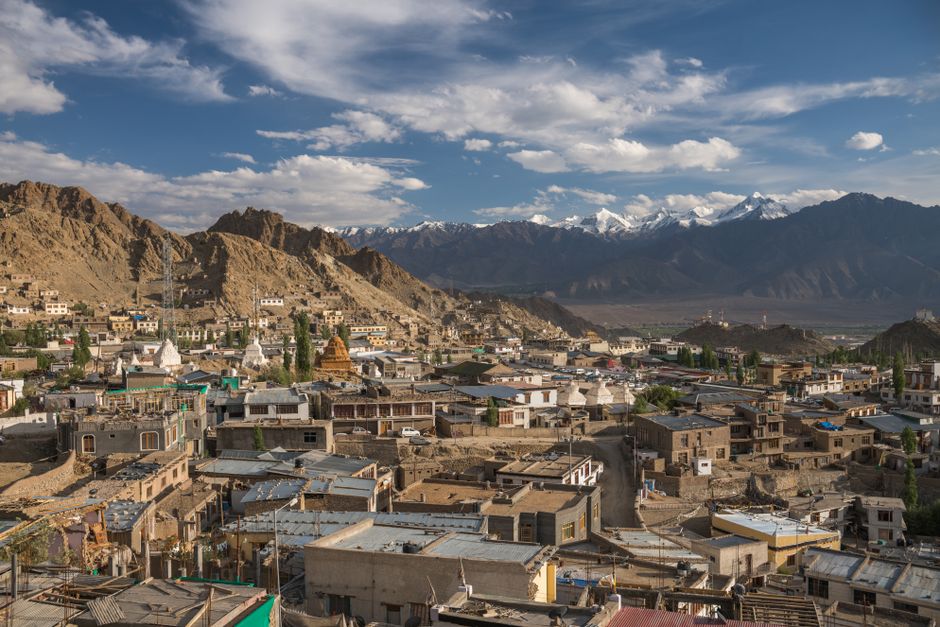
Leh, the main town of Ladakh, lies at about 3,500 m (11,500 ft) in a broad, sunny valley above the Indus River, ringed by bare brown mountains and snow peaks in the far north of India. For centuries it was a stop on the caravan routes between Punjab and Central Asia and between Kashmir and Tibet, and its old town, dominated by the nine-story Leh Palace, still feels closer to Tibet than to the plains of India. Around it, whitewashed Buddhist monasteries such as Thiksey, Hemis and Shey cling to ridges above green oases of barley fields, poplars and apricot orchards. Ladakh opened to tourism only in 1974, with 527 visitors that first year, according to the Leh district administration; today it is one of India’s great adventure destinations, the base for road trips over high passes to the Nubra Valley and the blue lake of Pangong Tso, for treks and river trips, and for monastery festivals with masked dances. Leh’s altitude demands care: every visitor must rest and acclimatize on arrival. Foreign visitors also need a permit for many of the most famous places beyond Leh. The main season runs from May to September; winters are long and extremely cold.
Right now in Leh (Ladakh) (Leh)
- Wed 3–11°C 38–52°F 1 mm Mostly clear
- Thu 3–11°C 37–52°F 2 mm Light rain
- Fri 2–8°C 35–46°F 1 mm Light showers
Weather: MET Norway (CC BY 4.0) · Air quality: OpenAQ
Top tours in Leh (Ladakh)
See all tours for Leh (Ladakh) →
From local operators, with prices and reviews; you check availability and book on Viator, our partner. We may earn a commission at no extra cost to you. How we earn money
Leh at a glance
- Best for: Buddhist monasteries and festivals, high-mountain scenery, road trips over high passes, trekking, rafting and stargazing.
- How long: at least 5 to 7 days, including two days of rest to acclimatize, Leh and the Indus Valley monasteries, and trips to Nubra and Pangong.
- Best time: May to September; June to August is peak season, and September is clear and quieter.
- Getting there: daily flights from Delhi (about 1 hour) and other cities to Leh’s Kushok Bakula Rimpochee Airport; by road from Srinagar or Manali in summer.
- Getting around: on foot in town; by taxi from the local union, or by rented motorbike, for monasteries and valleys.
- Good to know: foreign visitors need a Protected Area Permit for Nubra, Pangong, Tso Moriri and other areas, and all tourists pay an environmental fee; both are handled online through the Leh district’s permit system.
- Before you go: the e-Visa, the online e-Arrival card, money and general safety are in our India travel guide.
Leh’s town and valley: where things are
Leh is a small town, and most hotels and guesthouses are within walking distance of the Main Bazaar, though some lanes climb steeply.
Main Bazaar and the old town
The broad Main Bazaar, laid out wide enough for caravans of horses, donkeys and camels, is the center of town, lined with shops, cafés, travel agencies and stalls where village women sell fresh vegetables. Behind it, the old town of mud-brick houses and stupas climbs toward the palace. Guesthouses and small hotels are packed into the surrounding lanes.
Changspa
Northwest of the center, Changspa is a green suburb of guesthouses, homestays, cafés and gardens along the road to the Shanti Stupa. It is quieter than the bazaar and popular with independent travelers.
The Indus Valley
Upriver and downriver from Leh, villages such as Shey, Thiksey, Stok, Saboo and Nimmu have homestays, camps and boutique hotels, convenient for the monasteries and peaceful in the evenings.
Top things to do in Leh
Leh Palace
Built in the 1630s by King Sengge Namgyal, Ladakh’s most famous ruler, Leh Palace rises nine stories from the rocky ridge above the old town, its inward-leaning walls in the same tradition as the Potala Palace in Lhasa, which it predates. The royal family moved to Stok in the 19th century, and much of the interior is bare and partly ruined, but visitors can climb through dim corridors to the rooftop for sweeping views of Leh, the Indus Valley and the Stok Kangri range. The palace is protected by the Archaeological Survey of India (ASI); on its booking site, foreigners pay ₹250 online and Indian citizens ₹20.
Namgyal Tsemo and the Victory Fort
Above the palace, the 16th-century Tsemo Fort and the red Namgyal Tsemo Gompa crown the ridge, strung with prayer flags. The climb is steep, so leave it until you have acclimatized; the reward is the best view in Leh.
Shanti Stupa
On a hill above Changspa, this white stupa was built by Japanese Buddhists in the 1980s and inaugurated by the Dalai Lama. Climb the steps or drive up for sunset over the town and the mountains.
The Indus Valley monasteries
Several of Ladakh’s most important monasteries stand along the Indus, within an hour of Leh. Each typically sits on a hill above its village, with temples and assembly halls at the top and monks’ quarters spilling down the slope. They are active places of worship, so dress modestly, walk clockwise around shrines, and ask before taking photographs inside.
- Thiksey: a monastery that rises in tiers up a hill like a small Potala, about 19 km (12 miles) southeast, famous for its morning prayers and a two-story statue of the future Buddha, Maitreya.
- Hemis: the largest and richest monastery in central Ladakh, founded in the 1630s by King Sengge Namgyal, about 45 km (28 miles) southeast. Its summer festival honors Guru Padmasambhava, and every 12 years it unveils an enormous embroidered thangka; the last unveiling was in 2016.
- Shey: the ancient capital, about 15 km (9 miles) southeast, with a ruined palace and a giant late 17th-century statue of the Buddha.
- Stok Palace: the residence of the former royal family since the 19th century, about 15 km (9 miles) south, with a museum of thangkas, jewelry, the king’s crown and ceremonial robes.
- Matho: the only monastery of the Sakya order in Ladakh, known for its oracle festival in February or March.
Alchi, Likir and Lamayuru
West of Leh, along the road to Kargil and Srinagar, Alchi has temples with some of the finest early Buddhist murals in the Himalayas, from around the 11th century. Likir has a large golden statue of Maitreya, and Lamayuru, about 125 km (78 miles) from Leh, sits above a strange eroded landscape known as “moonland.” These monasteries along the main highway are generally open to foreigners without a protected area permit, although villages off the highway, such as Dha and Hanu, need one.
Other things to do in Leh
Road trips to Nubra and Pangong
The most famous trips from Leh cross high passes into protected areas. The Nubra Valley, north over the Khardung La pass, has sand dunes with Bactrian camels at Hunder, the monastery of Diskit with its giant Buddha statue, and, for those with the right permit, the Balti village of Turtuk. Pangong Tso, east over the Chang La pass, is a long, narrow high-altitude lake whose color shifts from turquoise to deep blue, stretching far to the east. Both are usually done as overnight trips, staying in camps and guesthouses, and some itineraries link them via the Shyok valley. Tso Moriri, a quieter high lake to the southeast, and Hanle, known for its dark skies and observatory, are longer trips. For foreigners, all of these require a Protected Area Permit.
Trekking and rafting
Treks range from village walks to the Markha Valley trek in Hemis National Park. Rafting on the Indus and Zanskar rivers runs in summer, from gentle stretches near Nimmu to more serious rapids. Use registered agencies and guides, and never trek high before acclimatizing. See our hiking guide.
Wildlife and stargazing
Hemis National Park is home to the snow leopard, Ladakh’s state animal, and winter tours, from about January to March, offer a chance to see one. Black-necked cranes nest around the high lakes, and blue sheep, ibex and marmots are common. Clear, dry air makes Ladakh one of the best places in India for stargazing.
Festivals
Many monastery festivals, with masked dance-dramas performed by monks in the courtyards, take place in winter, while the best known, Hemis Tsechu, is in June or July. The Leh district’s calendar also lists the Ladakh Polo Festival in July, the Ladakh Marathon and the week-long Ladakh Festival in September, and the Thiksey festival in November. Losar, the Ladakhi New Year, falls around the winter solstice. Dates follow the Tibetan lunar calendar and change each year.
Food and drink
Ladakhi and Tibetan food is warming and simple: momos (dumplings), thukpa (noodle soup), skyu (a hearty pasta stew with vegetables), khambir (a thick local bread), and salty butter tea, or gur gur cha. Apricots, fresh in August and dried year-round, and sea buckthorn juice are local specialties. Go easy on alcohol, especially in your first days at altitude.
Day trips from Leh
- Thiksey, Shey and Hemis: the classic Indus Valley monastery day, east of Leh.
- Stok Palace and Matho: a royal museum and a hilltop monastery across the Indus.
- Alchi, Likir and the Indus–Zanskar confluence: a long day west along the Srinagar road, about 70 km (43 miles) to Alchi.
- Lamayuru: a full day, about 125 km (78 miles) west.
- Srinagar: about 434 km (270 miles) west by road in summer, over the Zoji La. See our Srinagar travel guide.
Permits, fees and getting there
Permits for foreign visitors
Large parts of Ladakh near the international borders are protected areas. According to the Bureau of Immigration, foreigners need a Restricted or Protected Area Permit for parts of the Union Territory of Ladakh, and the e-Visa site states that an e-Visa is not valid for protected, restricted or cantonment areas without prior permission from the civil authority. In practice, for Leh district this means a Protected Area Permit (PAP) for places such as Nubra (including Khardung La, Hunder and Turtuk), Pangong, Tso Moriri and Hanle. The permit is issued by the district administration through the official Leh district permit system at lahdclehpermit.in, which has a separate registration for overseas visitors, and is usually arranged through a registered Leh travel agency; the portal says permits done through a local agent get a 10% discount on the total fees. Citizens of some countries (including Pakistan, China, Afghanistan, Bangladesh, Myanmar and Sri Lanka) and holders of diplomatic or official passports need permission from the central government instead. Rules on group size, validity and the villages open to foreigners change, so check with your agency before you book. Leh town, the Indus Valley monasteries and the main highway west to Alchi and Lamayuru generally do not need a protected area permit.
The environmental fee
All tourists visiting Leh district pay an environmental (green) fee collected by the Ladakh Autonomous Hill Development Council (LAHDC), set at ₹400 per person in the council’s 2021 notice. The district has confirmed that the existing fee structure continues and includes the environmental fee, a Red Cross contribution and a wildlife fee, all payable online on the same portal, so you do not need to visit a government office. The administration has warned that some private agencies have issued fake fee slips, so pay through the official portal or a registered agency and keep the receipt.
By air
Kushok Bakula Rimpochee Airport (IXL), about 4 km (2.5 miles) south of the bazaar, has daily flights from Delhi, taking about an hour, and from cities such as Mumbai, Srinagar, Jammu and Chandigarh. Flights can be canceled in bad weather. Leh is not a designated e-Visa entry airport, so international visitors land first in Delhi or another designated airport.
By road
According to the Leh district administration, two main roads reach Leh: the Srinagar–Leh highway (434 km, 270 miles), via Drass and Kargil, usually open from May to November or December, and the Manali–Leh highway (473 km, 294 miles), via Keylong and high passes, usually open from May or June to September or October. A third route from Manali runs via Darcha and Zanskar.
Around Leh
Taxis from the local taxi union, with fixed rates for set routes, are the usual way to visit monasteries and valleys; motorbike rental is popular but demands experience on mountain roads.
When to go and how long to stay
Leh has a cold, high-altitude desert climate with very little rain or snow and intense sunshine. May to September is the travel season: days are sunny and warm, with highs of 20 to 28 °C (68 to 83 °F), but nights are cool, and the high passes can see snow at any time. June to August is busiest; the region is in the rain shadow of the Himalayas, but occasional heavy summer storms can cause flash floods and mudslides. October is crisp and quiet, with frosty nights. November to March is bitterly cold, with average lows of −13 °C (8 °F) in January and much lower in the valleys; many hotels close, though winter tours for snow leopards and monastery festivals continue. The table shows 1991–2020 normals for the Leh station from the India Meteorological Department (IMD), as published by the World Meteorological Organization (WMO); rainy days are days with at least 2.5 mm of rain or snow (as water).
| Month | Average high / low | Rain (rainy days) | What to expect |
|---|---|---|---|
| January | 2 °C (35 °F) / −13 °C (8 °F) | 4 mm (0.2 in), under 1 day | Bitterly cold; winter festivals |
| February | 4 °C (40 °F) / −9 °C (15 °F) | 2 mm (0.1 in), under 1 day | Very cold; snow leopard tours |
| March | 10 °C (49 °F) / −4 °C (25 °F) | 2 mm (0.1 in), under 1 day | Cold; first signs of spring |
| April | 15 °C (60 °F) / 2 °C (35 °F) | 2 mm (0.1 in), under 1 day | Cool; apricot blossom |
| May | 20 °C (68 °F) / 6 °C (43 °F) | 1 mm, under 1 day | Season begins; roads opening |
| June | 24 °C (76 °F) / 11 °C (52 °F) | 3 mm (0.1 in), under 1 day | Sunny and warm; Hemis festival in some years |
| July | 28 °C (83 °F) / 16 °C (61 °F) | 7 mm (0.3 in), under 1 day | Peak season; occasional storms |
| August | 28 °C (83 °F) / 15 °C (59 °F) | 6 mm (0.2 in), under 1 day | Peak season; warmest month |
| September | 23 °C (74 °F) / 9 °C (49 °F) | 4 mm (0.2 in), under 1 day | Clear and dry; Ladakh Festival |
| October | 17 °C (62 °F) / 0 °C (33 °F) | 2 mm (0.1 in), under 1 day | Crisp days, freezing nights |
| November | 11 °C (51 °F) / −7 °C (19 °F) | 1 mm, under 1 day | Cold; many hotels close |
| December | 4 °C (40 °F) / −12 °C (11 °F) | 1 mm, under 1 day | Bitterly cold; Losar |
The station records only about 35 mm (1.4 in) of precipitation a year.
A week in Leh
Days one and two: rest, then gentle walks in the bazaar, Changspa and the Shanti Stupa. Day three: Leh Palace, Tsemo and the old town. Day four: Thiksey, Shey and Hemis. Days five and six: over the Khardung La to Nubra, with a night at Hunder. Day seven: back to Leh, or on to Pangong for a night by the lake.
Ten days or more
Add Pangong and Tso Moriri, Alchi and Lamayuru, a trek in the Markha Valley, or rafting on the Indus or Zanskar.
Where to stay in Leh
- Main Bazaar and old town: guesthouses and small hotels close to everything.
- Changspa: quieter guesthouses, homestays and cafés with garden views.
- Indus Valley villages: homestays and boutique stays near the monasteries.
- Nubra and Pangong: camps and simple guesthouses for overnight trips.
According to the district administration, Leh district has about 317 hotels, 691 guesthouses, 1,055 homestays and 105 camps. Many close from November to March; check heating and hot water if you travel outside summer.
What a trip to Leh costs
Prices are approximate, for October 2026, converted at about 96 rupees (₹) to the US dollar. The Leh Palace fee is the ASI’s online price, and the environmental fee is from the LAHDC; the rest are estimates.
| Item | Typical cost |
|---|---|
| Leh environmental (green) fee, per person | ₹400 (about US$4.20) |
| Leh Palace, foreigners online | ₹250 (about US$2.60) |
| Monastery entry (Thiksey, Hemis and others) | ₹50–200 each (about US$0.50–2) |
| Taxi for an Indus Valley monastery day | ₹3,000–4,500 (about US$31–47) |
| Two-day taxi trip to Nubra | ₹10,000–16,000 per vehicle (about US$104–167) |
| Motorbike rental, per day | ₹1,200–2,500 (about US$12.50–26) |
| Thukpa or momos in a local restaurant | ₹150–350 (about US$1.60–3.60) |
| Mid-range hotel double, per night (summer) | ₹3,500–9,000 (about US$36–94) |
Practical tips for Leh
- Acclimatize first: rest for at least 48 hours after flying in, before any exertion or trips over the passes.
- Arrange permits early: agencies can apply on the official portal; carry several photocopies for checkpoints.
- Respect the environment: carry a water bottle and bag, take waste back to Leh, and do not drive off-road.
- Respect wildlife: do not feed animals, and the district asks visitors not to geotag photos of wildlife, to prevent poaching.
Safety
Leh is very safe in terms of crime, but its environment is demanding. Altitude is the main risk: the Leh district’s health guidance says that all visitors arriving in Leh must rest for at least 48 hours to acclimatize before going to higher areas, avoid physical exertion on the first two days, drink 2 to 3 liters of water a day, and avoid alcohol, smoking and sedatives. Warning signs of altitude sickness include headache, nausea, loss of appetite, disturbed sleep and breathlessness. High-altitude pulmonary and cerebral edema (HAPE and HACE) can be life-threatening: seek a doctor immediately and descend if symptoms worsen. The guidance mentions preventive medicine; ask your own doctor before you travel. Mountain roads are narrow, unpaved in places and cross passes above 5,000 m (16,400 ft); travel with experienced local drivers, and do not attempt the Manali or Srinagar roads in bad weather or out of season. Weather: summer cloudbursts can cause flash floods and mudslides, and snow can close passes even in June or September; winter closes the highways. Local rules: restrictions in protected and border areas, and local administrative orders, can change at short notice; follow instructions at checkpoints and from your agency. In an emergency, call 112.
What to pack for Leh
Warm layers even in summer: a fleece, a down jacket, hat and gloves for the passes and nights; sturdy walking shoes; sunglasses with UV protection, high-factor sunscreen and lip balm against strong sun; a reusable water bottle; a headlamp for power cuts; and copies of your passport, visa and permits. India uses 230 V, with round-pin plugs of types C, D and M. See our hiking shoes and travel adapters guides.
Leh travel FAQ
Do foreigners need a permit for Leh?
Not for Leh town and the Indus Valley monasteries, but foreigners need a Protected Area Permit for Nubra, Pangong, Tso Moriri, Hanle and other protected areas, usually arranged through a registered Leh travel agency on the district’s official permit portal.
How much is the Leh environmental fee?
The LAHDC set the environmental (green) fee at ₹400 per person in 2021, and the district says the current fee also includes a Red Cross contribution and a wildlife fee. Pay online on the official portal.
Is an e-Visa valid for Nubra and Pangong?
Not on its own. The e-Visa is not valid for protected areas without prior permission, so you need a Protected Area Permit in addition to your visa.
How do I avoid altitude sickness in Leh?
Rest for at least 48 hours after arriving by air, drink plenty of water, avoid alcohol and exertion, and see a doctor if symptoms get worse.
What is the best time to visit Leh?
May to September. June to August is busiest; September is clear and quieter.
How do I get to Leh?
By daily flights from Delhi and other cities, or by road from Srinagar or Manali in summer.
When are the Manali–Leh and Srinagar–Leh roads open?
The Leh district says the Srinagar road is usually open from May to November or December, and the Manali road from May or June to September or October.
How many days do I need in Leh?
At least five to seven days, including two days of rest, the monasteries and an overnight trip to Nubra or Pangong.
Can I visit Leh in winter?
Yes, with flights, but it is very cold, many hotels close, and the highways are shut. Winter brings monastery festivals and snow leopard tours.
Is Leh safe for tourists?
Yes, crime is low. The real risks are altitude, mountain roads and sudden weather changes, so acclimatize and travel with experienced drivers.
Sources and last review
Researched and last reviewed on 4 October 2026. Protected area permits for foreigners, the environmental fee, the fake-slip warning and the health guidance: the Leh District Tourist Management System (lahdclehpermit.in) of the LAHDC and District Administration Leh; road seasons, acclimatization, accommodation numbers, monasteries and festivals: the Leh district administration; permit requirements and the e-Visa’s validity for protected areas, and designated e-Visa airports (not including Leh): the Bureau of Immigration; Leh Palace fees: the Archaeological Survey of India’s e-ticket booking site; Leh Palace and the monasteries: Incredible India (Ministry of Tourism); climate normals for the Leh station: the India Meteorological Department, via the World Meteorological Organization (1991–2020 normals archived by NOAA’s National Centers for Environmental Information); altitude: Wikidata; the exchange rate: the Reserve Bank of India (FBIL reference rate). Permit group-size and validity rules, the wildlife fee amount, monastery fees, distances and typical prices are general references or estimates, flagged for checking. Prices, rules and hours change, so check locally before you go. For the e-Visa and money, see our India travel guide.
Plan your trip
Partner links: TravelerCenter may earn a commission if you book, at no extra cost to you.
🇮🇳 Useful Hindi phrases for Leh (Ladakh)
All 38 Hindi phrases: restaurant, hotel, emergencies, romance (printable) →