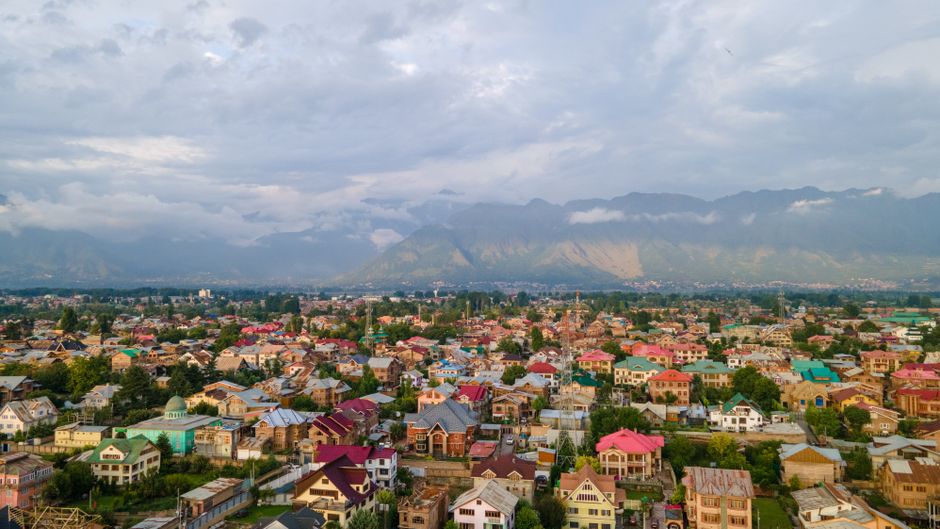
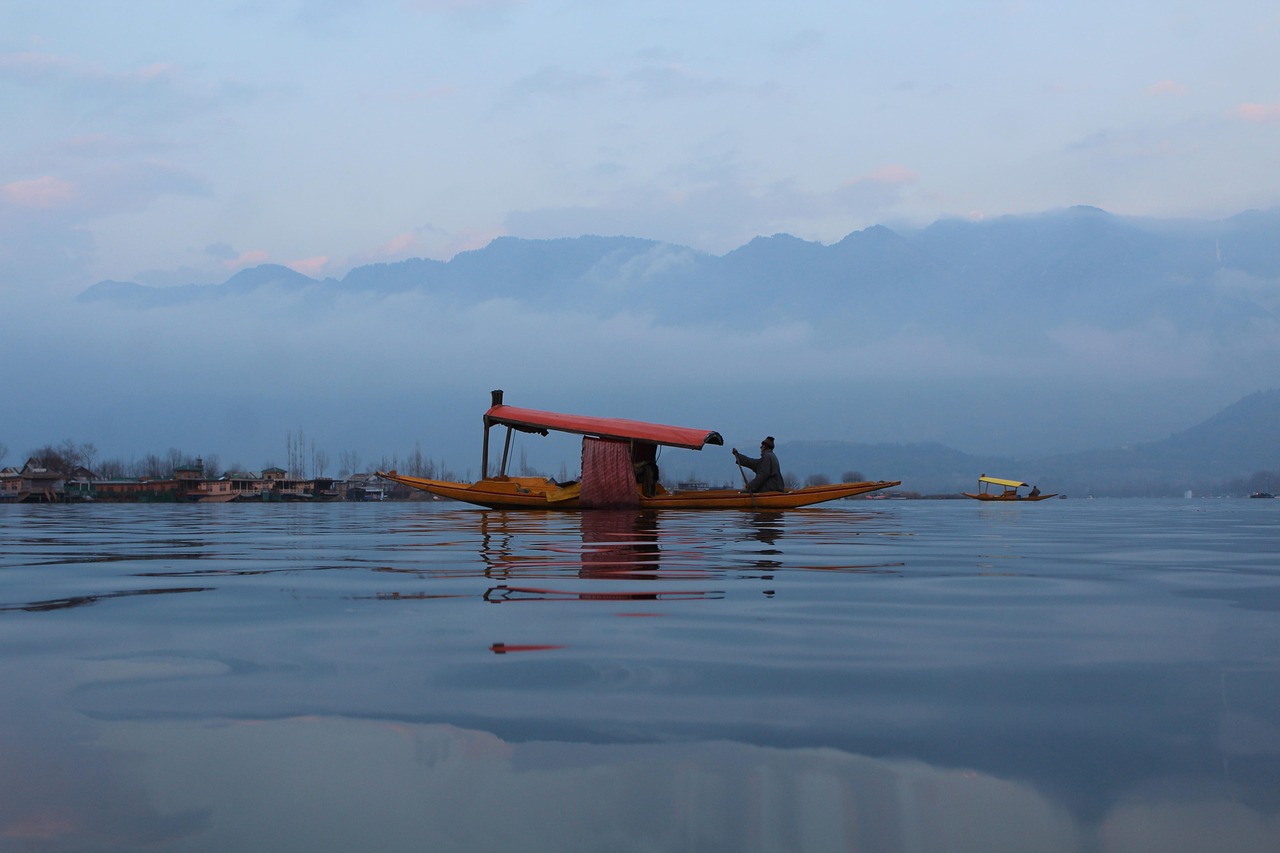
Srinagar, the summer capital of Jammu and Kashmir, spreads along the Jhelum River and the shores of Dal Lake at about 1,600 m (5,200 ft) in the Kashmir Valley, ringed by the Zabarwan range and the snow peaks of the Pir Panjal. It is a city of water and gardens: carved wooden houseboats moored in rows along the lake, painted shikara boats gliding past floating gardens and vegetable markets, terraced Mughal gardens laid out by emperors in the 17th century, and an old city of wooden mosques, shrines and bazaars selling papier-mâché, carpets and pashmina. Founded, according to ancient chronicles, in the time of the emperor Ashoka and rebuilt by King Pravarasena II, Srinagar has been ruled by Hindu and Buddhist kings, sultans, Mughals, Afghans, Sikhs and Dogras, and each left its mark. With more than a million people, it is the largest city in the Himalayas and the base for day trips to the meadows of Gulmarg, Sonamarg and Pahalgam. Each season has its draw: tulips in spring, cool summers, golden chinar trees in autumn and snow in winter. The main travel season runs from April to October.
Right now in Srinagar
- Wed 13–21°C 55–71°F 3 mm Mostly clear
- Thu 10–23°C 50–73°F 1 mm Light showers
- Fri 9–21°C 48–70°F Clear
Weather: MET Norway (CC BY 4.0)
Top tours in Srinagar
See all tours for Srinagar →
From local operators, with prices and reviews; you check availability and book on Viator, our partner. We may earn a commission at no extra cost to you. How we earn money
Srinagar at a glance
- Best for: houseboat stays, shikara rides, Mughal gardens, the old city’s shrines and crafts, Kashmiri food, and mountain day trips to Gulmarg, Sonamarg and Pahalgam.
- How long: 3 days for Srinagar; 5 or 6 with Gulmarg, Sonamarg and Pahalgam.
- Best time: April to October; late March to April for the tulip garden; October and November for autumn colors; December to February for snow.
- Getting there: Srinagar’s Sheikh ul-Alam International Airport, about 14 km (9 miles) from the city, with daily flights; trains on the new Udhampur–Srinagar–Baramulla line; roads from Jammu.
- Getting around: shikaras on the lake, taxis and auto-rickshaws in the city, and hired cars for day trips.
- Good to know: Srinagar’s airport is not a designated e-Visa entry airport, so international visitors arrive in India through Delhi or another designated airport first.
- Before you go: the e-Visa, the online e-Arrival card, money and general safety are in our India travel guide.
Srinagar’s areas and where to stay
Most visitors stay on or near Dal Lake.
Dal Lake houseboats
Hundreds of houseboats, some dating back a century, are moored along the western and southern shores of Dal Lake and in its inner channels. They were first built when outsiders were not allowed to own land in Kashmir, and the best still have carved walnut paneling, khatamband ceilings of interlocking wood and chandeliers. You reach them by shikara, and meals are usually included. Houseboats are graded by the tourism department; ask to see the boat and the category certificate before you pay.
Boulevard Road
The road along the southern and eastern shore of Dal Lake, known as the Boulevard, is lined with hotels, restaurants and shikara ghats, with views over the water to the mountains. It is busy but convenient.
Nigeen Lake
North of Dal, the smaller and quieter Nigeen Lake has a cleaner, calmer feel, with fewer boats and some of the finest houseboats, popular with travelers who want peace.
Rajbagh and the city center
The Rajbagh and Lal Chowk areas along the Jhelum River, in the modern center, have business hotels, guesthouses and shopping streets, close to museums and offices but away from the lake views.
Top things to see in Srinagar
Dal Lake and a shikara ride
Dal Lake is the heart of Srinagar. According to Incredible India, it spans over 18 sq km (7 sq miles), divided into basins and channels, with a shoreline of about 15.5 km (9.6 miles) lined by a boulevard, gardens and houseboats. A ride in a shikara, a wooden boat paddled with a heart-shaped oar, is the essential Srinagar experience: past houseboats, lotus beds in summer, floating gardens where vegetables are grown on mats of reeds, and small islands such as Char Chinar. Go early in the morning to see the floating vegetable market, where farmers trade from their boats near Nehru Park, or at sunset, when the mountains turn pink. Shikara rides start from numbered ghats along the Boulevard, and the tourism department sets official rates by route and duration, displayed at the ghats; agree on the route, time and price before boarding.
The Mughal gardens
The Mughal emperors loved Kashmir and laid out terraced gardens along the slopes above Dal Lake, with water channels, fountains, pavilions and great chinar trees.
- Shalimar Bagh: built by Emperor Jahangir for his wife, Nur Jahan, around 1619, the largest Mughal garden in Kashmir, with four terraces rising one above the other and a black marble pavilion.
- Nishat Bagh: laid out in 1633 by Asaf Khan, Nur Jahan’s brother, with twelve terraces climbing toward the Zabarwan range and sweeping views over the lake.
- Chashme Shahi: a smaller garden built around a spring whose water is famed for its purity.
- Pari Mahal: a ruined 17th-century terraced palace on the hillside above Chashme Shahi, with views over the whole city, especially at sunset.
The gardens are run by the state’s floriculture department, with small entry fees; they are at their best from April to October.
Indira Gandhi Memorial Tulip Garden
Below the Zabarwan hills near Dal Lake, the tulip garden, formerly known as Siraj Bagh, is described by the Jammu and Kashmir Tourism Development Corporation as Asia’s largest tulip garden, with dozens of varieties of early, mid and late blooming tulips. It opens for a few weeks each spring, usually from late March to April, with a tulip festival.
Hazratbal Shrine
On the western shore of Dal Lake, the white marble Hazratbal shrine houses a relic believed to be a hair of the Prophet Muhammad and is one of the most important Muslim shrines in Kashmir. Visitors are welcome outside prayer times; dress modestly, and women should cover their heads.
The old city’s mosques and shrines
The Jamia Masjid, the great mosque of the old city, has a vast courtyard surrounded by halls supported by 378 pillars, each made from the trunk of a single deodar tree. The Khanqah-e-Moula (Shah-i-Hamadan) on the bank of the Jhelum is a wooden shrine decorated inside and out with papier-mâché reliefs and khatamband paneling; according to Incredible India, non-Muslim visitors may look in from the door but not enter. Walk on through the lanes of old wooden houses, spice markets and crafts workshops.
Shankaracharya Temple and Hari Parbat
On a wooded hill above the Boulevard, the small stone Shankaracharya temple to Shiva, reached by a road and about 240 steps, has wide views over the lake and city; it is named after the sage Adi Shankaracharya, and parts of the site are very old. Opposite, the hill of Hari Parbat is crowned by a fort, with a Hindu temple, a Sufi shrine and a Sikh gurdwara on its slopes.
More classic sights
- Sri Pratap Singh Museum: collections of Kashmiri papier-mâché, arms, textiles and archaeology across the Jhelum.
- Kashmir Government Arts Emporium: crafts in a restored half-timbered former British Residency, without sales pressure.
Other things to do in Srinagar
Food and drink
Kashmiri food is a highlight. The wazwan, a ceremonial feast of many courses cooked by master chefs (waza), includes rista and gushtaba (meatballs in red and yogurt gravies), rogan josh, tabak maaz (fried lamb ribs) and yakhni (lamb in a yogurt and fennel sauce). Vegetarians will enjoy dum aloo, nadru (lotus stem) dishes and haak (collard greens). Drink sweet, saffron-scented kahwa tea, or salty pink noon chai with breakfast breads from the neighborhood bakeries (kandur). Most restaurants in Srinagar do not serve alcohol.
Shopping and crafts
Srinagar is one of India’s great craft cities: hand-knotted silk and wool carpets, papier-mâché boxes, walnut-wood carving, crewel and chain-stitch embroidery, copperware and, above all, fine pashmina shawls. Genuine pashmina is expensive; buy from government emporiums or established shops, and ask about certification.
Gardens, walks and the seasons
Spring brings almond blossom at Badamwari in March and the tulip festival in April. In autumn, the chinar trees in the Mughal gardens and at Naseem Bagh turn red and gold, usually in late October and November. See our city sightseeing and boat trips guides.
Day trips from Srinagar
Gulmarg
Gulmarg, the “meadow of flowers,” lies at about 2,700 m (8,900 ft) in the Pir Panjal range, about 52 km (32 miles) west of Srinagar according to the Jammu and Kashmir Tourism Development Corporation (JKTDC). In summer its meadows are covered with wildflowers and one of the world’s highest golf courses; in winter it is India’s best-known ski resort. Its highlight is the Gulmarg Gondola, a cable car that, according to JKTDC, climbs about 1,330 m (4,360 ft) over nearly 5 km (3 miles) in two stages: from Gulmarg to Kongdori, and from Kongdori to near Apharwat Peak at about 3,980 m (13,060 ft). JKTDC lists fares of ₹750 for the first stage and ₹950 for the second, though current fares may be higher; tickets are sold online and the second stage often closes in bad weather. Apharwat lies close to the Line of Control, so access to some areas above the gondola is restricted. Warm clothes are needed at the top even in summer.
Sonamarg
Sonamarg, the “meadow of gold,” is about 2½ hours northeast of Srinagar on the road to Ladakh, at about 2,800 m (9,200 ft), with the Thajiwas glacier, river valleys and treks to high lakes. Beyond it, the road climbs to the Zoji La pass at 3,540 m (11,600 ft) on the way to Kargil and Leh.
Pahalgam
Pahalgam, at about 2,130 m (7,000 ft) and about 95 km (59 miles) southeast, is a resort town on the Lidder River, with pine forests, meadows such as Aru and Betaab Valley, and the start of the Amarnath pilgrimage in July and August. Access to some meadows and trails around Pahalgam has been restricted by local authorities in recent seasons, so check what is open before you go.
More day trips
- Awantipora: the ruins of 9th-century Hindu temples, about 30 km (19 miles) south; on the Archaeological Survey of India’s (ASI) booking site, foreigners pay ₹250 online for the Awantiswami Temple.
- Yusmarg and Doodhpathri: quieter meadows southwest of the city.
- Dachigam National Park: a forest reserve above the city, home to the hangul, or Kashmir stag; entry by permit.
Nearby destinations
- Islamabad169 km
- Hunza Valley248 km
- Leh (Ladakh)256 km
- Amritsar274 km
- Lahore286 km
Getting there and getting around
By air
Sheikh ul-Alam International Airport (SXR), about 14 km (9 miles) from the city center, has daily flights from Delhi, Mumbai, Bengaluru, Kolkata and other cities. According to the Srinagar district administration, the drive to Dal Lake takes about 25 to 35 minutes, and security checks at the airport are thorough; arrive early for departures. Srinagar is not a designated e-Visa entry airport, though it is listed as an authorized exit point, so international visitors first land in Delhi or another designated airport.
By train
The Udhampur–Srinagar–Baramulla Rail Link now connects the Kashmir Valley with the national rail network via Katra, crossing the Chenab Bridge, described by the district administration as the world’s highest railway arch bridge, at 359 m (1,178 ft) above the river. The line has 36 tunnels, the longest 12.77 km (7.9 miles). Vande Bharat and other express trains serve Srinagar station at Nowgam; book on Indian Railways’ IRCTC system early in summer.
By road
Srinagar is about 290 km (180 miles) and 6 to 7 hours from Jammu on National Highway 44, through the Banihal tunnel, which the district says is open all year. The highway can be affected by landslides and snow, especially from November to March. The Srinagar–Leh highway, over the Zoji La, is closed in winter and typically reopens in May.
Around the city
Shikaras are the way to get around Dal Lake. In the city, use pre-paid taxis, app-based cabs and auto-rickshaws; agree on fares in advance. For day trips, hire a car with a driver through your hotel or the tourist reception center; local taxi unions control some routes, such as within Gulmarg and Pahalgam.
When to go and how long to stay
Srinagar has four distinct seasons. Spring, from March to May, brings blossom, tulips and highs of 16 to 25 °C (60 to 76 °F), with frequent showers. Summer, from June to August, is warm, with highs around 28 to 30 °C (83 to 86 °F), and the busiest season for Indian tourists. Autumn, from September to November, is dry, clear and golden with the chinar leaves. Winter, from December to February, is cold, with lows below freezing, and snow falls in the city in some years; Dal Lake can partly freeze in very cold spells. The table shows 1991–2020 normals for the Srinagar station from the India Meteorological Department (IMD), as published by the World Meteorological Organization (WMO); rainy days are days with at least 2.5 mm of rain or snow (as water). Gulmarg, about 1,100 m higher, is roughly 6 to 9 °C (11 to 16 °F) colder and much snowier.
| Month | Average high / low | Rain (rainy days) | What to expect |
|---|---|---|---|
| January | 7 °C (45 °F) / −2 °C (29 °F) | 64 mm (2.5 in), 5 days | Coldest month; snow possible |
| February | 10 °C (51 °F) / 1 °C (33 °F) | 85 mm (3.3 in), 6 days | Cold; snow and rain |
| March | 16 °C (60 °F) / 4 °C (40 °F) | 105 mm (4.1 in), 7 days | Wettest month; almond blossom |
| April | 21 °C (69 °F) / 8 °C (46 °F) | 92 mm (3.6 in), 7 days | Spring; tulip festival |
| May | 25 °C (76 °F) / 11 °C (52 °F) | 64 mm (2.5 in), 6 days | Pleasant; gardens in bloom |
| June | 28 °C (83 °F) / 15 °C (59 °F) | 46 mm (1.8 in), 4 days | Warm; peak season |
| July | 30 °C (86 °F) / 18 °C (65 °F) | 64 mm (2.5 in), 5 days | Warmest month; Amarnath pilgrimage |
| August | 30 °C (85 °F) / 18 °C (64 °F) | 64 mm (2.5 in), 5 days | Warm and busy |
| September | 28 °C (82 °F) / 13 °C (56 °F) | 37 mm (1.5 in), 3 days | Dry and sunny |
| October | 23 °C (73 °F) / 6 °C (43 °F) | 22 mm (0.9 in), 2 days | Crisp; chinars turning |
| November | 16 °C (61 °F) / 1 °C (34 °F) | 28 mm (1.1 in), 2 days | Cold nights; autumn colors |
| December | 10 °C (50 °F) / −2 °C (29 °F) | 27 mm (1.1 in), 3 days | Cold; snow possible |
The station gets about 700 mm (27 in) of precipitation a year, most of it from January to May.
Three days in Srinagar
Day one: a morning shikara ride to the floating market, Hazratbal, and the Mughal gardens of Nishat and Shalimar in the afternoon. Day two: the old city’s Jamia Masjid, Khanqah-e-Moula and crafts workshops, then Pari Mahal and Chashme Shahi for sunset. Day three: Shankaracharya hill, the museum and emporium, and an evening on Nigeen Lake.
Six days with the mountains
Add a day each to Gulmarg, Sonamarg and Pahalgam, or overnight in one of them.
Where to stay in Srinagar
- Dal Lake houseboats: the classic Srinagar stay; choose a graded boat and confirm meals and transfers.
- Nigeen Lake houseboats: quieter, often of higher quality.
- Boulevard Road: hotels with lake views and easy access.
- Rajbagh and the center: business hotels and guesthouses.
- Gulmarg and Pahalgam: mountain hotels for overnight stays.
Book early for April, May and June and for the tulip festival, and confirm heating in houseboats from November to March.
What a trip to Srinagar costs
Prices are approximate, for October 2026, converted at about 96 rupees (₹) to the US dollar. The gondola fares are those listed by JKTDC and the Awantipora fee is the ASI’s online price; shikara and other prices are estimates, as the tourism department’s rate list could not be checked.
| Item | Typical cost |
|---|---|
| Shikara ride on Dal Lake, per boat per hour | ₹600–1,000 (about US$6–10.40) |
| Gulmarg Gondola, stage 1 / stage 2 (JKTDC list) | ₹750 / ₹950 (about US$7.80 / US$9.90) |
| Mughal garden entry | ₹25–50 (about US$0.30–0.50) |
| Awantipora temple, foreigners online | ₹250 (about US$2.60) |
| Kashmiri wazwan meal for one | ₹800–2,000 (about US$8.30–21) |
| Car and driver for a day trip to Gulmarg | ₹3,000–4,500 (about US$31–47) |
| Mid-range houseboat double with meals, per night | ₹4,000–10,000 (about US$42–104) |
Practical tips for Srinagar
- Fix shikara prices first: check the official rate at the ghat, and agree on the route and time.
- Inspect houseboats before paying: book graded boats directly or through reputable agents, and avoid pressure sales at the airport.
- Carry ID: security checks are common at the airport, on roads and at some sites.
- Dress modestly: Kashmir is conservative; cover shoulders and legs, and women should carry a scarf for shrines.
- Check the mountains before you go: gondola stages, meadows and roads close in bad weather and for local reasons.
Safety
Srinagar receives large numbers of Indian and foreign visitors each year, and tourist areas are busy and well policed. Security measures are part of daily life: expect checkpoints, bag checks and an armed police presence, and keep your passport or ID with you. Access to some areas, including places close to the Line of Control and some meadows and trails around Pahalgam and Gulmarg, is restricted or can be closed by local authorities at short notice; according to the Bureau of Immigration, foreigners need a permit for parts of Jammu and Kashmir. Follow instructions from officials and check current conditions with your hotel or the tourist reception center before day trips. Roads: the Jammu–Srinagar highway and mountain roads can close for landslides and snow, particularly from November to March. Winter brings snow and ice; Gulmarg’s slopes have avalanche risk, so ski only with guides in the backcountry. Water: shikaras should carry life jackets; do not swim in the lake. Touts may approach you at the airport with houseboat offers; book in advance. In an emergency, call 112.
What to pack for Srinagar
Layers for changeable weather, a warm jacket for evenings and for Gulmarg, a heavy coat, hat and gloves from November to March, a rain jacket in spring, modest clothes and a scarf for shrines, and comfortable walking shoes for the old city and gardens. India uses 230 V, with round-pin plugs of types C, D and M. See our rain jackets and travel adapters guides.
Srinagar travel FAQ
How much does a shikara ride cost in Srinagar?
The tourism department sets official rates by route and duration, displayed at the ghats. Expect roughly ₹600 to ₹1,000 an hour per boat; agree on the route and price before boarding.
Is a houseboat stay worth it?
Yes, it is the classic Srinagar experience. Choose a graded houseboat, inspect it if you can, and confirm what meals and transfers are included.
How do I get to Gulmarg from Srinagar?
By car or taxi, about 52 km (32 miles) and 1½ to 2 hours each way, via Tangmarg.
How much is the Gulmarg Gondola?
JKTDC lists ₹750 for the first stage and ₹950 for the second, though fares change. Book online in season, as tickets sell out.
When is the Srinagar tulip garden open?
For a few weeks each spring, usually from late March to April, depending on the weather.
Can I fly into Srinagar on an e-Visa?
No. Srinagar is not a designated e-Visa entry airport. Arrive in India at a designated airport, such as Delhi, and then connect.
Can I take the train to Srinagar?
Yes. The Udhampur–Srinagar–Baramulla line connects Srinagar with the national network via Katra, including Vande Bharat services. Book early in summer.
What is the best time to visit Srinagar?
April to October for gardens and mountains; late March and April for tulips; October and November for autumn colors; winter for snow.
Do foreigners need a permit to visit Srinagar?
No permit is needed for Srinagar itself, Gulmarg’s resort area or the main tourist sights, but foreigners need a permit for some areas of Jammu and Kashmir, and access near the Line of Control is restricted.
Is it safe to visit Srinagar?
Many tourists visit every year. Expect visible security, carry ID, follow local instructions, and check which areas are open before day trips.
Sources and last review
Researched and last reviewed on 4 October 2026. Dal Lake, the floating market, houseboats, the shrines and mosques and the Mughal gardens: Incredible India (Ministry of Tourism); the Dal Lake shoreline, history, garden dates, the tulip garden, Gulmarg and the gondola (fares, height and stages), Apharwat, Sonamarg, the Zoji La and Pahalgam: the Jammu and Kashmir Tourism Development Corporation; airport, rail and highway details: the Srinagar district administration; the Awantipora fee: the Archaeological Survey of India’s e-ticket booking site; permits for parts of Jammu and Kashmir and e-Visa entry and exit airports: the Bureau of Immigration; climate normals for Srinagar and Gulmarg: the India Meteorological Department, via the World Meteorological Organization (1991–2020 normals archived by NOAA’s National Centers for Environmental Information); altitude and population: Wikidata; the exchange rate: the Reserve Bank of India (FBIL reference rate). Jammu and Kashmir Tourism’s website, with the official shikara rates, and the gondola’s booking site could not be reached, so shikara prices, current gondola fares, local restrictions, train services and typical prices are general references or estimates, flagged for checking. Prices, rules and hours change, so check locally before you go. For the e-Visa and money, see our India travel guide.
Plan your trip
Partner links: TravelerCenter may earn a commission if you book, at no extra cost to you.
🇮🇳 Useful Hindi phrases for Srinagar
All 38 Hindi phrases: restaurant, hotel, emergencies, romance (printable) →