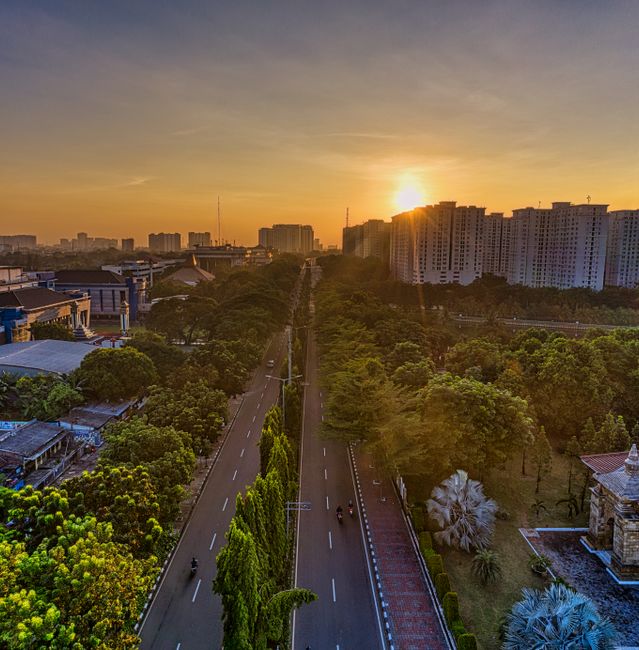
Jakarta, Indonesia’s capital and largest city, sprawls along the north coast of western Java, at the heart of a metropolitan region of more than 30 million people. It is hot, crowded and often congested, but also energetic, diverse and full of surprises: the old Dutch port of Batavia in Kota Tua, the 132 m (433 ft) National Monument rising from Merdeka Square, Southeast Asia’s largest mosque facing a neo-Gothic cathedral, a lively Chinatown, superb museums and some of the best food in the country, from street carts to rooftop restaurants. Getting around has become far easier with the MRT, LRT, commuter trains and TransJakarta buses, and the Whoosh high-speed train now reaches Bandung in about 45 minutes. Jakarta is the main entry point for Java; most visitors spend two or three days before heading to Yogyakarta or Bali. The drier months, from about May to October, are the most comfortable; January and February bring the heaviest rain and frequent flooding.
Right now in Jakarta
- Wed 24–34°C 75–94°F 17 mm Showers
- Thu 25–32°C 76–89°F 3 mm Showers
- Fri 26–31°C 79–88°F 1 mm Clear
Weather: MET Norway (CC BY 4.0) · Sea temperature: NOAA CoastWatch
Top tours in Jakarta
See all tours for Jakarta →
From local operators, with prices and reviews; you check availability and book on Viator, our partner. We may earn a commission at no extra cost to you. How we earn money
Jakarta at a glance
- Best for: museums and colonial history, food, shopping malls, nightlife, modern architecture and onward travel across Java.
- How long: 2–3 days for the city; 4 or more with Bogor, Bandung or the Thousand Islands.
- Best time: May to October, the drier months, with highs of about 33 °C (91 °F); January and February are the wettest.
- Getting there: Soekarno-Hatta International Airport (CGK) has flights from around the world; the airport train runs to the city center, and trains link Jakarta with Bandung, Yogyakarta and Surabaya.
- Getting around: the MRT, LRT, KRL commuter trains, TransJakarta buses, Grab, Gojek and Bluebird taxis.
- Good to know: traffic is legendary; travel by rail where you can and avoid rush hours.
- Before you go: visas, the e-VOA, the All Indonesia arrival card, money and general safety are in our Indonesia travel guide; see also our Yogyakarta guide.
Jakarta’s areas and where to stay
Jakarta is divided into five administrative cities, North, Central, West, South and East Jakarta, plus the Thousand Islands regency offshore. For visitors, the city is easiest to understand as a north–south axis, from the old port in the north through the government district to the business and nightlife areas of the south.
Kota Tua and the north
The old town of Batavia, the Dutch East India Company’s headquarters from the 17th century, centers on Fatahillah Square, with the Jakarta History Museum, canals, colonial warehouses and the Sunda Kelapa harbor, where wooden pinisi schooners still load cargo. Glodok, Jakarta’s Chinatown, is next door. Atmospheric by day, quiet at night.
Central Jakarta: Monas, Menteng and Thamrin
Merdeka Square and the National Monument, the National Museum, Istiqlal Mosque and the Cathedral, plus leafy Menteng, with its 1920s villas and cafés, and the hotel strip along Jalan Thamrin and Sudirman around Bundaran HI, the city’s best-connected base.
Sudirman, Kuningan and SCBD
The glittering business district, with skyscrapers, luxury hotels, malls such as Grand Indonesia and Plaza Senayan, restaurants and rooftop bars, all on the MRT line.
South Jakarta: Kemang, Senopati and Blok M
Residential neighborhoods with Jakarta’s liveliest dining and nightlife; Blok M, at the MRT’s southern hub, has a busy market, a revived food scene around its old terminal and good-value hotels.
Ancol and the north coast
Ancol Dreamland, a seafront leisure complex with beaches, an aquarium and theme parks, and the marinas for boats to the Thousand Islands.
Top things to see in Jakarta
Kota Tua and Fatahillah Square
The cobbled square in front of the 18th-century city hall of Batavia, now the Jakarta History Museum, is surrounded by the Wayang (puppet) Museum, the Museum of Fine Arts and Ceramics and the historic Café Batavia. Rent a vintage bicycle on the square, walk to the Kali Besar canal and the Toko Merah (Red Shop), and continue to Sunda Kelapa, the old harbor, and the Maritime Museum in former Dutch warehouses.
The National Monument (Monas) and Merdeka Square
Monas, a 132 m (433 ft) obelisk topped by a gilded flame, commemorates Indonesia’s struggle for independence. A museum of dioramas fills the base, and an elevator climbs to an observation deck with views over the city. The surrounding park, one of the largest city squares in the world, is busy with families at weekends.
Istiqlal Mosque and Jakarta Cathedral
Istiqlal, completed in 1978, is the largest mosque in Southeast Asia, with a vast prayer hall under a 45 m (148 ft) dome. Visitors are welcome outside prayer times on guided tours; dress modestly, and robes are provided. Across the road, the neo-Gothic Cathedral (1901) symbolizes Indonesia’s religious harmony; the two are linked by an underground “friendship tunnel.”
The National Museum
Museum Nasional, known as the Elephant Museum for the bronze elephant outside, holds Indonesia’s finest collection of archaeology, ethnography and Hindu-Buddhist sculpture. Part of the building was damaged by a fire in September 2023; check opening details before you go.
Glodok, Chinatown
Jakarta’s Chinatown is a maze of markets, temples and food stalls. Visit the 17th-century Jin De Yuan (Vihara Dharma Bhakti) temple and the narrow Petak Sembilan lanes, especially lively before Chinese New Year.
More classic sights
- Taman Mini Indonesia Indah: a park of traditional houses from every province, museums and gardens in East Jakarta.
- Textile Museum and Museum MACAN: batik traditions and modern and contemporary art.
- Ragunan Zoo: a large zoo with a primate center in South Jakarta.
- Pasar Baru and Jalan Surabaya: an old shopping street and an antiques market.
- The Thousand Islands: coral islands in Jakarta Bay, an hour or two by boat from Ancol or Muara Angke.
Other things to do in Jakarta
Food and drink
Jakarta brings together food from across the archipelago. Try the local Betawi dishes soto Betawi (beef soup with coconut milk), kerak telor (spicy omelet with sticky rice, sold at Kota Tua and fairs), gado-gado and nasi uduk (coconut rice), plus sate, bakso, Padang restaurants with their stacked dishes, and Chinese-Indonesian noodles in Glodok. Street food clusters at night markets such as Jalan Sabang, Blok M and Pecenongan, and Jakarta’s malls have huge food courts. Kemang, Senopati and SCBD have a cosmopolitan restaurant and cocktail-bar scene. Drink bottled water, and drink alcohol only in licensed bars and restaurants.
Shopping
Jakarta is a mall city: Grand Indonesia, Plaza Indonesia, Pacific Place and Senayan City for international brands, and Thamrin City and Tanah Abang for textiles and batik at wholesale prices. Pasar Baru has tailors and fabric shops.
Nightlife and culture
Rooftop bars and clubs cluster around SCBD, Kemang and Senopati. The Taman Ismail Marzuki arts center in Cikini hosts theater, music and film, and Gedung Kesenian Jakarta, a colonial-era theater, stages performances.
Festivals
The Jakarta Fair, a huge month-long fair held around the city’s anniversary on June 22, Chinese New Year in Glodok, Independence Day on August 17 with parades and village games in every neighborhood, and big international concerts and music festivals through the year. At Idul Fitri, the end of Ramadan, the city empties as millions of residents travel home, and the streets are briefly, eerily quiet.
Day trips from Jakarta
- Bandung: the cool highland city of art deco buildings, factory outlets and volcanoes such as Tangkuban Parahu, about 45 minutes on the Whoosh high-speed train.
- Bogor: the Bogor Botanical Gardens, founded in 1817, and the presidential palace, about an hour by KRL commuter train from central Jakarta.
- The Thousand Islands: snorkeling and white-sand islands such as Pulau Pramuka, Tidung and resort islands, 1–2 hours by speedboat.
- Puncak: tea plantations in the hills between Bogor and Cianjur; weekend traffic is heavy.
- Ujung Kulon National Park: the last home of the Javan rhinoceros, on Java’s western tip; a multi-day trip.
Nearby destinations
- Bandung120 km
Getting there and getting around
By air
Soekarno-Hatta International Airport (CGK), about 25 km (16 miles) northwest of the center in Tangerang, has three terminals: Garuda Indonesia and many international airlines use Terminal 3. The airport train links the airport’s skytrain station with BNI City station near Sudirman and Manggarai in about an hour; airport buses (DAMRI) run to central hubs; and taxis and Grab take 45 minutes to two hours or more, depending on traffic. Halim Perdanakusuma Airport (HLP), in East Jakarta, handles some domestic flights and is next to the Whoosh station.
By train
Jakarta’s main long-distance stations are Gambir, by Monas, and Pasar Senen, with KAI trains to Bandung, Cirebon, Semarang, Yogyakarta, Solo and Surabaya; the fastest trains to Yogyakarta take about six to seven hours. The Whoosh high-speed train runs from Halim to Tegalluar near Bandung, with stops at Karawang and Padalarang, covering about 142 km (88 miles) in around 45 minutes at up to 350 km/h (217 mph); a feeder train connects Padalarang with Bandung station. Book KAI trains on the Access by KAI app or website, and Whoosh tickets on its own app or website.
MRT, LRT and commuter trains
The MRT Jakarta North–South Line runs underground and elevated from Lebak Bulus in the south through Blok M, Senayan and Sudirman to Bundaran HI, with an extension north toward Kota under construction. The LRT Jabodebek links Dukuh Atas with Cibubur and Bekasi, and the smaller LRT Jakarta serves Kelapa Gading in the north. KRL Commuter Line trains reach Bogor, Depok, Bekasi, Tangerang and Jakarta Kota. Dukuh Atas, by Sudirman and BNI City, is the interchange for the MRT, LRT, KRL and airport train. Pay with a contactless bank e-money card (such as Mandiri e-money or BCA Flazz), sold at stations and convenience stores, or a QR ticket in the official apps.
TransJakarta, taxis and apps
TransJakarta runs one of the world’s largest bus rapid transit networks, on dedicated lanes, with a low flat fare paid by e-money card. Grab and Gojek are the easiest way to take cars and motorbike taxis, and Bluebird metered taxis are reliable. Traffic is severe at rush hours, from about 7 to 10 a.m. and 4 to 8 p.m., and odd-even license plate rules apply on main roads; a motorbike taxi is often fastest, but wear the helmet provided.
When to go and how long to stay
Jakarta is hot and humid all year, with little change in temperature and a pronounced rainy season. The table uses the 1991–2020 climate normals of BMKG, Indonesia’s meteorological agency, for its Kemayoran station in Central Jakarta, as submitted to the World Meteorological Organization: average daily highs and lows, total rain and days with at least 1 mm of rain.
| Month | Average high / low | Rain (days with 1 mm or more) | What to expect |
|---|---|---|---|
| January | 31 °C (88 °F) / 25 °C (77 °F) | 373 mm (14.7 in), 18 days | Wettest period; frequent floods |
| February | 31 °C (87 °F) / 25 °C (77 °F) | 381 mm (15.0 in), 18 days | Very wet; flood risk; Chinese New Year |
| March | 32 °C (90 °F) / 26 °C (78 °F) | 210 mm (8.3 in), 14 days | Rain easing; humid |
| April | 33 °C (91 °F) / 26 °C (78 °F) | 164 mm (6.5 in), 12 days | Transition; afternoon storms |
| May | 33 °C (92 °F) / 26 °C (78 °F) | 103 mm (4.1 in), 8 days | Drier and hot |
| June | 33 °C (91 °F) / 26 °C (78 °F) | 80 mm (3.2 in), 6 days | Dry; Jakarta Fair and city anniversary |
| July | 33 °C (91 °F) / 25 °C (78 °F) | 78 mm (3.1 in), 5 days | Dry; school holidays |
| August | 33 °C (91 °F) / 25 °C (78 °F) | 52 mm (2.0 in), 3 days | Driest month; Independence Day on August 17 |
| September | 33 °C (92 °F) / 26 °C (78 °F) | 61 mm (2.4 in), 4 days | Dry and hot; haze possible |
| October | 33 °C (92 °F) / 26 °C (78 °F) | 112 mm (4.4 in), 7 days | Hot; first storms |
| November | 33 °C (91 °F) / 26 °C (78 °F) | 135 mm (5.3 in), 10 days | Rainy season begins |
| December | 32 °C (90 °F) / 26 °C (78 °F) | 183 mm (7.2 in), 13 days | Wet; holiday season |
Kemayoran averages about 1,930 mm (76 in) of rain a year, nearly 40% of it in January and February, when heavy downpours often flood low-lying districts and disrupt traffic. In its outlook for the 2026–27 rainy season, BMKG expected the rains to begin later than normal across Jakarta because of a very strong El Niño. Air pollution can be high in the dry season; check the air-quality index on hazy days.
2 days in Jakarta
Day one, Kota Tua, Fatahillah Square and its museums, Sunda Kelapa and lunch in Glodok, then Monas at sunset. Day two, Istiqlal and the Cathedral, the National Museum, an afternoon in a mall or Menteng, and dinner and drinks in SCBD or Senopati.
4 days with day trips
Add a day in Bogor’s botanical gardens and a day trip to Bandung on the Whoosh, or a night on one of the Thousand Islands.
Where to stay in Jakarta
- Thamrin and Bundaran HI: international hotels on the MRT, close to Monas and the malls; the best base for first-timers.
- Sudirman and SCBD: business hotels, restaurants and nightlife.
- Menteng and Cikini: quieter boutique hotels and guesthouses.
- Kota Tua: heritage hotels in restored colonial buildings, atmospheric but less central.
- Blok M and Kemang: good-value hotels near food and nightlife in the south.
Jakarta’s five-star hotels are among the best value in Asia; book a hotel near an MRT station to avoid traffic.
What a trip to Jakarta costs
Prices are approximate, for October 2026, converted at about 17,900 rupiah to the US dollar.
| Item | Typical cost |
|---|---|
| MRT ride | 3,000–14,000 rupiah (about US$0.20–0.80) |
| TransJakarta bus ride | 3,500 rupiah (about US$0.20) |
| Airport train, Soekarno-Hatta to BNI City | about 70,000 rupiah (about US$3.90) |
| Whoosh, Jakarta to Bandung, economy | about 150,000–250,000 rupiah (about US$8.40–14) |
| Grab car across the city | 50,000–150,000 rupiah (about US$2.80–8.40) |
| Soto Betawi or nasi uduk | 25,000–50,000 rupiah (about US$1.40–2.80) |
| Dinner in a mid-range restaurant, per person | 150,000–350,000 rupiah (about US$8.40–20) |
| Monas and museum entry | 5,000–25,000 rupiah (about US$0.30–1.40) |
| Mid-range hotel double, per night | 600,000–1,200,000 rupiah (about US$34–67) |
| Five-star hotel, per night | 1,800,000 rupiah and up (about US$100 and up) |
Practical tips for Jakarta
- Get an e-money card: it works on the MRT, LRT, KRL, TransJakarta and toll roads.
- Avoid rush hours: plan sightseeing between 10 a.m. and 4 p.m. and travel by rail.
- Dress: cover shoulders and knees for mosques and churches.
- Ramadan: many restaurants stay open but some cover their windows; be discreet eating in public in daylight.
- Weekends: Car Free Day closes Sudirman and Thamrin to traffic on Sunday mornings, a great time to walk or cycle.
Safety
Jakarta is generally safe for visitors, though petty crime such as pickpocketing and phone snatching happens on crowded buses, trains and at night markets. Use Grab, Gojek or Bluebird rather than unmarked taxis. Flooding is the main natural hazard: from December to February, heavy rain can flood streets and underpasses within hours; follow BMKG warnings and avoid driving through floodwater. Traffic is dangerous for pedestrians, so cross at bridges or lights. Drink bottled water to avoid stomach upsets, and protect yourself from mosquitoes because dengue is common in the rainy season. Air quality is often poor; consider a mask on smoggy days. In an emergency, call 112, or 110 for the police and 119 for an ambulance.
What to pack for Jakarta
Light, breathable clothes, with long pants or a long skirt and covered shoulders for mosques and offices, comfortable walking shoes, an umbrella or light rain jacket from November to April, sunscreen, insect repellent and a light layer for the fierce air conditioning in malls and trains. Indonesia uses 230 V and round two-pin plugs.
Jakarta travel FAQ
How many days do I need in Jakarta?
Two or three days for Kota Tua, Monas, Istiqlal, the museums and food; four or more with Bogor or Bandung.
How do I get from Soekarno-Hatta Airport to central Jakarta?
Take the airport train to BNI City or Manggarai (about an hour), a DAMRI bus, or a taxi or Grab, which takes 45 minutes to two hours depending on traffic.
What is the Whoosh train?
Indonesia’s high-speed train, running about 142 km (88 miles) from Halim in Jakarta to Tegalluar near Bandung in around 45 minutes, with a feeder train to Bandung station.
Does Jakarta have a metro?
Yes. The MRT runs from Lebak Bulus to Bundaran HI, and the LRT, KRL commuter trains and TransJakarta buses cover much of the city; pay with an e-money card.
When is the best time to visit Jakarta?
May to October, the drier months. January and February are the wettest, with frequent flooding.
Is Jakarta worth visiting?
Yes, for two or three days: it has Indonesia’s best museums, colonial history in Kota Tua, great food and easy onward connections.
What should I wear to Istiqlal Mosque?
Long pants or a skirt and covered shoulders; women should cover their hair. Robes and scarves are provided at the entrance.
Is Jakarta safe for tourists?
Generally yes. Watch for pickpockets in crowds, use registered taxis or apps, and avoid floodwater in the rainy season.
How do I get from Jakarta to Yogyakarta?
By train from Gambir or Pasar Senen in about six to eight hours, or by a one-hour flight to Yogyakarta International Airport (YIA).
Is Jakarta still Indonesia’s capital?
Yes. A law passed in 2022 designates Nusantara, in East Kalimantan, as the future capital, but the move is gradual, and Jakarta remains the seat of government until the president formally transfers the capital.
Sources and last review
Researched and last reviewed on 4 October 2026. Climate normals: BMKG’s Kemayoran station, 1991–2020, via the World Meteorological Organization; the 2026–27 rainy season outlook: BMKG; visas and the arrival card: the Directorate General of Immigration; exchange rate: Bank Indonesia. The MRT, LRT, KRL, TransJakarta, airport train and Whoosh routes, journey times and fares, museum details, the capital-relocation status, population and typical prices are general references or estimates, flagged for checking, because the operators’ websites could not be read here. Prices and schedules change, so check the official sites before you go. For entry rules, money and general safety, see our Indonesia travel guide.
Plan your trip
Partner links: TravelerCenter may earn a commission if you book, at no extra cost to you.
🇮🇩 Useful Indonesian phrases for Jakarta
All 38 Indonesian phrases: restaurant, hotel, emergencies, romance (printable) →