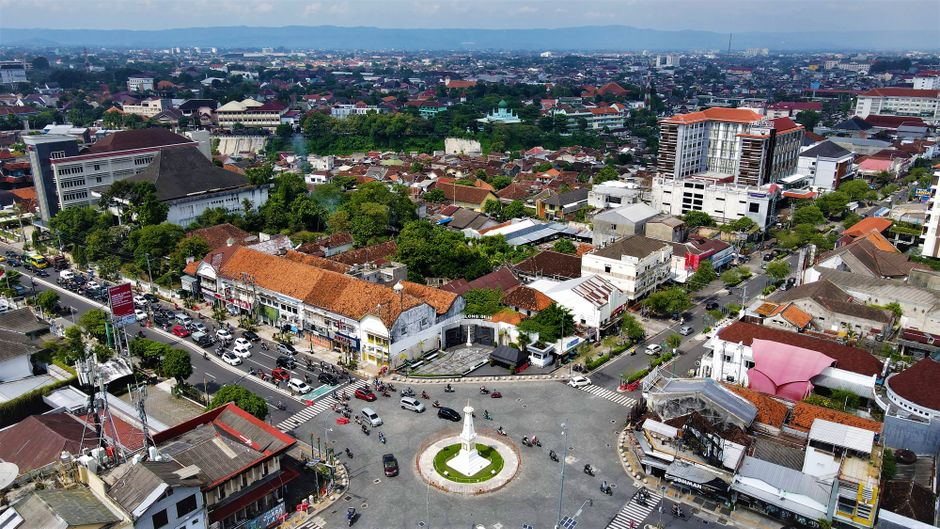
Yogyakarta, usually shortened to Yogya or Jogja, is the cultural capital of Java: a city of about 400,000 people at the heart of a wider urban area, ruled by a hereditary sultan whose palace, the kraton, still stands at its center. It is a city of batik and silver, gamelan and shadow puppets, students and street food, and the base for two of the world’s great religious monuments, the Buddhist temple of Borobudur and the Hindu temples of Prambanan, both UNESCO World Heritage sites. Behind the city rises Mount Merapi, one of Indonesia’s most active volcanoes. Yogyakarta is relaxed, friendly and inexpensive, and easy to reach by train from Jakarta or by air from Bali. The dry season, from about May to October, is the best time to visit the temples; from November to April, mornings are usually clear and storms arrive in the afternoon.
Right now in Yogyakarta
- Wed 24–33°C 75–91°F 2 mm Light showers
- Thu 23–33°C 74–91°F 1 mm Partly cloudy
- Fri 24–31°C 75–87°F Partly cloudy
Weather: MET Norway (CC BY 4.0)
Top tours in Yogyakarta
See all tours for Yogyakarta →
From local operators, with prices and reviews; you check availability and book on Viator, our partner. We may earn a commission at no extra cost to you. How we earn money
Yogyakarta at a glance
- Best for: Borobudur and Prambanan, Javanese culture, the sultan’s palace, batik and crafts, street food, volcano tours and a relaxed city pace.
- How long: 3 days for the city and both temples; 4–5 with Merapi, the south coast or Dieng.
- Best time: May to October, the dry season; sunrise at Borobudur is clearest in the dry months.
- Getting there: Yogyakarta International Airport (YIA), about 45 km (28 miles) west of the city, with an airport train; KAI trains from Jakarta take about six to eight hours.
- Getting around: walking and becak (cycle rickshaws) in the center, Grab and Gojek, Trans Jogja buses, and a driver for the temples.
- Good to know: climbing Borobudur needs a separate, timed temple-structure ticket that includes a guide and special sandals.
- Before you go: visas, the arrival card, money and general safety are in our Indonesia travel guide; see also our Jakarta guide.
Yogyakarta’s areas and where to stay
The Special Region of Yogyakarta is the only Indonesian province still headed by a sultan, who also serves as governor. The city is laid out along a symbolic north–south line from Mount Merapi through the Tugu monument, Malioboro and the kraton to the Indian Ocean; this “Cosmological Axis of Yogyakarta and its Historic Landmarks” was added to the UNESCO World Heritage list in 2023.
Malioboro
The city’s main shopping street, running south from the Tugu railway station toward the kraton, with batik shops, street vendors, becak, the Beringharjo market and evening food stalls. Central, lively and convenient, with hotels of every level.
The kraton and Prawirotaman
Inside the old walled royal quarter, around the palace and Taman Sari, are quiet lanes of homes and craft workshops. Just south, Prawirotaman is the traveler district, with guesthouses, cafés and good-value boutique hotels.
Kotagede
The former capital of the Mataram sultanate in the southeast, known for its silversmiths, old mosque and royal graves, and traditional Javanese houses.
The north and Kaliurang
Northern Yogyakarta has the universities, malls and newer hotels, and the road climbs to Kaliurang on Merapi’s slopes, cooler and green, for volcano tours.
Borobudur village
Staying near the temple, in Magelang regency about 1–1.5 hours northwest of the city, makes an early start easy; rural guesthouses and resorts overlook the rice fields and the Menoreh hills.
Top things to see in Yogyakarta
Borobudur
Built by the Sailendra dynasty between about 780 and 840 CE, Borobudur is the world’s largest Buddhist monument: a stepped pyramid of nine platforms, six square and three circular, decorated with more than 2,600 relief panels and topped by 72 openwork stupas around a central dome, symbolizing the path from the world of desire to enlightenment. The site is run by the state-owned InJourney Destination Management. According to its official ticketing site, foreign visitors buy the temple-structure ticket, which gives access to the courtyard and the upper terraces, with a guide and a pair of upanat sandals, designed to protect the stone, included; visits to the structure run every day from 8:30 a.m. to 5 p.m., in timed groups, and you should arrive 30–45 minutes before your slot. The courtyard-only ticket is for domestic tourists. Separate sunrise and sunset experiences from the Manohara area are limited to 100 people a day. Book through ticket.injourneydestination.id; numbers on the monument are capped to protect it.
Prambanan
About 17 km (11 miles) east of the city, Prambanan is Indonesia’s largest Hindu temple complex, built in the mid-9th century and dedicated to the Trimurti: Shiva, whose central temple rises 47 m (154 ft), Vishnu and Brahma. Reliefs on the main temples tell the Ramayana. The same park includes the Buddhist temples of Sewu, Lumbung and Bubrah, and the hilltop Ratu Boko palace ruins, 3 km (2 miles) south, are popular at sunset. The Ramayana Ballet is performed on an open-air stage with Prambanan floodlit behind it, on set evenings in the dry season and indoors at other times.
The Kraton
The sultan’s palace, built from 1755, is a complex of pavilions and courtyards where court life continues; museum rooms display gamelan, carriages, batik and royal gifts, and morning performances of gamelan, dance, wayang or poetry change daily. Dress modestly; the palace closes early in the afternoon.
Taman Sari
The 18th-century Water Castle, a royal pleasure garden with bathing pools, underground passages and the ruined mosque of Sumur Gumuling, set among the kampung lanes just west of the kraton.
Mount Merapi
Merapi, about 2,900 m (9,500 ft), last erupted catastrophically in 2010. Jeep “lava tours” from Kaliurang visit villages buried by that eruption and viewpoints within the safe zone. In early October 2026, PVMBG’s MAGMA Indonesia listed Merapi at Level III (Siaga), with danger zones of up to 5–7 km (3–4 miles) along the southwest and southeast river valleys and a 3 km (2-mile) radius from the summit; climbing to the summit is not possible, and lahars are a risk in heavy rain. Go only with licensed tour operators that follow the official limits.
More classic sights
- Mendut and Pawon: two smaller temples on the processional route to Borobudur, with a giant seated Buddha in Mendut.
- Kotagede: silver workshops, the royal cemetery and Java’s oldest mosque in the city.
- Sonobudoyo Museum: Javanese art, wayang puppets and keris daggers.
- Vredeburg Fort: a Dutch fort turned museum at the southern end of Malioboro.
- Plaosan: twin Buddhist temples near Prambanan, quieter and beautiful at sunrise.
Other things to do in Yogyakarta
Food and drink
Yogyakarta’s signature dish is gudeg, young jackfruit stewed for hours in palm sugar and coconut milk, served with rice, chicken, egg and spicy krecek; Wijilan street, near the kraton, is lined with gudeg restaurants. Try bakmi Jawa (Javanese noodles cooked over charcoal), sate klathak (goat satay grilled on bicycle spokes) and angkringan, humble night stalls selling small rice parcels, skewers and kopi joss, coffee with a piece of glowing charcoal dropped in. Prawirotaman has cafés and international food. Alcohol is less common than in Bali; drink only labeled bottles.
Batik, silver and shadow puppets
Take a batik class and make your own cloth, watch silversmiths in Kotagede, and see wayang kulit (leather shadow puppets) performed with gamelan; Sonobudoyo Museum and the kraton hold regular shows.
Cycling and village tours
Bicycle tours run through the rice fields and villages around Borobudur and the city’s outskirts, with stops at tofu, pottery and batik workshops. See our cycling guide.
Festivals
Vesak, the Buddhist festival, brings a candlelit procession from Mendut to Borobudur, usually in May or June; the kraton’s Sekaten and Grebeg ceremonies mark the Prophet’s birthday with processions of giant rice mountains; and the Prambanan Jazz Festival and art festivals fill the calendar in the dry season.
Day trips from Yogyakarta
- Borobudur and Mendut: about 1–1.5 hours northwest by car, or by bus to the Borobudur terminal.
- Prambanan and Ratu Boko: about 30–45 minutes east; combine with Plaosan and the Ramayana Ballet.
- Merapi lava tour: half a day by jeep from Kaliurang, within the official safety limits.
- The Dieng Plateau: high, cool volcanic plateau with ancient Hindu temples, colored lakes and craters, about 3–4 hours away.
- The south coast: Parangtritis’s dunes and legends and the white-sand beaches of Gunung Kidul, such as Indrayanti; dangerous for swimming.
- Jomblang Cave: a vertical sinkhole in Gunung Kidul, about 1.5 hours southeast, where you are lowered by rope to an underground forest and a shaft of light falls in late morning; tours run with guides and safety gear.
- The Menoreh hills: viewpoints and tree-top platforms west of the city, with sunrise views of Merapi and Borobudur in the mist.
- Solo (Surakarta): another royal city with two palaces and batik markets, about an hour by train.
Nearby destinations
Getting there and getting around
By air
Yogyakarta International Airport (YIA), at Kulon Progo on the south coast, has flights from Jakarta, Bali, other Indonesian cities and some international routes. The airport train runs to Tugu station in the city center in about 40 minutes; DAMRI buses and taxis take about an hour. The old city airport, Adisutjipto (JOG), handles a few domestic flights.
By train
Yogyakarta’s Tugu station, on Malioboro, and Lempuyangan station have KAI trains to Jakarta (about six to eight hours from Gambir or Pasar Senen), Bandung, Solo, Semarang, Surabaya and Banyuwangi, for the ferry to Bali. Book on the Access by KAI app or website, especially for weekends and holidays. Commuter trains (KRL) run to Solo.
Around the city
The center is walkable, and becak and andong (horse carts) wait along Malioboro; agree on the fare first. Grab and Gojek are cheap and widely used, and Trans Jogja buses cover the main roads. For Borobudur and Prambanan in one day, hire a car with a driver.
When to go and how long to stay
Weather for your datesSunrise and sunset
Yogyakarta has a tropical monsoon climate, hot and humid all year, with a long rainy season. BMKG’s published WMO normals for the region do not include temperature or rainfall, and no 1991–2020 station series is readable from here, so the table uses NASA’s satellite and model-based averages for 2001–2020 at Yogyakarta’s coordinates. These smooth out the daily range, so afternoon highs in town are often a few degrees warmer than shown, and nights in the hills cooler.
| Month | Average high / low (NASA POWER) | Rain | What to expect |
|---|---|---|---|
| January | 28 °C (82 °F) / 24 °C (75 °F) | 346 mm (13.6 in) | Wettest period; afternoon storms |
| February | 28 °C (83 °F) / 24 °C (75 °F) | 342 mm (13.5 in) | Very wet; humid |
| March | 28 °C (83 °F) / 24 °C (75 °F) | 221 mm (8.7 in) | Rain easing |
| April | 29 °C (84 °F) / 24 °C (76 °F) | 191 mm (7.5 in) | Transition; green fields |
| May | 29 °C (83 °F) / 24 °C (74 °F) | 147 mm (5.8 in) | Dry season begins; Vesak may fall in May or June |
| June | 28 °C (83 °F) / 23 °C (73 °F) | 95 mm (3.7 in) | Dry and pleasant; school holidays |
| July | 28 °C (82 °F) / 21 °C (71 °F) | 55 mm (2.2 in) | Dry; cool mornings; peak season |
| August | 28 °C (83 °F) / 21 °C (70 °F) | 31 mm (1.2 in) | Driest month; best temple sunrises |
| September | 30 °C (85 °F) / 22 °C (71 °F) | 65 mm (2.6 in) | Dry and warm; fewer crowds |
| October | 30 °C (86 °F) / 23 °C (73 °F) | 139 mm (5.5 in) | Hottest; first storms |
| November | 29 °C (84 °F) / 24 °C (75 °F) | 231 mm (9.1 in) | Rainy season begins |
| December | 28 °C (83 °F) / 24 °C (75 °F) | 294 mm (11.6 in) | Wet; holiday crowds |
Rainfall totals about 2,160 mm (85 in) a year in this dataset. In its outlook for the 2026–27 rainy season, BMKG, Indonesia’s meteorological agency, expected the rains across the Special Region of Yogyakarta to begin later than normal because of a very strong El Niño, mostly in November or December 2026, with wetter than normal conditions in the western part of the province and the peak of the rains around February 2027.
3 days in Yogyakarta
Day one, Borobudur at opening time, Mendut and Pawon, then back to the city for Malioboro and gudeg for dinner. Day two, the kraton in the morning, Taman Sari, a batik class, then Prambanan in the late afternoon and the Ramayana Ballet. Day three, a Merapi jeep tour in the morning and Kotagede’s silversmiths in the afternoon.
5 days with day trips
Add the Dieng Plateau or a day on the south coast, and a day trip to Solo by train.
Where to stay in Yogyakarta
- Malioboro: hotels of every level near the station, shops and street food.
- Prawirotaman: guesthouses, boutique hotels and cafés in a relaxed neighborhood south of the kraton.
- Around the kraton: heritage homestays in the old royal quarter.
- Borobudur: resorts and village guesthouses for an early start at the temple.
- Kaliurang: cool mountain lodges on Merapi’s slopes.
Book ahead for Indonesian school holidays in June and July, Idul Fitri and Christmas and New Year.
What a trip to Yogyakarta costs
Money exchange (IDR)Tip calculator
Prices are approximate, for October 2026, converted at about 17,900 rupiah to the US dollar.
| Item | Typical cost |
|---|---|
| Airport train, YIA to Tugu | about 20,000 rupiah (about US$1.10) |
| Train, Jakarta to Yogyakarta, executive class | 350,000–700,000 rupiah (about US$20–39) |
| Car with driver for Borobudur and Prambanan | 600,000–900,000 rupiah (about US$34–50) |
| Gudeg with rice and chicken | 20,000–40,000 rupiah (about US$1.10–2.20) |
| Angkringan snacks and kopi joss | 10,000–25,000 rupiah (about US$0.60–1.40) |
| Merapi jeep lava tour, per jeep | 400,000–700,000 rupiah (about US$22–39) |
| Batik class, half day | 150,000–350,000 rupiah (about US$8.40–20) |
| Becak ride in the center | 20,000–50,000 rupiah (about US$1.10–2.80) |
| Guesthouse double, per night | 250,000–500,000 rupiah (about US$14–28) |
| Mid-range hotel double, per night | 500,000–1,000,000 rupiah (about US$28–56) |
Borobudur and Prambanan tickets for foreign visitors are sold in rupiah on InJourney’s official site; check the current price there when you book.
Practical tips for Yogyakarta
- Book Borobudur early: structure slots are limited; choose the first one for cooler temperatures.
- Dress: cover shoulders and knees at temples, the kraton and mosques.
- Batik scams: friendly strangers steering you to a “special exhibition” usually lead to overpriced galleries.
- Ramadan: many local restaurants close in daylight; tourist cafés stay open.
- Early starts: temples and the kraton are best in the morning; the kraton closes early in the afternoon.
Safety
Yogyakarta is one of Indonesia’s most relaxed cities. Natural hazards are the main concern. Merapi was at Level III (Siaga) in early October 2026: never enter the danger zones set by PVMBG, follow MAGMA Indonesia updates, and be aware that ash can disrupt flights. Yogyakarta also lies in an earthquake zone; a strong earthquake in 2006 killed thousands south of the city, so learn your hotel’s evacuation routes. The south-coast beaches, including Parangtritis, have powerful waves and rip currents; swimming is dangerous, so stay at the water’s edge. Traffic is busy, especially with motorbikes; take care crossing roads. Drink bottled water and avoid unlabeled alcohol, as methanol-laced bootleg liquor has killed people in Java. In an emergency, call 112.
What to pack for Yogyakarta
Light clothes that cover shoulders and knees, comfortable shoes for temple terraces, a hat and sunscreen for Borobudur, a light rain jacket or umbrella from November to April, a warm layer for sunrise trips and Merapi’s slopes, and insect repellent. Indonesia uses 230 V and round two-pin plugs.
Yogyakarta travel FAQ
Can you climb Borobudur?
Yes, with the temple-structure ticket from InJourney’s official site. It includes a guide and upanat sandals, and visits to the structure run daily from 8:30 a.m. to 5 p.m. in timed groups.
How do I get from Yogyakarta to Borobudur?
By car in about 1–1.5 hours, or by local bus to the Borobudur terminal. Hiring a driver lets you combine it with Mendut, Pawon and Prambanan.
Can I see Borobudur at sunrise?
Yes, through the official Borobudur Sunrise experience from the Manohara area, limited to 100 people a day; book ahead.
How far is Prambanan from Yogyakarta?
About 17 km (11 miles) east, or 30–45 minutes by car; Trans Jogja buses also go there.
When is the best time to visit Yogyakarta?
May to October, the dry season, with the clearest mornings from July to September.
When is the rainy season in Yogyakarta?
Usually from November to April. BMKG expected the 2026–27 rains to begin late, mostly in November or December 2026.
Is it safe to visit Mount Merapi?
Only within the official limits. Merapi was at Level III (Siaga) in early October 2026, with danger zones of up to 7 km (4 miles) along some river valleys; jeep tours stay in permitted areas.
How do I get from Jakarta to Yogyakarta?
By KAI train in about six to eight hours, or by a one-hour flight to Yogyakarta International Airport.
How many days do I need in Yogyakarta?
Three days for the city, Borobudur and Prambanan; four or five with Merapi, Dieng or the south coast.
What is Yogyakarta famous for?
Borobudur and Prambanan, the sultan’s palace, batik, silver, gudeg and Javanese performing arts.
Plan your trip
Partner links: TravelerCenter may earn a commission if you book, at no extra cost to you.
🇮🇩 Useful Indonesian phrases for Yogyakarta
All 38 Indonesian phrases: restaurant, hotel, emergencies, romance (printable) →
Sources · last reviewed 4 October 2026
Researched and last reviewed on 4 October 2026. Borobudur structure-ticket inclusions, hours, the domestic-only courtyard ticket and the sunrise and sunset limits: InJourney Destination Management’s official ticket site; Borobudur and Prambanan history: InJourney; Merapi’s alert level and danger zones: PVMBG’s MAGMA Indonesia; the Cosmological Axis World Heritage listing: UNESCO; the 2026–27 rainy season outlook: BMKG; climate table: NASA POWER (2001–2020), used because no official 1991–2020 normals were readable; exchange rate: Bank Indonesia. Ticket prices, daily climbing quotas, train and airport-train times and fares, festival dates and typical prices are general references or estimates, flagged for checking. Prices and rules change, so check before you go. For entry rules, money and general safety, see our Indonesia travel guide.
Place data: Wikidata (CC0)