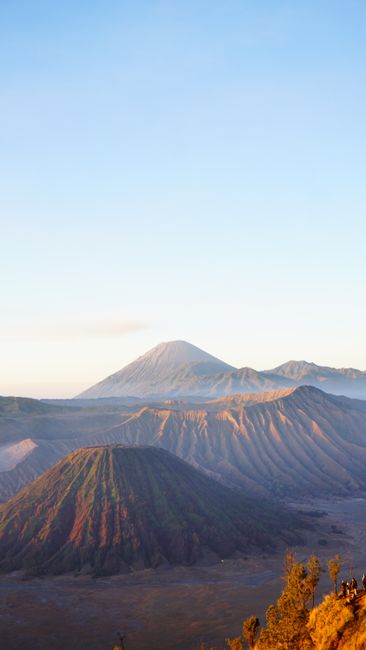
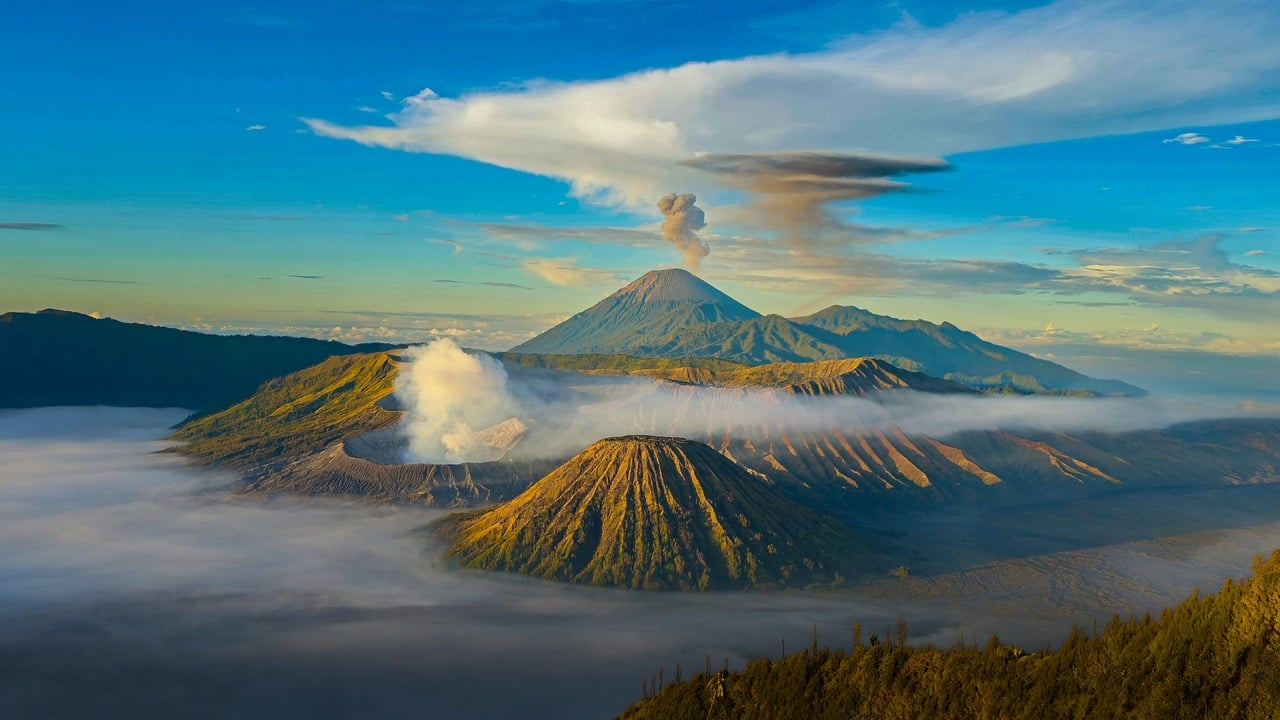
Bromo Tengger Semeru National Park, in the highlands of East Java, protects one of Indonesia’s most extraordinary landscapes: the vast Tengger caldera, about 10 km (6 miles) across, whose floor is a sea of gray volcanic sand, with the smoking cone of Mount Bromo rising from it beside the ribbed, extinct Batok, and, on the southern horizon, Mount Semeru, at 3,676 m (12,060 ft) the highest peak on Java, puffing ash every few minutes. The classic visit is a pre-dawn jeep ride to the Penanjakan viewpoints to watch the sun rise over the caldera, followed by a walk across the sand and up a stairway to Bromo’s crater rim. The caldera is also the homeland of the Tengger people, Hindus who make offerings to the volcano at the Yadnya Kasada festival. The park is managed by Indonesia’s Ministry of Forestry, which sells all tickets for the Bromo area online, with a daily quota, and closes the area for ceremonies, holidays and volcanic activity. In early October 2026, Bromo was at alert Level II, with a 1 km (0.6-mile) exclusion zone around the crater, and Semeru at Level III.
Right now in Bromo Tengger Semeru National Park (Cemoro Lawang)
- Fri12–18°C53–64°F5 mm rain
- Sat11–18°C52–64°F4 mm rain
- Sun11–18°C52–65°F2 mm rain
Top tours in Bromo Tengger Semeru National Park
See all tours for Bromo Tengger Semeru National Park →
From local operators, with prices and reviews; you check availability and book on Viator, our partner. We may earn a commission at no extra cost to you. How we earn money
Bromo at a glance
- Best for: volcano sunrises, the caldera’s sea of sand, crater walks, jeep tours, Tengger culture and, for experienced trekkers, Semeru.
- How long: one night at Cemoro Lawang or nearby; two to add the savanna, Ranu Pane or Madakaripura waterfall.
- Best time: May to October, the dry season, for clear sunrises; July and August are the coldest and busiest.
- Getting there: from Surabaya, Malang or Probolinggo by car, tour or train and minibus; Cemoro Lawang is 2–3 hours from Surabaya.
- Tickets: 255,000 rupiah for foreign visitors, bought online only through the park’s booking site.
- Good to know: it is cold before dawn, often near freezing in July and August.
- Before you go: visas, the arrival card, money and general safety are in our Indonesia travel guide.
Tickets, booking and rules (as of October 2026)
Tickets and prices
According to the park authority (Balai Besar Taman Nasional Bromo Tengger Semeru), entry tickets to the Mount Bromo area have cost 255,000 rupiah (about US$14) per foreign visitor per day, on weekdays and holidays alike, since October 30, 2024, under Government Regulation 36 of 2024 on non-tax state revenue. The price includes visitor insurance of 5,000 rupiah. Indonesian visitors pay 54,000 rupiah on weekdays and 79,000 rupiah on holidays. Vehicles pay extra: 10,000 rupiah for a car or jeep and 5,000 rupiah for a motorbike. Visitors without a valid ticket are fined five times the normal price.
Booking online
Tickets for the Bromo area must be bought online through the park’s official booking website, bookingbromo.bromotenggersemeru.org; there is no on-the-spot sale. Choose your dates and entry point, enter the details of the group leader, members and vehicle, and pay by bank virtual account within two hours, or the booking lapses. Once paid, the booking cannot be refunded. Check the payment status with your booking code to receive a barcode, which is scanned at the gate. The park introduced a daily visitor quota, set at 2,752 people when online booking began in December 2019, to reduce traffic jams at the viewpoints and damage to the savanna. If you book a jeep tour, the operator usually handles the tickets; ask for proof.
Closures
The park closes the Bromo area, or the whole park, for religious occasions and holidays: for example, in 2025, it closed completely from March 28 to April 1 for Nyepi and Idul Fitri. The Tengger community’s sacred month of Wulan Kapitu brings restrictions around the crater, and during Yadnya Kasada the crater area is reserved for ceremonies. Trails to Semeru close regularly for weather, fires, eruptions and ecosystem recovery. Check the park’s announcements and the MAGMA Indonesia volcano reports before you go.
Volcano alert levels
Indonesia’s volcano agency, PVMBG, listed Bromo at Level II (Waspada) in early October 2026, with no activity allowed within 1 km (0.6 miles) of the active crater; the park decides whether the crater stairs and rim are open, and the authorities can close the crater area at short notice. Semeru was at Level III (Siaga), with wide exclusion zones on its southeastern slopes; climbing to its summit is not permitted at elevated alert levels.
Rules
- Stay on the marked routes across the sand and on the crater stairs; don’t climb onto the crater lip beyond the railings.
- Jeeps and motorbikes must keep to tracks; driving across the savanna damages it.
- Don’t light fires or drop cigarettes, especially in the dry season, when grass fires are common.
- Respect offerings and ceremonies at Pura Luhur Poten and on the crater; dress modestly near the temple.
- Take your rubbish with you.
The caldera and its sights
The Penanjakan sunrise viewpoints
The famous sunrise view is from Penanjakan (King Kong Hill, Penanjakan 1 and 2 and Bukit Cinta), on the caldera rim at about 2,700 m (8,900 ft), looking down on Bromo, Batok and Semeru as the sun rises behind them. Jeeps leave Cemoro Lawang and the other villages at about 3–3.30 a.m. to reach the viewpoints before dawn; it is crowded and cold, but on a clear morning unforgettable. Less crowded viewpoints include Seruni Point, near Cemoro Lawang, reached by a staircase.
The Sea of Sand and Bromo’s crater
After sunrise, jeeps drive down into the caldera and across the Sea of Sand (Lautan Pasir) to the foot of Bromo, from where you walk or ride a horse to the base of a stairway of about 250 steps leading to the crater rim at about 2,329 m (7,641 ft). From the rim, you look into a steaming, roaring vent; sulfurous gas can be strong.
Pura Luhur Poten
A Hindu temple of dark volcanic stone on the sand at the foot of Bromo, the center of the Tengger people’s Yadnya Kasada festival, when offerings of crops and livestock are thrown into the crater.
The savanna and Whispering Sands
South of Bromo, the caldera opens into rolling grassy hills known as the Bromo savanna, or “Teletubbies Hill,” green in the rainy season and golden in the dry season, and the Pasir Berbisik (“Whispering Sands”), where the wind hisses across the sand.
Ranu Pane and Ranu Kumbolo
On the road toward Semeru, the village of Ranu Pane has two small lakes and is the starting point of the Semeru trek; Ranu Kumbolo, a beautiful lake at about 2,400 m (7,900 ft), is a day’s walk in, along the climbing trail, and follows its own opening schedule.
More classic sights
- Mount Batok: the perfectly ribbed, extinct cone beside Bromo.
- Cemoro Lawang: the main village on the caldera rim, with views straight across the sand.
- Wonokitri and Tosari: Tengger villages on the northwestern approach from Pasuruan.
- Madakaripura Waterfall: a tall waterfall in a narrow canyon near Probolinggo, outside the park.
- Tengger farm terraces: potato, cabbage and leek fields on the steep slopes around the caldera.
Hiking and Semeru
Within the caldera, walk from Cemoro Lawang across the sand to Bromo instead of taking a jeep (about an hour each way), or along the rim to Seruni Point. The Semeru climb, from Ranu Pane via Ranu Kumbolo and Kalimati, normally takes two to three days and requires online booking through the park’s separate Semeru booking system, a health certificate, and, for the final ascent, a guide and good fitness; it has been closed for long periods, and summit climbs are not allowed while Semeru is at an elevated alert level. See our hiking guide.
Other things to do around Bromo
Tengger culture
The Tengger, about 100,000 people living in villages around the caldera, are among the few Hindu communities on Java, with their own priests (dukun), calendar and festivals. Yadnya Kasada, held on the 14th day of the Tengger month of Kasada, draws pilgrims who climb Bromo at night to throw offerings into the crater; the date changes every year. Karo, the Tengger new year, brings dances and feasts.
Food
Simple warungs in Cemoro Lawang and the other villages serve hot soto, rawon (East Java’s black beef soup), fried rice and noodles, and sweet ginger drinks that help against the cold. Bring snacks for the early start.
Combining Bromo with Ijen
Many travelers combine Bromo with the Ijen crater, near Banyuwangi in the far east of Java, on two- or three-day tours from Surabaya, Malang or Yogyakarta, ending at the ferry to Bali. See our Bali guide and Yogyakarta guide.
Getting there
By road and tour
The usual approach is from the north, via Probolinggo to Cemoro Lawang, 2–3 hours by car from Surabaya. From Malang, jeeps take the western route through Tumpang and the savanna, about 2–3 hours; from Pasuruan, the road climbs through Tosari and Wonokitri to the Penanjakan viewpoints. Most visitors book a private car or a jeep tour that includes the sunrise viewpoint, the caldera and tickets.
By train and minibus
Trains from Surabaya, Banyuwangi, Yogyakarta and Malang stop at Probolinggo, from where public minibuses and shared cars climb to Cemoro Lawang in about 1.5–2 hours, more slowly and less reliably. Surabaya’s Juanda International Airport (SUB) and Malang’s Abdul Rachman Saleh Airport have flights from Jakarta and Bali.
Getting around the caldera
Hired 4×4 jeeps, with drivers, are the standard way to reach the viewpoints and cross the sand; private cars and minibuses cannot enter the caldera. Horses, led by Tengger handlers, carry visitors from the jeep park to the crater stairs.
Around Bromo
- Malang: a cool, colonial-era city with good food and the Jodipan colorful village, base for the western approach.
- Surabaya: Indonesia’s second city, with its House of Sampoerna museum and old Arab quarter.
- The Ijen crater: sulfur mining and blue flames, near Banyuwangi.
- Bali: by ferry from Ketapang, near Banyuwangi. See our Bali guide.
Nearby destinations
- Bali235 km
- Canggu250 km
- Kuta255 km
- Ubud259 km
- Sanur264 km
- Yogyakarta284 km
- Nusa Penida294 km
When to go and how long to stay
The Tengger highlands have a dry season from about May to October, the best time for clear sunrises, and a rainy season from November to April, when clouds often hide the views and afternoon rain is heavy. BMKG has no published normals for the caldera itself, so the table shows BMKG’s 1991–2020 WMO normals for its Pasuruan geophysics station, at 832 m (2,730 ft) on the lower slopes of the Tengger and Arjuno mountains, northwest of the park; rain days count days with at least 1 mm. Cemoro Lawang, at about 2,200 m (7,200 ft), is roughly 8–9 °C (14–16 °F) colder, with daytime highs around 17–20 °C (63–68 °F) and nights of about 3–8 °C (37–46 °F), colder still at the viewpoints before dawn.
| Month | Average high / low (Pasuruan, 832 m) | Rain (rain days) | What to expect at Bromo |
|---|---|---|---|
| January | 26 °C (79 °F) / 16 °C (60 °F) | 557 mm (21.9 in), 26 days | Very wet; sunrise often clouded |
| February | 26 °C (79 °F) / 16 °C (60 °F) | 520 mm (20.5 in), 24 days | Wet; green savanna |
| March | 27 °C (80 °F) / 16 °C (60 °F) | 473 mm (18.6 in), 23 days | Rain easing; possible holiday closures |
| April | 27 °C (80 °F) / 16 °C (61 °F) | 370 mm (14.6 in), 19 days | Transition; clearer mornings |
| May | 27 °C (80 °F) / 16 °C (60 °F) | 222 mm (8.8 in), 14 days | Dry season begins |
| June | 26 °C (80 °F) / 15 °C (59 °F) | 129 mm (5.1 in), 10 days | Clear and cold nights |
| July | 26 °C (79 °F) / 14 °C (58 °F) | 62 mm (2.5 in), 8 days | Coldest nights, frost possible at the rim; busy |
| August | 26 °C (79 °F) / 14 °C (58 °F) | 39 mm (1.5 in), 5 days | Peak season; clear sunrises |
| September | 27 °C (81 °F) / 15 °C (59 °F) | 28 mm (1.1 in), 4 days | Driest month; dusty sand, fire risk |
| October | 28 °C (82 °F) / 16 °C (61 °F) | 80 mm (3.1 in), 7 days | Hot days, first storms |
| November | 28 °C (82 °F) / 16 °C (61 °F) | 256 mm (10.1 in), 14 days | Rainy season starts |
| December | 26 °C (80 °F) / 16 °C (61 °F) | 468 mm (18.4 in), 22 days | Wet; holiday crowds |
The figures add up to about 3,200 mm (126 in) of rain a year at Pasuruan. BMKG’s 2026–27 outlook expected the rains to start later than normal in much of East Java because of a very strong El Niño, with the season peaking around February 2027.
One night at Bromo
Arrive in Cemoro Lawang in the afternoon and walk to Seruni Point for sunset over the caldera. Leave at about 3 a.m. by jeep for the Penanjakan sunrise, then cross the Sea of Sand to Pura Luhur Poten and climb the crater stairs, returning for breakfast before leaving by late morning.
Two nights
Add the savanna and Whispering Sands by jeep, a visit to Ranu Pane, or Madakaripura Waterfall on the way down, or continue east to Ijen.
Where to stay
- Cemoro Lawang: the closest village to the crater, with simple guesthouses and a few mid-range hotels on the caldera rim.
- Ngadisari and Sukapura: lodges and resorts a little lower down the Probolinggo road.
- Tosari and Wonokitri: quieter guesthouses on the Pasuruan side.
- Malang: city hotels for early jeep departures via Tumpang.
Rooms in Cemoro Lawang fill up in July and August and on Indonesian holidays; many have no heating, so ask for extra blankets.
Food and drink on the trail
Carry water and snacks for the pre-dawn trip; warungs at the viewpoints sell coffee, tea and fried snacks, and Cemoro Lawang’s guesthouses serve breakfast after the tour.
What a trip to Bromo costs
Prices are approximate, for October 2026, converted at about 17,900 rupiah to the US dollar.
| Item | Typical cost |
|---|---|
| Bromo entry ticket, foreign visitor, per day | 255,000 rupiah (about US$14) |
| Vehicle ticket, car or jeep | 10,000 rupiah (about US$0.60) |
| Jeep for sunrise and caldera tour, per jeep (up to 6 people) | 700,000–1,500,000 rupiah (about US$39–84) |
| Horse ride from the jeep park to the crater stairs | 100,000–200,000 rupiah (about US$5.60–11) |
| Private car with driver from Surabaya or Malang, one way | 600,000–1,200,000 rupiah (about US$34–67) |
| Bowl of rawon or soto at a warung | 20,000–40,000 rupiah (about US$1.10–2.20) |
| Guesthouse double in Cemoro Lawang, per night | 300,000–800,000 rupiah (about US$17–45) |
| Mid-range hotel double near the park, per night | 900,000–2,000,000 rupiah (about US$50–110) |
Practical tips for Bromo
- Book tickets online: there is no ticket sale at the gates; book on the park’s site or through your tour operator.
- Dress warmly: a down jacket, hat and gloves for the sunrise; you can rent jackets in Cemoro Lawang.
- Masks and eyewear: the sand is dusty and gas at the crater can sting; bring a buff or mask and sunglasses.
- Cash: carry cash for jeeps, horses and warungs; ATMs are scarce in the villages.
- Ceremony dates: check for Yadnya Kasada and other closures before you book.
Safety
Volcanic activity: Bromo was at Level II in early October 2026, with a 1 km (0.6-mile) exclusion zone around the crater, and Semeru at Level III; follow the park’s instructions and the MAGMA Indonesia reports, and never enter closed areas. Gas: sulfur dioxide at Bromo’s rim can cause breathing problems, especially for people with asthma or heart conditions; turn back if you feel unwell. The crater rim: it is narrow and unfenced in places, with a steep drop; stay behind the railings and away from the edge in wind. Cold: temperatures before dawn can fall close to freezing in the dry season; hypothermia is possible if you are wet. Fires: grass and forest fires spread quickly in the dry months, especially in El Niño years such as 2026. Roads: mountain roads are steep and winding; travel with experienced drivers. In an emergency, call 112.
What to pack for Bromo
A warm jacket, hat, gloves and layers, sturdy shoes, a scarf or mask against dust and gas, sunglasses, a headlamp, sunscreen, water and snacks, a rain jacket from November to April, and cash. Indonesia uses 230 V and round two-pin plugs.
Bromo travel FAQ
How much is the Bromo entrance fee?
255,000 rupiah (about US$14) per foreign visitor per day, including insurance, on weekdays and holidays, according to the park authority; vehicles pay extra.
How do I buy Bromo tickets?
Only online, through the park’s official booking site, bookingbromo.bromotenggersemeru.org, with payment by bank virtual account within two hours. There is no ticket sale at the gate.
Is Mount Bromo open in October 2026?
Bromo was at alert Level II in early October 2026, with a 1 km (0.6-mile) exclusion zone around the crater. The park can close the crater or the whole area for activity, ceremonies or holidays, so check before you go.
What is the best time to visit Bromo?
May to October, the dry season, for clear sunrises; July and August are the coldest and busiest months.
How cold is it at Bromo?
At Cemoro Lawang, nights are usually about 3–8 °C (37–46 °F), and it can be near freezing at the sunrise viewpoints in July and August.
How do I get to Bromo from Surabaya?
By private car or tour in about 2–3 hours to Cemoro Lawang, or by train to Probolinggo and a minibus up the mountain.
Do I need a jeep at Bromo?
For the sunrise viewpoints and the savanna, yes; jeeps with drivers are the only vehicles allowed in the caldera. You can walk from Cemoro Lawang to the crater.
Can I climb Mount Semeru?
Only when the park opens the trail and the alert level allows, with online booking and a health certificate. In early October 2026, Semeru was at Level III, and summit climbs were not permitted.
What is Yadnya Kasada?
The Tengger people’s annual festival, when pilgrims climb Bromo at night to throw offerings into the crater. The date follows the Tengger calendar, and the crater area is reserved for the ceremony.
Can I combine Bromo and Ijen?
Yes. Two- or three-day tours from Surabaya or Malang visit Bromo and the Ijen crater, often ending at the ferry to Bali.
Plan your trip
Partner links: TravelerCenter may earn a commission if you book, at no extra cost to you.
🇮🇩 Useful Indonesian phrases for Bromo Tengger Semeru National Park
All 38 Indonesian phrases: restaurant, hotel, emergencies, romance (printable) →
Sources · last reviewed 4 October 2026
Researched and last reviewed on 4 October 2026. Ticket prices, insurance, vehicle tickets, fines, online-only booking, payment and refund rules, the daily quota and the 2025 holiday closure: the Bromo Tengger Semeru National Park authority (Ministry of Forestry); volcano alert levels and exclusion zones: PVMBG’s MAGMA Indonesia; climate normals (1991–2020): BMKG’s Pasuruan geophysics station via the World Meteorological Organization; the 2026–27 rainy season outlook: BMKG; visas and the arrival card: the Directorate General of Immigration; exchange rate: Bank Indonesia. Altitudes, caldera size, the temperature difference at Cemoro Lawang, festival details, jeep and travel times, Semeru booking rules and typical prices are general references or estimates, flagged for checking. Rules change, so check the official sites before you go. For entry rules, money and general safety, see our Indonesia travel guide.
Data: Weather: MET Norway (CC BY 4.0) · Rates: ECB · Costs: World Bank ICP and price levels · Wikidata (CC0)