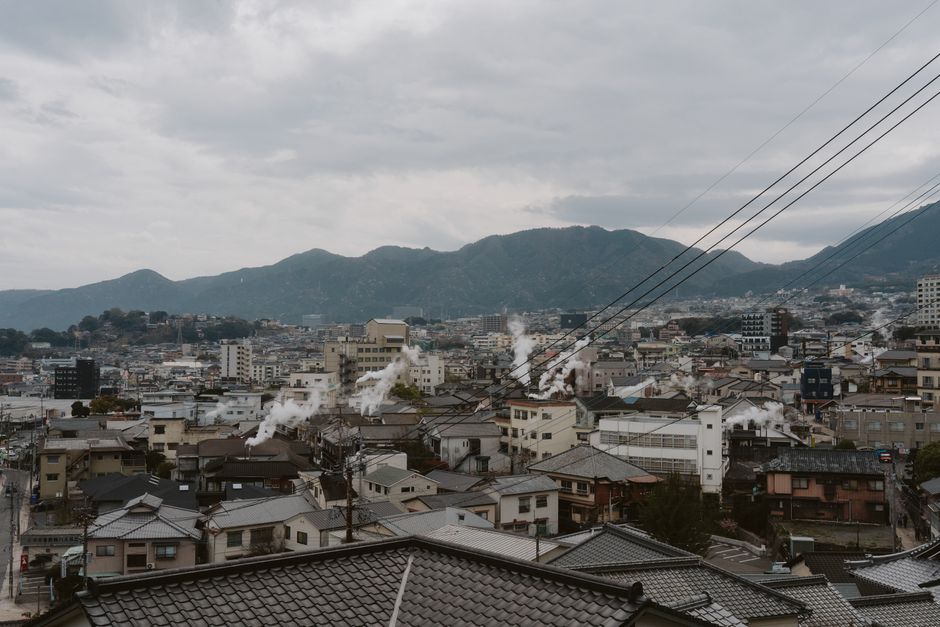
Beppu is a seaside city of about 110,000 people on Beppu Bay in Oita Prefecture, eastern Kyushu, and Japan’s hot spring capital. More than 2,000 hot spring sources pour out water and steam across eight historic spa districts, the “Beppu Hatto”, and on a cool morning, columns of steam rise from rooftops, gutters and hillsides all over the city. Beppu has the largest hot spring output in Japan, and bathing here is a way of life: locals drop into neighborhood bathhouses for a few hundred yen, bury themselves in hot sand on the beach, and cook their dinners in natural steam. Come for the colorful “hells” (jigoku) of Kannawa, the sand baths and mud baths, steam-cooked food and a day trip to Yufuin. The best months are March to May and October to November, though a hot bath is welcome all year.
Right now in Beppu
- Wed 13–21°C 56–69°F Clear
- Thu 14–21°C 56–69°F Clear
- Fri 16–21°C 61–70°F 1 mm Cloudy
- Mon 12 Oct Sports Day (スポーツの日)
Weather: MET Norway (CC BY 4.0) · Sea temperature: NOAA CoastWatch · Air quality: OpenAQ · Rates: ECB · Holidays: Nager.Date
Top tours in Beppu
See all tours for Beppu →
From local operators, with prices and reviews; you check availability and book on Viator, our partner. We may earn a commission at no extra cost to you. How we earn money
Beppu at a glance
- Best for: hot springs of every kind, the Hells of Beppu, sand and mud baths, steam-cooked food, relaxed ryokan stays.
- How long: 2 days for Beppu; 3–4 days with Yufuin, Usuki or the mountains of Kuju.
- Best time: March to May and October to November, with highs of about 15–24 °C (58–75 °F); winter is perfect for outdoor baths.
- Getting there: about 2 hours from Fukuoka (Hakata) by the Sonic limited express; about 45 minutes by bus from Oita Airport; overnight ferry from Osaka.
- Getting around: city buses between the station, Kannawa and Myoban; pay with an IC card or a bus pass.
- Fees to know: the Hells common ticket costs ¥2,400 for adults, valid for two days, as of October 2026; Beppu’s bathing tax is ¥250 per person per night at most hotels.
- Before you go: entry rules, rail passes, money and general safety are in our Japan travel guide; combine Beppu with our Fukuoka guide.
Beppu’s areas and where to stay
Beppu climbs from the bay up the slopes of Mount Tsurumi, with the eight spa districts spread across the city. The station area is by the sea; Kannawa and Myoban are on the hills to the north-west.
Beppu Station and the seafront
The downtown area, with business hotels, large resort hotels along the bay, shopping arcades, izakaya and the old Takegawara bathhouse. The most convenient base for trains, buses and day trips.
Kannawa
The heart of hot spring Beppu, about 20 minutes uphill by bus, where steam billows from vents in the streets. Most of the Hells are here, along with traditional inns, steam-cooking restaurants and the public bath Kannawa Mushiyu. The most atmospheric place to stay.
Myoban
High on the hillside above Kannawa, known for its thatched huts where “yu-no-hana” bath salts are made from mineral deposits, and for milky-blue sulfur springs with views over the bay.
Shibaseki and Kamegawa
Quieter spa districts to the north, with two of the Hells (Chinoike and Tatsumaki) and local bathhouses.
Horita and Kankaiji
Resort hotels on the hills to the west, with large outdoor baths overlooking the city and the bay.
Top things to see in Beppu
The Hells of Beppu (Jigoku Meguri)
Seven spectacular hot spring pools, too hot for bathing, have been shown to visitors for more than a century as the “hells” of Beppu, a name that dates back to a time when the steaming land was avoided as cursed. Umi Jigoku (Sea Hell) is a pool of cobalt-blue water at about 98 °C (208 °F); Chinoike Jigoku (Blood Pond Hell) is colored deep red by iron oxide; Tatsumaki Jigoku is a geyser that erupts every 30–40 minutes; Shiraike Jigoku is milky white; Oniishibozu Jigoku bubbles with gray mud like shaven heads; Kamado Jigoku has several pools of different colors; and Oniyama Jigoku keeps crocodiles warmed by the hot water. Four of them, Umi, Chinoike, Tatsumaki and Shiraike, are designated national Places of Scenic Beauty. Four have free foot baths.
According to the Beppu Hells Association, the common ticket for all seven costs ¥2,400 (about US$15) for adults (high school age and up) and ¥1,200 for elementary and junior high school students, prices in force since February 1, 2025. It is sold at every hell and is valid on the day of purchase and the next day, with one entry to each hell. Single entries are also sold. The hells are open daily, all year, from 8 a.m. to 5 p.m. Five of them are within walking distance in Kannawa; Chinoike and Tatsumaki are about 3 km (2 miles) away in Shibaseki, a short bus ride.
Takegawara Onsen
Beppu’s most famous public bathhouse, in a grand wooden building from 1879 near the station, with a traditional bath and a sand bath, where attendants bury you up to the neck in naturally heated sand. It is simple, inexpensive and full of local character.
Beppu Kaihin Sand Bath and the mud baths
At Shoningahama beach, you can lie in warm sand facing the sea; at Hoyoland and other mud baths in Myoban, you can soak in silky, mineral-rich mud. Both are classic Beppu experiences.
Kannawa’s steam and the Jigoku Mushi kitchens
At the Jigoku Mushi Kobo in Kannawa, you buy a basket of vegetables, eggs, seafood or meat and steam it yourself over natural hot spring vents for a few minutes; the food takes on a light, salty flavor. Nearby, Kannawa Mushiyu is a steam bath with medicinal herbs, used since the 13th century.
Myoban’s yu-no-hana huts
On the slopes of Myoban, workers grow bath salts in thatched huts using a technique handed down since the Edo period; the huts are a nationally registered intangible folk cultural property. You can watch the process, buy the salts and bathe in a cloudy sulfur spring nearby.
More classic sights
- Mount Tsurumi and the Beppu Ropeway: a cable car up the 1,375 m (4,511 ft) peak above the city, with views over the bay and, in spring, azaleas and cherry blossoms.
- Takasakiyama Natural Zoo: a mountain park where about 1,000 wild Japanese macaques come down to be fed, between Beppu and Oita.
- Umitamago: an aquarium by the sea next to Takasakiyama, with dolphins and walruses.
- Hyotan Onsen: a large modern bathhouse in Kannawa with steam baths, waterfall showers and sand baths.
- Beppu Tower and the seafront: the old 1957 tower and the promenade along the bay.
- Beppu Park: a pleasant park in the city with cherry trees and a view of the mountain.
Peaks and mountains
- Mount Tsurumi
Other sights
- Beppu Kaihin Sand Bath
- Chinoike Jigoku
- Hells of Beppu
- Kamado Jigoku
- Shiraike Jigoku
- Takegawara Onsen
- Tatsumaki Jigoku
- Umi Jigoku (Sea Hell)
Viewpoints
- Beppu Tower
Other things to do in Beppu
Bathing in Beppu
Beppu offers almost every kind of hot spring: clear, salty, milky sulfur, iron-red, mud and steam. The city’s many community baths cost from a few hundred yen, and some are free but intended for locals, so follow the house rules: wash before entering, keep towels out of the water, and remember that tattoos may not be allowed in some places (ask first, or choose a private family bath, which many inns rent by the hour). The Beppu Hatto Onsen Dojo stamp book rewards those who collect stamps from dozens of baths.
Food and drink
Beppu’s soul food is toriten, chicken tempura dipped in vinegar and soy sauce with mustard, and Beppu reimen, chilled noodles in beef broth with kimchi, introduced after the war. Jigoku-mushi, food cooked in hot spring steam, is the specialty of Kannawa. Oita Prefecture is famous for seki saba and seki aji, mackerel and horse mackerel caught in the strait off its coast and served raw, dango-jiru (flat noodle soup), Bungo beef and the citrus kabosu, squeezed over almost everything. Try the local shochu made from barley.
Festivals
The Beppu Hatto Onsen Festival in early April opens the season with free bathing in many baths and parades, and the Ogi Yamabiraki fire festival on Mount Ogi follows in March. In summer, fireworks light up the bay.
Activities and best months
- CultureA common ticket for Beppu's seven hells costs ¥2,400 for adults (valid two days), sold at every hell, open 8:00-17:00 all year; five of them are within walking distance in Kannawa. · source
Day trips from Beppu
- Yufuin: a stylish hot spring village in a valley below Mount Yufu, with Lake Kinrin’s morning mist, galleries and cafés; about 1 hour by bus or 1 hour 10 minutes by train.
- Usuki: stone Buddhas carved into the cliffs from the 12th century, a national treasure, and an old castle town; about 1 hour by train.
- Kuju and the Kuju Highlands: mountain hiking, the Kokonoe “Yume” suspension bridge and highland hot springs, about 1.5–2 hours by car.
- Mount Aso: one of the world’s largest calderas, in Kumamoto Prefecture, about 2.5 hours by car or bus. Check the crater status before going.
- Usa Jingu: the head shrine of all Hachiman shrines in Japan, with vermilion halls in a forest, about 1 hour by train.
- Kitsuki: a castle town with samurai streets on two hills, about 30 minutes by train.
- Fukuoka: Kyushu’s biggest city, about 2 hours away. See our Fukuoka guide.
Nearby destinations
- Fukuoka103 km
- Itsukushima (Miyajima)135 km
- Hiroshima153 km
- Nagasaki158 km
- Naoshima268 km
Getting there and getting around
By train
The Sonic limited express runs from Hakata in Fukuoka to Beppu in about 2 hours along the coast, via Kokura, where you can also change from the Sanyo Shinkansen. The Japan Rail Pass (¥50,000 (about US$316) for 7 days on the official site, as of October 2026) covers it. JR Kyushu’s Northern Kyushu Rail Pass (¥15,000 (about US$95) for 3 days, ¥17,000 for 5 days) covers the area north of Oita, including Beppu, Yufuin and Fukuoka, and the All Kyushu Rail Pass (from ¥22,000 for 3 days) adds the south. The passes do not cover the Sanyo Shinkansen between Hakata and Kokura.
By air and sea
Oita Airport has flights from Tokyo, Osaka, Nagoya and some Asian cities; the airport bus to Beppu takes about 45 minutes. The overnight Sunflower ferry sails from Osaka to Beppu, a relaxing trip across the Seto Inland Sea with a public bath on board. Highway buses link Beppu with Fukuoka and Yufuin.
Around the city
Kamenoi buses link Beppu Station with Kannawa and the Hells (about 20 minutes from the station’s west exit, on routes 2, 5, 24 and 41), Myoban and Shibaseki; one- and two-day “My Beppu Free” passes are good value. Pay with an IC card. Taxis are easy to find, and car rental helps for Kuju and Aso.
When to go and how long to stay
Beppu has a mild climate on the Seto Inland Sea side of Kyushu, with cool winters, a rainy early summer and hot, humid summers. The table uses the Japan Meteorological Agency’s (JMA) 1991–2020 normals for its Oita station, on the same bay about 12 km (7 miles) south and the nearest with full climate normals: average daily highs and lows, total rain and days with at least 0.5 mm. Kannawa and Myoban, higher up the hill, are a few degrees cooler.
| Month | Average high / low | Rain (days with 0.5 mm or more) | What to expect |
|---|---|---|---|
| January | 11 °C (51 °F) / 3 °C (37 °F) | 50 mm (2.0 in), 6 days | Cool and dry; steaming streets; perfect for outdoor baths |
| February | 12 °C (53 °F) / 3 °C (37 °F) | 64 mm (2.5 in), 8 days | Cool; plum blossoms; clear days |
| March | 15 °C (58 °F) / 6 °C (43 °F) | 99 mm (3.9 in), 10 days | Mild; cherry blossoms usually open around March 24 |
| April | 20 °C (67 °F) / 10 °C (51 °F) | 120 mm (4.7 in), 10 days | Pleasant; cherries peak early in the month; Onsen Festival |
| May | 24 °C (75 °F) / 15 °C (59 °F) | 134 mm (5.3 in), 10 days | Warm; fresh green on Mount Tsurumi; Golden Week crowds |
| June | 26 °C (80 °F) / 19 °C (67 °F) | 314 mm (12.3 in), 14 days | Rainy season usually from about June 4; the wettest month |
| July | 31 °C (88 °F) / 24 °C (74 °F) | 261 mm (10.3 in), 12 days | Hot and humid; rainy season usually ends around July 19 |
| August | 32 °C (90 °F) / 24 °C (76 °F) | 166 mm (6.5 in), 11 days | The hottest month; summer festivals and fireworks |
| September | 28 °C (83 °F) / 21 °C (70 °F) | 255 mm (10.0 in), 11 days | Hot; typhoons most likely; wet |
| October | 23 °C (74 °F) / 15 °C (59 °F) | 145 mm (5.7 in), 8 days | Warm and drier; a great month |
| November | 18 °C (65 °F) / 10 °C (49 °F) | 73 mm (2.9 in), 7 days | Mild and clear; autumn leaves in Kuju and Yufuin |
| December | 13 °C (55 °F) / 5 °C (40 °F) | 47 mm (1.9 in), 6 days | Cool; maples linger early in the month; hot spring season |
The Oita area gets about 1,730 mm (68 in) of rain a year, a third of it in June and July, while winters are dry and sunny. The JMA’s normal rainy season for northern Kyushu runs from about June 4 to July 19; in 2026 it ran from about June 2 to July 7. Snow falls rarely in the city but more often on Mount Tsurumi and in Yufuin.
Weather month by month
Averages from JMA normals 1991–2020, Oita · Last reviewed 5 Oct 2026
Typhoons: according to the JMA’s 1991–2020 normals, about four typhoons a year come close to northern Kyushu, most often in August and September. They can cancel the ferry from Osaka, stop trains and close the Hells for a day.
Cherry blossoms and fall colors: the JMA’s normal date for the first cherry blossoms in Oita is March 24, with full bloom around April 4; in 2026 they opened on March 24 and peaked on April 5. Beppu Park and the Beppu Ropeway’s Mount Tsurumi are good spots. The maples at the JMA’s Oita station normally turn in late November, a little earlier in Yufuin and Kuju.
Crowds: Beppu is busy in Golden Week, in mid-August and at New Year, and the Hells fill with tour buses from late morning. Visit the Hells soon after 8 a.m., and book ryokan well ahead for holiday weekends.
Two days in Beppu
Day one, the Hells of Kannawa in the morning with a steam-cooked lunch at the Jigoku Mushi Kobo, then Chinoike and Tatsumaki by bus, and an evening soak at Hyotan Onsen or your ryokan. Day two, a sand bath at Takegawara Onsen or on the beach, the Myoban bath-salt huts, the ropeway up Mount Tsurumi, and toriten and reimen for dinner downtown.
Four days with Yufuin and Usuki
Add a night in a Yufuin ryokan for its morning mist and galleries, and a day trip to the stone Buddhas of Usuki, or drive into the Kuju Highlands for hiking and mountain hot springs.
Where to stay in Beppu and taxes
- Beppu Station and the seafront: business hotels and large resort hotels with bay views; best for transport.
- Kannawa: traditional ryokan and guesthouses among the steam vents; many have private hot spring baths.
- Myoban: small inns with milky sulfur springs and views over the bay.
- Horita and Kankaiji: hillside resort hotels with large outdoor baths.
- Yufuin: upscale ryokan in the countryside, an hour away.
Instead of an accommodation tax, Beppu charges a bathing tax (nyuto-zei) on hotel and ryokan guests who use hot springs. According to the City of Beppu, under a higher rate in force until March 31, 2029, the tax is ¥250 (about US$1.6) per person per night where the room and meals cost ¥6,001 to ¥50,000, and ¥500 above that, with lower rates for cheaper stays and for long stays of seven nights or more.
Oita Prefecture has also approved a prefectural accommodation tax: ¥100 per person per night under ¥5,000, ¥200 from ¥5,000 to ¥19,999, ¥500 from ¥20,000 to ¥99,999 and ¥2,000 from ¥100,000, based on the room rate excluding consumption tax. According to Oita Prefecture, as of its last update in July 2026 the starting date had not yet been set; check before you travel.
What a trip to Beppu costs
Prices are approximate, for October 2026, converted at about ¥158 to the US dollar.
| Item | Typical cost |
|---|---|
| Hells common ticket (7 hells, 2 days) | ¥2,400 (about US$15) |
| Neighborhood bathhouse | ¥100–500 (about US$0.6–3.2) |
| Sand bath | about ¥1,500–2,000 (about US$9.5–13) |
| Steam-cooked lunch at Kannawa | ¥1,000–2,500 (about US$6.3–16) |
| Toriten set meal | ¥1,000–1,500 (about US$6.3–9.5) |
| Bus day pass | about ¥1,000–1,800 (about US$6.3–11) |
| Business hotel double, per night | ¥8,000–16,000 (about US$51–101) |
| Ryokan with dinner and breakfast, per person | ¥15,000–40,000 (about US$95–253) |
Practical tips for Beppu
- Bring a towel and coins: community baths rarely supply towels or soap, and many take cash only.
- Bathing etiquette: wash thoroughly first, tie up long hair, keep towels out of the water, and drink water between baths.
- Tattoos: policies vary; many ryokan offer private baths, and some public baths welcome tattoos, so ask first.
- Get a bus pass: the Hells, Myoban and the ropeway are spread out, and a day pass quickly pays for itself.
- Departure tax: since July 2026, Japan’s International Tourist Tax is ¥3,000 per departure, usually included in your air fare (tickets issued by June 30, 2026 keep the old ¥1,000).
- Visitor hotline: the JNTO’s Japan Visitor Hotline, 050-3816-2787, answers in English 24 hours a day.
Safety
Beppu is safe and relaxed. The water and steam at the Hells and in vents around Kannawa can be close to boiling, so stay behind barriers and keep children close. In the baths, avoid long soaks, alcohol and sudden temperature changes, and get out if you feel dizzy, especially if you have heart or blood pressure problems. Beppu lies among active volcanoes: as of October 4, 2026, the JMA had no eruption warning in force for Tsurumi-dake–Garan-dake above the city or for Kuju, while Mount Aso was at eruption alert level 2, with entry restricted around the crater; check the JMA’s volcanic warnings before hiking. Other hazards are typhoons and heavy rain from June to October and earthquakes; the 2016 Kumamoto earthquakes also shook Oita. In an emergency, call 110 for the police or 119 for an ambulance or fire, and keep the JNTO’s Safety Tips app on your phone.
What to pack for Beppu
A small towel and a bag for wet things, slip-on shoes for moving between baths, a light yukata-friendly layer for strolling Kannawa at night, an umbrella from May to September, and warm layers for winter evenings. Japan uses 100 V and two-pin type A plugs like the US.
Beppu travel FAQ
How much is the Beppu Hells ticket?
The common ticket for all seven Hells costs ¥2,400 for adults and ¥1,200 for children as of October 2026, and is valid for two days.
What are the Hells’ opening hours?
8 a.m. to 5 p.m. every day of the year.
Can you swim in the Hells of Beppu?
No. The Hells are far too hot for bathing, but four have foot baths, and Beppu has hundreds of hot springs for soaking.
How do I get from Beppu Station to the Hells?
Take a Kamenoi bus from the west exit to Kannawa (about 20 minutes); Chinoike and Tatsumaki are a short bus ride further.
How many days do I need in Beppu?
Two days for the Hells, baths and Mount Tsurumi; three or four to add Yufuin, Usuki or Kuju.
How do I get from Fukuoka to Beppu?
By the Sonic limited express from Hakata in about 2 hours; the JR Pass and the Northern Kyushu Rail Pass cover it.
Is there an accommodation tax in Beppu?
Beppu charges a bathing tax, usually ¥250 per person per night. Oita Prefecture has approved an accommodation tax, but its starting date had not been set as of July 2026.
Can I visit Beppu hot springs with tattoos?
Some baths accept tattoos and others do not; private family baths at many inns are the easiest option.
What should I eat in Beppu?
Toriten chicken tempura, Beppu reimen, food steamed in the Kannawa vents, seki saba mackerel and dango-jiru.
Is Beppu affected by volcanic activity?
The volcanoes near Beppu had no eruption warnings in force as of October 4, 2026; Mount Aso, farther away, was at alert level 2, so check the JMA before visiting its crater.
Sources
- © OpenStreetMap contributors · ODbL · fetched 5 Oct 2026
- Wikidata · CC0 · fetched 5 Oct 2026
Sources and last review
Researched and last reviewed on 4 October 2026. Hells common ticket, prices, validity, hours and access: the Beppu Hells Association (Beppu Jigoku Kumiai); bathing tax: the City of Beppu; prefectural accommodation tax: Oita Prefecture; JR Kyushu passes: JR Kyushu; JR Pass: the official Japan Rail Pass website; climate normals, rainy season, typhoon statistics, cherry blossom and maple dates, and volcanic warnings: the Japan Meteorological Agency (JMA); visitor hotline: JNTO; exchange rate: the US Federal Reserve. Population, hot spring statistics, history, sight descriptions, journey times, festival dates, other admission prices and typical prices are general references or estimates, flagged for checking. Prices and hours change, so check the official sites before you go. For entry rules, money and general safety, see our Japan travel guide.
Plan your trip
Partner links: TravelerCenter may earn a commission if you book, at no extra cost to you.
🇯🇵 Useful Japanese phrases for Beppu
All 38 Japanese phrases: restaurant, hotel, emergencies, romance (printable) →