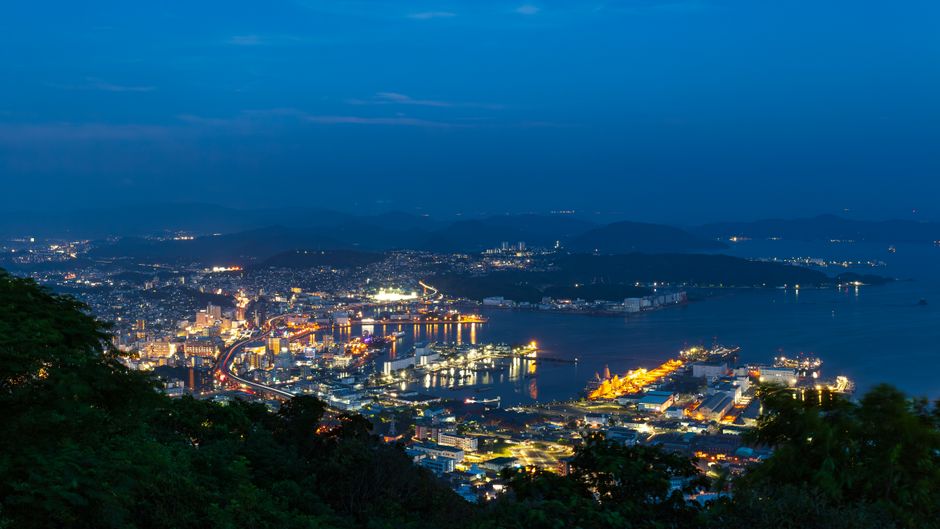
Nagasaki is a hilly port city of about 390,000 people on the west coast of Kyushu, wrapped around a long, deep harbor. For more than two centuries, while Japan was closed to the world, it was the country’s only window to the West and China, through the Dutch trading post on the artificial island of Dejima and the Chinese merchants of its port. That history left Catholic churches, Chinese temples, a Western merchants’ hillside and a cuisine all its own. On August 9, 1945, an atomic bomb destroyed the Urakami district in the north of the city, and the Peace Park and Atomic Bomb Museum are the reason many visitors come. Come too for the night view from Mount Inasa, the abandoned island of Gunkanjima, and champon noodles. The best months are March to May and October to November.
Right now in Nagasaki
- Wed17–23°C62–74°FMostly clear
- Thu15–25°C59–77°FClear
- Fri18–27°C64–80°F1 mm rain
- Mon 12 Oct Sports Day (スポーツの日)
Top tours in Nagasaki
See all tours for Nagasaki →
From local operators, with prices and reviews; you check availability and book on Viator, our partner. We may earn a commission at no extra cost to you. How we earn money
Nagasaki at a glance
- Best for: peace history, churches and Hidden Christian heritage, Dejima and the Glover Garden, Gunkanjima, night views and food.
- How long: 2 days for the city; 3–4 days with Gunkanjima, Unzen or the Goto Islands.
- Best time: March to May and October to November, with highs of about 15–24 °C (60–75 °F).
- Getting there: about 1.5 hours from Fukuoka (Hakata) by limited express and the Nishi Kyushu Shinkansen; about 45 minutes by bus from Nagasaki Airport.
- Getting around: the streetcar network covers almost every sight; pay with an IC card.
- Fees to know: the Atomic Bomb Museum costs ¥200 and the Glover Garden ¥1,300 as of October 2026; a Gunkanjima landing tour costs about ¥4,000–5,000 with the city’s landing fee; Nagasaki’s accommodation tax is ¥100 to ¥500 per person per night.
- Before you go: entry rules, rail passes, money and general safety are in our Japan travel guide; combine Nagasaki with our Fukuoka guide.
Nagasaki’s areas and where to stay
Nagasaki stretches for several kilometers along the harbor and the narrow Urakami valley, with houses climbing the steep hills on both sides. The station is in the middle; the peace sites are to the north, and the old foreign quarters to the south.
Nagasaki Station
Rebuilt for the shinkansen in 2022, with a large shopping complex, hotels and the main streetcar and bus stops. Convenient for arrival and day trips.
Dejima, Shinchi Chinatown and the Hamanomachi arcade
The city center, a short streetcar ride south of the station: the restored Dutch trading post, Japan’s oldest Chinatown, and the covered shopping streets of Hamanomachi. Lots of hotels and restaurants.
Shianbashi and the Teramachi temples
Nagasaki’s nightlife district, small and lively, next to the old temple street of Teramachi and the stone Megane (Spectacles) Bridge. Good for dinner and bars.
Minamiyamate and Oura
The hillside where Western merchants lived after the port opened in 1859, with the Glover Garden, Oura Cathedral, and the Dutch Slope. Hotels with harbor views.
Urakami and the Peace Park
The northern district around the hypocenter of the atomic bomb, with the Peace Park, the museum and Urakami Cathedral. Quieter, with a few business hotels.
Top things to see in Nagasaki
The Atomic Bomb Museum and the hypocenter
The Nagasaki Atomic Bomb Museum tells the story of August 9, 1945, from the moment the bomb exploded at 11:02 a.m. to the lives of the survivors and the movement to abolish nuclear weapons, with objects recovered from the ruins, photographs and testimony. Allow at least 1.5 hours. According to the City of Nagasaki, admission is ¥200 (about US$1.3) for adults, and since April 1, 2026, entry is free for high school students and younger. The museum opens from 8:30 a.m. to 5:30 p.m. (last entry 5 p.m.), until 6:30 p.m. from May to August, and closes only from December 29 to 31. Next door, the free Nagasaki National Peace Memorial Hall for the Atomic Bomb Victims is a quiet space of remembrance. Below the museum, a black stone pillar marks the hypocenter, with fragments of the old Urakami Cathedral.
The Peace Park
A short walk north, the free Peace Park is dominated by the 9.7 m (32 ft) Peace Statue, its right hand pointing to the threat from the sky and its left extended for peace. The Fountain of Peace remembers victims who died begging for water, and countries around the world have donated monuments. The memorial ceremony is held here every August 9.
Gunkanjima (Hashima)
About 15 km (9 miles) off the coast lies Hashima, nicknamed Gunkanjima (“battleship island”) for its silhouette. Once a busy undersea coal mine with more than 5,000 residents packed into concrete apartment blocks, it was abandoned in 1974 and is now part of the UNESCO site “Sites of Japan’s Meiji Industrial Revolution”. You can visit only on a licensed boat tour, which circles the island and, when conditions allow, lands at a fenced viewing area on the southern tip. Tours from Nagasaki Port take about 2.5–3 hours.
According to the operators, from April 1, 2026 the City of Nagasaki’s landing fee rose to ¥650 (about US$4.1) for adults and ¥320 for students, paid on top of the boat fare, which is about ¥3,600–4,200 (about US$23–27) for adults. The city allows landing only in calm seas, with limits on wave height, wind speed and visibility, and the captain decides on the day; in rough weather, boats circle the island without landing. Book a few days ahead, and expect cancellations in winter and typhoon season.
The Glover Garden and Oura Cathedral
On the hill of Minamiyamate, the Glover Garden gathers the homes of Western merchants, including the 1863 house of Thomas Glover, a Scottish trader who helped modernize Japan’s shipbuilding and mining, now part of the Meiji Industrial Revolution UNESCO site. According to the garden, since April 1, 2026 admission is ¥1,300 (about US$8.2) for adults and ¥650 for students. It opens from 8 a.m. to 6 p.m., with evening openings until 8 or 9:30 p.m. from mid-July to December. Just below, Oura Cathedral (1864), Japan’s oldest standing church, is where Hidden Christians revealed their faith to a French priest in 1865; it is part of the UNESCO site “Hidden Christian Sites in the Nagasaki Region”.
Dejima
From 1641 to 1859, the Dutch were confined to this small fan-shaped artificial island, the only Western trading post in Japan. Many of its warehouses, residences and the chief factor’s house have been rebuilt, with exhibits on trade, science and daily life, and a miniature model of the island.
Mount Inasa night view
From the summit of Mount Inasa, 333 m (1,093 ft) above the harbor, the lights of the city fill the valleys below. The Nagasaki Ropeway climbs from Fuchi Shrine, and a free shuttle bus runs from the main hotels in the evening; the observation deck is free.
More classic sights
- Twenty-Six Martyrs Monument and Museum: remembering Christians crucified here in 1597, near the station.
- Megane Bridge: a double-arched stone bridge from 1634 whose reflection in the river looks like spectacles.
- Sofuku-ji: a red-gated Chinese Zen temple from 1629, a reminder of the city’s Chinese community.
- Urakami Cathedral: rebuilt after the bombing, with a bell tower that fell in 1945 left where it landed.
- Shinchi Chinatown: Japan’s oldest Chinatown, small and busy, with champon restaurants and pork buns.
- Nagasaki Museum of History and Culture: the city’s foreign trade history and a reconstructed magistrate’s office.
Monuments
- Hashima Island
- Megane Bridge
- Ōura Church
Archaeological sites
- Dejima
Museums
- Nagasaki Atomic Bomb Museum
- Twenty-Six Martyrs Museum and Monument
Parks and gardens
- Glover Garden
- Nagasaki Peace Park
Peaks and mountains
- Mount Inasa
Churches and cathedrals
- Urakami Cathedral
Other things to do in Nagasaki
Food and drink
Nagasaki’s food mixes Japanese, Chinese and Portuguese influences. The essential dish is champon, thick noodles in a milky pork broth with seafood and vegetables, invented by a Chinese restaurant owner for students around 1899; sara udon is its crispy cousin, fried noodles under a thick sauce. Try kakuni manju, braised pork belly in a soft bun; Turkish rice, a plate of pilaf, spaghetti and a pork cutlet; and shippoku, a banquet of Japanese, Chinese and Western dishes shared from a round table. Castella, the sponge cake introduced by Portuguese traders in the 16th century, is sold everywhere. Local seafood is excellent, and the Goto Islands are known for udon and tuna.
Festivals
The Nagasaki Lantern Festival fills the center with about 15,000 Chinese lanterns for two weeks around the Lunar New Year (January or February). Nagasaki Kunchi, from October 7 to 9, is the autumn festival of Suwa Shrine, with spinning boat floats and a Chinese dragon dance. On August 15, families carry illuminated boats for the dead through the streets in Shoro Nagashi, with deafening firecrackers.
Hidden Christian heritage
Christians were banned in Japan from the early 1600s, and many in the Nagasaki region kept their faith in secret for more than 250 years. The UNESCO-listed sites include villages on the Sotome coast and the Goto Islands; some churches require advance notice to visit, so check with the information center before you go.
Activities and best months
- City sightseeingThe Nagasaki Atomic Bomb Museum costs ¥200 (free for high-school age and younger from 1 April 2026), open 8:30-17:30; the Glover Garden costs ¥1,300 for adults from 1 April 2026 with evening openings in summer and autumn.
Day trips from Nagasaki
- Unzen: a hot spring town in the mountains of the Shimabara Peninsula, with steaming “hells” and hiking on Mount Unzen; about 1.5–2 hours by bus.
- Shimabara: a rebuilt castle and samurai streets with carp swimming in the canals.
- Huis Ten Bosch: a large Dutch-style theme park with flowers and illuminations, about 1.5 hours by train.
- Sasebo and the Kujukushima Islands: boat trips among 208 small green islands.
- Sotome: the Hidden Christian villages and churches on the coast north of the city, about 45 minutes by bus.
- The Goto Islands: churches, beaches and Hidden Christian heritage, about 1.5 hours by jetfoil, better as an overnight trip.
- Fukuoka: the big city of Kyushu, about 1.5 hours away. See our Fukuoka guide.
Nearby destinations
- Fukuoka105 km
- Beppu158 km
- Yakushima273 km
- Busan280 km
- Itsukushima (Miyajima)282 km
Getting there and getting around
By train
Since 2022, the Nishi Kyushu Shinkansen links Nagasaki with Takeo-Onsen; from Hakata, take the Relay Kamome limited express and change across the platform at Takeo-Onsen, about 1 hour 20 to 1 hour 30 minutes in total. The Japan Rail Pass (¥50,000 (about US$316) for 7 days on the official site, as of October 2026) covers the trip. JR Kyushu’s Northern Kyushu Rail Pass (¥15,000 (about US$95) for 3 days, ¥17,000 for 5 days) and All Kyushu Rail Pass (from ¥22,000 for 3 days) cover the Nishi Kyushu Shinkansen and limited expresses, but not the Sanyo Shinkansen between Hakata and Kokura.
By air and bus
Nagasaki Airport sits on an island in Omura Bay, with flights from Tokyo, Osaka, Nagoya and a few Asian cities; the airport bus to the city takes about 45 minutes. Highway buses run frequently to Fukuoka (about 2.5 hours), and ferries and jetfoils sail to the Goto Islands from Nagasaki Port.
Around the city
Nagasaki’s streetcars are cheap, frequent and reach almost every sight, with a flat fare and a one-day pass sold at the information center and hotels; IC cards are accepted. The city is hilly, so expect steep slopes and stairs in Minamiyamate and on Mount Inasa. Taxis are plentiful.
When to go and how long to stay
Nagasaki has a warm, humid climate with mild winters, a wet early summer and hot, sticky days in July and August. The table uses the Japan Meteorological Agency’s (JMA) 1991–2020 normals for its Nagasaki station: average daily highs and lows, total rain and days with at least 0.5 mm.
| Month | Average high / low | Rain (days with 0.5 mm or more) | What to expect |
|---|---|---|---|
| January | 11 °C (51 °F) / 4 °C (39 °F) | 63 mm (2.5 in), 10 days | Cool; Lantern Festival may start late in the month |
| February | 12 °C (54 °F) / 4 °C (40 °F) | 84 mm (3.3 in), 10 days | Cool; Lantern Festival around the Lunar New Year |
| March | 15 °C (60 °F) / 8 °C (46 °F) | 123 mm (4.9 in), 11 days | Mild; cherry blossoms usually open around March 23 |
| April | 20 °C (68 °F) / 12 °C (53 °F) | 153 mm (6.0 in), 10 days | Pleasant; cherries peak early in the month |
| May | 24 °C (75 °F) / 16 °C (61 °F) | 161 mm (6.3 in), 10 days | Warm; azaleas; Golden Week crowds |
| June | 26 °C (80 °F) / 20 °C (68 °F) | 336 mm (13.2 in), 14 days | Rainy season usually from about June 4; the wettest month |
| July | 30 °C (87 °F) / 24 °C (76 °F) | 293 mm (11.5 in), 12 days | Hot and humid; rainy season usually ends around July 19 |
| August | 32 °C (89 °F) / 25 °C (78 °F) | 218 mm (8.6 in), 11 days | The hottest month; peace ceremony on August 9; Shoro Nagashi on August 15 |
| September | 29 °C (84 °F) / 22 °C (71 °F) | 187 mm (7.3 in), 10 days | Hot; typhoons most likely |
| October | 24 °C (75 °F) / 16 °C (62 °F) | 102 mm (4.0 in), 7 days | Warm and dry; Nagasaki Kunchi on October 7 to 9; a great month |
| November | 18 °C (65 °F) / 11 °C (52 °F) | 101 mm (4.0 in), 10 days | Mild; clear days; good for walking |
| December | 13 °C (56 °F) / 6 °C (43 °F) | 75 mm (2.9 in), 10 days | Cool; maples color late in the year; illuminations |
Nagasaki gets about 1,890 mm (75 in) of rain a year, more than a third of it in June and July. The JMA’s normal rainy season for northern Kyushu runs from about June 4 to July 19; in 2026 it ran from about June 2 to July 7. Downpours in the rainy season can be intense, and the city’s steep slopes are prone to landslides. Winters are mild, with only the occasional dusting of snow.
Weather month by month
Typhoons: according to the JMA’s 1991–2020 normals, about four typhoons a year come close to northern Kyushu, most often in August and September. A typhoon can cancel flights, ferries and Gunkanjima tours and stop the streetcars for a day or two, so keep your plans flexible in late summer.
Cherry blossoms and fall colors: the JMA’s normal date for the first cherry blossoms in Nagasaki is March 23, with full bloom around April 2; in 2026 they opened on March 27 and peaked on April 3. Good spots include Tateyama Park, the Peace Park and Omura Park outside the city. The maples at the JMA’s Nagasaki station turn late, usually in early December.
Crowds: Nagasaki is busy in Golden Week, during the Lantern Festival and Kunchi, and on August 9. School groups fill the peace sites on weekday mornings in spring and fall; go in the late afternoon for a quieter visit.
Two days in Nagasaki
Day one, the Atomic Bomb Museum, the hypocenter and the Peace Park in the morning, then Urakami Cathedral and the Twenty-Six Martyrs Monument; at sunset, Mount Inasa for the night view. Day two, a morning Gunkanjima tour, lunch in Chinatown, then Dejima, the Glover Garden and Oura Cathedral, and dinner in Shianbashi.
Four days with Unzen or the islands
Add a night in a hot spring ryokan in Unzen with a stop in Shimabara, or a ferry to the Goto Islands for churches and beaches. Families may prefer a day at Huis Ten Bosch.
Where to stay in Nagasaki and the accommodation tax
- Nagasaki Station: new hotels in and around the station, best for trains and buses.
- Dejima and Hamanomachi: central hotels near Chinatown, the arcades and the streetcars.
- Shianbashi: small hotels close to restaurants and nightlife.
- Minamiyamate: hotels with harbor views near the Glover Garden.
- Mount Inasa: a few hotels with spectacular night views.
Since April 1, 2023, the City of Nagasaki has charged an accommodation tax on all hotels, ryokan and private rentals, per person per night, based on the room rate. According to the City of Nagasaki, the rates are:
| Room rate per person per night | Tax per person per night |
|---|---|
| under ¥10,000 | ¥100 (about US$0.6) |
| ¥10,000 to ¥19,999 | ¥200 (about US$1.3) |
| ¥20,000 or more | ¥500 (about US$3.2) |
There is no exemption for cheap rooms, but students on school trips are exempt. The city plans to change the rates to ¥100 under ¥6,000, ¥300 from ¥6,000 to ¥19,999 and ¥500 from ¥20,000, aiming for April 1, 2027, once the national government approves; check before you book for stays after that date.
What a trip to Nagasaki costs
Prices are approximate, for October 2026, converted at about ¥158 to the US dollar.
| Item | Typical cost |
|---|---|
| Atomic Bomb Museum | ¥200 (about US$1.3); free for high school students and younger |
| Glover Garden | ¥1,300 (about US$8.2) |
| Gunkanjima landing tour with the landing fee | about ¥4,300–4,900 (about US$27–31) |
| Dejima | about ¥500–600 (about US$3.2–3.8) |
| Streetcar ride | about ¥140–150 (about US$0.9) |
| Bowl of champon | ¥900–1,500 (about US$5.7–9.5) |
| Shippoku banquet, per person | ¥5,000–15,000 (about US$32–95) |
| Business hotel double, per night | ¥9,000–18,000 (about US$57–114) |
Practical tips for Nagasaki
- Book Gunkanjima early: tours sell out on weekends and holidays, and landings are often canceled in rough seas, so pick a day early in your stay to allow a second try.
- Allow time at the museum: the Atomic Bomb Museum is moving and detailed; give it at least 1.5 hours, and visit the Peace Memorial Hall afterward.
- Wear good shoes: Nagasaki is a city of slopes and stone steps, especially around the Glover Garden.
- Visiting churches: many are active places of worship; dress modestly, keep quiet, and check whether photography is allowed.
- Departure tax: since July 2026, Japan’s International Tourist Tax is ¥3,000 per departure, usually included in your air fare (tickets issued by June 30, 2026 keep the old ¥1,000).
- Visitor hotline: the JNTO’s Japan Visitor Hotline, 050-3816-2787, answers in English 24 hours a day.
Safety
Nagasaki is a safe and welcoming city. Its hazards are natural: heavy rain in the June–July rainy season, when landslide warnings are common on the steep hillsides; typhoons from July to October; heat in summer; and earthquakes and tsunami. On boat tours, follow the crew’s instructions and stay inside the fenced areas on Gunkanjima, whose buildings are crumbling. Mount Unzen, an active volcano on the Shimabara Peninsula, had no eruption warning in force as of October 4, 2026, but check the JMA’s volcanic information before hiking near the summit. In an emergency, call 110 for the police, 119 for an ambulance or fire, or 118 for the Japan Coast Guard at sea, and keep the JNTO’s Safety Tips app on your phone.
What to pack for Nagasaki
Comfortable shoes with grip for slopes and steps, a folding umbrella and light rain jacket from May to September, light breathable clothes and a hat for summer, a light jacket for the windy summit of Mount Inasa, and modest clothes for church visits. Japan uses 100 V and two-pin type A plugs like the US.
What to pack
- City walking shoesLisbon and Porto are steep, with polished limestone cobbles that get slippery, so grippy soles matter.
- Day packs and anti-theft bagsA small zipped or anti-theft bag makes crowded trams and viewpoints less stressful.
- Rain jacketsFrom October to April Porto and Lisbon see rain on roughly a third of days.
- Travel adapters and convertersPortugal uses Type C and F sockets at 230 V, so most visitors from outside Europe need an adapter.
Nagasaki travel FAQ
How much is the Nagasaki Atomic Bomb Museum?
¥200 for adults as of October 2026; since April 1, 2026, entry is free for high school students and younger.
What are the Atomic Bomb Museum’s opening hours?
8:30 a.m. to 5:30 p.m. (last entry 5 p.m.), until 6:30 p.m. from May to August; it closes from December 29 to 31.
Is the Peace Park free?
Yes. The Peace Park, the hypocenter park and the Peace Memorial Hall are free.
Can I land on Gunkanjima?
Yes, on a licensed boat tour, when the sea is calm enough; the city sets limits on waves, wind and visibility, and the captain decides on the day.
How much does a Gunkanjima tour cost?
Boat fares are about ¥3,600–4,200 for adults, plus the city’s landing fee, ¥650 for adults since April 1, 2026.
How many days do I need in Nagasaki?
Two days for the city and Gunkanjima; three or four to add Unzen, Shimabara or the Goto Islands.
How do I get from Fukuoka to Nagasaki?
Take the Relay Kamome limited express to Takeo-Onsen and the Nishi Kyushu Shinkansen to Nagasaki, about 1.5 hours; the JR Pass and JR Kyushu’s passes cover it.
How much is Nagasaki’s accommodation tax?
¥100 under ¥10,000, ¥200 from ¥10,000 to ¥19,999, and ¥500 from ¥20,000 per person per night; the city plans new rates from April 2027.
What food is Nagasaki famous for?
Champon noodles, sara udon, castella sponge cake, kakuni manju pork buns and Turkish rice.
When is the Nagasaki Lantern Festival?
For about two weeks around the Lunar New Year, in January or February, with some 15,000 lanterns in the city center.
Plan your trip
Partner links: TravelerCenter may earn a commission if you book, at no extra cost to you.
🇯🇵 Useful Japanese phrases for Nagasaki
All 38 Japanese phrases: restaurant, hotel, emergencies, romance (printable) →
Sources · last reviewed 4 October 2026
Researched and last reviewed on 4 October 2026. Atomic Bomb Museum fees, hours and the 2026 fee change: the City of Nagasaki; Glover Garden fees and hours: the Glover Garden (City of Nagasaki); accommodation tax and planned changes: the City of Nagasaki; Gunkanjima landing rules: the City of Nagasaki; Gunkanjima landing fee and boat fares: the tour operators; JR Kyushu passes: JR Kyushu; JR Pass: the official Japan Rail Pass website; climate normals, rainy season, typhoon statistics, cherry blossom and maple dates and volcanic warnings: the Japan Meteorological Agency (JMA); visitor hotline: JNTO; exchange rate: the US Federal Reserve. Population, history, sight descriptions, journey times, festival dates, other admission prices and typical prices are general references or estimates, flagged for checking. Prices and hours change, so check the official sites before you go. For entry rules, money and general safety, see our Japan travel guide.
Also: city.nagasaki.lg.jp · JMA normals 1991–2020, Nagasaki (climate)
Data: Weather: MET Norway (CC BY 4.0) · Sea temperature: NOAA CoastWatch · Air quality: OpenAQ · Rates: ECB · Holidays: Nager.Date · Costs: World Bank ICP and price levels · © OpenStreetMap contributors (ODBL) · Wikidata (CC0)