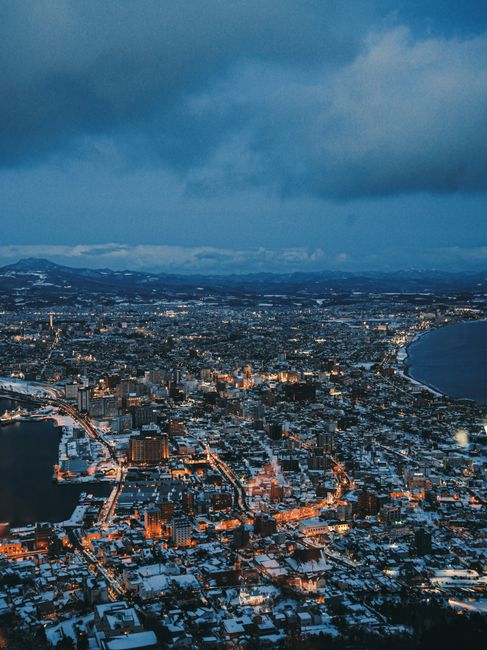
Hakodate is the historic port city at the southern tip of Hokkaido, a city of about 240,000 people spread across a narrow neck of land between two bays, with the 334 m (1,096 ft) Mount Hakodate rising at its end. It was one of the first Japanese ports opened to foreign trade in 1859, and the slopes below the mountain still have Western-style churches, consulates and brick warehouses from that era, while the star-shaped Goryokaku fort recalls the last battle of the Boshin War in 1869. Come for the famous night view from Mount Hakodate, squid and crab for breakfast at the morning market, the Motomachi slopes and the Bay Area, and the hot springs of Yunokawa. The best months are May to October; winters are snowy and cold, but the illuminations and the quiet streets have their own charm.
Right now in Hakodate
- Wed 10–19°C 50–67°F Clear
- Thu 9–19°C 49–66°F Mostly clear
- Fri 12–20°C 54–68°F Partly cloudy
- Mon 12 Oct Sports Day (スポーツの日)
Weather: MET Norway (CC BY 4.0) · Sea temperature: NOAA CoastWatch · Rates: ECB · Holidays: Nager.Date
Top tours in Hakodate
See all tours for Hakodate →
From local operators, with prices and reviews; you check availability and book on Viator, our partner. We may earn a commission at no extra cost to you. How we earn money
Hakodate at a glance
- Best for: night views, seafood and the morning market, Meiji-era architecture, Goryokaku and its history, hot springs.
- How long: 2 days for the city; 3 days with Onuma Park or a night in Yunokawa Onsen.
- Best time: June to early October, with highs of about 20–26 °C (69–79 °F); late April to early May for cherry blossoms at Goryokaku.
- Getting there: about 4 hours from Tokyo by the Hokkaido Shinkansen to Shin-Hakodate-Hokuto, then the Hakodate Liner; about 3.5 to 4 hours from Sapporo by limited express; or fly into Hakodate Airport.
- Getting around: two streetcar lines, buses and walking; the Mount Hakodate Ropeway to the summit.
- Fees to know: the ropeway costs ¥1,800 round trip as of October 2026 (closed for inspection from October 20 to November 8, 2026); Hakodate and Hokkaido charge accommodation taxes from ¥200 per person per night.
- Before you go: entry rules, rail passes, money and general safety are in our Japan travel guide; pair Hakodate with our Sapporo and Otaru guides.
Hakodate’s areas and where to stay
Hakodate’s historic core sits on the narrow strip of land between Hakodate Bay and the Tsugaru Strait, at the foot of Mount Hakodate. The station, the morning market and the Bay Area are close together; Goryokaku and Yunokawa are a streetcar ride inland.
Hakodate Station and the morning market
The busiest base for visitors, with many hotels, the bus terminal, the airport bus and the Hakodate Liner to the shinkansen. The morning market is right next to the station, and the Bay Area is a 10-minute walk away.
The Bay Area
The waterfront of red-brick warehouses, the Kanemori Red Brick Warehouse complex of shops and restaurants, and the old harbor. Good hotels with sea views, and the liveliest place for dinner.
Motomachi
The slopes below Mount Hakodate where foreign merchants and consuls once lived, with churches, the old public hall and steep, tree-lined streets running straight down to the harbor. Quiet guesthouses and small hotels; the ropeway station is here.
Goryokaku
The modern downtown around the star fort, about 15–20 minutes by streetcar from the station, with shopping, restaurants and business hotels. A good base for cherry blossom season.
Yunokawa Onsen
Hakodate’s hot spring district on the coast near the airport, with large ryokan and hotels with sea-view baths, about 30 minutes by streetcar from the station. A relaxing alternative to staying in town.
Top things to see in Hakodate
The night view from Mount Hakodate
The view from the summit at dusk, when the lights of the city fill the curved neck of land between two dark bays, is one of the most famous in Japan. According to the operator, as of October 2026 the Mount Hakodate Ropeway costs ¥1,800 (about US$11) round trip and ¥1,200 one way for adults (junior high school age and up), and ¥900 round trip for children. Cars leave every 15 minutes, or every 5–10 minutes when busy, and the ride takes about 3 minutes. It runs from 10 a.m.; the last car up is at 9:30 p.m. from April 20 to September 30 and at 8:30 p.m. from October 1 to April 19.
The operator closes the ropeway for its statutory inspection from October 20 to November 8, 2026; the summit observatory stays open, and you can reach it by bus, taxi or on foot. The summit is very crowded for an hour or two after sunset, so go up before dusk and stake out a spot, or come back for the day view. Private cars and rental cars are not allowed on the summit road in the evenings from late April to early November (from 4 to 9 p.m. between October 1 and November 8, 2026), and the road is closed in winter.
Hakodate Morning Market
A block of about 250 stalls and small restaurants next to the station, selling crab, sea urchin, salmon roe, scallops and Hokkaido melons. Eat a kaisendon, a bowl of rice piled with raw seafood, try catching your own squid at the squid-fishing pool, and walk the covered Donburi Yokocho alley. According to the market association, it is open year-round, from 5 a.m. from May to December and from 6 a.m. from January to April, until just after 2 p.m., though each shop keeps its own hours.
Goryokaku and the Hakodate Magistrate’s Office
Japan’s first Western-style star fort, built from 1857 to 1864 to defend the newly opened port, later became the last stronghold of the forces loyal to the shogun in the Battle of Hakodate. Today it is a park with moats and about 1,500 cherry trees. Inside, the Hakodate Magistrate’s Office was rebuilt in 2010 with traditional materials and methods. The 107 m (351 ft) Goryokaku Tower next door gives the best view of the star shape and has an exhibit on its history.
Motomachi’s churches and the Old Public Hall
Walk the Hachiman-zaka and Daisan-zaka slopes, which run straight down toward the harbor, and visit the Russian Orthodox Church with its green domes, the Catholic Motomachi Church and the Episcopal Church. The pastel blue-and-yellow Old Public Hall of Hakodate Ward (1910) has a balcony with views over the bay, and the former British Consulate has a rose garden and a tea room.
The Bay Area and the red-brick warehouses
The Kanemori Red Brick Warehouses date from the late 19th century and now hold shops, a beer hall and restaurants. Walk along the water at sunset, when the warehouses are lit up, and visit the nearby Hakodate Meiji-kan, a former post office.
More classic sights
- Hakodate City Museum of Northern Peoples: Ainu and Indigenous cultures of the north, in Motomachi.
- Former Soma residence: the house of a wealthy merchant, with a fine garden.
- Tachimachi Misaki: a windswept cape at the foot of Mount Hakodate with views over the strait.
- Hakodate Tropical Botanical Garden in Yunokawa: famous for its Japanese macaques soaking in a hot spring bath in winter.
- Trappistine Convent: a red-brick convent with a garden and a shop selling its cookies and butter candy.
- Hakodate Christmas Fantasy: a giant illuminated Christmas tree in the Bay Area in December.
Other sights
- Hakodate Morning Market
Museums
- Hakodate City Museum of Northern Peoples
Churches and cathedrals
- Hakodate Orthodox Church
Monuments
- Old Public Hall of Hakodate Ward
Peaks and mountains
- Mount Hakodate
Viewpoints
- Cape Tachimachi
- Goryōkaku Tower
Castles and forts
- Goryōkaku
Other things to do in Hakodate
Food and drink
Hakodate is one of Japan’s best cities for seafood. Squid is the city’s emblem, eaten raw as ika somen, cut into thin noodle-like strips, or stuffed with rice as ika-meshi. Summer brings sea urchin from the coast and crab is sold year-round at the market. Try Hakodate shio ramen, a light, clear salt broth that differs from the miso ramen of Sapporo; the “Chinese chicken” burger at the local Lucky Pierrot chain; and Hokkaido dairy, from soft-serve to cheesecake. Hakodate also has a long tradition of Western cooking, and Gotoken in Motomachi, founded in 1879, serves a historic curry. The Bay Area has craft beer, and sake from southern Hokkaido is sold at the market.
Hot springs
Yunokawa Onsen has public bathhouses and ryokan whose baths look out over the Tsugaru Strait; many accept day visitors. In winter, watch the monkeys bathing at the botanical garden nearby. The City of Hakodate lowered its bathing tax for overnight guests from April 1, 2026, when its accommodation tax began.
Festivals and events
The Hakodate Port Festival in early August fills the streets with thousands of dancers and ends with fireworks over the bay. The Goryokaku Festival in May recreates the Battle of Hakodate with a costumed parade. In winter, the Hakodate Christmas Fantasy and the illuminations on the Motomachi slopes light up the snowy streets.
Activities and best months
- City sightseeingThe Mount Hakodate Ropeway costs ¥1,800 return for adults and runs from 10:00 to about 21:00-22:00; it closes for its statutory inspection from 20 October to 8 November 2026, and private cars may not drive up in the evening. · source
Day trips from Hakodate
- Onuma Quasi-National Park: lakes dotted with small islands below the volcano Hokkaido-Komagatake, with walking paths, cycling and boat trips, about 20–30 minutes by train.
- Matsumae: the only castle town in Hokkaido, with a rebuilt keep and some 250 varieties of cherry trees, best in late April and May; about 2.5 hours by bus.
- Esashi: an old herring-trading town with merchant houses on the Sea of Japan coast.
- Cape Esan: a rugged cape with a steaming volcano, wildflowers and hot springs, about an hour east by car.
- Aomori: across the strait in Honshu, about an hour by shinkansen from Shin-Hakodate-Hokuto, for the Nebuta Museum and seafood.
- Sapporo and Otaru: better as an onward trip than a day trip, about 3.5–4 hours north. See our Sapporo guide and Otaru guide.
Getting there and getting around
By shinkansen and train
The Hokkaido Shinkansen runs through the Seikan Tunnel under the Tsugaru Strait to Shin-Hakodate-Hokuto, about 4 hours from Tokyo on the fastest trains. From there, the Hakodate Liner shuttles to Hakodate Station in about 15–20 minutes. From Sapporo, the Hokuto limited express takes about 3.5–4 hours along the coast. The nationwide Japan Rail Pass (¥50,000 (about US$316) for 7 days on the official site, as of October 2026) covers these trains. JR Hokkaido’s Hokkaido Rail Pass, from ¥22,000 (about US$139) for 5 days bought in advance, covers all JR Hokkaido lines, including the Hokuto between Sapporo and Hakodate, but not the Hokkaido Shinkansen.
By air and sea
Hakodate Airport has flights from Tokyo Haneda, Osaka and other cities, and some international routes, and is about 20 minutes by bus from the city. Ferries cross the Tsugaru Strait from Aomori and Oma, a slow but scenic option, and cruise ships call at the port.
Around the city
Two streetcar lines run from Yunokawa via Goryokaku to the station, then split to Motomachi and Yachigashira; one-day passes cover the streetcar and city buses. Pay with an IC card. Motomachi and the Bay Area are walkable, but the slopes are steep, especially on icy days. Taxis are plentiful and reasonable for the summit when the ropeway is closed.
When to go and how long to stay
Hakodate has a cool climate: snowy, cold winters and mild summers without the long rainy season of the rest of Japan. The table uses the Japan Meteorological Agency’s (JMA) 1991–2020 normals for its Hakodate station: average daily highs and lows, total precipitation (rain and melted snow) and days with at least 0.5 mm.
| Month | Average high / low | Precipitation (days with 0.5 mm or more) | What to expect |
|---|---|---|---|
| January | 1 °C (34 °F) / −6 °C (21 °F) | 77 mm (3.0 in), 20 days | Cold; snowy days; clear nights for the view; illuminations |
| February | 2 °C (35 °F) / −6 °C (22 °F) | 64 mm (2.5 in), 18 days | The coldest nights; snow; quiet and cheap |
| March | 6 °C (42 °F) / −2 °C (28 °F) | 64 mm (2.5 in), 17 days | Still wintry; snow melting late in the month |
| April | 12 °C (54 °F) / 3 °C (37 °F) | 72 mm (2.8 in), 12 days | Cool; snow gone; cherries usually open in late April |
| May | 17 °C (63 °F) / 8 °C (46 °F) | 89 mm (3.5 in), 11 days | Cherry blossoms at Goryokaku early in the month; Golden Week crowds |
| June | 20 °C (69 °F) / 13 °C (55 °F) | 80 mm (3.1 in), 9 days | Fresh and green; mild; no real rainy season |
| July | 24 °C (75 °F) / 17 °C (63 °F) | 124 mm (4.9 in), 10 days | Warm and pleasant; summer crowds begin |
| August | 26 °C (79 °F) / 19 °C (66 °F) | 156 mm (6.2 in), 10 days | The warmest month; Port Festival; squid season under way |
| September | 23 °C (74 °F) / 15 °C (58 °F) | 150 mm (5.9 in), 12 days | Warm early in the month; often clear; typhoon remnants possible |
| October | 17 °C (63 °F) / 8 °C (46 °F) | 106 mm (4.2 in), 13 days | Crisp; autumn leaves begin; the ropeway closes for inspection from October 20 in 2026 |
| November | 10 °C (50 °F) / 2 °C (35 °F) | 111 mm (4.4 in), 17 days | Maples in early November; first snow; Christmas Fantasy prepares |
| December | 3 °C (38 °F) / −4 °C (26 °F) | 95 mm (3.7 in), 19 days | Snowy; Christmas Fantasy in the Bay Area |
Hakodate gets about 1,190 mm (47 in) of precipitation a year, the most from July to September. Snow falls from late November to March; the JMA’s normals give about 3 m (10 ft) of snowfall over a season, but the deepest snow on the ground is usually only about 45 cm (18 in), far less than in Sapporo or Otaru. Hokkaido has no official rainy season in the JMA’s records, so June is often a pleasant month here while the rest of Japan is wet. Typhoons reach Hokkaido less often than the south: according to the JMA’s 1991–2020 normals, about two a year come close to the Hokkaido region, mostly in August and September.
Weather month by month
Averages from JMA normals 1991–2020, Hakodate · Last reviewed 5 Oct 2026
Cherry blossoms and fall colors: the JMA’s normal date for the first cherry blossoms in Hakodate is April 28, with full bloom around May 2; in 2026 they opened on April 18 and reached full bloom on April 20, much earlier than usual. Goryokaku Park and Matsumae are the best places to see them. The maples at the JMA’s Hakodate station normally turn around November 2.
Crowds: Hakodate is busiest in Golden Week, in the cherry blossom week, and from mid-July to August. The summit at sunset is crowded all year; go early, and visit the morning market before 8 a.m.
Two days in Hakodate
Day one, breakfast at the morning market, then the Bay Area and the warehouses, the Motomachi churches and the Old Public Hall, and the ropeway up Mount Hakodate before sunset. Day two, Goryokaku Tower and the Magistrate’s Office, lunch and shopping in the Goryokaku area, then an evening soak in Yunokawa Onsen.
Three days with Onuma
Add a morning at Onuma Park, walking or cycling around the lakes, or a spring day trip to Matsumae for the cherry trees, before heading north to Sapporo and Otaru.
Where to stay in Hakodate and the accommodation tax
- Hakodate Station: business and chain hotels, many with large breakfast buffets of local seafood; best for trains and day trips.
- Bay Area: hotels with views over the harbor, near restaurants and nightlife.
- Motomachi: guesthouses and small hotels near the ropeway and churches.
- Goryokaku: city hotels downtown, convenient in cherry blossom season.
- Yunokawa Onsen: ryokan and hot spring hotels with sea-view baths.
Since April 1, 2026, guests in Hakodate pay two accommodation taxes, a city tax and the new Hokkaido prefectural tax, collected together by the hotel and based on the room rate per person per night. According to the City of Hakodate, the totals are:
| Room rate per person per night | City tax | Total with Hokkaido tax |
|---|---|---|
| under ¥20,000 | ¥100 | ¥200 (about US$1.3) |
| ¥20,000 to ¥49,999 | ¥200 | ¥400 (about US$2.5) |
| ¥50,000 to ¥99,999 | ¥500 | ¥1,000 (about US$6.3) |
| ¥100,000 or more | ¥2,000 | ¥2,500 (about US$16) |
Students on school trips are exempt. Hot spring hotels also collect a small bathing tax, which the city reduced for overnight guests when the accommodation tax began.
What a trip to Hakodate costs
Prices are approximate, for October 2026, converted at about ¥158 to the US dollar.
| Item | Typical cost |
|---|---|
| Mount Hakodate Ropeway, round trip | ¥1,800 (about US$11) |
| Goryokaku Tower | about ¥1,000–1,200 (about US$6.3–7.6) |
| Streetcar ride | about ¥210–260 (about US$1.3–1.6) |
| Seafood bowl at the morning market | ¥2,000–4,500 (about US$13–28) |
| Bowl of shio ramen | ¥800–1,200 (about US$5.1–7.6) |
| Seafood izakaya dinner | ¥4,000–8,000 (about US$25–51) |
| Business hotel double, per night | ¥9,000–18,000 (about US$57–114) |
| Yunokawa ryokan with dinner and breakfast, per person | ¥18,000–40,000 (about US$114–253) |
Practical tips for Hakodate
- Time the view: check the sunset time on the ropeway’s website and go up 30–60 minutes earlier; clouds often clear quickly, so a live camera check is worth it.
- Mind the closure: the ropeway does not run from October 20 to November 8, 2026; use the bus or a taxi to the summit.
- Market manners: ask the price before ordering crab or seafood by weight, and stick to shops that display prices clearly.
- Icy slopes: from December to March, wear shoes with good grip on the Motomachi slopes.
- Departure tax: since July 2026, Japan’s International Tourist Tax is ¥3,000 per departure, usually included in your air fare (tickets issued by June 30, 2026 keep the old ¥1,000).
- Visitor hotline: the JNTO’s Japan Visitor Hotline, 050-3816-2787, answers in English 24 hours a day.
Safety
Hakodate is a very safe city. Its hazards are natural: snow and ice from December to March, which make the slopes and sidewalks slippery; strong winds on the summit and the capes; and earthquakes and tsunami, since much of the city lies on low land between two bays, so learn the evacuation routes near your hotel and move to high ground if a tsunami warning is issued. The volcano Hokkaido-Komagatake above Onuma Park was at JMA eruption alert level 2, with entry restricted near the crater, as of October 4, 2026; this does not affect the park’s lakeside paths, but check the JMA’s volcanic warnings before hiking. In an emergency, call 110 for the police or 119 for an ambulance or fire, and keep the JNTO’s Safety Tips app on your phone.
What to pack for Hakodate
A warm jacket for the summit even in summer evenings; a down coat, hat, gloves and boots with good grip from November to March; light layers and a rain jacket in summer; and a small towel for the hot springs. Japan uses 100 V and two-pin type A plugs like the US.
What to pack
- City walking shoesLisbon and Porto are steep, with polished limestone cobbles that get slippery, so grippy soles matter.
- Day packs and anti-theft bagsA small zipped or anti-theft bag makes crowded trams and viewpoints less stressful.
- Rain jacketsFrom October to April Porto and Lisbon see rain on roughly a third of days.
- Travel adapters and convertersPortugal uses Type C and F sockets at 230 V, so most visitors from outside Europe need an adapter.
Hakodate travel FAQ
How much is the Mount Hakodate Ropeway?
¥1,800 round trip and ¥1,200 one way for adults as of October 2026; children pay ¥900 round trip. The ride takes about 3 minutes.
When is the Mount Hakodate Ropeway closed?
For its statutory inspection from October 20 to November 8, 2026, when the summit can still be reached by bus or taxi. It may also stop in strong winds.
What time is the best for the night view?
Go up before sunset and stay until the city lights come on, about 20–30 minutes after sunset. The summit is busiest just after dark.
What time does the Hakodate Morning Market open?
From 5 a.m. from May to December and from 6 a.m. from January to April, until about 2 p.m.; individual shops set their own hours.
How many days do I need in Hakodate?
Two days cover the main sights; three let you add Onuma Park, Matsumae or a night in Yunokawa Onsen.
How do I get from Tokyo to Hakodate?
Take the Hokkaido Shinkansen to Shin-Hakodate-Hokuto (about 4 hours) and change to the Hakodate Liner, or fly to Hakodate Airport in about 80 minutes.
Is there an accommodation tax in Hakodate?
Yes. Since April 1, 2026, the city and Hokkaido taxes together cost ¥200 to ¥2,500 per person per night, depending on the room rate.
When do cherry blossoms bloom in Hakodate?
Usually in late April or early May; the JMA’s normal date for full bloom is May 2, but in 2026 the trees peaked on April 20.
Does the Hokkaido Rail Pass cover the shinkansen to Hakodate?
No. The Hokkaido Rail Pass covers JR Hokkaido’s conventional lines, including the limited express from Sapporo, but not the Hokkaido Shinkansen; the Japan Rail Pass covers both.
What food is Hakodate famous for?
Squid, seafood bowls from the morning market, shio ramen with clear salt broth, and Hokkaido dairy sweets.
Sources
- © OpenStreetMap contributors · ODbL · fetched 5 Oct 2026
- Wikidata · CC0 · fetched 5 Oct 2026
Sources and last review
Researched and last reviewed on 4 October 2026. Ropeway fares, hours, inspection closure and summit road restrictions: Mount Hakodate Ropeway; morning market hours: the Hakodate Morning Market association; accommodation and bathing taxes: the City of Hakodate; Hokkaido Rail Pass: JR Hokkaido; JR Pass: the official Japan Rail Pass website; climate normals, cherry blossom and maple dates, typhoon statistics and volcanic alert levels: the Japan Meteorological Agency (JMA); visitor hotline: JNTO; exchange rate: the US Federal Reserve. Population, history, sight descriptions, journey times, festival dates, other admission prices and typical prices are general references or estimates, flagged for checking. Prices and hours change, so check the official sites before you go. For entry rules, money and general safety, see our Japan travel guide.
Plan your trip
Partner links: TravelerCenter may earn a commission if you book, at no extra cost to you.
🇯🇵 Useful Japanese phrases for Hakodate
All 38 Japanese phrases: restaurant, hotel, emergencies, romance (printable) →