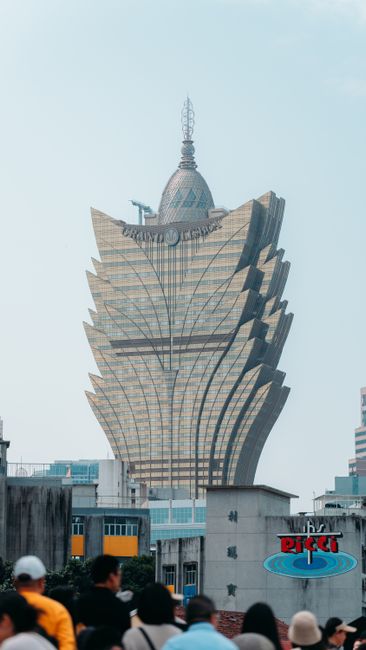
Macau is a small, fascinating place on the southern coast of China, an hour from Hong Kong across the Pearl River estuary, where more than four centuries of Portuguese and Chinese history meet the glitter of the world’s largest gambling hub. In the old city, black-and-white wave-patterned pavements lead from pastel colonial squares to Baroque churches, Chinese temples and the stone facade of the Ruins of St. Paul’s, the symbol of Macau and part of a UNESCO World Heritage site. Across the bridges, the reclaimed strip of Cotai is lined with vast casino resorts, replicas of Venice, Paris and London, big-name shows and some of Asia’s most acclaimed restaurants. Beyond them are the quiet villages of Taipa and Coloane, with Portuguese bakeries and seafood. Macau is easy to visit: many Western passport holders need no visa, Hong Kong dollars are accepted almost everywhere alongside the pataca, the light rail and free hotel shuttles make getting around simple, and the ferry and the Hong Kong–Zhuhai–Macao Bridge make it an easy day trip or a weekend from Hong Kong. Go from October to December for the best weather; summer is hot, wet and typhoon season.
Right now in Macau
- Wed 22–28°C 71–83°F Mostly clear
- Thu 24–29°C 75–85°F Partly cloudy
- Fri 26–30°C 79–86°F Clear
Weather: MET Norway (CC BY 4.0)
Multi-day tours of Macau
Multi-day tours from local operators. You check dates and book on Viator, our partner; we may earn a commission at no extra cost to you. How we earn money
Macau at a glance: overview and geography
Macau (officially Macao) covers only about 33 km² (13 sq miles), much of it land reclaimed from the sea, and about 690,000 people live here, making it one of the most densely populated places on earth. It has three parts: the Macau Peninsula, attached to mainland China at the Border Gate with Zhuhai; the island of Taipa; and Coloane to the south, now joined to Taipa by the reclaimed land of Cotai. Three bridges link the peninsula with Taipa, and the light rail now crosses to the peninsula too.
Portuguese traders settled here in the 1550s, and Macau became the first and longest-lasting European outpost in East Asia, a hub of trade and missionaries between China, Japan and Europe. Portugal administered it until December 20, 1999, when it became a Special Administrative Region of the People’s Republic of China. Like Hong Kong, it has its own currency, border controls and laws. The official languages are Chinese and Portuguese; Cantonese is the everyday language, signs are in Chinese and Portuguese, and English is spoken in hotels, casinos and tourist areas. Macau is on UTC+8 all year, with no daylight saving time. Electricity is 220 V, mostly with British-style three-pin (type G) sockets. Tourism is the backbone of the economy: according to the Statistics and Census Service (DSEC), Macau recorded a record 40.07 million visitor arrivals in 2025, more than half of them same-day visitors.
The areas of Macau
- The historic center: Senado Square, the Ruins of St. Paul’s, Monte Fort, St. Dominic’s Church, the Cathedral and the lanes between them; most of the UNESCO sites are within a 20-minute walk.
- The southern peninsula: A-Ma Temple, the Mandarin’s House, the Moorish Barracks, the waterfront of Barra and Penha Hill.
- The Outer Harbour and NAPE: the ferry terminal, Fisherman’s Wharf, the older casino hotels around the Grand Lisboa, and Macau Tower.
- Taipa: Taipa Village with its food street, the Taipa Houses, the airport and the Taipa Ferry Terminal.
- Cotai: the strip of integrated resorts, from the Venetian, the Parisian and the Londoner to Galaxy, City of Dreams, Studio City, Wynn Palace and MGM Cotai.
- Coloane: the greenest part of Macau, with Coloane Village, Hác Sá and Cheoc Van beaches, hiking trails and the giant pandas at Seac Pai Van Park.
Where to go: the old city, Taipa, Cotai and Coloane
The Ruins of St. Paul’s
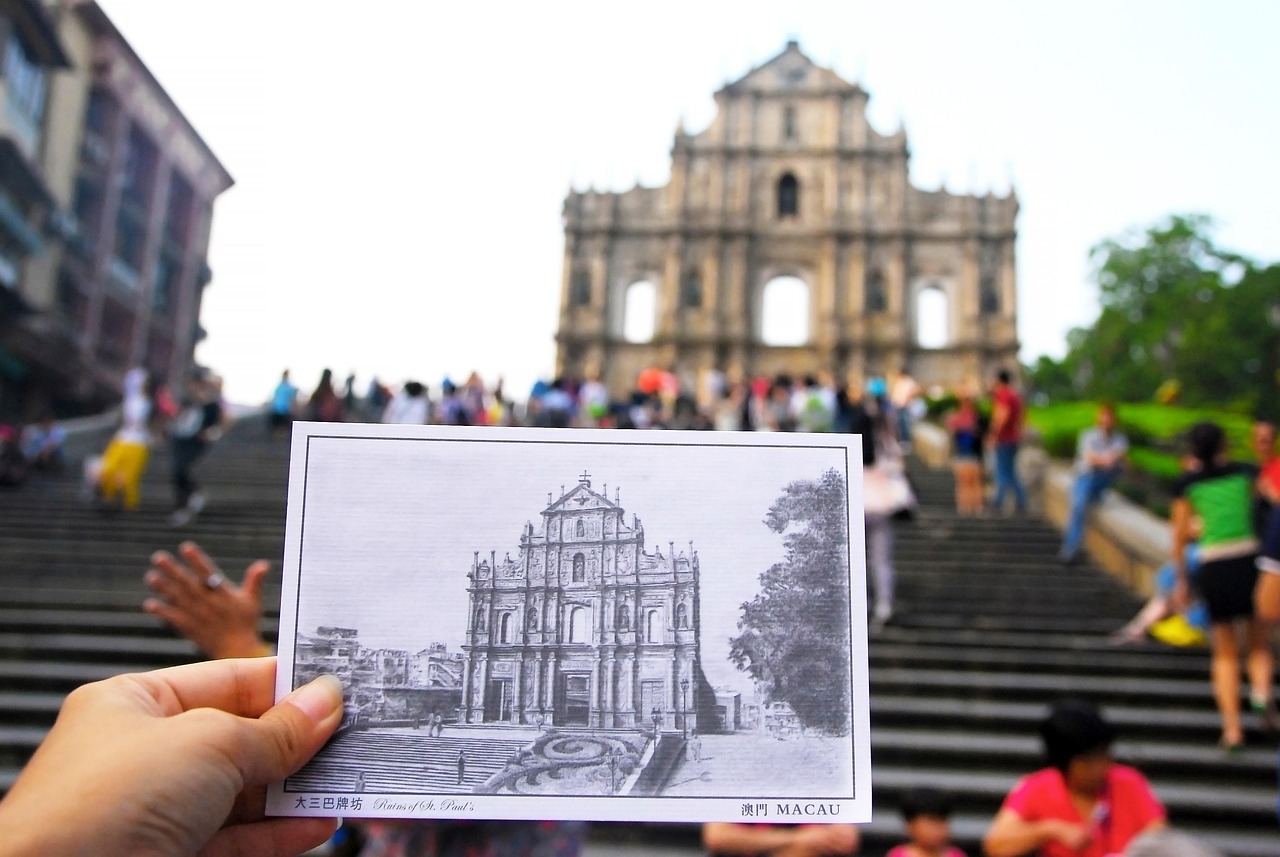
The granite facade of the Church of Mater Dei, built by the Jesuits in the early 17th century, is all that remains of the church and the College of St. Paul after a fire in 1835. It stands at the top of a broad flight of steps, covered in carvings that mix Christian saints with Chinese characters, a Portuguese ship and a dragon. According to the Cultural Affairs Bureau, the facade is accessible 24 hours a day and free; behind it, the small Museum of Sacred Art and the Crypt are open from 9 a.m. to 6 p.m. (last entry 5:30 p.m.) and close on Tuesday afternoons from 2 p.m. Come early in the morning or after dark, when it is lit up and the tour groups have gone. Next door, the little Na Tcha Temple and a surviving section of the old city walls show how closely Chinese and Portuguese Macau lived together.
Senado Square and the Historic Centre of Macao
The Historic Centre of Macao has been a UNESCO World Heritage site since 2005, a chain of more than 20 monuments and squares from A-Ma Temple to Guia Fortress. Its heart is Senado Square, paved in wavy Portuguese mosaic and lined with arcaded pastel buildings, the Leal Senado building and the Holy House of Mercy. From there, lanes lead to the yellow St. Dominic’s Church, founded in 1587 (open 10 a.m. to 6 p.m.), the Cathedral, the courtyard house of Lou Kau Mansion (closed on Mondays) and the Rua da Felicidade, a red-shuttered street of old guesthouses and restaurants. Most sites are free.
Monte Fort, Guia Fortress and the viewpoints
Beside the Ruins, the 17th-century Monte Fort has cannons on its ramparts and city views, open from 7 a.m. to 7 p.m.; inside, the Macao Museum tells the city’s story (10 a.m. to 6 p.m., closed on Mondays). On the peninsula’s highest hill, Guia Fortress has a 19th-century lighthouse, the oldest on the Chinese coast, and a chapel with frescoes; the fort is open from 9 a.m. to 6 p.m. and the chapel from 10 a.m. to 5 p.m. A short cable car climbs from Flora Garden. For the highest view, the 338 m (1,109 ft) Macau Tower has an observation deck and the bungee jump, skywalk and climbs of its adventure operator.
A-Ma Temple and the southern peninsula
A-Ma Temple, dedicated to the goddess of seafarers, already existed before the city was founded, and its name is said to have given Macau its name. Its halls and pavilions climb the hillside among rocks and incense coils, open daily from 7 a.m. to 6 p.m. Nearby are the Maritime Museum, the elegant Mandarin’s House, home of the 19th-century reformer Zheng Guanying, the Moorish Barracks, the colonial lanes of Lilau Square, and Penha Hill with its chapel and harbor view.
Taipa Village and the Taipa Houses
Taipa Village keeps narrow lanes of colorful old houses, temples and a small church. Its pedestrian street, Rua do Cunha, is crammed with bakeries selling almond cookies, pork jerky and serradura, a Portuguese cream-and-biscuit pudding, and with Portuguese and Macanese restaurants. Downhill, the Taipa Houses, five green-and-white colonial villas facing a former waterfront, are now small museums and a photogenic promenade.
Cotai: the resorts
Cotai’s resorts are attractions in themselves, even if you never gamble. Walk through the Venetian‘s canals with gondolas under a painted sky, see the half-size Eiffel Tower at the Parisian and the Big Ben clock tower of the Londoner, watch the musical fountain show at Wynn Palace, or ride the figure-eight observation wheel at Studio City. The resorts also have arenas, theaters, water parks, luxury malls and hundreds of restaurants, from food courts to Michelin-starred dining. Free shuttle buses connect them with the ferry terminals, the airport and the border crossings.
Coloane
Coloane feels like another world: a sleepy village square with the Chapel of St. Francis Xavier, waterfront cafés and the original Lord Stow’s Bakery, famous for Portuguese-style egg tarts. The black-sand Hác Sá beach and the smaller Cheoc Van beach have lifeguards in summer, and hiking trails run over the hills to the white marble A-Ma statue. At Seac Pai Van Park, the Giant Panda Pavilion houses pandas given by mainland China.
Where to stay in Macau
- Cotai: the big resort hotels, with pools, shows and free shuttles; often good value from Sunday to Thursday and much more expensive on Fridays, Saturdays and holidays.
- The peninsula: hotels around the Grand Lisboa and NAPE, and smaller boutique and mid-range hotels within walking distance of Senado Square; best for sightseeing.
- Taipa: close to the airport, the ferry terminal and the village restaurants.
- Coloane: a few quiet hotels and inns near the beaches.
Room rates in Macau usually have a service charge and a tourism tax added, so compare final prices. Weekends, Chinese New Year, the Golden Week holidays in early May and early October, and the Grand Prix weekend in November are the busiest and most expensive times.
Best time to visit Macau
Macau has a humid subtropical monsoon climate very like Hong Kong’s. October to December is the best time: sunny, dry and warm, with low humidity. January to March is cool, often cloudy and damp, with fog in spring. April to September is hot, humid and wet, with heavy showers, thunderstorms and typhoons, the most likely from July to September. The table shows the 1991–2020 climate normals of the Macao Meteorological and Geophysical Bureau (SMG) for its Taipa Grande station, as submitted to the World Meteorological Organization; rain days are days with at least 0.2 mm of rain.
| Month | Average high / low | Rain (days with 0.2 mm or more) | What to expect |
|---|---|---|---|
| January | 19 °C (65 °F) / 13 °C (55 °F) | 34 mm (1.3 in), 6 days | Cool and dry, sometimes chilly; quiet |
| February | 19 °C (67 °F) / 14 °C (57 °F) | 44 mm (1.7 in), 9 days | Chinese New Year (starting February 6 in 2027) brings crowds, lion dances and fireworks |
| March | 21 °C (71 °F) / 16 °C (62 °F) | 80 mm (3.1 in), 11 days | Mild, humid and often foggy; the least sunny month |
| April | 25 °C (77 °F) / 20 °C (69 °F) | 154 mm (6.0 in), 12 days | Warm and humid; A-Ma Festival |
| May | 29 °C (84 °F) / 24 °C (75 °F) | 286 mm (11.3 in), 14 days | Hot and stormy; Golden Week crowds early in the month |
| June | 30 °C (87 °F) / 26 °C (78 °F) | 374 mm (14.7 in), 18 days | The wettest month; Dragon Boat races |
| July | 31 °C (89 °F) / 26 °C (79 °F) | 291 mm (11.4 in), 17 days | Hot and humid; typhoons possible |
| August | 32 °C (89 °F) / 26 °C (79 °F) | 331 mm (13.0 in), 16 days | The hottest month; typhoon season peaks |
| September | 31 °C (87 °F) / 25 °C (77 °F) | 228 mm (9.0 in), 12 days | Typhoons still possible; fireworks contest season; Mid-Autumn lanterns |
| October | 28 °C (83 °F) / 23 °C (73 °F) | 75 mm (3.0 in), 6 days | Sunny and drier; one of the best months; Golden Week crowds early in the month |
| November | 25 °C (76 °F) / 19 °C (66 °F) | 39 mm (1.5 in), 5 days | Clear and pleasant; the Macau Grand Prix and the Food Festival |
| December | 20 °C (69 °F) / 14 °C (58 °F) | 31 mm (1.2 in), 5 days | Cool and dry; the Light Festival and Christmas decorations |
Taipa Grande averages about 1,967 mm (77 in) of rain a year, two-thirds of it from May to August, and humidity averages about 80%. July is the sunniest month and March the gloomiest.
Typhoons and warning signals
SMG issues numbered typhoon signals similar to Hong Kong’s: No. 1 (standby), No. 3 (strong winds), No. 8 (gale or storm-force winds, issued with a direction), No. 9 (winds increasing) and No. 10 (hurricane-force winds). It also issues storm surge warnings, starting at Blue, for flooding in low-lying areas such as the Inner Harbour, and rainstorm warnings, and publishes the probability of issuing each signal over the coming days on its website and through the government portal. According to the Macao Government Tourism Office (MGTO), when Typhoon Signal No. 8 or higher is hoisted, its tourist information counters close and hotels must display notices about the signal and transport arrangements; ferries, bridge buses and flights are usually suspended, and many attractions close. In July 2026, for example, SMG raised the No. 3 signal and forecast the probabilities of No. 8 and a Blue storm surge warning as Typhoon Noul approached. If a strong typhoon is forecast, stay in your hotel, keep away from the waterfront and follow SMG’s updates. MGTO’s 24-hour Tourism Hotline is (+853) 2833 3000.
Festivals and events
- Chinese New Year: lion and dragon dances, a parade and fireworks; the busiest time of the year.
- The Macao International Fireworks Display Contest: teams from around the world compete on several evenings over the sea by Macau Tower, around September and October.
- The Macau Grand Prix: motor races, including Formula 3 and motorcycles, on the twisting Guia street circuit, usually in mid-November; roads close and hotels fill.
- The Macao Food Festival: food stalls by Macau Tower in November.
- The Macao Light Festival: light installations and projections on the historic buildings in December.
How long to stay: sample itineraries
- A day trip from Hong Kong: take an early ferry to the Outer Harbour, walk from Senado Square to the Ruins of St. Paul’s and Monte Fort, have lunch in the old city, then take the light rail or a shuttle to Taipa Village and Cotai for the evening, and a night ferry or bridge bus back.
- 2 days: day 1, the historic center, A-Ma Temple and the southern peninsula, with sunset at Guia or Macau Tower; day 2, Taipa Village, the Taipa Houses, Coloane Village and an evening show in Cotai.
- 3 days: add a slower day on Coloane’s beaches and trails, the pandas and the museums, and a long Macanese dinner.
Entry, money, casinos and costs
Entry and visa-free stays (last reviewed October 2026)
Macau has its own immigration rules, separate from both Hong Kong’s and mainland China’s, enforced by the Public Security Police Force. According to the Macao government portal, nationals of 88 countries are exempt from a visa, and the stay granted on arrival depends on the passport. It is up to 30 days for most visa-exempt passports, including the United States, Canada and Australia; up to 90 days for passports of European Union and Schengen countries, Japan, South Korea, Brazil, Mexico and several others; up to 3 months for New Zealand and Israel; up to 6 months for British citizens; and 14 days for Brunei and Kazakhstan. Holders of a Hong Kong permanent identity card can stay up to a year.
Your passport must be valid for at least 90 days beyond your intended stay, and you need an onward or return ticket (unless you live in mainland China or Hong Kong). Officers may ask for proof that you can support yourself: according to the portal, at least MOP 5,000 for a stay of up to seven days, MOP 10,000 for up to 14 days and MOP 15,000 for up to 21 days. Some nationalities that are not visa-exempt can get an Authorization to Enter and Stay (“visa upon arrival”) at the border for a fee of MOP 100 to MOP 600, depending on nationality and the number of entries, valid for up to 30 days; others must apply in advance. Biometric data may be collected at the border.
Leaving Macau for Zhuhai or Hengqin means entering mainland China, which has its own visa and visa-free rules; check them before crossing. Hong Kong’s rules are covered in our Hong Kong travel guide.
Money: the pataca and Hong Kong dollars
The currency is the pataca (MOP, written MOP$ or “ptcs”), pegged to the Hong Kong dollar at about MOP 103 to HK$100, which works out at about MOP 8.08 to the US dollar at the US Federal Reserve’s late-September 2026 rate for the Hong Kong dollar. Hong Kong dollars are accepted almost everywhere, usually at par (one for one), so you lose about 3% by paying in HK$; casinos generally use HK$. Patacas are rarely accepted in Hong Kong, so spend or change them before you leave. Cards are taken in hotels, malls and bigger restaurants, and mobile payments are widespread, but small shops, bakeries and taxis may want cash. According to the Macao Light Rapid Transit operator, its customer service centers accept patacas, Hong Kong dollars and Chinese yuan at one for one, but ticket machines take only patacas. Restaurants in hotels usually add a 10% service charge; elsewhere, tipping is not expected.
Casinos: age rules and etiquette
Macau’s casinos are regulated by the Gaming Inspection and Coordination Bureau (DICJ) under Law No. 10/2012 on the conditions for entering, working and gaming in casinos, which sets the minimum age for entering a casino at 21; you may be asked to show your passport at the door. The same law bars off-duty casino workers from gambling. Entry is free, and many visitors simply walk through to see the gaming floors. Photography is not allowed on the gaming floor; dress is smart casual, and some casinos refuse entry in beachwear or flip-flops. If you do play, set a budget and stick to it. Macau’s six licensed operators run most casinos inside the big resorts.
Typical travel costs
Prices are approximate, for October 2026, converted at about MOP 8.08 to the US dollar.
| Item | Typical cost |
|---|---|
| Portuguese egg tart | MOP 10–15 (about US$1.25–1.85) |
| Pork chop bun or noodle soup | MOP 35–70 (about US$4.30–8.70) |
| Macanese or Portuguese dinner for one | MOP 200–450 (about US$25–56) |
| Light rail ride | MOP 3–6 (about US$0.40–0.75) |
| Public bus ride | about MOP 6 (about US$0.75) |
| Ruins of St. Paul’s, Senado Square, A-Ma Temple | Free |
| Ferry from Hong Kong, economy, weekday daytime | HK$194 (about US$25) |
| Taxi across Cotai or to the old city | MOP 60–120 (about US$7.50–15) |
| Mid-range hotel double, weeknight | MOP 800–1,500 (about US$100–185) |
| Cotai resort hotel, weekend night | MOP 1,800–4,000 (about US$225–495) |
Sightseeing in the historic center costs almost nothing, and the free hotel shuttles save on transport; the big costs are weekend hotel rates and dinners in the resorts. A comfortable mid-range trip costs roughly MOP 1,500–2,500 (about US$185–310) per person per day, including a shared weeknight hotel room.
Getting there and getting around
From Hong Kong: ferry or bridge
Ferries run from the Hong Kong–Macau Ferry Terminal at Sheung Wan, and on some routes from Kowloon and Hong Kong airport, to Macau’s two ferry terminals: the Outer Harbour on the peninsula and Taipa, near Cotai and the airport. According to TurboJET, the Sheung Wan–Outer Harbour crossing takes about 60 minutes, with sailings from 7:30 a.m. and night sailings until 10:30 p.m.; economy fares, effective April 25, 2026, are HK$194 on weekday daytime sailings, HK$212 at weekends and on holidays and HK$242 at night. Cotai Water Jet sails to Taipa.
The Hong Kong–Zhuhai–Macao Bridge, according to Hong Kong’s Highways Department, is a 55 km (34-mile) bridge-and-tunnel crossing open 24 hours a day, and the trip between the Hong Kong Port, beside Hong Kong airport, and the Macao Port takes about 40 minutes. Shuttle buses run around the clock, every 5 to 30 minutes depending on the time of day, for about HK$65–70 one way. From the Macao Port, on reclaimed land off the peninsula, take a public bus, a taxi or a free hotel shuttle onward. The bridge is the better choice from the airport, Lantau or western Kowloon, and the ferry from Hong Kong Island. You pass immigration on both sides, so allow time at busy weekends and holidays.
By air and from mainland China
Macau International Airport (MFM), on Taipa, has flights to cities across mainland China, Taiwan and Southeast Asia, and is home to Air Macau. Many long-haul travelers fly into Hong Kong instead. From the Zhuhai side, you can cross on foot at the Border Gate (Portas do Cerco), which according to MGTO is open from 6 a.m. to 1 a.m., or at the Hengqin port on Cotai, reached by the light rail’s Hengqin Line.
The light rail (LRT)
The Macao Light Rapid Transit has three lines. The Taipa Line links Barra station on the peninsula, near A-Ma Temple, across the water to Taipa, the airport, the Taipa Ferry Terminal and the Cotai resorts; the Seac Pai Van Line branches south toward Coloane; and the Hengqin Line runs to the Hengqin border crossing. According to the operator, single-journey fares are MOP 3 to MOP 6, depending on the number of stations (each sea crossing counts as two), and a prepaid LRT card costs MOP 30, with bonus value when you top up. Holders of the Macau Pass, the local stored-value card, pay the same discounted fare. The Taipa Line runs from 6:30 a.m. until 11:15 p.m., later on some nights. The light rail doesn’t reach Senado Square or the Ruins of St. Paul’s, so combine it with buses, taxis or walking.
Buses, shuttles, taxis and walking
Public buses go everywhere for a low flat fare, best paid with a Macau Pass or exact change; they are crowded but cheap. The casino resorts run free shuttle buses from the ferry terminals, the Border Gate, the airport and the bridge port, which many visitors use to get around whether or not they stay at the hotel. Taxis are metered, but can be hard to find at peak times; have your destination written in Chinese. The historic center is compact and best explored on foot, though some lanes are steep and cobbled.
Day trips from Macau
- Hong Kong: an hour by ferry or bridge bus, for the harbor, the Peak and the Big Buddha. See our Hong Kong guide.
- Coloane: the village, the beaches, the pandas and the hill trails, 20 to 30 minutes from the old city.
- Zhuhai and Hengqin, China: a seaside city and a fast-developing island across the border, with theme parks and markets; you must meet China’s entry rules.
Food, drink and culture
Macau is a UNESCO Creative City of Gastronomy, and its food is a highlight of any trip. Macanese cuisine, one of the world’s oldest fusion cuisines, blends Portuguese, Chinese, Indian, African and Malay influences: try minchi (minced meat with potato), African chicken in a spicy peanut and coconut sauce, galinha à portuguesa (Portuguese-style curry chicken), and tacho, a rich winter stew. Portuguese restaurants serve bacalhau (salt cod), grilled sardines and Portuguese wine at good prices. Street snacks include the Portuguese egg tart, flakier and more caramelized than the Hong Kong version, the pork chop bun, almond cookies, beef jerky from the shops near St. Paul’s, and serradura. Cantonese dim sum, noodle shops and Michelin-starred restaurants in the resorts complete the picture. Tap water is treated, but most people drink bottled or boiled water.
Macau is relaxed and multicultural. Dress modestly in churches and temples, don’t touch offerings, and keep noise down at religious sites. Smoking is banned in most indoor public places and many outdoor areas, and casinos allow it only in designated lounges.
Things to do: heritage, food, shows and the outdoors
- City sightseeing: the Historic Centre’s churches, temples, squares and fortresses, and the Taipa Houses. See our guide to city sightseeing.
- Hiking: Coloane’s trails and the Guia Hill and Taipa Grande paths. See our hiking guide.
- Beaches: Hác Sá and Cheoc Van on Coloane, with lifeguards in the swimming season. See our guide to beaches.
- Shows and nightlife: big-name concerts and resident shows in Cotai, and bars and live music in the resorts and around NAPE.
- Food tours: egg tarts in Coloane, Taipa Village’s food street and Macanese restaurants on the peninsula.
- Thrills: the Macau Tower bungee and skywalk, and the Studio City observation wheel.
Safety, health and connectivity
Safety
Macau has a low rate of violent crime, and the tourist areas are busy and well policed. Watch for pickpockets in the crowds around the Ruins of St. Paul’s and Senado Square, especially on weekends and holidays. Around the casinos, avoid unlicensed money changers and people offering loans or “help” with gambling. Macau’s laws, including on drugs and national security, apply to visitors; follow police and staff instructions. The main natural hazards are typhoons and storm surges, which can flood the Inner Harbour area (see above), and heat in summer. In an emergency, call 999; MGTO’s Tourism Hotline, (+853) 2833 3000, answers visitors’ questions 24 hours a day.
Health
Healthcare is good, with public and private hospitals, but treatment for visitors is charged; buy travel insurance. Drink plenty of water and avoid the midday sun from May to September, and use mosquito repellent in summer.
Accessibility and connectivity
The resorts, the light rail and newer buildings are accessible, but the historic center has steep, cobbled lanes and many steps, including those up to the Ruins of St. Paul’s. Mobile coverage is good: buy a tourist SIM or eSIM, or use roaming plans that cover Hong Kong and Macau together; free Wi-Fi is available in many public places.
What to pack
Comfortable shoes with good grip for the cobbles and stairs, light clothes and a small umbrella from April to October, a light jacket from December to March and for the cold air-conditioning in the resorts, smart-casual clothes for casinos and restaurants, and your passport, which you need to cross from Hong Kong and may be asked for at casino doors. Macau uses 220 V, mostly with British-style three-pin plugs.
Macau travel FAQ
Do I need a visa to visit Macau?
Not if you hold a passport from one of 88 visa-exempt countries, including the US, Canada, the UK, the EU countries, Australia and New Zealand. Macau’s rules are separate from Hong Kong’s and mainland China’s.
How long can I stay in Macau?
Up to 30 days for US, Canadian and Australian citizens, 90 days for EU and Schengen passports, 3 months for New Zealanders and 6 months for British citizens.
Can I use Hong Kong dollars in Macau?
Yes, almost everywhere, usually one for one with the pataca, although the pataca is worth about 3% less. Casinos generally play in Hong Kong dollars.
What is the casino age in Macau?
21. Under Law No. 10/2012, you must be at least 21 to enter a casino, and staff may ask for your passport.
Is it free to visit the Ruins of St. Paul’s?
Yes. The facade is open 24 hours and free; the Museum of Sacred Art and Crypt behind it are open from 9 a.m. to 6 p.m., except Tuesday afternoons.
How do I get from Hong Kong to Macau?
By ferry from Sheung Wan, about an hour, from HK$194 in economy; or by 24-hour shuttle bus over the Hong Kong–Zhuhai–Macao Bridge from the port near Hong Kong airport, about 40 minutes.
Does Macau have a metro?
It has a light rail, the LRT, with lines from Barra on the peninsula to Taipa, the airport, the ferry terminal, Cotai, Seac Pai Van and Hengqin; single fares are MOP 3–6.
How many days do you need in Macau?
A long day trip covers the historic center and a taste of Cotai; two days lets you add Taipa, Coloane and an evening show without rushing.
When is the best time to visit Macau?
October to December, when it is sunny, dry and comfortable. Avoid Chinese New Year and the Golden Week holidays if you dislike crowds.
What happens in Macau during a typhoon?
When SMG raises Signal No. 8 or higher, ferries, bridge buses and flights usually stop and many attractions close. Stay in your hotel and follow SMG’s updates.
Do I need a China visa to visit Zhuhai from Macau?
Crossing to Zhuhai or Hengqin means entering mainland China, so you must meet China’s entry rules; Macau’s visa exemption doesn’t cover it.
Is Macau safe for tourists?
Yes. Violent crime is rare; watch for pickpockets in crowded squares, avoid unlicensed money changers near casinos, and follow typhoon warnings.
Sources and last review
Researched and last reviewed on 4 October 2026. Visa exemptions, limits of stay, passport validity, proof of funds and visa-upon-arrival fees: the Macao SAR Government Portal (Public Security Police Force); visitor arrivals: the Statistics and Census Service via the government portal; opening hours of the Ruins of St. Paul’s, Monte Fort, the Macao Museum, Guia Fortress, A-Ma Temple, St. Dominic’s, Lou Kau Mansion and the Cathedral: the Cultural Affairs Bureau’s World Heritage site; casino entry law: the Gaming Inspection and Coordination Bureau (DICJ); typhoon and storm surge signals and the Tourism Hotline: SMG and the Macao Government Tourism Office via the government portal; Border Gate hours: MGTO; light rail fares, payment and hours: Macao Light Rapid Transit; ferries: TurboJET; Hong Kong–Zhuhai–Macao Bridge: Hong Kong’s Highways Department and the shuttle bus operator; climate normals: SMG via the World Meteorological Organization’s 1991–2020 normals for Taipa Grande; exchange rate: the US Federal Reserve. Area, population, history, the pataca peg, the minimum casino age as written in the law, rainstorm and storm surge warning levels, bus and taxi fares, hotel taxes, bridge bus fares, event dates and typical prices are general references or estimates, flagged for checking. Rules and prices change, so check the official sites before you go.
Plan your trip
Partner links: TravelerCenter may earn a commission if you book, at no extra cost to you.
🇭🇰 Useful Cantonese phrases for Macau
All 38 Cantonese phrases: restaurant, hotel, emergencies, romance (printable) →