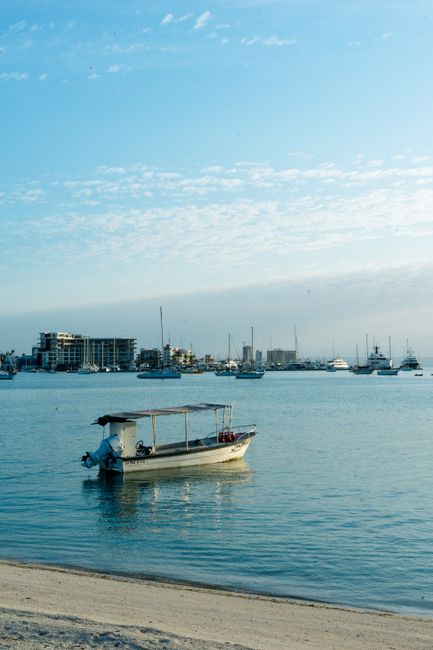
La Paz, the capital of Baja California Sur, is a relaxed seaside city on a wide bay of the Sea of Cortez, about two hours north of Los Cabos. It has a long seafront malecón, sunsets over the water, excellent seafood and a local, unhurried feel. Just beyond town lie some of Mexico’s most beautiful beaches, such as Balandra, with its shallow turquoise lagoon and desert hills, and offshore is the Espíritu Santo archipelago, a national park where you can swim with a colony of California sea lions. From fall to spring, whale sharks feed in the bay. The city has an airport and ferries to mainland Mexico, and its dry climate means sunshine almost all year; October to May is the best time to visit, as summers are very hot.
Right now in La Paz
- Tue 26–32°C 78–90°F 4 mm Showers
- Wed 26–33°C 78–92°F Clear
- Thu 26–34°C 78–93°F Clear
Weather: MET Norway (CC BY 4.0) · Sea temperature: NOAA CoastWatch · Rates: ECB
Top tours in La Paz
See all tours for La Paz →
From local operators, with prices and reviews; you check availability and book on Viator, our partner. We may earn a commission at no extra cost to you. How we earn money
La Paz at a glance
- Best for: boat trips, snorkeling with sea lions, whale sharks in season, empty desert beaches, kayaking, sunsets on the malecón and seafood.
- How long: 3–4 days for the malecón, Balandra and Espíritu Santo; 5–6 days to add Todos Santos, diving or a kayak trip.
- Best time: October to May, with highs of 25–35 °C (78–96 °F) and almost no rain. June to September is very hot, with highs around 37–38 °C (99–101 °F), and the Pacific hurricane season runs from May 15 to November 30.
- Getting there: La Paz International Airport (LAP), about 12 km (7 miles) south-west of downtown; ferries from Mazatlán and Topolobampo; or by road from Los Cabos.
- Getting around: walking and cycling on the malecón, taxis and apps, and a rental car for the beaches.
- Before you go: entry rules, money and general safety are in our Mexico travel guide; for the resort area at the tip of the peninsula, see our Los Cabos guide.
La Paz’s areas: where things are
The city faces north-west across the bay. Downtown and the malecón run along the waterfront; the road north-east along the coast leads to the marinas, the ferry port of Pichilingue and the beaches of Balandra and El Tecolote.
Downtown and the malecón
The seafront promenade runs for about 5 km (3 miles) past sculptures, piers, palm trees and restaurants, and is the heart of local life at sunset. Behind it, the historic center has the cathedral, the Jardín Velasco square, the regional museum and small hotels and cafés.
The marinas
East of downtown, the Marina de La Paz and Costa Baja marinas are the departure points for many boat tours to Espíritu Santo, with hotels, restaurants and condos nearby.
The road to Pichilingue and the beaches
The coastal road leads past the beaches of El Coromuel, Caimancito and Pichilingue to the ferry terminal, then on to Balandra, El Tecolote and El Coyote, about 25–30 km (16–19 miles) from downtown.
Top things to see in La Paz
Prices and hours below were checked on the official sites in October 2026, unless we say otherwise; check again before you go.
Balandra beach
A shallow bay of white sand and clear, turquoise water surrounded by red desert hills, so shallow in places that you can wade across at low tide. Its symbol is El Hongo, a mushroom-shaped rock eroded by wind and water. Balandra is a protected area, and access is controlled. According to the National Commission of Natural Protected Areas (CONANP), visits are in two shifts, 8 a.m. to noon and 1 p.m. to 5 p.m., with a maximum of 450 people per shift; all digital (pre-booked) access is for the second shift. The fee is MXN 125 (about US$7) per person per day, with exemptions for seniors, people with disabilities and children under 12. Arrive early for the morning shift, bring water and shade, and take your trash with you; there are no restaurants on the beach.
Espíritu Santo and Los Islotes
North of the bay, the Espíritu Santo archipelago is a national park of pink and red volcanic cliffs, white-sand coves and clear water, part of a UNESCO World Heritage site that covers the islands and protected areas of the Gulf of California. According to CONANP, Los Islotes, at its northern tip, has the most important California sea lion colony in Mexico, with 400 to 600 animals, and you can swim with the playful young sea lions with an authorized guide. The park fee is MXN 225 (about US$12) per person per day, usually included in tours. Full-day boat tours combine the sea lions, snorkeling, a beach lunch and views of the cliffs; kayaking and camping trips are also possible with licensed operators. See our boat trips and snorkeling guides.
Whale sharks in the Bay of La Paz
Young whale sharks gather to feed in the bay off El Mogote, close to the city, roughly from October to April. The area is a federal refuge for the species, and only authorized boats may take visitors, in small groups, keeping their distance and for limited times. Choose a licensed operator, and never touch the sharks.
Museo Regional de Antropología e Historia de Baja California Sur
The National Institute of Anthropology and History’s (INAH) regional museum covers the peninsula’s cave paintings, its first peoples, the Jesuit missions and the history of La Paz. According to INAH, it opens daily from 9 a.m. to 3 p.m., and costs MXN 145 (about US$8), or MXN 80 for Mexicans and foreign residents, as of 2026.
More to see
- The cathedral and Jardín Velasco: the city’s main square, with the cathedral of Our Lady of Peace on the site of an 18th-century mission.
- Playa El Tecolote: a long, open beach beyond Balandra with seafood restaurants and boats to Espíritu Santo.
- El Mogote: the sandbar peninsula across the bay from the malecón, with mangroves and birds.
- The malecón sculptures: public art along the seafront, including whales and sea creatures.
Churches and cathedrals
- La Paz Cathedral
- Misión de Nuestra Señora del Pilar, La Paz
Protected areas
- Isla Espíritu Santo
Nature
- Isla Partida
Activities and best months
- Beaches and swimmingBalandra (CONANP protected area) admits up to 450 people per shift, 8:00-12:00 and 13:00-17:00, MXN 125 per person per day. · source
- SnorkelingCONANP's Espíritu Santo marine national park is open every day (MXN 225) and holds Mexico's most important California sea-lion colony, 400-600 animals; swimming with sea lions at Los Islotes follows activity rules. · source
Other things to do in La Paz
Diving, kayaking and fishing
La Paz is one of Mexico’s top dive destinations, with sea lions, reefs, wrecks such as the Salvatierra ferry, and seamounts where hammerhead sharks and mobula rays may appear. Kayakers can paddle the coves of Espíritu Santo on guided trips of one or several days. Sport-fishing charters target dorado, marlin and yellowtail. See our diving guide.
Beaches
All beaches in Mexico are public by law. The bay beaches near town, such as El Coromuel, are calm and popular with families; Balandra, El Tecolote and El Coyote are more scenic and less developed. In the afternoon, a cooling breeze called the Coromuel often blows across the bay. See our beaches guide.
Food
Try fish and shrimp tacos, chocolate clams (almejas chocolatas, a local specialty), fresh ceviche, scallops and the region’s dates and damiana liqueur. The malecón has many seafood restaurants; downtown has local taquerías.
Day trips from La Paz
- Todos Santos: about an hour south-west, a Pueblo Mágico of colonial buildings, galleries and restaurants near the Pacific surf beaches of Cerritos and San Pedrito.
- Los Cabos: about two to two and a half hours south, with the Arch at Cabo San Lucas and the art district of San José del Cabo; see our Los Cabos guide.
- El Triunfo and San Antonio: old mining villages in the hills south of La Paz, with a music museum and cafés.
- Sierra de la Laguna: the peninsula’s highest mountains, with oak and pine forests, for hikes with a guide.
- Isla San José and Bahía de los Muertos: remote islands and beaches reached on longer boat or car trips.
Nearby destinations
- Los Cabos Municipality112 km
Getting there and getting around
By air
La Paz International Airport (LAP), Manuel Márquez de León, run by the airport group GAP, lies about 12 km (7 miles) south-west of downtown. It has flights from Mexico City, Guadalajara, Tijuana, Monterrey and other Mexican cities, and some routes from the United States; check which airlines currently fly your route. Many international visitors fly into Los Cabos (SJD), about two hours away, which has many more flights.
By ferry and by road
Car and passenger ferries cross the Sea of Cortez from Pichilingue, about 17 km (11 miles) north-east of downtown, to Mazatlán and to Topolobampo near Los Mochis, mostly overnight; check the operator’s current timetable. Highway 1 links La Paz with Los Cabos and with the north of the peninsula, and a highway via Todos Santos runs to Cabo San Lucas. Buses run frequently to Todos Santos and Los Cabos.
Getting around La Paz
Downtown and the malecón are walkable, and bike rentals are popular on the seafront path. Taxis and ride-hailing apps are cheap within the city. For Balandra and El Tecolote, take a taxi, a bus from the downtown terminal in season, or drive; a rental car is the easiest way to explore the beaches and Todos Santos.
When to go and how long to stay
La Paz is dry and sunny, with mild winters and very hot summers. The table uses the National Meteorological Service’s (SMN-Conagua) 1991–2020 climate normals for the La Paz station: average daily highs and lows, and days with rain.
| Season | Average high / low | Rainy days per month | What it’s like | Good for |
|---|---|---|---|---|
| Winter (Dec–Feb) | 25–26 °C (78–80 °F) / 12–14 °C (54–57 °F) | 2 | Sunny and mild, with cool nights; can be windy | Whale sharks, sea lions, gray whale trips to Magdalena Bay |
| Spring (Mar–May) | 29–35 °C (85–96 °F) / 14–17 °C (57–62 °F) | 0–1 | Dry, sunny and warming | Beaches, kayaking, diving |
| Summer (Jun–Aug) | 37–38 °C (99–101 °F) / 20–25 °C (68–77 °F) | 1–6 | Very hot; occasional storms from August; warmest, clearest water | Diving, sea lions, early-morning outings |
| Fall (Sep–Nov) | 36 °C falling to 30 °C (97 to 86 °F) / 25 °C falling to 17 °C (76 to 63 °F) | 6 in September, 1 in November | Hot and humid in September, the main hurricane month; pleasant by November | Whale sharks from October, quieter beaches |
The station records only about 186 mm (7 in) of rain a year, mostly from tropical storms; September is the wettest month, with about 81 mm (3 in).
Hurricane season: according to NOAA’s National Hurricane Center, the eastern Pacific hurricane season runs from May 15 to November 30. In late September 2026, Hurricane Polo made landfall on Baja California Sur as a category 3 hurricane about 155 km (95 miles) south of Santa Rosalía, far north of La Paz, according to the Hurricane Center’s bulletins. If a storm threatens, follow the instructions of Baja California Sur’s civil protection authorities and your hotel, and check Mexico’s National Meteorological Service (SMN) and the National Hurricane Center; boat trips and ferries stop in rough weather.
3 days in La Paz
Day one, walk or cycle the malecón, visit the regional museum and the cathedral, and watch the sunset with seafood. Day two, a full-day boat trip to Espíritu Santo and the sea lions of Los Islotes. Day three, the morning shift at Balandra, then lunch at El Tecolote.
5 to 6 days in La Paz
Add a whale shark trip in season, a dive or kayak trip, and a day in Todos Santos and the Pacific beaches. With six days, visit El Triunfo or continue south to Los Cabos.
Where to stay in La Paz and the hotel taxes
- The malecón and downtown: hotels and guesthouses facing the bay or a block back, close to restaurants and sunset walks.
- The marinas: resort hotels and condos near the boat departures, a short drive from downtown.
- Near Pichilingue and the beaches: a few hotels and rentals for beach lovers with a car.
- Todos Santos: boutique hotels if you want to split your stay with the Pacific side.
Room rates are often quoted before tax. Baja California Sur’s state lodging tax is listed at 4% on the state government’s tax procedures page (an older version of the state law shows a lower rate, so we flag it for checking), and federal VAT (IVA) of 16% is added on top. VISITAX does not apply here; it is a Quintana Roo fee only.
Practical tips for La Paz
- Time zone: Baja California Sur uses Pacific time (UTC−7 all year), one hour behind Mexico City.
- Cash and cards: cards are widely accepted in the city; carry pesos for taxis, beach stalls and small taquerías.
- Sun and water: bring plenty of water and shade to the beaches, which have little or no services; the sun is strong all year.
- Tipping: 10–15% in restaurants; tip boat crews and guides.
- Safety: La Paz is known as a calm, friendly city, and the malecón is busy day and night. Take normal precautions, don’t leave valuables in parked cars at beaches, drive by day outside town and don’t buy drugs.
- Emergencies: call 911.
What to pack for La Paz
Bring light, breathable clothes, swimwear, a sun hat, sunglasses and reef-friendly sunscreen, a rash guard or thin wetsuit for sea lion snorkeling (the water is cool from December to April), water shoes and a dry bag. Add a light jacket for winter evenings and boat trips, a refillable water bottle and an umbrella for shade at the beach. Plugs are the US type.
What to pack
- Day packs and anti-theft bagsCarries water, towel and sunscreen down the long stairways to Algarve coves.
- Dry bags and phone pouchesProtects phones and cameras from sand and spray on beaches reached by ferry or steep paths.
- Quick-dry beach towelsA sand-shedding quick-dry towel packs small for beach days and lido visits.
- Reef-friendly sunscreenSummer UV is strong on Portuguese beaches and there is little shade below the cliffs.
- Snorkel masks and finsYour own mask fits better than a rental and makes clear-water coves and lava pools more fun.
- Water shoesRocky coves, lava pools and weever fish in shallow sand make water shoes useful.
- WetsuitsOn the west and north coasts the sea stays around 16–18 °C even in summer, so a thin suit helps for long swims.
La Paz travel FAQ
Do you need a reservation for Balandra beach?
Access is controlled in two shifts, 8 a.m. to noon and 1 p.m. to 5 p.m., with up to 450 people per shift, according to CONANP; pre-booked digital access is for the afternoon shift. Arrive early for the morning shift.
How much does it cost to visit Balandra?
CONANP’s fee is MXN 125 (about US$7) per person per day as of October 2026; seniors, people with disabilities and children under 12 are exempt.
Can you swim with sea lions in La Paz?
Yes, at Los Islotes in the Espíritu Santo archipelago, with an authorized tour. CONANP says the colony has 400 to 600 California sea lions. The park fee is MXN 225 per person.
When is whale shark season in La Paz?
Roughly from October to April, in the federal refuge area in the bay. Only authorized boats may take visitors, in small groups.
How far is La Paz from Los Cabos?
About two to two and a half hours by road, via Highway 1 or via Todos Santos on the Pacific side.
Is there a ferry from La Paz to the mainland?
Yes. Ferries from Pichilingue cross to Mazatlán and to Topolobampo, near Los Mochis, mostly overnight. Check the operator’s current timetable.
What is the best time to visit La Paz?
October to May, when it is sunny and warm but not too hot; October to April is also whale shark season. June to September is very hot.
What taxes are added to La Paz hotel bills?
16% IVA plus Baja California Sur’s lodging tax, listed at 4% by the state. There is no VISITAX here.
What time zone is La Paz in?
Pacific time, UTC−7 all year, one hour behind Mexico City.
How much is the regional museum in La Paz?
MXN 145 (about US$8) for foreign visitors and MXN 80 for Mexicans and residents, daily from 9 a.m. to 3 p.m., according to INAH.
Sources
- © OpenStreetMap contributors · ODbL · fetched 4 Oct 2026
- Wikidata · CC0 · fetched 4 Oct 2026
Sources and last review
Researched and last reviewed on 4 October 2026. Balandra and Espíritu Santo shifts, capacity, fees and the sea lion colony: the National Commission of Natural Protected Areas (CONANP); the regional museum: the National Institute of Anthropology and History (INAH); the lodging tax: Baja California Sur’s tax procedures page; Hurricane Polo: the US National Hurricane Center’s public bulletins; hurricane season: NOAA’s National Hurricane Center; climate: SMN-Conagua 1991–2020 normals for the La Paz station. The whale shark season dates, ferry details, airport routes, distances, the UNESCO listing and local sights come from secondary sources or general knowledge and are flagged for checking. Prices and timetables change, so check the official sites before you go. For entry rules, money and general safety, see our Mexico travel guide.
Plan your trip
Partner links: TravelerCenter may earn a commission if you book, at no extra cost to you.
🇪🇸 Useful Spanish phrases for La Paz
All 38 Spanish phrases: restaurant, hotel, emergencies, romance (printable) →