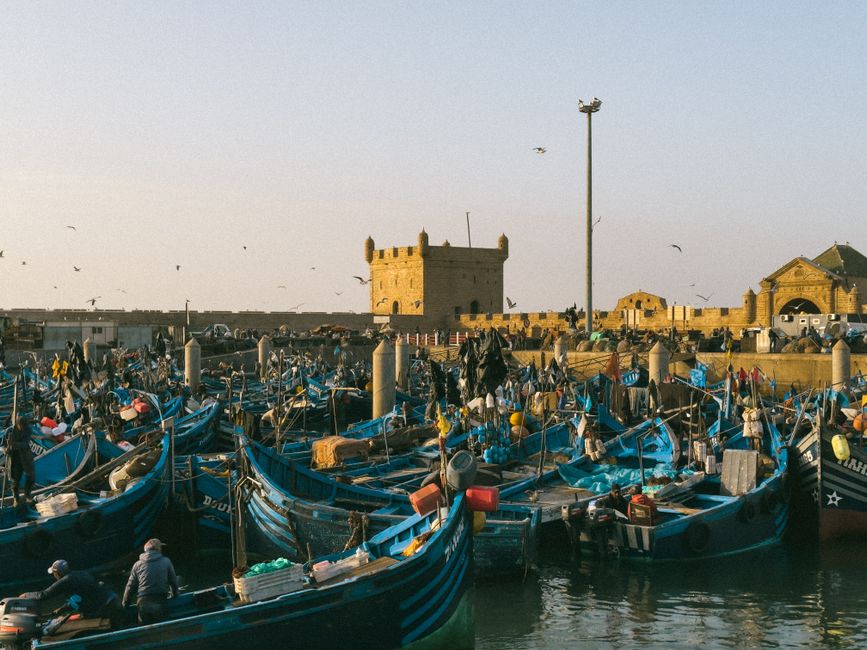
Essaouira is Morocco’s most charming seaside town: a whitewashed, blue-shuttered medina inside 18th-century sea walls, a working harbor full of blue fishing boats and gulls, and a long, windswept beach that is one of the best places in Africa for windsurfing and kitesurfing. The Portuguese and others knew it as Mogador, and the present town was laid out from the 1760s by Sultan Sidi Mohammed ben Abdallah as a fortified royal port open to foreign merchants, with a regular, European-style street plan unusual in Morocco. The Medina of Essaouira has been a UNESCO World Heritage Site since 2001. Life here is slower and the hassle much lighter than in Marrakech, about three hours inland. Spend your days walking the ramparts of the Skala, eating grilled sardines at the port, browsing art galleries and thuya-wood workshops, and watching the kites over the bay; in June, the Gnaoua and World Music Festival fills the squares with trance music. Essaouira has a famously mild, breezy climate, cool in summer when the rest of Morocco bakes, which makes it a favorite escape from the heat.
Right now in Essaouira
- Wed19–26°C66–78°FMostly clear
- Thu18–25°C65–77°FClear
- Fri18–23°C64–74°FClear
Top tours in Essaouira
See all tours for Essaouira →
From local operators, with prices and reviews; you check availability and book on Viator, our partner. We may earn a commission at no extra cost to you. How we earn money
Essaouira at a glance
- Best for: the medina and ramparts, the fishing port, seafood, art and crafts, windsurfing, kitesurfing and a slow pace.
- How long: 2–3 nights; 4–5 for watersports or a relaxed beach stay.
- Best time: April to October for wind and mild weather; spring and autumn for walking; June for the Gnaoua festival.
- Getting there: Supratours or CTM bus from Marrakech (about 3 hours), private transfer, or a few flights to Essaouira-Mogador (ESU).
- Getting around: entirely on foot in the medina; petit taxis to the beach hotels and grand taxis to nearby villages.
- Good to know: bring a windproof layer even in summer; the trade wind blows hard most afternoons.
- Before you go: visas, money and general safety are in our Morocco travel guide.
Essaouira’s areas and who each one suits
Essaouira is small. The walled medina sits on a rocky headland with the port at its southern end; the beach and a modern hotel strip run south along the bay; and the villages of Diabat, Sidi Kaouki and Moulay Bouzerktoun lie a short drive away along the coast.
The medina
Most riads and guesthouses are inside the medina, from simple rooms to restored merchant houses with roof terraces facing the sea. It’s car-free, flat and easy to navigate along the main street, Avenue Mohammed Zerktouni and Avenue de l’Istiqlal. Best for first-time visitors, couples and anyone who wants to walk everywhere. The Mellah, the old Jewish quarter in the north of the medina, is quieter and more run-down, with some restored houses.
The beach and the new town
South of the medina, the bay is lined with a promenade, larger hotels with pools and apartment buildings. It’s convenient for watersports centers and families who want a pool, about 10–20 minutes’ walk to the medina.
Diabat, Sidi Kaouki and Moulay Bouzerktoun
Diabat, across the river at the south end of the bay, is a small village with guesthouses, a golf resort and the ruins of Borj el-Berod. Sidi Kaouki, about 25 km (16 miles) south, is a laid-back surf village with a huge beach. Moulay Bouzerktoun, to the north, is known for wave sailing. All suit surfers, kiters and visitors who want quiet.
Where to stay in Essaouira
- Medina riad near the Skala or the port: sea views and atmosphere.
- Medina near Bab Doukkala: quieter, near the bus station and taxi rank.
- Beachfront hotel: pools and easy access to watersports.
- Diabat or the golf resort: space, pools and golf.
- Sidi Kaouki: surf guesthouses on a wild beach.
Top things to see in Essaouira
The Skala de la Ville
The Skala de la Ville is the long sea bastion along the medina’s northwest edge, lined with bronze cannons and looking out over the rocks and waves, with views to the islands and the sunset. Underneath its arches are workshops of thuya woodcarvers, who make boxes and inlaid furniture from the fragrant root of the local thuya tree.
The port and the Skala du Port
The port is the heart of Essaouira, with blue boats pulled up on the quays, nets being mended, a boatyard where wooden trawlers are still built by hand, and a busy fish market. The Skala du Port, the fortified bastion with two 200 m (656 ft) wings that guarded the harbor entrance, has views back over the medina’s white walls. According to the Ministry of Youth, Culture and Communication, entry costs MAD 60 (about US$6) for foreign adults and MAD 30 for children aged 7 to 13. Come in the late afternoon, when the boats return and the fish is auctioned on the quay, gulls wheel overhead, and the low sun lights up the walls; photographers love the scene, but ask before photographing fishermen.
The medina, souks and galleries
The medina’s grid of streets is easy to explore: spice and jewelry souks around the old grain market, carpet and leather shops, and many art galleries showing the naive and colorful work of local painters. Place Moulay Hassan, between the medina and the port, is the main square, with cafés for watching the world go by.
The Mellah and the Jewish heritage
In the 19th century, Jewish merchants made up a large part of Essaouira’s population. In the Mellah, the restored Bayt Dakira (“house of memory”) and the Slat Lkahal synagogue tell the story of the community, and the old Jewish cemeteries lie outside the walls near Bab Doukkala.
The beach
The town beach is long and wide, with fine sand, horse and camel rides and beach football in the evening. The water is cool, and the wind and waves make it better for watersports than for lazy swimming in the afternoon. Mornings are calmer. See our beaches guide.
The Mogador islands
Just offshore, the Mogador islands (the Îles Purpuraires) are a protected nature reserve and an important breeding site for the Eleonora’s falcon, which arrives from Madagascar each spring. Visits to the islands are restricted, but you can watch the falcons hunting over the bay from the beach and the Skala, especially from late spring to early autumn, and spot the ruins of an old prison on the main island.
Museums and cultural centers
The Sidi Mohammed ben Abdallah Museum, in a 19th-century mansion in the medina, shows regional jewelry, costumes, musical instruments and carpets. Dar Souiri, a cultural center near the main square, hosts concerts, exhibitions and festival events.
From Mogador to Essaouira
Phoenician and Roman traders came to the islands off the town for the purple dye made from local shellfish, and the Portuguese built a fortress here in the early 16th century. In 1764, Sultan Sidi Mohammed ben Abdallah commissioned a new port town, known in Arabic as Essaouira (“the well-designed”), which became Morocco’s main trading port with Europe and sub-Saharan Africa for a century. Musicians, artists and hippies, from Jimi Hendrix to Cat Stevens, gave it a bohemian reputation from the 1960s.
Other things to do in Essaouira
Windsurfing and kitesurfing
The alizé trade wind blows strongly and steadily across the bay, especially from April to September, making Essaouira one of the top kitesurfing and windsurfing spots in Africa. Schools on the beach rent equipment and teach beginners in the bay; experienced riders head to Sidi Kaouki and Moulay Bouzerktoun for waves. See our surfing and wetsuits guides.
Food and drink
Choose your fish at the port grills, where stalls cook sardines, sea bream, prawns and calamari to order, and agree the price by weight before cooking. The medina has good restaurants for fish tagines, seafood pastilla and couscous. Try the local amlou spread with argan oil, almonds and honey. Several restaurants and hotels serve alcohol, and the Essaouira region has a few small wine estates.
Music and crafts
Essaouira is a center of Gnawa music, the spiritual trance music of descendants of sub-Saharan Africans, which UNESCO lists as Intangible Cultural Heritage. Listen in small venues in the medina, or visit during the festival. Watch thuya woodworkers at the Skala, and visit argan cooperatives on the road to Marrakech.
Horse riding, cycling and hammams
Ride horses or camels along the beach to Diabat and the dunes, cycle the coastal road to Sidi Kaouki, or take a scrub in a traditional medina hammam.
Day trips from Essaouira
Sidi Kaouki
A surf village about 25 km (16 miles) south, with a long beach, a white marabout shrine and laid-back cafés; reached by grand taxi or bike.
Argan cooperatives and the countryside
Women’s cooperatives along the road to Marrakech show the traditional pressing of argan oil. Inland, the hills have small villages and wine estates.
Marrakech
About 3 hours by road, with the souks, palaces and gardens of the Red City; see our Marrakech guide.
Safi
About 2 hours north along the coast, the port of Safi is Morocco’s pottery capital, with a hill of potters’ kilns, the National Museum of Ceramics and a Portuguese sea fortress.
Agadir and the surf coast
About 3 hours south along the coast, with stops at Imsouane and Taghazout; see our Agadir guide.
Nearby destinations
- Agadir123 km
- Marrakech170 km
- Ouarzazate279 km
Getting there and getting around
By road
Supratours, ONCF’s coach company, runs buses from Marrakech train station to Essaouira in about 3 hours, and CTM buses run from Marrakech, Casablanca and Agadir. Private transfers and grand taxis are also available. The bus station is a short walk from Bab Doukkala.
By air
Essaouira-Mogador Airport (ESU), about 15 km (9 miles) southeast, has a small number of flights, mainly from Europe and Casablanca. Most visitors fly into Marrakech.
Getting around
The medina is car-free; porters with handcarts wait at the gates to carry luggage to your riad (agree the price). Petit taxis run between the medina, the beach hotels and the bus station, and grand taxis go to Diabat, Sidi Kaouki and further.
When to go and how long to stay
Essaouira has the most even climate in Morocco. The cold Canary Current keeps summer highs around 21–23 °C (70–73 °F), with strong winds and sometimes morning sea mist, while inland Marrakech can be 15 °C (27 °F) hotter. Winter is mild, around 18–19 °C (64–66 °F) by day and 11–13 °C (52–55 °F) at night, with rain on about five days a month. The wind is lightest in winter and strongest from spring to early autumn. The table uses the 1991–2020 climate normals for the Essaouira station of Morocco’s General Directorate of Meteorology (DGM), as published by the World Meteorological Organization (WMO): average daily highs and lows, total precipitation, and days with at least 1 mm of rain.
| Month | Average high / low | Rain (days with 1 mm or more) | What to expect |
|---|---|---|---|
| January | 18 °C (65 °F) / 11 °C (52 °F) | 48 mm (1.9 in), 5 days | Mild; lighter winds; some rain |
| February | 19 °C (66 °F) / 12 °C (54 °F) | 37 mm (1.5 in), 4 days | Mild; good surf |
| March | 19 °C (67 °F) / 13 °C (56 °F) | 38 mm (1.5 in), 4 days | Mild, breezy |
| April | 20 °C (67 °F) / 14 °C (57 °F) | 17 mm (0.7 in), 3 days | Pleasant; the windy season starts |
| May | 21 °C (69 °F) / 16 °C (60 °F) | 9 mm (0.4 in), 1 day | Pleasant and windy; good for kitesurfing |
| June | 21 °C (71 °F) / 17 °C (63 °F) | 0 mm (under 0.1 in), 0 days | Breezy and cool by Moroccan standards; festival month |
| July | 22 °C (71 °F) / 18 °C (64 °F) | under 1 mm, 0 days | Windy and cool; escape from the inland heat |
| August | 22 °C (72 °F) / 18 °C (65 °F) | 1 mm (under 0.1 in), 0 days | Windy; busy with summer visitors |
| September | 23 °C (73 °F) / 18 °C (64 °F) | 4 mm (0.2 in), 1 day | Warmest month; still breezy |
| October | 22 °C (72 °F) / 17 °C (63 °F) | 33 mm (1.3 in), 3 days | Pleasant; winds ease |
| November | 20 °C (69 °F) / 14 °C (58 °F) | 54 mm (2.1 in), 5 days | Mild; first rains |
| December | 19 °C (67 °F) / 13 °C (55 °F) | 56 mm (2.2 in), 5 days | Mild; the wettest month |
Essaouira receives about 300 mm (12 in) of rain a year, almost none from June to September.
Events worth planning around
The Gnaoua and World Music Festival is usually held in June, with free concerts in the squares and on the beach; book accommodation well ahead. During Ramadan, expected to begin in early February 2027, many cafés in the medina open only after sunset.
How long to stay: 2, 3 and 5 days
Two days: the Skala, the port and fish grills, the medina and galleries, and a sunset walk on the beach. Three days: add the Mellah, a hammam and a horse ride to Diabat, or a kitesurf lesson. Five days: add Sidi Kaouki, the argan cooperatives and a lazy day on a riad terrace.
Typical costs in Essaouira
Prices are approximate, for October 2026, converted at about MAD 9.85 to the US dollar (Bank Al-Maghrib reference rate).
| Item | Typical cost |
|---|---|
| Skala du Port (foreign adult) | MAD 60 (about US$6) |
| Grilled fish at the port, per person | MAD 80–200 (about US$8–20) |
| Medina restaurant dinner | MAD 150–300 (about US$15–30) |
| Kitesurf lesson, 2–3 hours | MAD 600–1,000 (about US$60–100) |
| Supratours bus from Marrakech | MAD 90–120 (about US$9–12) |
| Mid-range riad double, per night | MAD 600–1,400 (about US$60–140) |
Safety in Essaouira
Essaouira is one of the safest and most relaxed towns in Morocco, with little hassle. Take normal care with valuables in the souks and on the beach, and agree prices with porters, fish grills and guides beforehand. The main risks are in the water: the Atlantic here is cold, with strong winds, waves and rip currents, so swim only where it’s calm and supervised, and don’t swim alone. Kitesurfing and windsurfing in strong wind can be dangerous for beginners: learn with a qualified school, stay inside the zones they set, and check your insurance covers watersports. Waves at Sidi Kaouki and Moulay Bouzerktoun can be powerful, and the rocks along the Skala are slippery. In an emergency, call 190 for the police and 150 for an ambulance or fire.
Practical tips for Essaouira
- Pack a windbreaker: afternoons are breezy even in July.
- Agree prices at the fish grills: check the price per kilo before they cook.
- Use porters: to carry luggage from the gates to your riad.
- Book ahead in June: for the festival.
- Carry cash: small shops, stalls and porters prefer dirhams.
- Mornings for the beach: the wind usually picks up after midday, so swim and walk early.
What to pack for Essaouira
A windproof jacket and a warm sweater for evenings, sunscreen, sunglasses and a hat (the breeze hides the strength of the sun), comfortable sandals, a wetsuit if you plan to kite or surf, and swimwear. Morocco uses 220 V with two-pin European sockets. See our wetsuits, water shoes and travel adapters guides.
Essaouira travel FAQ
How do I get from Marrakech to Essaouira?
By Supratours or CTM bus in about 3 hours, by private transfer, or by grand taxi.
Is Essaouira worth a visit?
Yes. It has a beautiful UNESCO-listed medina, a working fishing port, excellent seafood and a relaxed atmosphere with little hassle.
Can you swim in Essaouira?
Yes, but the water is cool and the wind and waves can be strong, especially in the afternoon. Swim in the morning, in calm water, and only where it’s supervised.
When is the best time for kitesurfing in Essaouira?
From about April to September, when the trade wind blows most strongly.
How much does the Skala du Port cost?
MAD 60 (about US$6) for foreign adults and MAD 30 for children aged 7 to 13, according to the Ministry of Youth, Culture and Communication.
How many days do I need in Essaouira?
Two or three nights to enjoy the medina, the port and the beach; longer for watersports.
When is the Gnaoua festival?
Usually in June. Check the festival’s announcements and book accommodation early.
Is Essaouira good for families?
Yes, it’s calm and safe, with a big beach, horse rides, and car-free lanes, though the sea is cold and windy.
Is it cold in Essaouira?
It’s mild all year: summer highs average about 22 °C (72 °F), and winter days about 18–19 °C (64–66 °F), but the wind makes evenings feel cool.
Is Essaouira safe?
Yes, it’s one of Morocco’s safest and most relaxed towns. Take care in the sea and in strong wind.
Plan your trip
Partner links: TravelerCenter may earn a commission if you book, at no extra cost to you.
🇪🇬 Useful Arabic phrases for Essaouira
All 38 Arabic phrases: restaurant, hotel, emergencies, romance (printable) →
Sources · last reviewed 5 October 2026
Researched and last reviewed on 5 October 2026. The Skala du Port price and description: the Ministry of Youth, Culture and Communication’s official ticket site; the UNESCO listing: the UNESCO World Heritage Center; Supratours links with trains: the Moroccan National Tourist Office; emergency numbers and water-sports safety: the UK government’s factual safety pages, used for practical facts only; the exchange rate: Bank Al-Maghrib; climate normals: Morocco’s General Directorate of Meteorology via the World Meteorological Organization’s 1991–2020 normals (Essaouira station). The town’s history, the Gnawa and festival details, wind seasons, distances, bus times and typical prices are general references or estimates, flagged for checking. Prices and rules change, so check locally before you go. For visas, money and general safety, see our Morocco travel guide.
Data: Weather: MET Norway (CC BY 4.0) · Sea temperature: NOAA CoastWatch · Rates: ECB · Costs: World Bank ICP and price levels · Wikidata (CC0)