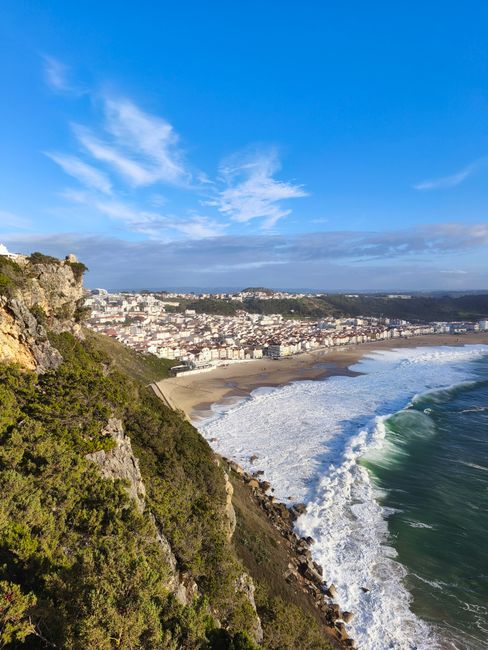
The best surfing in southern Europe and the UK is on the Atlantic. Portugal has surf all year, from Lisbon’s train-line beaches to Ericeira, Peniche, the western Algarve, the Azores and Madeira. Spain adds San Sebastián’s Zurriola beach and year-round warm-water surf in Tenerife and Gran Canaria. In France, learn on the Basque coast or in Normandy; in the UK, Cornwall’s Fistral Beach is the country’s surf capital. The Mediterranean coasts of Italy and Greece get few reliable waves, so go there for windsurfing and kitesurfing instead.
This page covers where and when to surf in the six countries TravelerCenter publishes, which spots suit beginners, the water temperature through the year, and the safety rules, beach flags and surf-school checks that matter in each country.
Surfing at a glance
- Who it suits: anyone who can swim. Beginners learn in the whitewater with a coach; intermediates move out to the breaking waves.
- Best for beginners: sandy beach breaks with surf schools and lifeguards, from late spring to early autumn: Carcavelos and Matosinhos in Portugal, Zurriola in San Sebastián, La Cícer in Gran Canaria, Fistral and Watergate Bay in Cornwall.
- Best for experienced surfers: autumn to spring on the Atlantic, when storms send bigger, more regular swell: Ericeira, Peniche, Sagres, the Azores, Madeira and El Confital in Gran Canaria.
- Warmest water: the Canary Islands (about 19–24 °C all year), then Madeira and the Azores. Coldest: Cornwall, where the sea averages about 9–17 °C.
- Wetsuit: needed all year on the mainland Atlantic coasts and in the UK; a thin suit or shortie is enough in the Canaries and the Portuguese islands in late summer.
What surfing involves
Surfing means paddling out on a board and riding breaking waves back towards the shore. A first lesson is mostly on the sand: how to lie on the board, paddle and pop up to standing. Then you practise in waist-deep whitewater, the broken waves near the shore. Most people need several lessons before they can catch and ride unbroken waves on their own. Schools hand beginners a soft-top foam board, a leash and a wetsuit.
Waves come from swell: energy from distant storms that travels across the ocean. That is why the Atlantic coasts of Portugal, Spain, France and Cornwall get regular surf, while the enclosed Mediterranean only gets short, choppy waves on windy days. Tides matter too: some beaches only work at low or mid tide, especially in the Bay of Biscay and in Cornwall, where the tide range is several metres.
Safety and rules
Beach flags and lifeguards
- Portugal: the Maritime Authority’s lifeguard institute (ISN) uses green (swimming allowed), yellow (no swimming, paddle at the edge only), red (do not enter the water) and chequered (post temporarily without a lifeguard); a red-and-yellow striped flag marks the supervised zone. Lifeguards only work in each beach’s bathing season, set every year by government order (Portaria 204-A/2026/1). In 2026 it ran from 1 May to 30 September at Carcavelos and 1 June to 30 September at Arrifana and Amado, but only from 13 June to 13 September at Matosinhos and Ericeira’s Ribeira d’Ilhas.
- United Kingdom: the RNLI uses red-and-yellow flags for the lifeguarded swimming and bodyboarding zone, black-and-white chequered flags for the zone for surfboards, paddleboards and kayaks, and a red flag for danger: never go in. An orange windsock means offshore or strong wind, so no inflatables. Its rule is simple: no flags, no lifeguards. In 2026 Fistral was patrolled daily from 3 April to 1 November, 10:00 to 18:00.
- Spain and France: lifeguarded city beaches such as San Sebastián’s use the familiar green, yellow and red flags. In San Sebastián the 2026 beach season ran from 1 June to 30 September. Outside the season, assume there is no lifeguard.
Rips, rocks and weather
Rip currents are common on every Atlantic beach on this page. If one pulls you out, don’t fight it: float, then paddle or swim parallel to the shore and raise an arm for help. Many famous waves, from Ericeira’s reefs to Madeira’s boulder points and El Confital in Gran Canaria, break over rock: they are for experienced surfers only. Portugal’s surf federation rules say lessons must not run when a bad-weather or IPMA sea-state warning is in force; use the same rule for yourself everywhere. Emergencies: call 112 anywhere in the EU, and 999 (ask for the Coastguard) in the UK.
Choosing a surf school
- Portugal: under the Portuguese Surfing Federation’s (FPS) regulations, a surf school must be registered with the federation, have a technical director and coaches with a professional coaching certificate (TPTD, from IPDJ), carry €50,000 civil liability and personal-accident insurance, and keep groups to about one coach for six beginners. Companies selling activities must also be on Turismo de Portugal’s register; check them in the free RNAAT public search.
- Everywhere else: pick a school that teaches on a lifeguarded beach, includes the board and wetsuit, keeps groups small and cancels on dangerous days. San Sebastián’s official tourist office lists surf schools at Zurriola and sells surf days.
Where to surf: the best spots by country
Portugal
Portugal is Europe’s easiest all-year surf destination, with an Atlantic coast that faces both west and south.
- Lisbon coast: Carcavelos, a sandy beach about 27 minutes by train from Cais do Sodré, and Costa da Caparica across the river are the classic places to learn. Ericeira became Europe’s first World Surfing Reserve in 2011: about 4 km of coast with seven quality breaks such as Ribeira d’Ilhas and Coxos, mostly over rock and for intermediate and advanced surfers. Peniche has beaches facing different directions, and its Supertubos beach hosts the World Surf League’s MEO Rip Curl Pro Portugal, scheduled for 16–25 October 2026. Nazaré’s giant waves at Praia do Norte are for specialists; visitors watch from the clifftop, usually October to March. See our Lisbon travel guide.
- Sintra coast: Praia Grande hosts national and international surf and bodyboard contests; the best surf comes in early autumn and winter. See our Sintra guide.
- Porto: Matosinhos, on metro line A, is a sandy beach break sheltered by the harbour wall, with schools open all year, and young locals surf at Foz. See our Porto travel guide.
- Algarve: around Sagres, beaches face different ways, so something usually works: Tonel and Beliche catch the open swell, Mareta and Martinhal are sheltered. On the west coast, Arrifana and Amado are surf-school favourites. See our Algarve travel guide.
- Azores: surf all year at more than 25 spots; Areal de Santa Bárbara on São Miguel has hosted international contests since 2010. Many breaks are over volcanic rock. See our Azores guide.
- Madeira: Visit Madeira describes an average swell of about 2 metres, up to 10 metres in some seasons, on point and reef breaks over boulders; Paul do Mar is for advanced and expert surfers. Not a place to learn. See our Madeira travel guide.
Spain
- San Sebastián: of the city’s three beaches, Zurriola in the Gros district is the surf beach, which the tourist office sums up as “waves, surf and youngsters”. It has surf schools, and La Concha next door is calm for swimming. See our San Sebastián travel guide and La Concha beach.
- Tenerife: Turismo de Tenerife describes warm water all year with waves for every level. The strongest waves break on the north and north-west coasts; the south and south-west are gentler, with surf schools around Las Américas. El Médano is the island’s windsurf and kitesurf spot. See our Tenerife travel guide.
- Gran Canaria: the island’s tourist board says sea and wind allow water sports twelve months a year. In Las Palmas, La Cícer at the southern end of Las Canteras beach has gentle beach-break waves and a row of surf schools; El Confital, at the northern tip, is a powerful reef break for experienced surfers in winter swells. Pozo Izquierdo and Vargas are famous for windsurfing. See our Gran Canaria travel guide.
France
- Normandy: a surf club at Siouville-Hague on the Cotentin peninsula, a sandy beach by the Biville dunes, teaches beginners and other levels from April to November, with board and wetsuit included, according to Normandy’s tourist board. See our Normandy travel guide.
- Bordeaux and the Atlantic: the long Atlantic beaches west of Bordeaux, such as Lacanau, are a classic surf day out; plan with our Bordeaux travel guide, which also covers Arcachon and the Dune du Pilat.
- The Basque coast: Biarritz, which we don’t cover in its own guide yet, is often called the birthplace of European surfing. Its Côte des Basques beach has surf schools and gentle waves at low tide for beginners, but the beach almost disappears at high tide.
The French Riviera and Corsica sit on the Mediterranean: think paddleboards and snorkelling in Nice and Corsica, not surf.
United Kingdom
- Cornwall: Fistral Beach in Newquay hosts many of Britain’s biggest surf events, and surf schools there and at Watergate Bay make it easy for beginners, according to Visit Cornwall. Perranporth, Polzeath, Sennen Cove, Porthmeor in St Ives and Widemouth Bay near Bude are also good, and most have schools. The north coast faces the Atlantic and gets the surf; the south coast is calmer. Summer waves are smaller and better for learning; spring and autumn bring the best swell. See our Cornwall travel guide.
Italy and Greece: wind, not waves
Italy’s and Greece’s coasts face enclosed seas, so surf is short-lived and depends on local storms. None of the destinations we cover in either country is a surf destination, and we would not plan a surf trip there. Greece is a great place for wind sports instead: Prasonisi at the southern tip of Rhodes is a meeting point for windsurfers, Mikri Vigla on Naxos is known for kitesurfing and windsurfing, and Kalafatis and Ftelia on Mykonos are the island’s windsurf beaches. The summer meltemi wind that powers them also cancels small boats on windy days.
When to go: seasons and water temperature
Sea temperatures are 10-year monthly averages from satellite and in-situ data (seatemperature.info), except Madeira, where the figures are official 2024 readings at Funchal’s Pontinha pier (Madeira’s statistics office, from IPMA data). All as of October 2026.
| Region | Learning | Bigger swell | Sea temperature (coldest–warmest month) |
|---|---|---|---|
| Lisbon coast (Cascais, Ericeira) | May–Sep | Sep–Mar | Cascais 14.4 °C (Feb) to 18.3 °C (Sep) |
| Porto and Matosinhos | Jun–Sep | Oct–Apr | 13.2 °C (Feb) to 17.5 °C (Sep) |
| Algarve (Sagres, west coast) | All year, best spring and autumn | Oct–Mar | Sagres 15.3 °C (Mar) to 19.6 °C (Sep) |
| Azores (São Miguel) | All year | All year | Ponta Delgada 16.2 °C (Mar) to 23.3 °C (Aug) |
| Madeira | Not ideal | All year | 19.3 °C (Mar–Apr) to 23.6 °C (Aug) |
| San Sebastián | Jun–Sep | Autumn–spring | 12.2 °C (Feb) to 22.5 °C (Aug) |
| Tenerife | All year (south) | Winter (north) | Santa Cruz 19.1 °C (Mar) to 23.9 °C (Sep) |
| Gran Canaria | All year (La Cícer) | Winter (El Confital) | Las Palmas 18.9 °C (Mar) to 23.4 °C (Sep) |
| Normandy (Cotentin) | Apr–Nov (club season) | Autumn–spring | No sourced average; cool all year |
| Cornwall (Newquay) | May–Sep | Spring and autumn | 9.4 °C (Feb–Mar) to 16.6 °C (Aug) |
Autumn is the sweet spot for many surfers: in September and October the Atlantic is at or near its warmest, the first autumn swells arrive and the beaches empty once school holidays end. In winter, the Canary Islands are the warm-water choice.
How to book lessons, and what to pack
Lessons usually last about two hours and include the board and wetsuit. Book a few days ahead in July and August; in spring and autumn you can usually book the day before. Surf camps that combine lodging and daily lessons are common in Portugal, the Basque coast, the Canaries and Cornwall: check their registration and insurance as you would a school. If you only want to rent a board, rental shops line the main surf beaches, but stay in the flagged surf zone and never paddle out alone at an unfamiliar spot.
What to pack
- Dry bags and phone pouchesKeeps keys, phone and dry clothes safe on the beach while you are in the water.
- Quick-dry beach towelsA quick-dry towel or changing poncho makes the car-park wetsuit change easier on windy beaches.
- Reef-friendly sunscreenLong sessions on reflective water burn faces and the backs of hands even when the air feels cool.
- Surf accessories (boots, leashes, wax)Neoprene boots keep feet warm in winter and protect them on rock and reef breaks.
- WetsuitsThe Atlantic off Portugal stays cool enough that surfers wear a full wetsuit most of the year.
A wetsuit is the one item that matters most, and most schools include one. If you bring your own, choose its thickness for the water you’ll meet: a 4/3 mm full suit for Cornwall and the mainland Atlantic most of the year (with boots and a hood in a Cornish winter), a 3/2 mm suit for summer in Portugal and the Basque country, and a shortie or thin suit for the Canaries and the Portuguese islands in late summer. Our wetsuit guide explains thicknesses. Add water-resistant sunscreen, a hat and sunglasses, a towel or changing poncho, and water shoes for rocky entries in the Azores, Madeira and the Canaries.
Surfing in Europe: questions and answers
Where is the best place in Europe to learn to surf?
Choose a sandy, lifeguarded beach with plenty of schools: Carcavelos near Lisbon, Matosinhos by Porto, Zurriola in San Sebastián, La Cícer in Las Palmas de Gran Canaria, or Fistral and Watergate Bay in Cornwall. Portugal is the easiest all-year option.
Where can I surf in warm water in winter?
The Canary Islands. The sea off Tenerife and Gran Canaria averages about 19 °C at its coldest, in late winter, and about 23–24 °C in September. Madeira, at around 19 °C in March and April, is also mild but its waves are for experienced surfers.
Can you surf in Italy or Greece?
Only occasionally, when local storms whip up short waves, and none of the places we cover is a surf destination. Greece is excellent for windsurfing and kitesurfing instead, at Prasonisi on Rhodes, Mikri Vigla on Naxos and Kalafatis on Mykonos.
Do I need a wetsuit in summer?
On the Atlantic mainland and in Cornwall, yes: even at its warmest the sea averages about 17–18 °C at Cascais and Matosinhos and about 16–17 °C at Newquay. San Sebastián reaches about 22 °C in August, when a thin suit is enough, and many people surf the Canaries and Madeira in late summer in a shortie.
Is Ericeira good for beginners?
Ericeira’s famous waves are reef and point breaks for intermediate and advanced surfers. Beginners can still stay there; ask a registered school to pick a gentle sandy beach for your level on the day.
When is Cornwall’s surf season?
You can surf in Cornwall all year with a thick wetsuit. Summer waves are smaller and better for learning, while spring and autumn bring the best swell. RNLI lifeguards patrol Fistral from early April to early November (3 April to 1 November in 2026) and most other beaches from May to September.
What do the black-and-white chequered flags mean in the UK?
They mark the zone for surfboards, paddleboards, kayaks and other craft. Swimmers and bodyboarders should stay between the red-and-yellow flags, and nobody should go in when a red flag is flying.
How do I know a surf school in Portugal is licensed?
Ask whether it is registered with the Portuguese Surfing Federation, whether your coach holds an IPDJ coaching certificate, and look the company up in Turismo de Portugal’s RNAAT register. A good school will also tell you its group size and cancel when IPMA issues sea-state warnings.
Can I watch a pro surf contest?
Yes. The World Surf League’s MEO Rip Curl Pro Portugal is scheduled at Supertubos, Peniche, for 16–25 October 2026 (as of October 2026). Fistral in Newquay and Areal de Santa Bárbara in the Azores also host competitions. Contest days depend on the waves, so check each morning.
More ideas for your trip: the best beaches, snorkelling and boat trips.
Sources and last review
Researched and last reviewed by TravelerCenter on 4 October 2026. Surf school rules come from the Portuguese Surfing Federation’s regulations and Turismo de Portugal’s RNAAT register; Portuguese bathing seasons from Portaria 204-A/2026/1 and flags from the Maritime Authority’s lifeguard institute; UK flags and Fistral patrol dates from the RNLI; San Sebastián’s beach season from Donostia city council; spots from Visit Portugal, Visit Azores, Visit Madeira, San Sebastián Turismoa, Turismo de Tenerife, the Gran Canaria tourist board, Normandy’s tourist board, Destination Biarritz, Visit Cornwall and Visit Greece; the Ericeira reserve from Save The Waves; the Peniche contest from the World Surf League; sea temperatures from seatemperature.info’s 10-year averages and, for Madeira, the regional statistics office (DREM) from IPMA data. Seasons and rules change, so check the official sites before you go.